

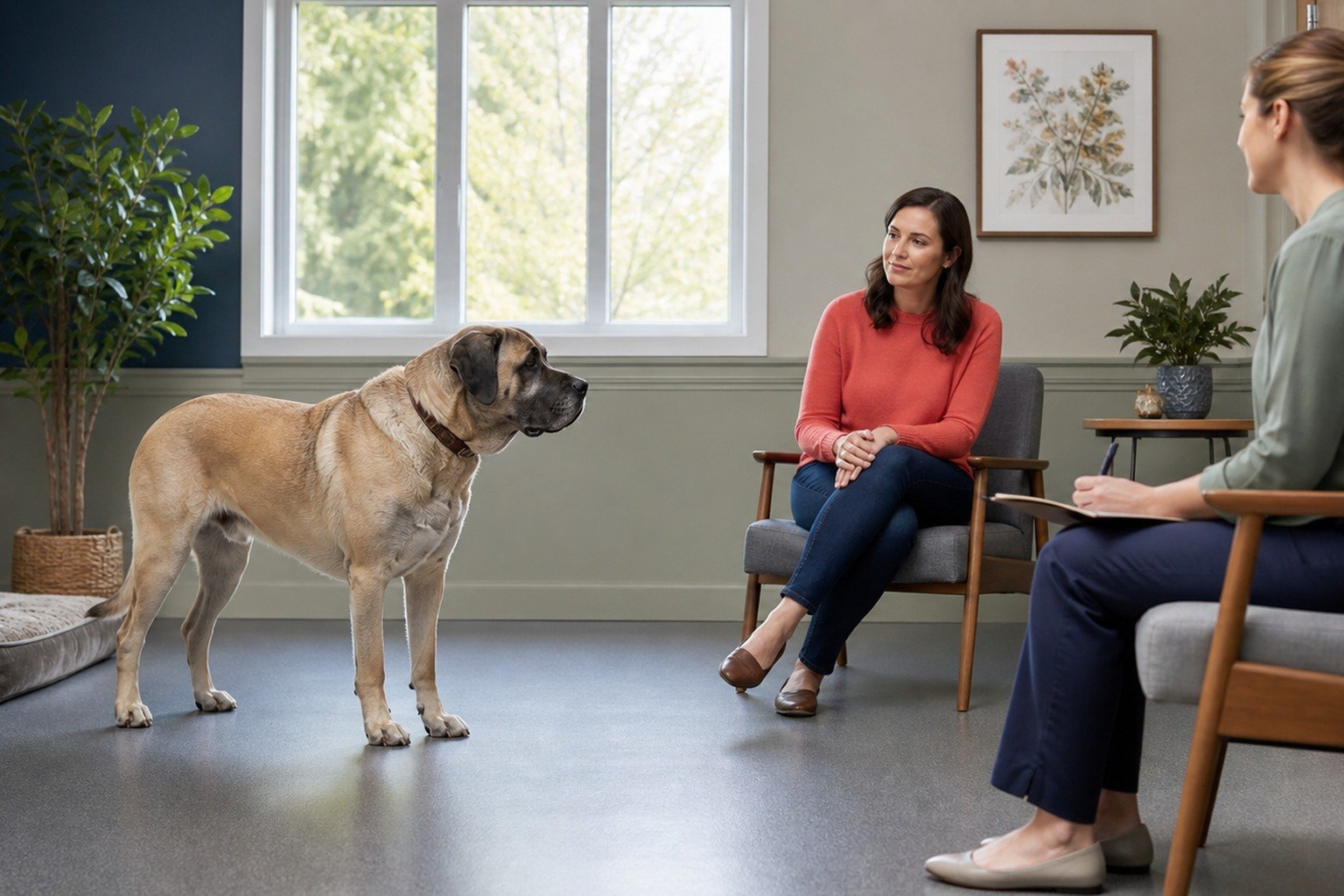
A large dog's freezing, retreating, pacing, panting, scanning, vocalizing, refusing, escape behavior, destructiveness, or sudden reactivity can be easy to misread as dominance or defiance. Those labels do not explain the behavior. Anxiety-related traits occur across breeds, and population studies describe breed differences, but body size alone does not diagnose anxiety or predict an individual dog's risk. Size matters because tight spaces, leash leverage, transport, visitors, children, veterinary handling, and an escape attempt can carry greater practical consequences. The humane response is early observation, medical assessment, secure management, reward-based behavior support, and enough distance to prevent rehearsal or injury. Do not punish warning signals or force exposure. A new or escalating behavior change may reflect pain, sensory loss, neurologic disease, medication effects, or another medical problem and deserves veterinary evaluation.
Short answer
Treat size as a planning factor, not a personality diagnosis
Large survey studies show anxiety-related traits across many dog breeds and report breed-level differences, while morphology research finds population correlations between body measures and selected behaviors. These observational results cannot predict one dog or prove that large size causes anxiety. [1] [2]
- Start with the individual dog's baseline, history, environment, and veterinary plan.
- Record context, function, and recovery instead of assigning a diagnosis from one sign.
- Use calm management and reward-based support without forced exposure or punishment.
- Escalate sudden, severe, persistent, or rapidly worsening changes promptly.
Safety first
Protect distance immediately when fear could lead to injury
Create space and contact a veterinarian promptly for sudden behavior change, escalating escape attempts, severe panic, self-injury, inability to settle or sleep, suspected pain, disorientation, aggression with injury risk, or a dog who cannot be handled safely. If a bite or immediate danger is possible, use secure separation and professional guidance; do not corner, grab, punish, or test the dog.
- Do not use this article to diagnose anxiety, pain, digestive disease, or an orthopedic condition.
- Do not force movement, exposure, food, water, or handling when a dog is distressed or painful.
- Seek urgent veterinary care for collapse, breathing difficulty, severe pain, major trauma, or rapid decline.
Veterinary note
This article is educational and does not diagnose, treat, prescribe, or replace care from a licensed veterinarian. Your dog’s history, examination, diet, medications, and current signs determine what is appropriate.
Read the dog's body before the behavior becomes dramatic
Look for changes in posture, weight shift, head and tail position, ear and eye tension, lip licking, yawning, scanning, freezing, hiding, following, panting outside heat or activity, pacing, refusal, vocalization, startle, sleep, appetite, and recovery after a trigger. Record the whole sequence instead of a single snapshot.
A very large dog may be physically blocked from retreating in hallways, elevators, vehicles, exam rooms, or crowded homes. When escape is unavailable, earlier subtle signals can be missed until barking, lunging, or struggling appears. That does not make anxiety and aggression interchangeable diagnoses; behavior must be interpreted in context by qualified professionals.
Use short natural video only when safe. Note trigger distance, who was present, barriers, surface, leash tension, pain or mobility change, time of day, duration, and time to recover. AAHA behavior guidance encourages routine behavioral assessment and attention to distress signs rather than waiting for a crisis. [3]
Rule out medical contributors and pain
Report new behavior even when it appears situation-specific. Pain, orthopedic disease, ear or skin disease, gastrointestinal discomfort, endocrine or neurologic conditions, sensory change, sleep disruption, and medication effects can change tolerance and behavior. The veterinarian determines what examination or testing is appropriate.
Large and giant dogs can have mobility and orthopedic concerns that make slick floors, restraint, stairs, vehicles, or crowded handling physically difficult. A dog who will not sit, turn, enter, or tolerate touch may be protecting a painful body part rather than refusing training. Do not repeatedly provoke the action to prove a behavioral theory.
Bring an exact medication, supplement, food, and health timeline. Behavior treatment can include environmental management, behavior modification, and sometimes medication, but selection and monitoring belong with the veterinary team. Do not borrow a drug or use a calming product to make a large dog easier to handle without assessment.
Manage space, visitors, and movement without stigma
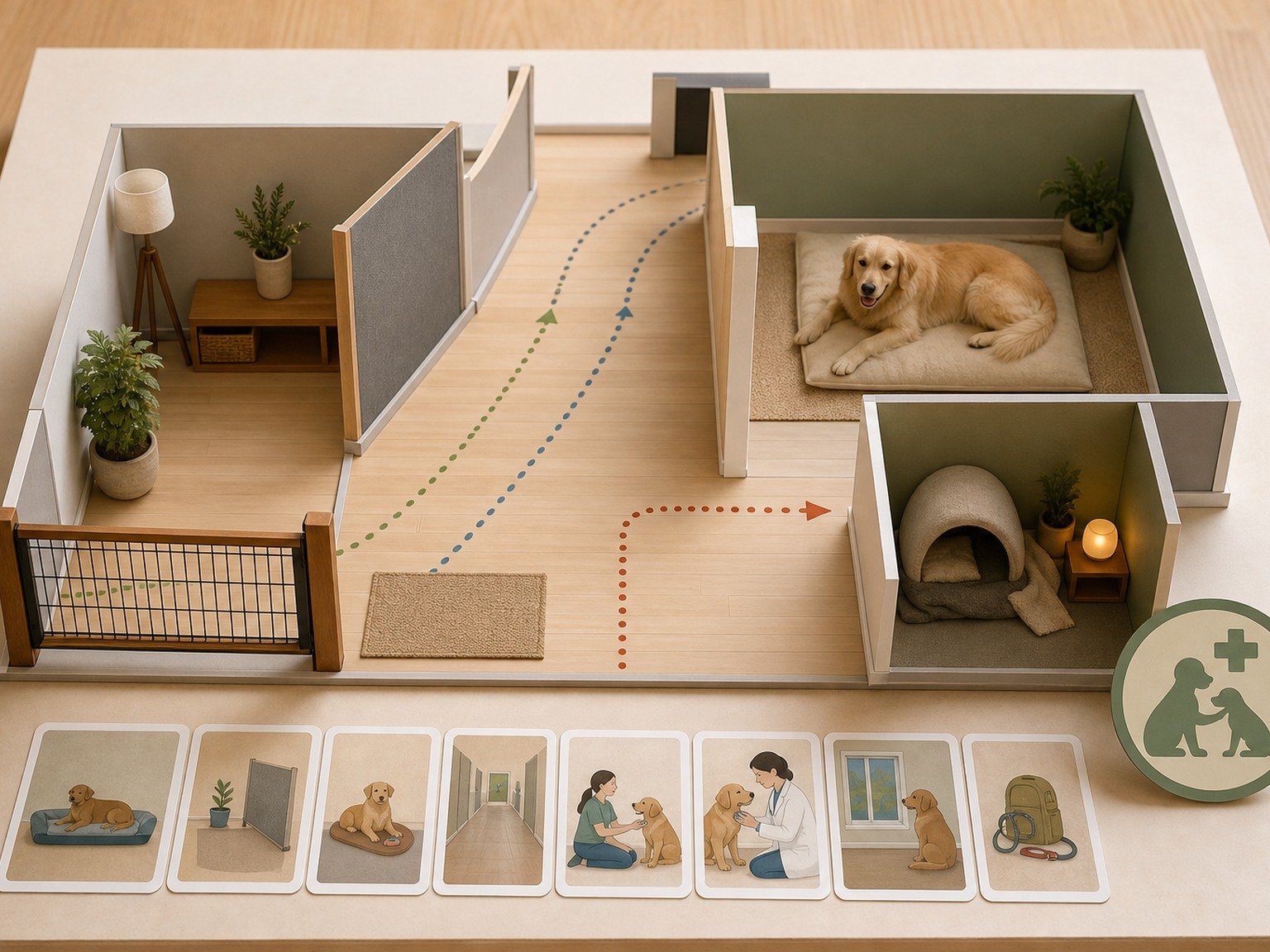
Plan secure retreat areas, gates or closed doors, predictable walking routes, enough turning room, nonslip footing, and calm transitions. Management is not failure; it prevents overwhelming exposure while assessment and learning occur. Verify that barriers match the dog's size and cannot be pushed over or climbed during distress.
For visitors, deliveries, children, other animals, elevators, and narrow paths, decide in advance where the dog will be and who controls doors. Avoid crowded greetings and hands reaching over the dog. Give the dog an exit and do not invite strangers to prove friendliness. Household safety should be specific to the observed triggers and professional plan.
Avoid breed-danger narratives. Population findings describe averages with substantial individual variation and do not justify predicting aggression, anxiety, or suitability from appearance. [1] [2] A clear record of this dog's learning history, environment, health, signals, and recovery is more useful than a stereotype.
Use reward-based professional support
AVSAB recommends reward-based training and warns that aversive methods can increase fear, anxiety, avoidance, and fear-related aggression. [4] Choke, prong, shock, intimidation, flooding, leash corrections, and physical punishment are especially risky when a large dog is already distressed and the handler has limited physical control.
Work below the dog's overwhelming threshold with a veterinarian and, when indicated, a board-certified veterinary behaviorist or appropriately credentialed reward-based professional. The sequence, distance, duration, and reinforcement must fit the case. This article cannot provide a universal desensitization or counterconditioning plan.
Track recovery as carefully as the visible reaction. A dog who stops barking but remains tense, refuses food, scans, cannot sleep, or takes hours to settle has not necessarily recovered. Reassessment should ask whether frequency, intensity, duration, and impact are changing and whether the safety plan is still realistic. [5]
Prepare for a focused veterinary conversation
Bring a concise timeline, short natural-movement or symptom videos when safe, the exact names and photographs of every food, treat, medication, and supplement label, and notes about appetite, water intake, stool, sleep, activity, comfort, and behavior. Include recent injuries, travel, boarding, diet changes, missed medication, and previous test results. A complete record helps the veterinary team separate a repeatable pattern from a single impression.
Decide in advance what you need from the visit: an urgency decision, a diagnosis plan, a nutrition review, a pain or mobility assessment, or a monitored trial. Ask what result would change the plan and what finding would rule an option out. This keeps research and product information in the right role. Evidence can shape questions and expectations, but it cannot determine what is safe for an individual dog without the history and examination.
Owner tool
Build a large-dog behavior and safety map
On a phone, swipe across the table to see every column.
| Checkpoint | What to record | Why it helps |
|---|---|---|
| Trigger | Place, distance, people, animals | Defines context |
| Signals | Posture, movement, voice, refusal | Finds early change |
| Safety | Doors, barriers, routes, retreat | Prevents exposure |
| Recovery | Time, sleep, appetite, baseline | Measures impact |
Better questions, calmer next steps
Questions to ask your veterinarian
- Could pain or another medical issue be changing behavior?
- Which early signals show this dog needs more distance?
- What barrier and handling plan is realistic for the dog's size?
- Is referral to a veterinary behaviorist appropriate?
- How will progress and medication effects be monitored?
FAQ
Are large dogs more likely to be anxious?
Body size alone does not determine an individual's anxiety risk.
Is barking proof of aggression?
No. Context, body language, motivation, and medical factors matter.
Should strangers offer treats?
Only if that step is part of a safe professional plan and the dog has choice.
Is a stronger correction needed for a stronger dog?
No. Aversive methods can worsen fear and risk.
Can management replace treatment?
Management protects safety while assessment and behavior care address the problem.
Sources
- Scientific Reports: Canine Anxiety in 13,700 Finnish Pet Dogs. Prevalence, comorbidity, and breed-level differences with individual limits.
- PLOS ONE: Dog Behavior Co-varies With Height, Bodyweight and Skull Shape. Population morphology-behavior correlations, not individual prediction.
- American Animal Hospital Association: Canine and Feline Behavior Management Guidelines. Behavior screening, distress signs, medical assessment, and intervention.
- American Veterinary Society of Animal Behavior: Humane Dog Training Position Statement. Reward-based training and risks of aversive methods.
- Merck Veterinary Manual: Animal Welfare. Welfare and evidence concerning punishment-based training.
