

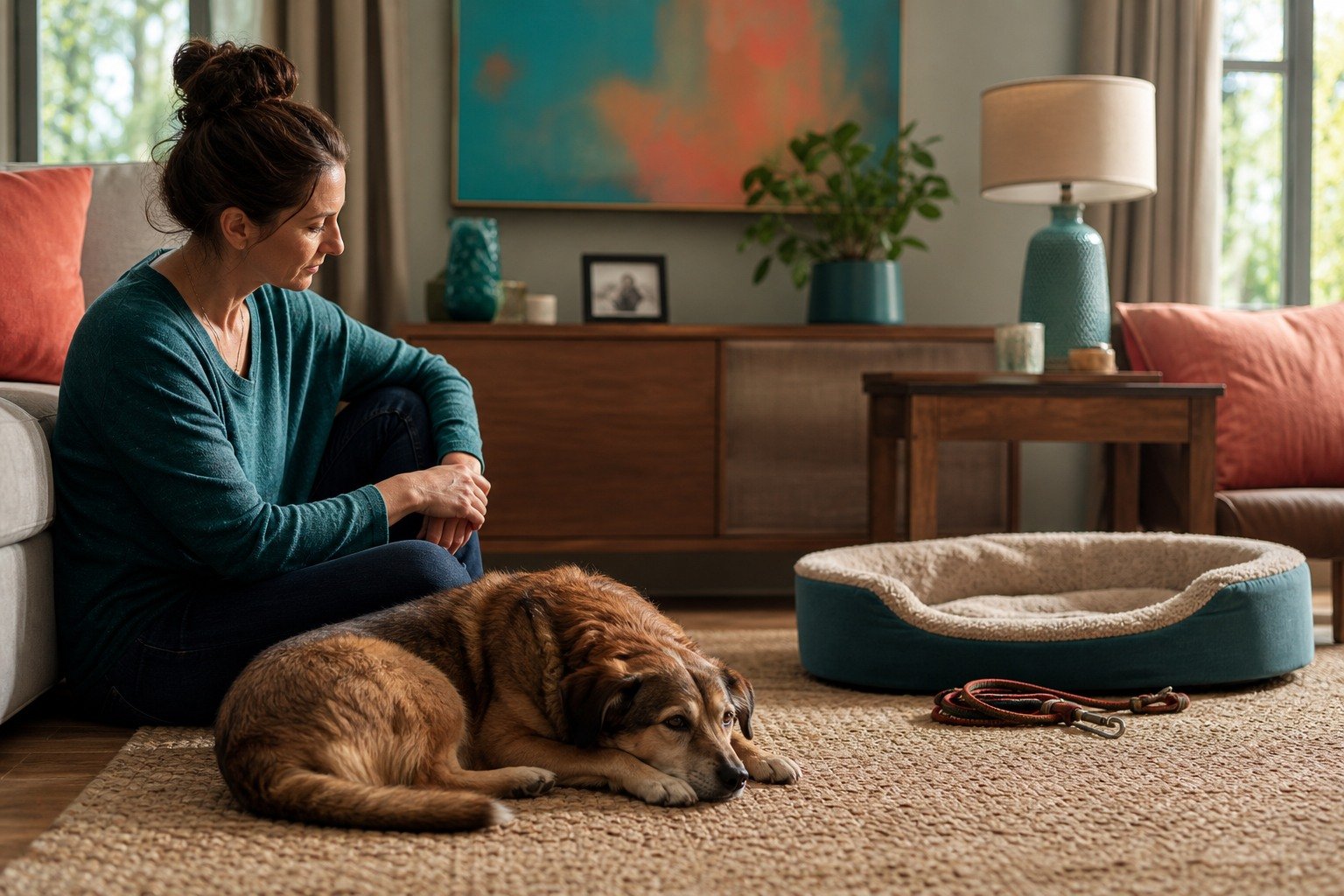
After an animal or human companion dies or leaves, a dog may eat differently, sleep more or less, search, vocalize, cling, withdraw, play less, seem fearful, or show no obvious change. These observations matter, but they do not reveal a dog's inner experience with certainty. Studies rely heavily on owner reports and are affected by routine disruption, the surviving dog's relationship with the missing companion, the owner's own distress, environmental changes, and possible medical disease. Researchers use terms such as grief-like behavior or behavioral response to loss while acknowledging uncertainty. Relationship quality may matter more than time lived together, but owner reports remain vulnerable to interpretation and recall. Owners can support welfare by preserving predictable care, allowing choice, monitoring food, sleep, elimination and activity, and seeking veterinary assessment for persistent, severe, or sudden change.
Short answer
Take post-loss behavior seriously without pretending research can read a dog's mind
Owner-report studies describe changes in affection, sleep, eating, play, searching, and fear after companion loss. They also emphasize reporting bias and uncertainty; one recent study concluded that grief could not be confirmed despite grief-like patterns. Medical and behavior references therefore support assessment of health, routine, and function rather than assuming one emotional explanation. [1] [2] [3]
- Record the context, trigger, duration, recovery, and effect on daily function.
- Use observations to support veterinary assessment, not to diagnose or treat at home.
- Protect safety and predictability while avoiding punishment, flooding, and forced exposure.
- Agree on measurable outcomes, a review date, and clear urgent-contact signs.
Safety first
Loss can coincide with illness, pain, dehydration, or dangerous behavior
Contact a veterinarian for persistent appetite loss, weight change, vomiting, diarrhea, sleep disruption, house-soiling, pain signs, withdrawal, fear, confusion, or loss of daily function. A recent loss should not become the default explanation for every new sign, especially in a senior or medically complex dog. Seek urgent care for inability to eat or drink, collapse, breathing difficulty, repeated vomiting, self-injury, severe weakness, or sudden neurologic change.
- Do not delay care for sudden, severe, escalating, or function-limiting change.
- Do not start, stop, combine, divide, or calculate treatment from this article.
- Use physical separation and professional help when people or animals could be injured.
Veterinary note
This article is educational and does not diagnose, treat, prescribe, or replace care from a licensed veterinarian. Your dog’s history, examination, diet, medications, and current signs determine what is appropriate.
Understand what the studies did and did not show
A survey of dogs and cats after animal-companion loss found owner-reported changes in affection, territorial behavior, food consumption, vocalization, and sleep. The self-selected retrospective design records perceptions, not a clinical diagnosis of grief. [1]
A later study of 426 Italian owners reported changes in play, sleep, eating, and fear related to the dogs' prior relationship. Owner grief and anger also influenced some reports, and seeing the body did not produce a clear difference. [2]
These findings support careful observation and welfare concern. They do not establish a universal timeline, prove that every dog mourns, or show that introducing a new animal will resolve distress.
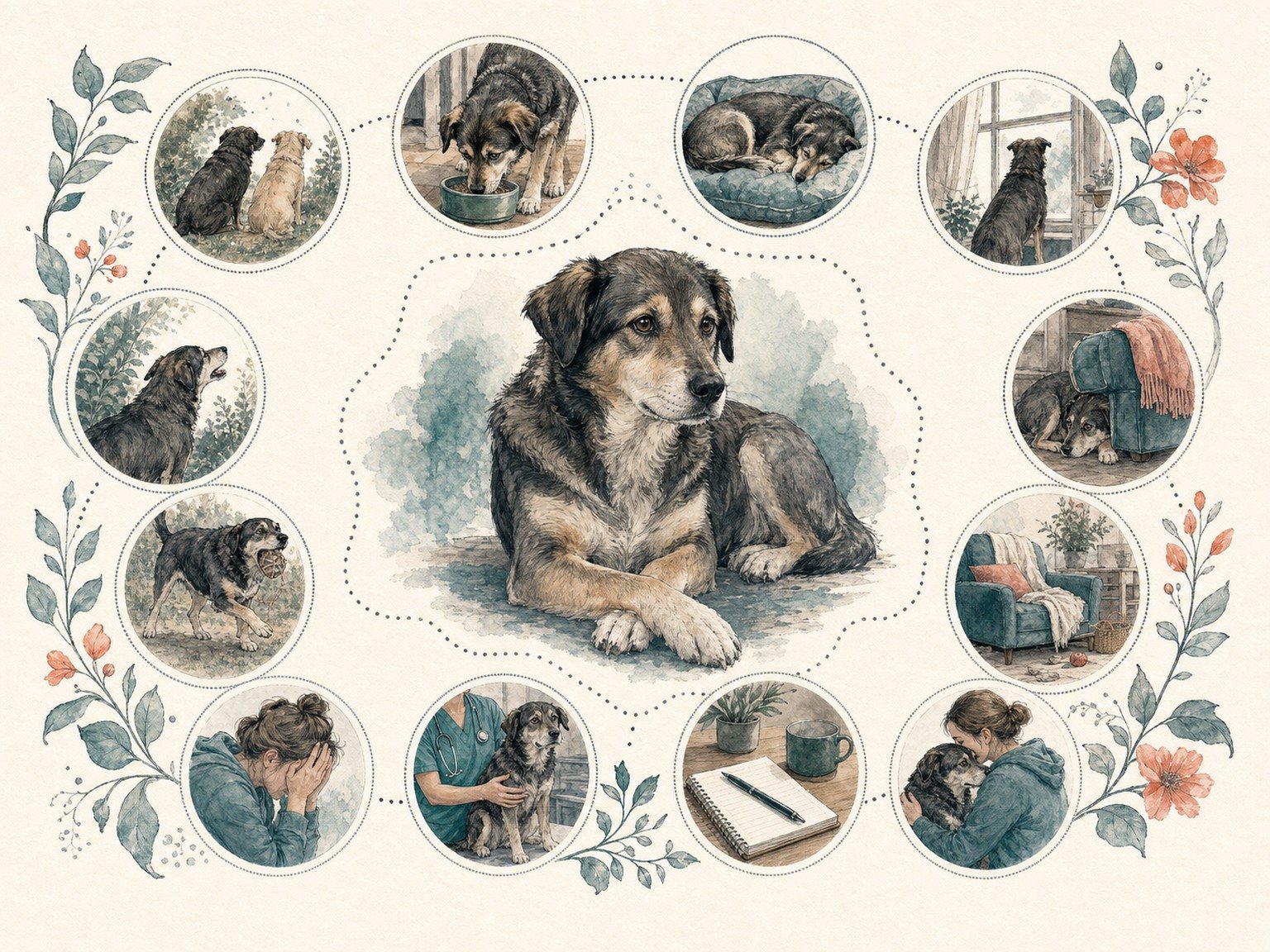
First rule out urgent and medical explanations
Appetite loss, sleep change, hiding, vocalization, restlessness, house-soiling, and reduced activity can occur with pain or disease. A recent loss may make another explanation easy to overlook, especially in senior dogs.
Record onset relative to the loss, food and water intake, weight, stool, urination, sleep, movement, interactions, medications, and environmental changes. Bring the record and videos when safe to the veterinary visit.
Tell the clinic whether the deceased companion shared an infectious exposure, food, medication, toxin, parasite risk, or household event. A shared cause may change the medical question.
Preserve safety, routine, and choice
Keep meals, walks, toileting, sleep, and medications predictable while allowing the dog to choose proximity and rest. Avoid crowding, repeated prompting, or forcing the dog to investigate belongings or locations.
Provide familiar bedding, gentle social contact when sought, quiet enrichment, and tolerable activity. Do not interpret refusal as stubbornness or use punishment for accidents, vocalization, or withdrawal.
Changes to household attention are understandable while people grieve. A simple written routine can help multiple caregivers meet the dog's needs consistently without requiring anyone to hide their own emotion.
Reassess rather than following a grief calendar
There is no evidence-based deadline by which every dog's behavior should return to baseline. Severity, function, health, relationship, routine, and trend matter more than a fixed number of days.
Do not acquire another animal as treatment without considering the surviving dog, the new animal, household capacity, and safety. New companionship can introduce stress and cannot replace a specific relationship.
If fear, separation distress, aggression, or prolonged dysfunction persists, ask about veterinary behavior support. Humane management and reward-based plans are appropriate; grief language should not prevent diagnosis and treatment of a behavior disorder.
Prepare for a focused veterinary conversation
Bring a concise timeline, short natural-movement or symptom videos when safe, the exact names and photographs of every food, treat, medication, and supplement label, and notes about appetite, water intake, stool, sleep, activity, comfort, and behavior. Include recent injuries, travel, boarding, diet changes, missed medication, and previous test results. A complete record helps the veterinary team separate a repeatable pattern from a single impression.
Decide in advance what you need from the visit: an urgency decision, a diagnosis plan, a nutrition review, a pain or mobility assessment, or a monitored trial. Ask what result would change the plan and what finding would rule an option out. This keeps research and product information in the right role. Evidence can shape questions and expectations, but it cannot determine what is safe for an individual dog without the history and examination.
Owner tool
Build a post-loss observation record
On a phone, swipe across the table to see every column.
| Checkpoint | Record | Why it helps |
|---|---|---|
| Before | Relationship and normal routine | Sets context |
| Change | Eating, sleep, play, searching, fear | Defines pattern |
| Health | Weight, pain, elimination, medication | Screens causes |
| Support | Routine, choice, review date | Guides care |
Better questions, calmer next steps
Questions to ask your veterinarian
- Which medical causes should we rule out?
- What changes are most important to track?
- How can we preserve routine without forcing interaction?
- When should behavior support be added?
- What signs require urgent care?
FAQ
Do dogs understand death?
Research cannot answer that fully.
Should a dog see the body?
Evidence does not show a clear universal benefit.
How long does grief last?
No fixed evidence-based timeline applies.
Will another dog help?
Not reliably and not as treatment.
Can owners comfort a dog?
Yes, with calm presence and choice.
Sources
- Animals: Owners' Perceptions After Loss of an Animal Companion. Owner-reported behavior changes and limits.
- Scientific Reports: Domestic Dogs Grieve Over Loss of a Conspecific. Grief-like patterns and uncertainty.
- Merck Veterinary Manual: Behavior Problems in Dogs. Medical and behavior differentials.
- American Animal Hospital Association: Canine Life Stage Guidelines. Behavior and health assessment across age.
- American Veterinary Society of Animal Behavior: Humane Dog Training Position Statement. Humane behavior support.
