

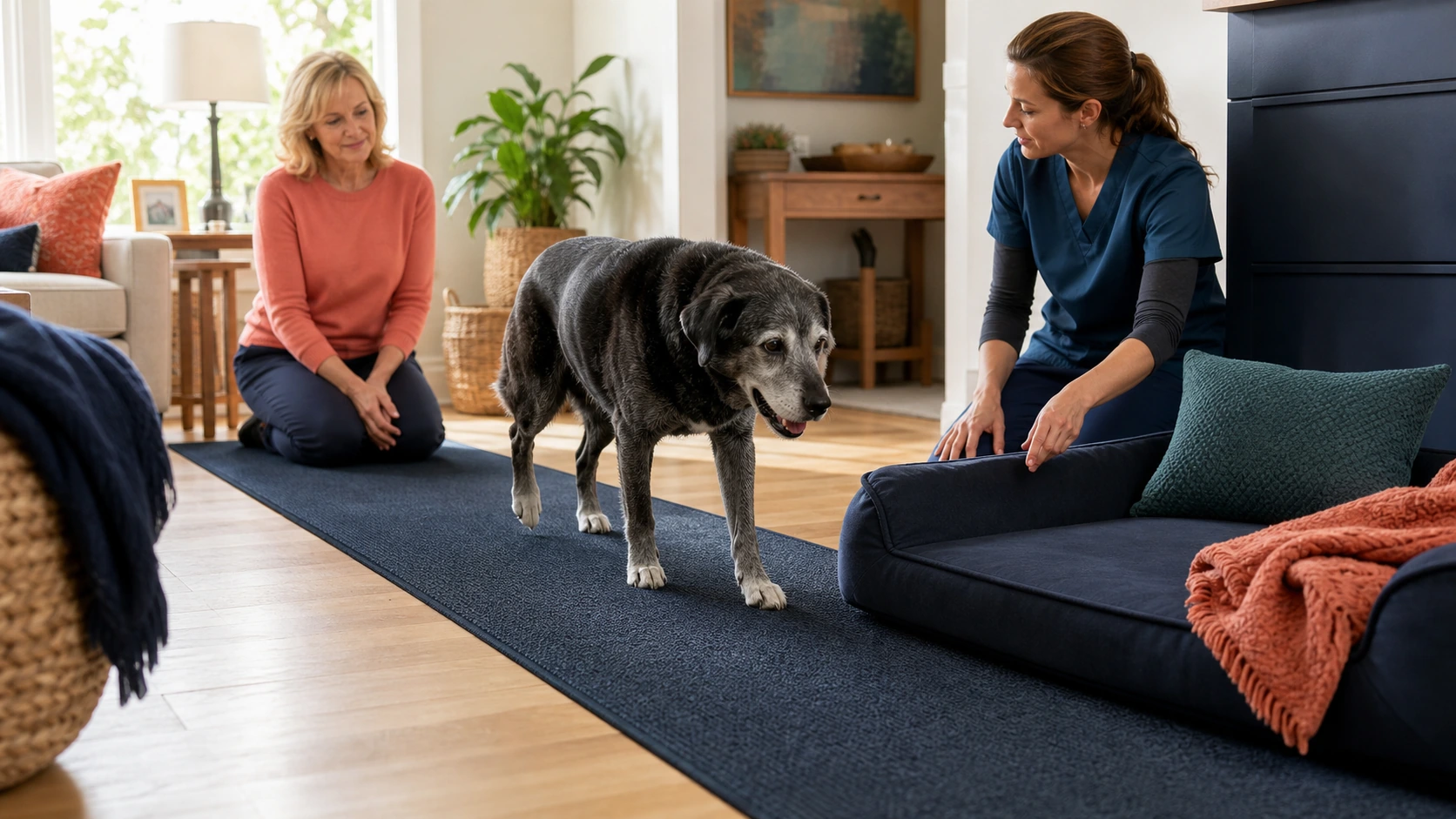
Aging dogs may move differently because of joint disease, pain, neurologic change, muscle loss, weakness, sensory change, medication effects, or several conditions together. Home modifications can reduce avoidable difficulty, but they should be selected from the dog's real movement pattern and veterinary plan. The aim is safer access and preserved choice, not a promise to treat disease.
Short answer
Improve the route before asking the dog to work harder
Observe how the dog rises, turns, crosses slick floors, reaches water, toilets, enters a vehicle, and settles. Add stable traction, reduce unnecessary level changes, protect stairs, and make resting areas easy to enter. Because evidence for specific rehabilitation and home interventions varies, changes should be individualized, monitored, and revised with the veterinary team. [1] [2]
- Map the bed-to-water-to-exit route and address the highest-risk surface or transition first.
- Choose stable dimensions, nonslip backing, low entry, washability, and safe fit before considering any product example.
- Record comfort and function the same day and the next day; stop and seek help after sudden or worsening signs.
Safety first
Sudden weakness, severe pain, or neurologic change needs veterinary care
Seek prompt or emergency care for inability to stand, sudden non-weight-bearing lameness, severe or escalating pain, collapse, breathing difficulty, dragging or knuckling paws, loss of coordination, major swelling, trauma, loss of bladder or bowel control, or rapid decline.
- Do not force stairs, long walks, repeated sit-to-stand work, or an unfamiliar device through pain or fear.
- Do not use unstable ramps, loose mats, steep steps, makeshift slings, or equipment that shifts under load.
- Do not let a bed, brace, supplement, or mobility aid delay diagnosis or replace prescribed care.
Veterinary note
This article is educational and does not diagnose, treat, prescribe, or replace care from a licensed veterinarian. Your dog’s history, examination, diet, medications, and current signs determine what is appropriate.
Map the dog's real daily route
Watch natural movement before changing the environment. Record the assistance needed to rise, first steps after rest, slips, turning radius, hesitation at thresholds, toileting posture, pace, recovery, and willingness. Film only on a safe level surface without provoking difficulty. A short consistent record is more useful than a one-time challenge.
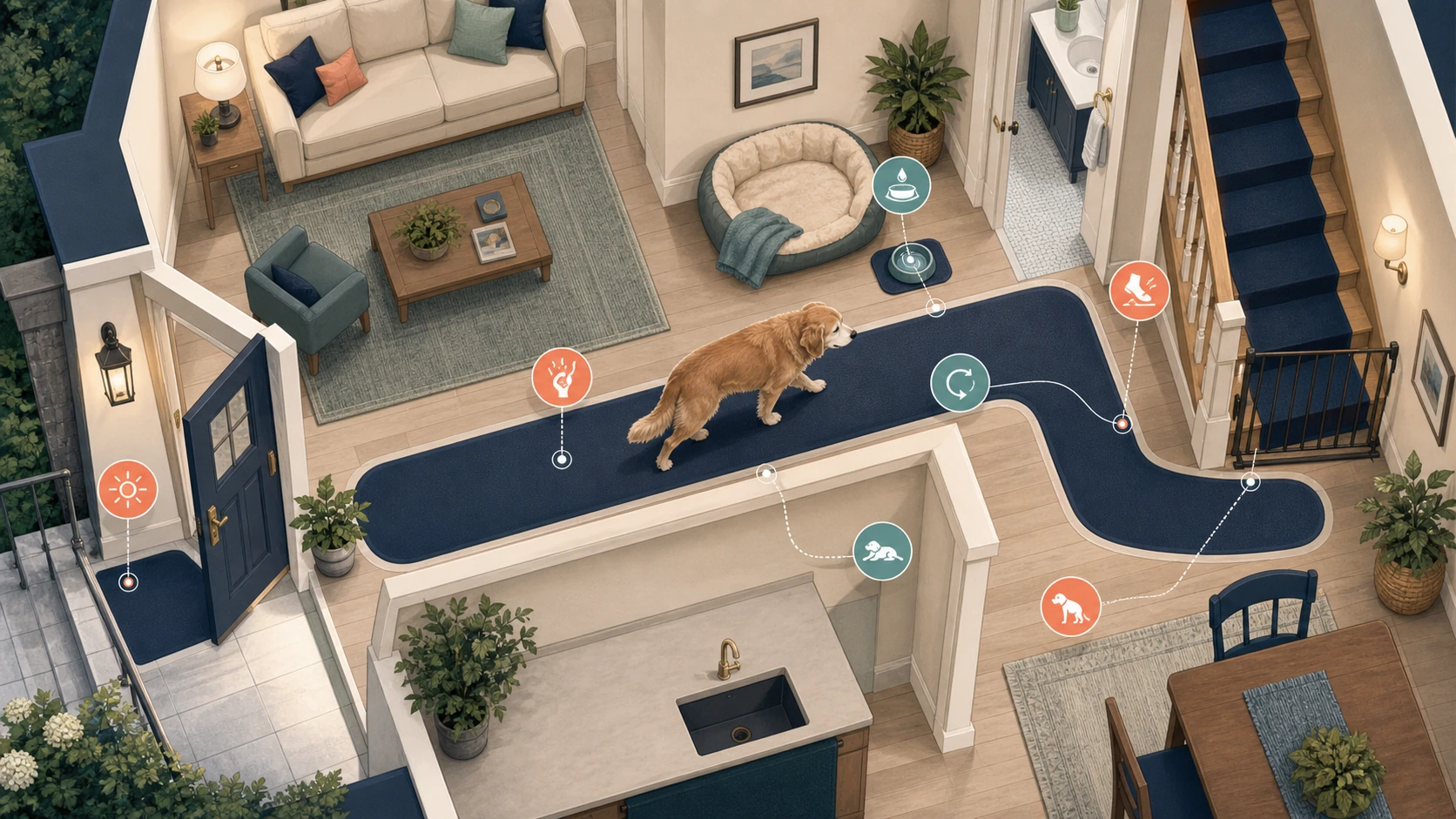
Note where the dog chooses to sleep, drink, eat, eliminate, and spend time with the family. The shortest route is not always the safest if it includes slick flooring, tight turns, steps, or clutter. Pain, vision change, hearing loss, cognitive change, and urgency can alter how a route works at different times of day.
Veterinary evaluation remains the starting point because similar mobility signs can arise from osteoarthritis, ligament injury, spinal or peripheral nerve disease, systemic illness, or more than one problem. Consensus osteoarthritis guidance supports flexible, patient-specific multimodal care and reassessment. [1]
Apply safety and fit criteria before shopping
For flooring support, prioritize a continuous route, strong nonslip backing, flat edges, adequate width for turning, easy cleaning, and a surface the dog accepts. Small disconnected mats can move or create new transitions. Tape, adhesives, and corners should not become chewing, skin, or trip hazards.
For a resting area, consider low and easy entry, a stable base, enough room to change position, washable covers, temperature, and location near family without blocking traffic. The word orthopedic is not a regulated guarantee of pain relief. Judge dimensions, stability, access, materials, and the individual dog's behavior rather than a label.
Ramps or steps require careful slope, width, side protection, surface traction, weight rating, transfer stability, and training. They are not automatically safer than avoiding the level change. Harnesses and slings must fit correctly and should not compress the neck, chest, abdomen, genitals, or painful tissue. Ask the veterinarian or rehabilitation professional to demonstrate use.
Change one variable and observe the response
Introduce one environmental change at a time so you can see whether it helps. Record slips, hesitation, assistance, time to settle, ability to reposition, skin contact, breathing, and next-day comfort. A dog who avoids a new surface or device is providing useful information, not being stubborn.
Exercise and rehabilitation plans should be diagnosis-linked. A systematic review of postoperative cruciate rehabilitation found limited or conflicting evidence and risk of bias across interventions, illustrating why a generic protocol should not be copied between dogs. [2] [3]
Body weight, nail and paw care, pain management, nutrition, and treatment of concurrent disease can affect function. These decisions belong in coordinated veterinary care. No home product can diagnose the cause or guarantee mobility improvement.
Plan for changing needs and caregiving capacity
Mobility support should reduce risk for both dog and caregiver. Consider the caregiver's strength, footing, stairs, sleep disruption, and ability to provide assistance. Ask for hands-on instruction before lifts or transfers. Prepare an emergency route and know how to move the dog without worsening injury.
Reassess after falls, new medication, appetite or weight change, worsening pain, neurologic signs, skin injury, or reduced participation. Useful goals are concrete: reaching water safely, toileting with less assistance, turning without slipping, or resting in a chosen area. Improvement does not mean the underlying disease is cured.
Veterinary physiotherapy literature describes possible roles for therapeutic movement, manual approaches, aquatic work, and environmental changes while emphasizing heterogeneous evidence and individualized application. [4] [5] Use that uncertainty to ask better questions, not to abandon support.
Optional example products
As an Amazon Associate, we earn from qualifying purchases.
These links are optional examples to help you compare tools after applying the safety and fit criteria above. They are not prescriptions, rankings, or substitutes for veterinary care.
- non-slip runners and traction mats for dogs – Optional examples to compare only after checking backing, edge profile, width, stability, and washability.
- supportive orthopedic beds for senior dogs – Optional examples to compare after checking entry height, base stability, usable dimensions, washable covers, and the dog's comfort.
Prepare for a focused veterinary conversation
Bring a concise timeline, short natural-movement or symptom videos when safe, the exact names and photographs of every food, treat, medication, and supplement label, and notes about appetite, water intake, stool, sleep, activity, comfort, and behavior. Include recent injuries, travel, boarding, diet changes, missed medication, and previous test results. A complete record helps the veterinary team separate a repeatable pattern from a single impression.
Decide in advance what you need from the visit: an urgency decision, a diagnosis plan, a nutrition review, a pain or mobility assessment, or a monitored trial. Ask what result would change the plan and what finding would rule an option out. This keeps research and product information in the right role. Evidence can shape questions and expectations, but it cannot determine what is safe for an individual dog without the history and examination.
Owner tool
Audit the senior dog's home route
On a phone, swipe across the table to see every column.
| Area | Safety and fit criteria | Observe |
|---|---|---|
| Floor | Stable, flat, continuous traction | Slips and hesitation |
| Rest | Low entry, stable, washable | Settling and repositioning |
| Access | Avoid or secure level changes | Assistance and confidence |
| Aid | Correct fit and instruction | Skin, breathing, comfort |
Better questions, calmer next steps
Questions to ask your veterinarian
- Which diagnosis and restrictions should guide home changes?
- Which route or transition creates the greatest current risk?
- Would a rehabilitation or neurology assessment change the plan?
- How should I fit and use any support device safely?
- Which decline or neurologic signs require urgent care?
FAQ
Do traction mats treat arthritis?
No. They may improve footing but do not treat the underlying disease.
Is an orthopedic bed guaranteed to relieve pain?
No. Evaluate access, stability, dimensions, washability, and individual comfort.
Are ramps always safer than stairs?
No. Design, slope, stability, training, and the dog's condition determine risk.
Should I exercise through stiffness?
Do not force activity through pain; use the veterinarian's individualized plan.
What should I track?
Record rising, slips, turns, toileting, assistance, recovery, and next-day comfort.
Sources
- Frontiers in Veterinary Science: International Consensus Guidelines for Canine Osteoarthritis Treatment. Individualized multimodal care and reassessment.
- Veterinary Surgery: Systematic Review of Rehabilitation after Canine Cruciate Surgery. Evidence limits and condition-specific rehabilitation.
- American College of Veterinary Surgeons: Osteoarthritis in Dogs. Diagnosis and multimodal mobility-care context.
- Veterinary Sciences: Physiotherapeutic Strategies for Canine Osteoarthritis. Rehabilitation categories and evidence limitations.
- American College of Veterinary Sports Medicine and Rehabilitation: About ACVSMR. Veterinary specialty and credential context.
