


Probiotic is a functional term for live microorganisms that, when administered in adequate amounts, confer a health benefit on the host. That definition requires identity, viability, amount, and demonstrated benefit; it is not a blanket description of every fermented ingredient or bacterial blend. Canine studies have explored acute diarrhea, chronic gastrointestinal disease, antibiotic-associated effects, stress, and other outcomes, but reviews describe heterogeneous strains, combinations, methods, populations, diets, endpoints, and study quality. A result for one strain cannot be assigned to another product. Changes in stool or microbiome measurements do not automatically prove better health. Persistent or severe digestive signs require diagnosis, and any veterinarian-approved trial should define the exact product, clinical target, monitoring, and review date.
Short answer
Probiotic effects cannot be generalized from one strain to another
Canine gastrointestinal reviews report possible benefits in selected settings but emphasize inconsistent methods, small studies, different organisms and outcomes, and limited ability to compare products. Evidence for a named strain or combination does not validate every product labeled probiotic. [1] [2]
- Record the exact question, baseline, product or exposure, timing, and whole-dog context.
- Use the record to support veterinary assessment, not to diagnose or create a regimen at home.
- Bring the complete diet, labels, medications, supplements, health history, and observed changes.
- Agree on measurable goals, a review point, and clear instructions for urgent changes.
Safety first
Blood, repeated vomiting, dehydration, severe pain, weakness, or rapid decline needs prompt care
Contact a veterinarian promptly for persistent diarrhea, recurrent vomiting, appetite loss, weight loss, fever, marked lethargy, pain, or a dog who is very young, old, pregnant, immunocompromised, or medically complex. Seek urgent care for collapse, repeated unproductive retching, severe weakness, black or bloody stool, breathing difficulty, or rapid deterioration.
- Do not delay care for sudden, severe, escalating, or function-limiting signs.
- Do not start, stop, combine, divide, or calculate treatment from this article.
- Preserve exact packages, lot information, exposure details, and a concise timeline.
Veterinary note
This article is educational and does not diagnose, treat, prescribe, or replace care from a licensed veterinarian. Your dog’s history, examination, diet, medications, and current signs determine what is appropriate.
Start with a diagnosis, not a microbiome story
Diarrhea and other digestive signs can reflect dietary change, parasites, infection, toxins, medication, pancreatitis, inflammatory disease, endocrine disease, obstruction, cancer, or problems outside the gut. Stool appearance alone cannot identify the cause.
Record onset, frequency, stool character, blood or mucus, vomiting, appetite, water, urination, pain, energy, weight, diet, scavenging, travel, stress, medications, and other animals affected. This history helps determine urgency and testing.
Microbiome research is rapidly evolving, but a diversity score or list of organisms is not automatically a diagnosis. Association does not show whether a microbial change caused disease, followed disease, or reflects diet, treatment, environment, or sampling.
Interpret studies by strain, product, and population
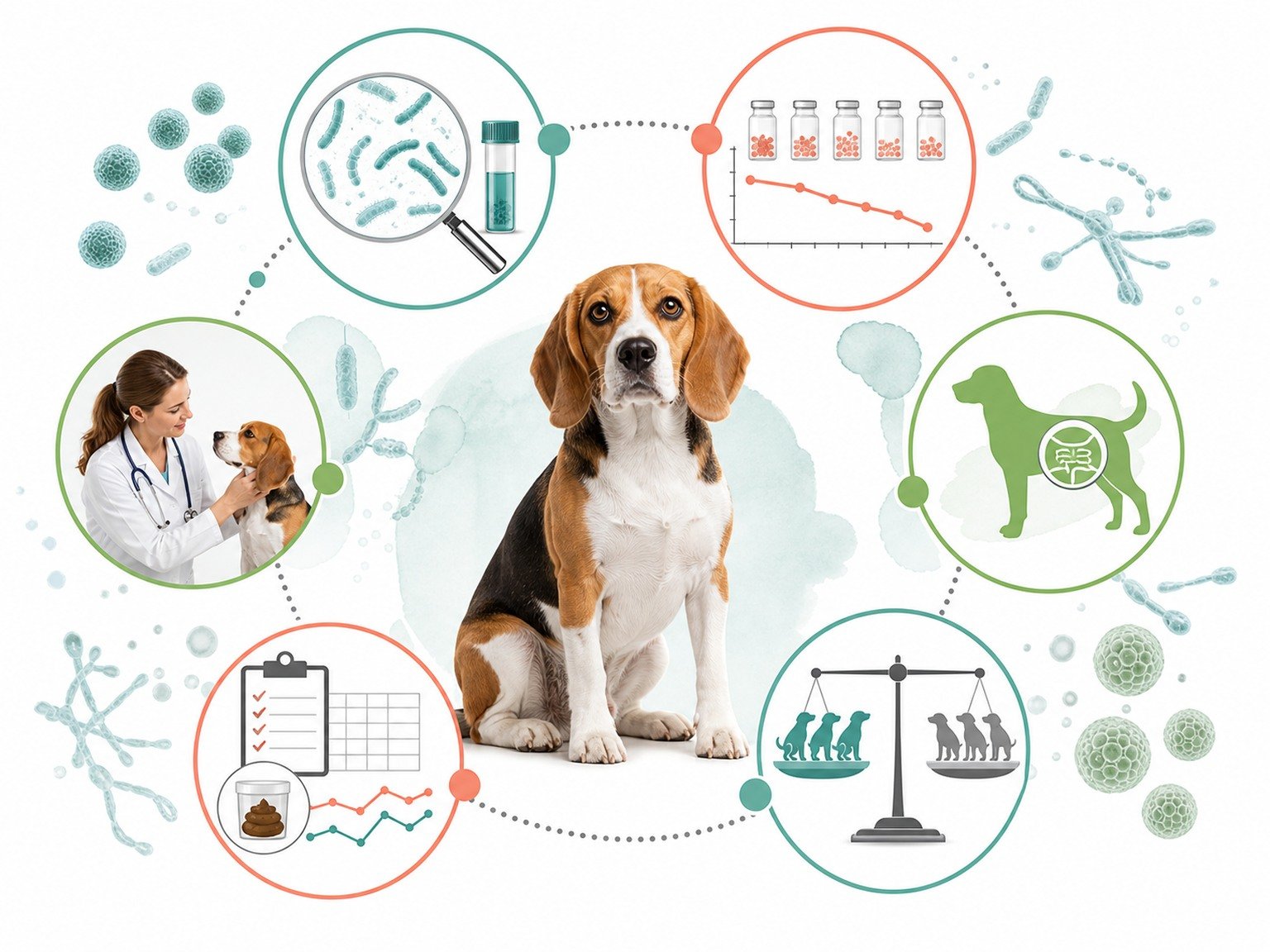
A systematic review of probiotics for canine gastrointestinal disease found substantial variation in study design, probiotic organisms, populations, and outcomes. The evidence did not support treating all probiotics as one intervention. [1]
A later review of canine probiotics and prebiotics likewise described potential roles alongside major gaps in standardization, mechanisms, clinical endpoints, and product-level translation. Review conclusions should guide questions, not become product promises. [2]
Ask for genus, species, strain identifier, viable amount through shelf life, combination ingredients, storage requirements, and the exact study matching the claim. A front-label colony count without strain and stability context is incomplete.
Separate clinical outcomes from surrogate changes
A study may measure stool score, diarrhea duration, inflammatory markers, microbial abundance, diversity, metabolite concentrations, or caregiver reports. These endpoints answer different questions and should not be treated as interchangeable evidence of overall gut health.
An observed microbiome shift is not automatically beneficial, and no change in a sequencing measure does not automatically mean a dog had no clinical response. The meaningful outcome should match the dog's problem and be interpreted with the veterinary team.
Diet is a major part of the gastrointestinal environment. Review complete food, treats, fiber, supplements, recent changes, and food trials so a probiotic is not evaluated while several other variables change at once.
Evaluate quality, safety, and reassessment
Live-organism products can vary in identity, viability, contamination control, stability, and labeling. Storage conditions and time matter. Follow the exact label and do not assume refrigeration, freezing, or room temperature is correct for every product. [3]
Discuss risk in dogs with severe illness, immune compromise, indwelling devices, pregnancy, very young age, or complex treatment. Absence of a commonly reported adverse event does not prove zero risk for every organism and patient.
For an approved trial, record baseline, exact product and lot, administration, diet, medication, stool and whole-dog outcomes, adverse signs, and review date. Stop-and-restart experiments should not be conducted without veterinary direction. [4]
Prepare for a focused veterinary conversation
Bring a concise timeline, short natural-movement or symptom videos when safe, the exact names and photographs of every food, treat, medication, and supplement label, and notes about appetite, water intake, stool, sleep, activity, comfort, and behavior. Include recent injuries, travel, boarding, diet changes, missed medication, and previous test results. A complete record helps the veterinary team separate a repeatable pattern from a single impression.
Decide in advance what you need from the visit: an urgency decision, a diagnosis plan, a nutrition review, a pain or mobility assessment, or a monitored trial. Ask what result would change the plan and what finding would rule an option out. This keeps research and product information in the right role. Evidence can shape questions and expectations, but it cannot determine what is safe for an individual dog without the history and examination.
Owner tool
Assess a canine probiotic claim
On a phone, swipe across the table to see every column.
| Checkpoint | Record | Why it helps |
|---|---|---|
| Identity | Genus, species, strain, viable amount | Defines product |
| Evidence | Dog population, outcome, comparator | Tests match |
| Context | Diagnosis, diet, drugs, risk | Prevents overreach |
| Review | Baseline, response, adverse signs | Guides next step |
Better questions, calmer next steps
Questions to ask your veterinarian
- What diagnosis or problem are we addressing?
- Which strain and formulation were studied?
- Is the outcome clinically meaningful for this dog?
- What quality and storage information is available?
- When should we reassess or stop?
FAQ
Are all dog probiotics the same?
No. Effects can be strain- and formulation-specific.
Can a probiotic replace diagnostic testing?
No. Persistent signs require appropriate evaluation.
Does a higher colony count mean better?
Not by itself; identity, viability, evidence, and fit matter.
Are fermented foods equivalent?
No. They are not automatically demonstrated probiotics for dogs.
Can stool improvement prove the product worked?
Not alone; diet, disease, and natural variation also matter.
Sources
- Journal of Veterinary Internal Medicine: Probiotics for Canine Gastrointestinal Disease. Systematic review and heterogeneity.
- Veterinary Sciences: Probiotics and Prebiotics in Canine Health. Current evidence and research gaps.
- Nutrition Today: Veterinary Pet Supplements and Nutraceuticals. Product quality and evidence variability.
- Merck Veterinary Manual: Introduction to Digestive Disorders of Dogs. Digestive differential and assessment context.
- World Small Animal Veterinary Association: Global Nutrition Guidelines. Diet and nutrition assessment framework.
