

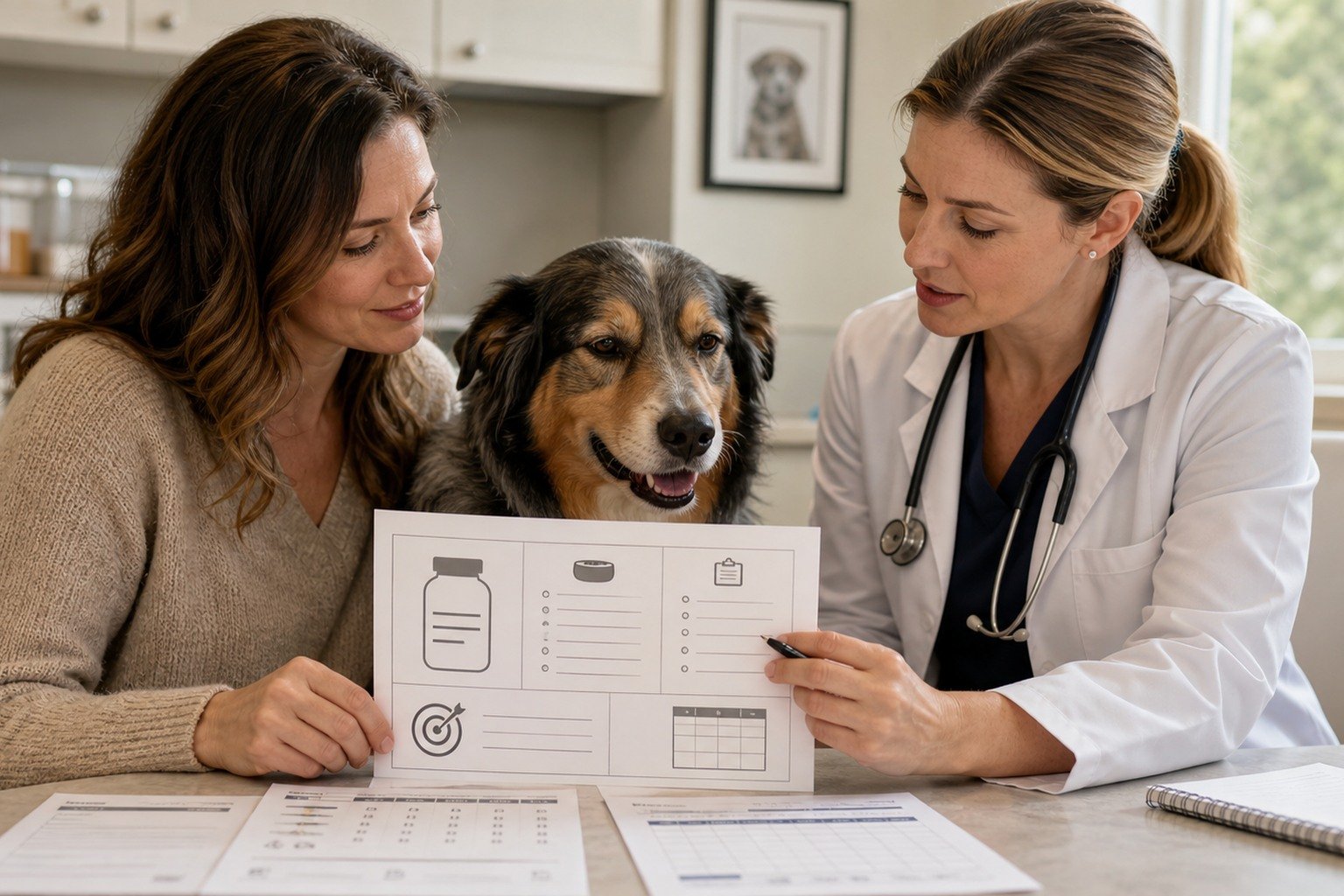
A productive supplement conversation is not a request for automatic approval or a test of whether a veterinarian is pro- or anti-supplement. It is shared work around an exact patient question: what the dog eats and receives, what health goal matters, what evidence supports the exact finished product, what uncertainty and interactions remain, how feasibility affects adherence, and how response or harm will be monitored. Preparation makes limited appointment time more useful and helps recommendations remain consistent across primary, specialty, emergency, rehabilitation, pharmacy, and nutrition teams.
Short answer
Bring a complete record and ask for a decision pathway
FDA, AAFCO, AAHA, and veterinary reviews show that intended use, complete diet, health context, exact product, evidence match, quality, and monitoring belong in the same conversation. A productive relationship makes uncertainty and tradeoffs visible rather than forcing a yes-or-no product verdict. [1] [2] [3] [4]
- Start with the individual dog's baseline, complete diet, health history, and current veterinary plan.
- Use exact terms, labels, dates, and observations without turning them into a home diagnosis or prescription.
- Keep population evidence, regulatory categories, ingredients, and finished products within their actual limits.
- Escalate sudden, severe, persistent, progressive, dangerous, or function-limiting change promptly.
Safety first
Contact the clinic promptly when health or exposure changes
Seek urgent care for collapse, breathing difficulty, seizure, severe pain or weakness, inability to stand, repeated unproductive retching, major bleeding, facial swelling with breathing concerns, or suspected toxin exposure. Report possible adverse effects, accidental ingestion, formulation changes, and conflicting instructions promptly.
- Do not delay urgent care while completing a glossary, FAQ, product record, or observation log.
- Do not start, stop, combine, divide, increase, decrease, or rechallenge medication or supplements from this article.
- Do not use a human product, leftover prescription, online dose conversion, or supplement as a substitute for indicated care.
Veterinary note
This article is educational and does not diagnose, treat, prescribe, or replace care from a licensed veterinarian. Your dog’s history, examination, diet, medications, and current signs determine what is appropriate.
Prepare a one-page exposure and goal summary
List complete food, treats, chews, toppers, flavored medications, prescriptions, preventives, over-the-counter products, and every supplement. Include exact labels, manufacturers, formulations, amounts as currently directed, timing, start dates, lots when available, and who recommended each item.
Describe the diagnosed condition or care question, one meaningful target, current baseline, prior response, adverse observations, and what decision you need today. Avoid asking whether supplements in general are good.
Mark uncertainty honestly: missing label, unknown prior use, conflicting instructions, changed formula, missed doses, or products from another clinic. Accurate unknowns are safer than reconstructed certainty.

Ask how the evidence maps to the exact decision
Ask whether evidence matches dogs, the relevant condition, population, ingredient form, formulation, amount, finished product, comparator, outcome, and duration. Request the most important limitation rather than only the headline result.
Separate quality from efficacy. Identity, potency, purity, contaminants, manufacturing, lot traceability, storage, and complaint handling matter, but quality documentation alone does not establish a clinical benefit.
Ask whether nutrition assessment, examination, diagnostics, medication, rehabilitation, environmental change, or no new exposure better answers the goal.
Make interactions and priorities explicit
Request reconciliation across all foods, treats, medications, preventives, supplements, conditions, procedures, and laboratory monitoring. An interaction can involve duplicate nutrients, additive effects, absorption, metabolism, bleeding, sedation, gastrointestinal tolerance, or interpretation of response.
When several conditions or clinicians are involved, identify who owns the decision and who should receive updates. Do not combine recommendations independently when their assumptions differ.
State cost, administration difficulty, household schedule, dog acceptance, and monitoring capacity. Feasibility is a safety and adherence issue, not an embarrassment.
Close with written instructions and a reassessment point
Record the exact decision: use, do not use, defer, gather more information, or discontinue under direction. Include instructions, intended goal, baseline, observation method, review date, and urgent or prompt contact signs.
Ask what would count as meaningful benefit, unacceptable harm, inadequate adherence, or evidence that the original question was wrong. A clear stop rule prevents an indefinite trial.
Share the updated list with every relevant clinic and at transitions of care. Reconcile again after diagnosis, diet, medication, procedure, hospitalization, adverse event, or formulation change.
Handle disagreement without losing the safety record
Ask whether disagreement concerns evidence quality, finished-product match, patient risk, interaction, goal, feasibility, or professional scope. Different reasons require different next steps.
A second opinion is reasonable when the question is important or specialized, but provide the complete same record. Do not hide products to avoid disagreement or shop for approval while omitting prior concerns.
Keep the dog's welfare and measurable function at the center. A productive relationship can end with no supplement, delayed decision, a monitored adjunct, or a different care priority.
Keep the evidence and product boundary visible
FDA explains that animal products are categorized through composition and intended use rather than a special human-style dietary-supplement category. A label word such as natural, wellness, veterinary, premium, or clinical does not establish safety, effectiveness, regulatory approval, or suitability for one dog. [1]
AAFCO and AAHA place supplement questions beside the complete diet, medical history, medications, body and muscle condition, environment, and veterinary assessment. Adding nutrients or active compounds can be unnecessary, duplicative, excessive, or difficult to interpret when the full exposure list is missing. [2] [3]
Veterinary reviews identify gaps between ingredient research and the exact finished product sold to an owner. Species, condition, population, formulation, dose, manufacturing, quality testing, outcome, duration, adverse-event capture, and conflicts all shape what a study can support. [4]
Prepare for a focused veterinary conversation
Bring a concise timeline, short natural-movement or symptom videos when safe, the exact names and photographs of every food, treat, medication, and supplement label, and notes about appetite, water intake, stool, sleep, activity, comfort, and behavior. Include recent injuries, travel, boarding, diet changes, missed medication, and previous test results. A complete record helps the veterinary team separate a repeatable pattern from a single impression.
Decide in advance what you need from the visit: an urgency decision, a diagnosis plan, a nutrition review, a pain or mobility assessment, or a monitored trial. Ask what result would change the plan and what finding would rule an option out. This keeps research and product information in the right role. Evidence can shape questions and expectations, but it cannot determine what is safe for an individual dog without the history and examination.
Owner tool
Prepare a focused supplement appointment
On a phone, swipe across the table to see every column.
| Checkpoint | What to record | Why it helps |
|---|---|---|
| Inventory | Exact exposures and labels | Supports reconciliation |
| Goal | Patient question and baseline | Focuses decision |
| Evidence | Match, quality, limits | Calibrates certainty |
| Close | Instruction, monitoring, review | Prevents drift |
Better questions, calmer next steps
Questions to ask your veterinarian
- What decision are we making today?
- Does evidence match this exact product and dog?
- What interactions or duplicate exposures matter?
- Who owns follow-up across the care team?
- What result or adverse sign changes the plan?
FAQ
Will my veterinarian be offended if I ask?
A concise, complete record supports a professional discussion.
Should I bring the bottle?
Bring the exact current label and product information.
Can different clinics disagree?
Yes; ask them to clarify assumptions and ownership.
What if cost is a concern?
State it early so feasible options can be discussed.
Is no supplement a failed visit?
No. It can be the evidence-aligned decision.
Sources
- U.S. Food and Drug Administration: FDA's Regulation of Pet Food. Animal-food, intended-use, and animal-drug boundaries.
- Association of American Feed Control Officials: Supplements. Complete-diet context, labels, excess exposure, and veterinary involvement.
- American Animal Hospital Association: Nutritional Risk Factors. Whole-patient nutrition, medication, supplement, and environment assessment.
- Nutrition Today: Veterinary Pet Supplements and Nutraceuticals. Regulatory, quality, safety, efficacy, and finished-product evidence limits.
