

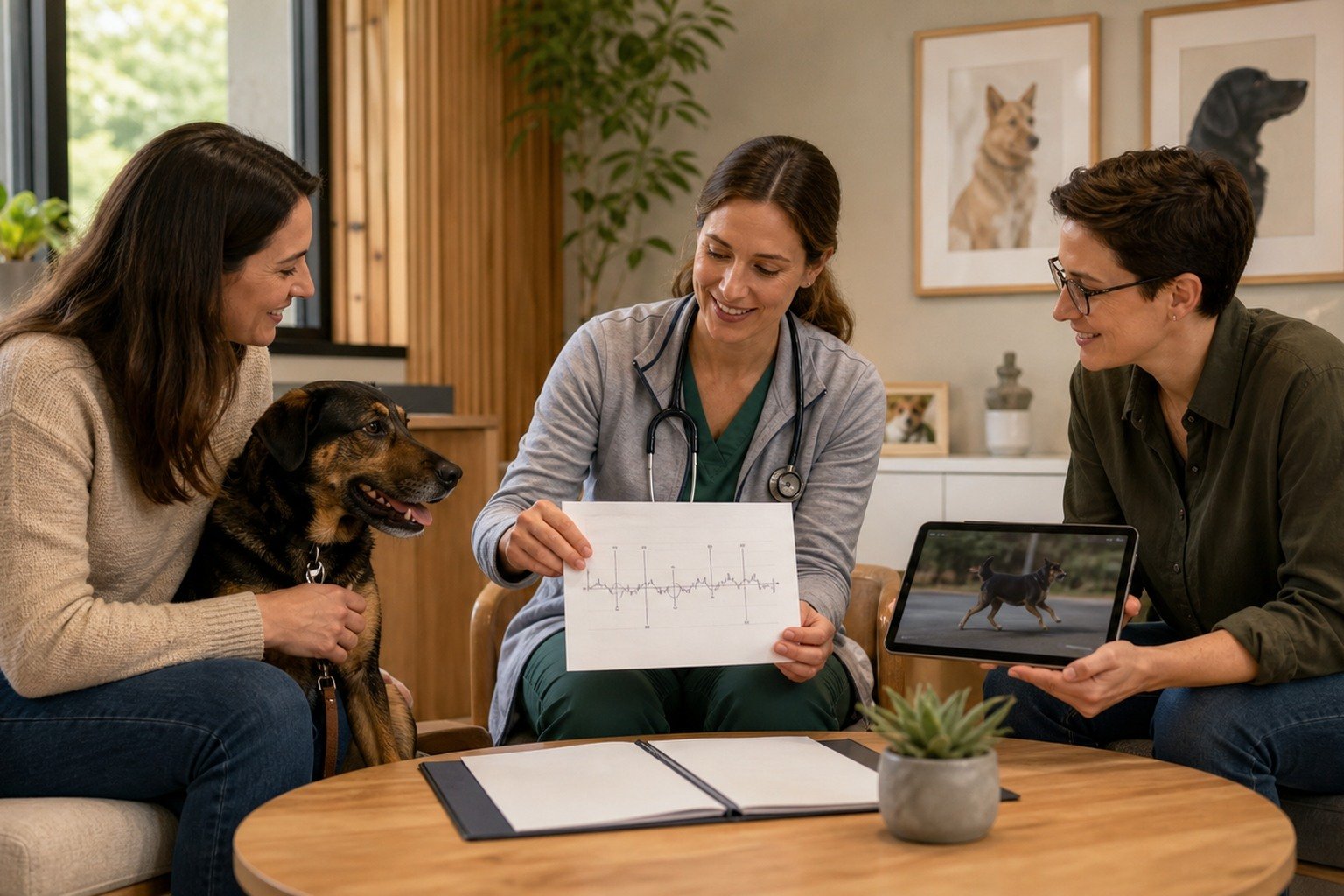
Owners contribute longitudinal observations; veterinarians assess medical contributors and direct medical care; qualified behavior professionals analyze behavior and teach humane plans within their scope. Productive collaboration depends on accurate records, defined roles, shared goals, consistent instructions, and a closed follow-up loop. No video, questionnaire, trainer title, or home experiment replaces veterinary assessment.
Short answer
Bring a neutral history and ask each professional to name their role
AAHA and MSD emphasize medical assessment, detailed behavior history, management, and referral. AVSAB defines humane method boundaries. Population evidence shows anxiety patterns can overlap. These sources support coordinated care rather than competing explanations or disconnected plans. [1] [2] [3] [4]
- Start with the individual dog's ordinary baseline and full context.
- Observe without provoking fear, pain, conflict, or a stronger example.
- Use terminology and research only within their intended limits.
- Escalate sudden, severe, progressive, dangerous, or function-limiting changes promptly.
Safety first
Safety and medical change come before behavior labels
Seek urgent veterinary help for collapse, breathing difficulty, seizure, severe injury, suspected toxin exposure, extreme overheating, inability to settle with escalating physical distress, sudden severe disorientation, or immediate danger to people or animals. Use distance and barriers without cornering the dog.
- Do not delay urgent veterinary care while completing a log or reading this guide.
- Do not corner, restrain, flood, punish, or deliberately trigger behavior for testing or video.
- Do not start, stop, combine, divide, or calculate medication or supplements from this article.
Veterinary note
This article is educational and does not diagnose, treat, prescribe, or replace care from a licensed veterinarian. Your dog’s history, examination, diet, medications, and current signs determine what is appropriate.
Prepare a useful behavior timeline
Record onset, sudden or gradual change, frequency, contexts, distance, observable posture and actions, duration, recovery, daily function, injury, health changes, medication, supplements, diet, sleep, appetite, elimination, and prior interventions. AAHA places comprehensive history inside behavior assessment. [1]
Include what happens before and after, what the dog can still do comfortably, and what has worsened. Preserve dates and distinguish representative events from unusual ones.
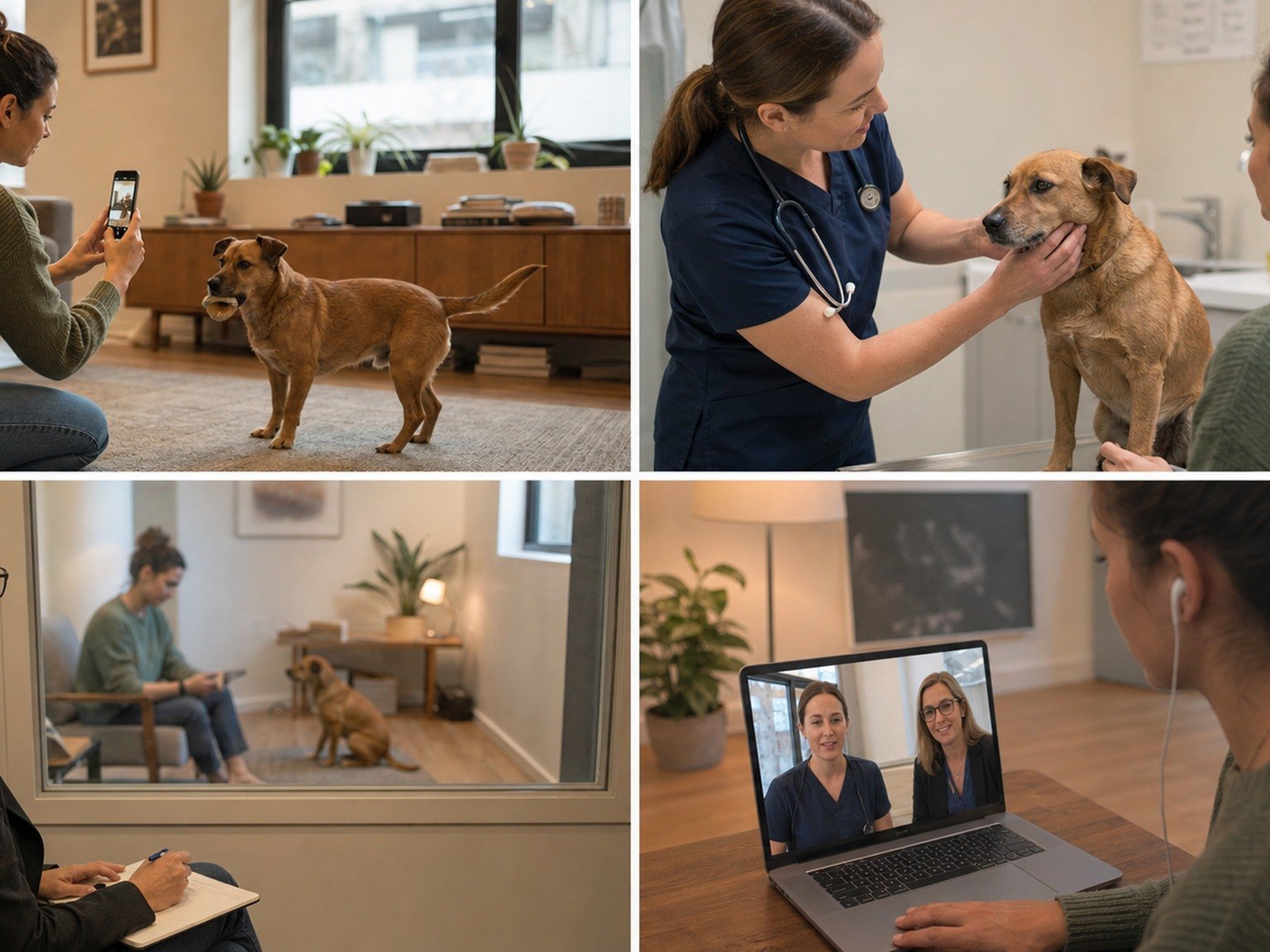
Capture short natural video only when safe. Never recreate the trigger, block escape, prolong exposure, or put a person or animal in danger for documentation.
Clarify professional roles and credentials
The veterinarian evaluates health, pain, medication, diagnostics, and referral. A veterinary behaviorist is a veterinarian with specialty behavior training. Trainers and consultants vary widely in education and scope.
Ask about credentials, continuing education, methods, experience with the concern, emergency boundaries, communication with the clinic, and when they refer out.
Avoid professionals who guarantee results, use dominance as a universal explanation, recommend flooding or intimidation, dismiss medical assessment, or work outside their scope.
Create one shared problem statement
Define the observed pattern and affected function without deciding the diagnosis in advance. Examples include inability to settle after routine sounds, escalating visitor risk, or distress during necessary handling.
Ask the veterinarian what medical contributors are being considered and the behavior professional how the environment and learning history fit. Competing labels should be reconciled, not silently combined.
Choose one or two observable outcomes meaningful to welfare and daily life. A score or absence of barking alone may not represent calm or safety.
Keep instructions and records consistent
Maintain one current list of medication, supplements, diet, management, training exercises, equipment, adverse effects, and contact instructions. Identify who recommended each item and when.
Do not change medication, combine products, increase exposure, or alter safety management because one team member has not replied. Ask the relevant professionals to reconcile conflicting guidance.
Share examination findings, laboratory or imaging results when relevant, behavior notes, and response updates through approved channels. Do not assume records transfer automatically.
Close the follow-up loop
Confirm what to keep stable, what not to attempt, warning signs, emergency routes, expected monitoring, and the date or trigger for reassessment.
Report worsening, self-injury, escape attempts, bites or near misses, inability to eat or sleep, medication effects, and plan barriers promptly. Honest difficulty is useful clinical information.
At reassessment, compare baseline function, context, recovery, adverse events, adherence, and quality of life. Adjustment is part of individualized care, not evidence that the owner or dog failed.
Prepare consent for team communication
Ask the clinic and behavior professional what written consent they need to exchange records, video, observations, and recommendations. Specify the organizations and time period rather than assuming a social-media message or verbal mention is sufficient.
Decide which channel is used for routine updates, urgent concerns, appointment records, medication questions, and behavior-plan changes. Store contact details where every caregiver can find them.
Privacy and documentation rules may differ between organizations. Send only relevant information through approved channels and keep a dated copy of what was shared.
Use disagreement as a signal to clarify the case
Professionals may weigh medical risk, behavior risk, household feasibility, and evidence differently. Ask each person to state the concern, evidence, uncertainty, and decision that would change with new information.
Do not average conflicting advice or implement pieces of both plans. Identify who has authority over medication and medical restrictions, who directs behavior exercises, and who coordinates immediate safety.
If communication cannot resolve a high-risk or complex case, ask about referral or a case conference. A second opinion should receive the same accurate timeline and current records, not a competing narrative.
Prepare for a focused veterinary conversation
Bring a concise timeline, short natural-movement or symptom videos when safe, the exact names and photographs of every food, treat, medication, and supplement label, and notes about appetite, water intake, stool, sleep, activity, comfort, and behavior. Include recent injuries, travel, boarding, diet changes, missed medication, and previous test results. A complete record helps the veterinary team separate a repeatable pattern from a single impression.
Decide in advance what you need from the visit: an urgency decision, a diagnosis plan, a nutrition review, a pain or mobility assessment, or a monitored trial. Ask what result would change the plan and what finding would rule an option out. This keeps research and product information in the right role. Evidence can shape questions and expectations, but it cannot determine what is safe for an individual dog without the history and examination.
Owner tool
Coordinate an anxiety care team
On a phone, swipe across the table to see every column.
| Checkpoint | What to record | Why it helps |
|---|---|---|
| History | Pattern, health, recovery | Builds shared picture |
| Roles | Scope and credentials | Prevents gaps |
| Plan | Safety, methods, outcome | Aligns work |
| Follow-up | Response, adverse signs, recheck | Closes loop |
Better questions, calmer next steps
Questions to ask your veterinarian
- Which medical contributors should be assessed?
- Who owns each part of the plan?
- Which methods are excluded?
- What outcome and adverse signs should we track?
- How will the team share updates and revise the plan?
FAQ
Do I need a veterinary behaviorist for every concern?
No; the appropriate team depends on severity, complexity, risk, and response.
Can a trainer diagnose anxiety?
Diagnosis belongs with a veterinarian.
Should professionals communicate?
Yes, with owner consent and clear channels.
Can video replace an exam?
No.
What if instructions conflict?
Pause the disputed change and ask the relevant professionals to reconcile it.
Sources
- American Animal Hospital Association: Canine and Feline Behavior Management Guidelines. Medical assessment, history, management, and referral.
- MSD Veterinary Manual: Diagnosis of Behavior Problems in Animals. Comprehensive history and medical contributors.
- American Veterinary Society of Animal Behavior: Humane Dog Training Position Statement. Reward-based methods and opposition to aversives and flooding.
- Scientific Reports: Prevalence and Comorbidity in Canine Anxiety. Population patterns and individual limits.
