

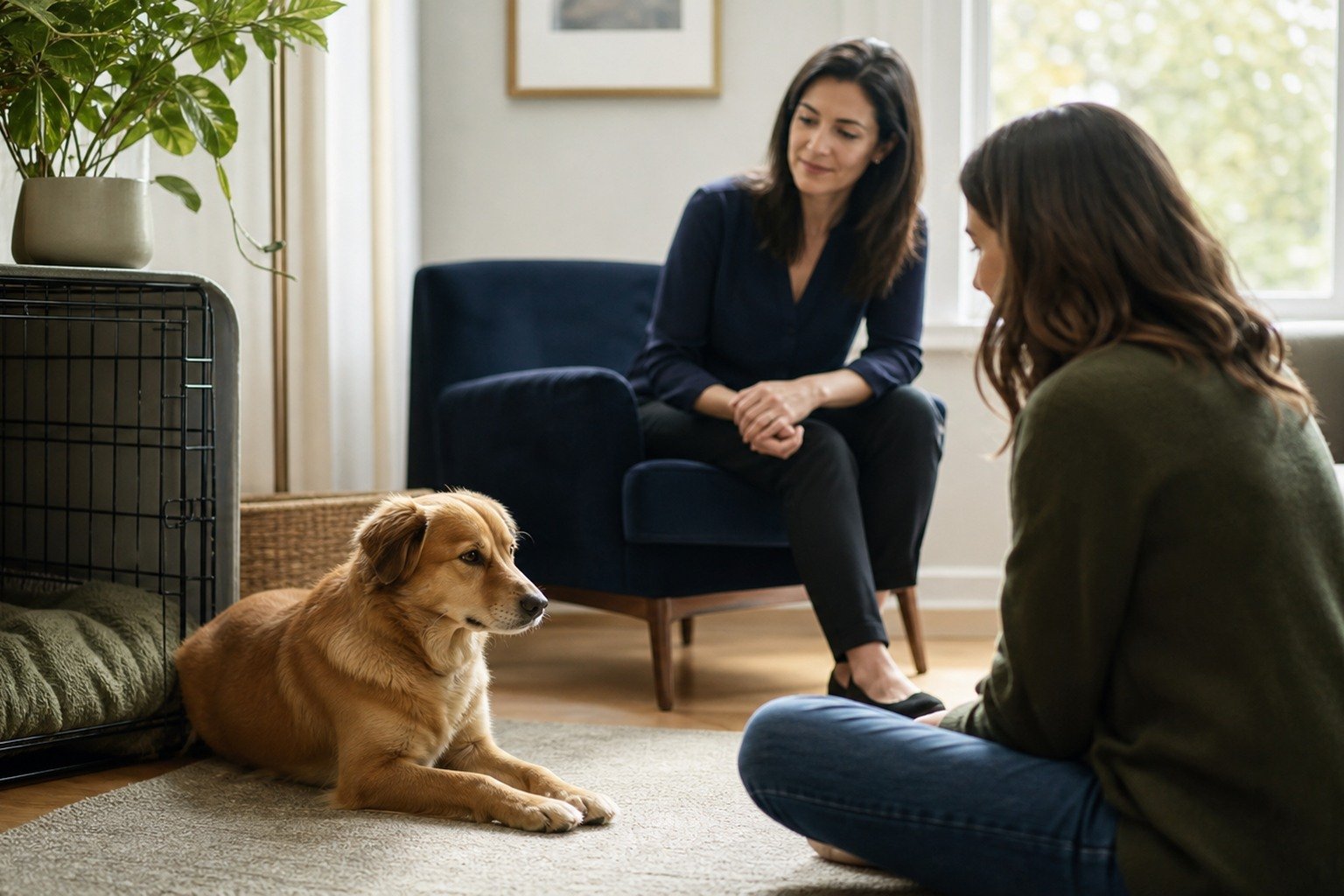
A first dog brings unfamiliar body language, routines, and uncertainty. Begin with safe observation, not a test of obedience or a diagnosis. Record what happened before, during, and after a change; how intense and prolonged it was; how the dog recovered; and what ordinary function changed. Protect distance, choice, predictable needs, and safe exits while veterinary and qualified behavior professionals evaluate persistent or severe concerns.
Short answer
Learn the dog's baseline before choosing a calming response
AAHA and MSD emphasize complete history, medical assessment, environment, and individualized behavior planning. AVSAB opposes aversives and flooding. Population research shows anxiety patterns and comorbidity without predicting one dog. Together they support humane observation and early professional partnership. [1] [2] [3] [4]
- Start with the individual dog's ordinary baseline and full context.
- Observe without provoking fear, pain, conflict, or a stronger example.
- Use terminology and research only within their intended limits.
- Escalate sudden, severe, progressive, dangerous, or function-limiting changes promptly.
Safety first
Safety and medical change come before behavior labels
Seek urgent veterinary help for collapse, breathing difficulty, seizure, severe injury, suspected toxin exposure, extreme overheating, inability to settle with escalating physical distress, sudden severe disorientation, or immediate danger to people or animals. Use distance and barriers without cornering the dog.
- Do not delay urgent veterinary care while completing a log or reading this guide.
- Do not corner, restrain, flood, punish, or deliberately trigger behavior for testing or video.
- Do not start, stop, combine, divide, or calculate medication or supplements from this article.
Veterinary note
This article is educational and does not diagnose, treat, prescribe, or replace care from a licensed veterinarian. Your dog’s history, examination, diet, medications, and current signs determine what is appropriate.
Read body language as a changing pattern
Observe posture, weight shift, muscle tension, ears, eyes, mouth, tail, movement, orientation, distance seeking, scanning, vocalization, elimination, appetite, sleep, and recovery. No single sign proves anxiety.
Compare the dog with its own ordinary behavior in the same context. A tucked tail, panting, yawning, freezing, pacing, hiding, or refusal may have behavioral, medical, environmental, or mixed contributors.
Do not stare, reach, corner, hug, scold, or lure closer to confirm a concern. Give space and record what occurred naturally.
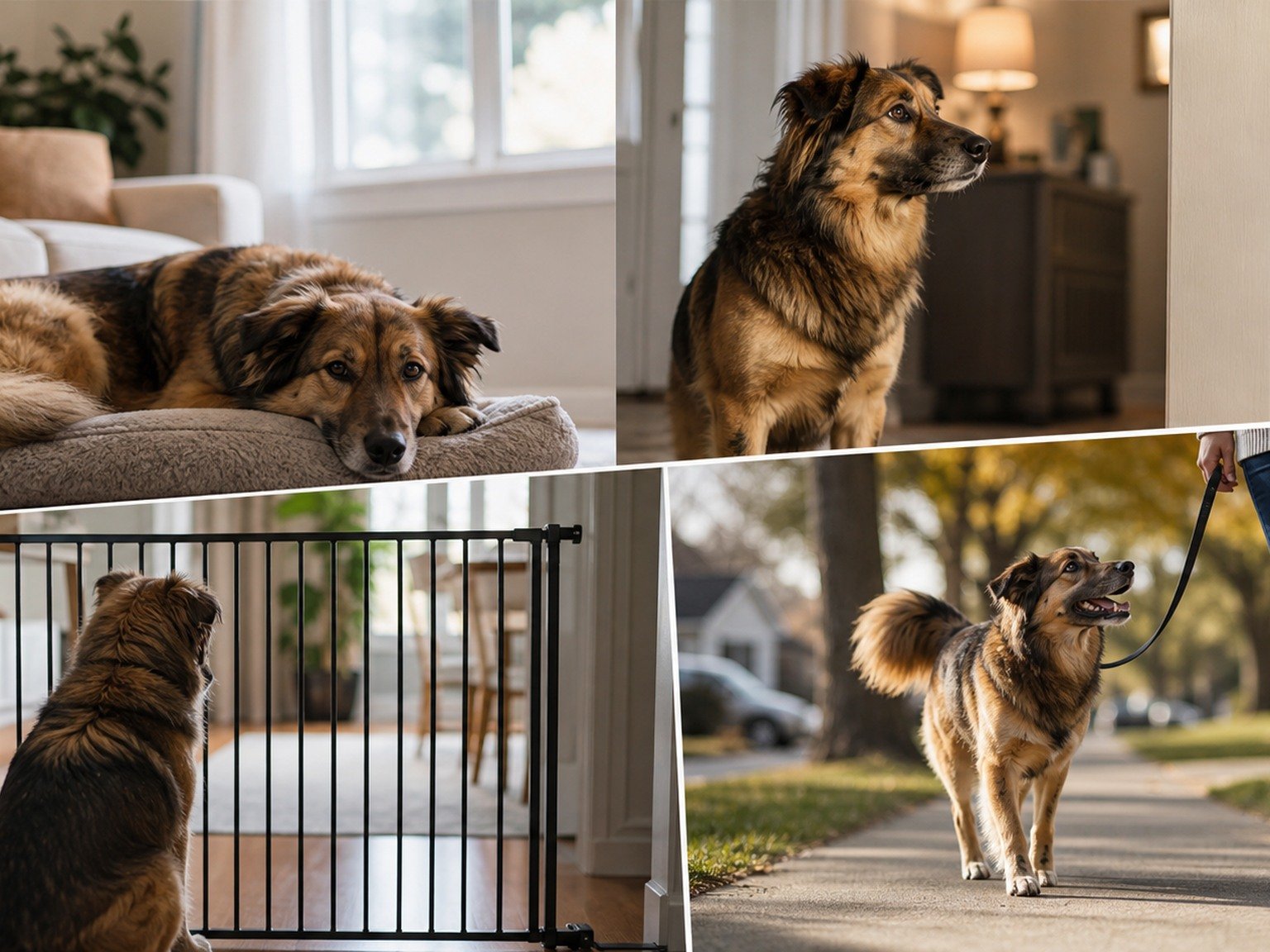
Build a stable first-owner baseline
Track sleep, appetite, water, elimination, play, walks, rest, handling, visitors, alone time, sounds, travel, and recovery across ordinary days. Mark changes in household routine, health, medication, diet, and environment.
Record antecedent, observable behavior, duration, intensity in neutral terms, distance, consequence, recovery, and next-day function. Avoid labels such as stubborn, guilty, dominant, or manipulative.
Short natural video can help when safe. Never recreate an episode, block escape, expose the dog longer, or put another person or animal at risk for documentation.
Use management without pretending it is treatment
Management changes immediate exposure or access: distance, a barrier, a quiet retreat, predictable routines, and prevention of known unsafe situations. It can protect welfare while assessment proceeds.
A safe space must remain voluntary and physically safe. A crate, room, bed, sound, scent, garment, or aid is not calming for every dog and should not be forced.
Training and behavior modification require humane methods, appropriate timing, and patient-specific progression. Flooding and punishment can increase risk and distress. [3]
Know when the veterinarian belongs in the plan
New or worsening behavior can accompany pain, neurologic, sensory, endocrine, gastrointestinal, urinary, medication, sleep, or other medical change. Behavior history and physical assessment are complementary.
Bring onset, pattern, contexts, recovery, injuries, health changes, medication, supplements, diet, sleep, appetite, elimination, and video. Ask what medical contributors should be considered.
The veterinarian may coordinate with a qualified trainer or behavior professional. Credentials, scope, methods, communication, and referral relationships matter more than a broad title.
Define a humane follow-up loop
Agree on one or two meaningful functional outcomes, such as resting after a routine sound, eating in a familiar context, or moving through the home without escalating vigilance. Avoid universal scores and deadlines.
Confirm what to keep stable, what not to attempt, contact triggers, adverse signs, and recheck timing. Report barriers rather than quietly increasing exposure or combining aids.
Progress may be uneven. A difficult day does not prove failure, and a quiet day does not prove resolution. Longitudinal context supports safer adjustment.
Separate immediate comfort from the longer care plan
An immediate response aims to reduce danger and overwhelming exposure: increase distance, open an exit, lower household activity, and avoid confrontation. It should not become an unsupervised exposure exercise or proof that the dog can tolerate more.
A longer plan begins after medical context, behavior history, environment, learning, and risk are considered. Management, skills, behavior modification, medication, or another support may have different roles and evidence.
Write which actions are emergency safety, temporary management, daily routine, or professionally directed training. Clear labels prevent a helpful short-term measure from being stretched into a universal treatment.
Protect the human side of the learning process
First-time owners may feel embarrassed, frightened, or responsible for every difficult moment. Shame makes accurate reporting harder. Neutral records and early questions are more useful than trying to present a perfect dog or household.
Agree on steps the household can perform consistently. Children, visitors, walkers, groomers, boarding staff, and other caregivers may need simple safety instructions without being asked to interpret a diagnosis.
If the plan is confusing, expensive, physically difficult, or incompatible with the home, say so promptly. Feasibility is part of patient welfare and professional planning, not a personal failure.
Prepare for a focused veterinary conversation
Bring a concise timeline, short natural-movement or symptom videos when safe, the exact names and photographs of every food, treat, medication, and supplement label, and notes about appetite, water intake, stool, sleep, activity, comfort, and behavior. Include recent injuries, travel, boarding, diet changes, missed medication, and previous test results. A complete record helps the veterinary team separate a repeatable pattern from a single impression.
Decide in advance what you need from the visit: an urgency decision, a diagnosis plan, a nutrition review, a pain or mobility assessment, or a monitored trial. Ask what result would change the plan and what finding would rule an option out. This keeps research and product information in the right role. Evidence can shape questions and expectations, but it cannot determine what is safe for an individual dog without the history and examination.
Owner tool
Build a first behavior baseline
On a phone, swipe across the table to see every column.
| Checkpoint | What to record | Why it helps |
|---|---|---|
| Context | Before and during event | Identifies pattern |
| Behavior | Visible actions and posture | Avoids labels |
| Recovery | Time and ordinary function | Tracks impact |
| Review | Health, safety, professional plan | Routes care |
Better questions, calmer next steps
Questions to ask your veterinarian
- Could pain or illness contribute?
- Which situations should be prevented for now?
- What credentials and methods fit this case?
- Which functional outcome should we track?
- When and how should I report change?
FAQ
Is every fearful behavior anxiety?
No.
Should I comfort my dog?
Calm support may be appropriate; avoid force and follow the individual plan.
Does ignoring fear make it stop?
No universal rule supports that.
Should I expose the dog until it adapts?
No; flooding can worsen distress.
Do calming products replace assessment?
No.
Sources
- American Animal Hospital Association: Canine and Feline Behavior Management Guidelines. Medical assessment, history, management, and referral.
- MSD Veterinary Manual: Diagnosis of Behavior Problems in Animals. Comprehensive history and medical contributors.
- American Veterinary Society of Animal Behavior: Humane Dog Training Position Statement. Reward-based methods and opposition to aversives and flooding.
- Scientific Reports: Prevalence and Comorbidity in Canine Anxiety. Population patterns and individual limits.
