


Anxiety is anticipation of a threat or adverse event, while fear is a response to a perceived current threat. Owners often see them overlap. The important task is not to attach a label from one behavior, but to document when the response begins, what the dog does, how intense it becomes, how long recovery takes, and whether pain or another medical problem may be contributing.
Short answer
Anxiety is a pattern involving context, body, behavior, and recovery
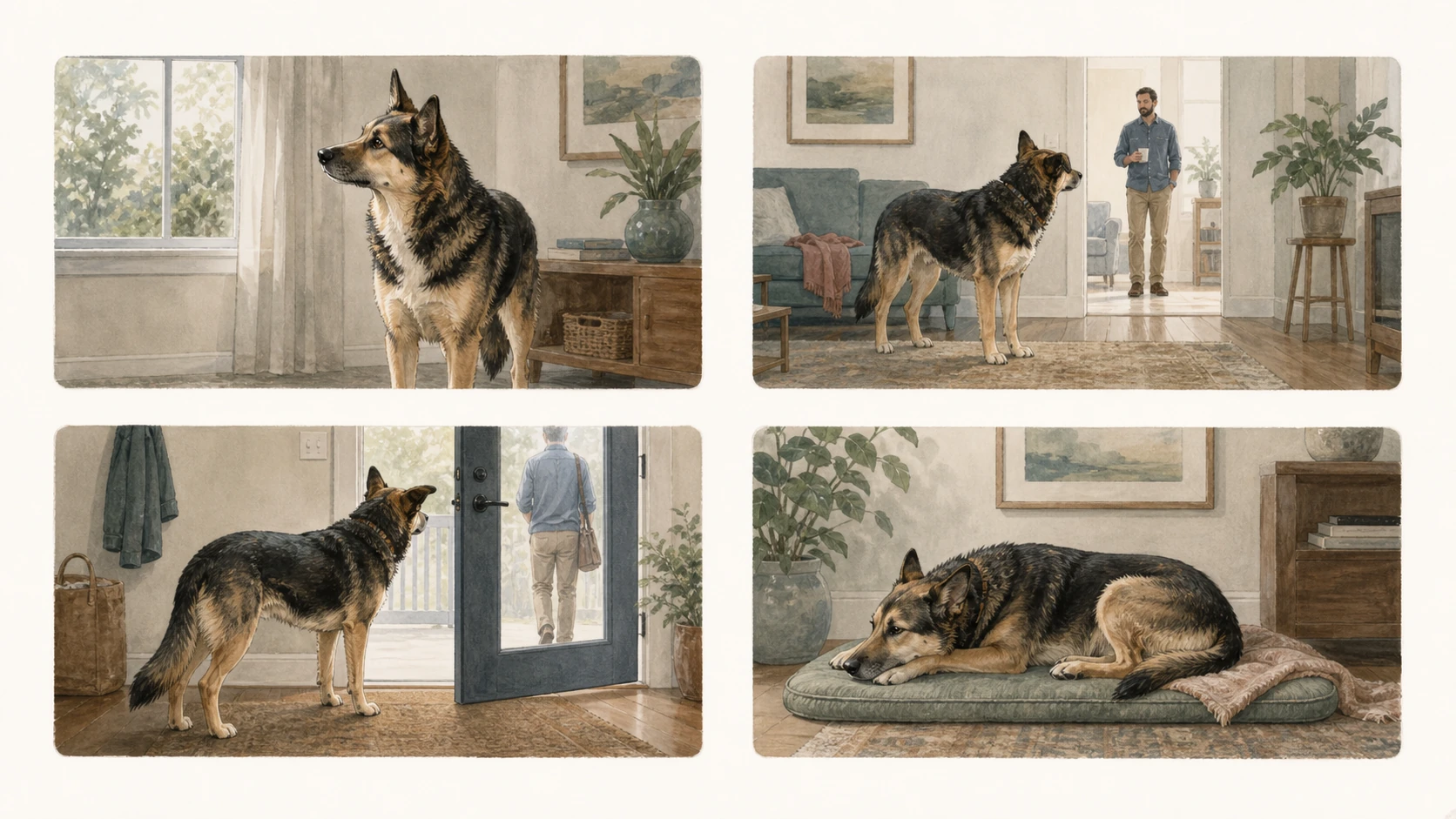
Pacing, panting, scanning, trembling, hiding, vocalizing, refusing food, eliminating, trying to escape, freezing, or becoming defensive can occur with fear or anxiety, but none diagnoses a specific disorder by itself. Veterinary behavioral diagnosis begins by ruling out medical contributors and reconstructing the sequence around the trigger. [1] [2]
- Record what happens before, during, and after the response rather than describing the dog as simply anxious.
- Pain, sensory change, neurologic disease, endocrine disease, medication effects, and cognitive change can alter behavior.
- Humane plans reduce avoidable exposure and use reward-based learning; flooding and punishment can worsen fear.
Safety first
Safety comes before training during severe distress
Contact a veterinarian promptly when behavior changes suddenly, the dog injures itself, cannot settle or eat for prolonged periods, escapes into danger, shows aggression with injury risk, collapses, appears disoriented, has a seizure, or may have ingested a toxin. Use barriers and distance without cornering or physically confronting a frightened dog.
- Do not punish growling, hiding, house soiling, destruction, or escape behavior that occurs during distress.
- Do not force exposure until the dog stops reacting; overwhelming exposure can sensitize rather than teach safety.
- Get urgent professional help when people or animals cannot be kept safely separated from a bite risk.
Veterinary note
This article is educational and does not diagnose, treat, prescribe, or replace care from a licensed veterinarian. Your dog’s history, examination, diet, medications, and current signs determine what is appropriate.
Fear, anxiety, and phobia are related but not interchangeable
Fear generally occurs in response to something the dog perceives now. Anxiety involves anticipation and may begin before the event. A phobia describes a marked, persistent, disproportionate fear response to a particular class of stimuli. Dogs can have more than one pattern, including noise sensitivity, separation distress, social fear, handling fear, travel-related fear, or generalized anticipation. [1]
A trigger is not the entire diagnosis. Two dogs that bark at a visitor may be motivated by fear, frustration, territorial behavior, learned anticipation, pain, or a mixture. Body position, distance-seeking, ability to eat, recovery, and the sequence of events help a veterinarian or veterinary behaviorist form and test explanations.
Medical assessment is part of behavior care
A sudden behavior change deserves a medical history and examination. Pain may reduce tolerance for handling or movement. Sensory loss can make approaches startling. Gastrointestinal, urinary, neurologic, endocrine, dermatologic, and cognitive problems can change sleep, elimination, attention, or irritability. Medication and supplement effects also belong in the review. [2] [3]
Bring videos only when they can be captured without provoking the dog. Record sleep, appetite, thirst, elimination, mobility, licking, scratching, medications, supplements, recent household changes, and the first date the pattern appeared. Medical and behavioral causes may coexist rather than compete as explanations.
Humane management lowers the rehearsal of panic
Management means preventing avoidable high-intensity episodes while assessment and treatment proceed. This may involve distance, visual barriers, predictable routines, a voluntary safe area, altered walking times, visitor plans, or temporary separation from a trigger. Management is not failure; it protects welfare and creates conditions in which learning can occur.
Reward-based desensitization and counterconditioning work below the dog's reaction threshold. The dog should be able to notice the trigger and remain capable of eating, orienting, or disengaging. AVSAB and veterinary guidance oppose aversive methods for fear and anxiety because pain, intimidation, and forced exposure can increase distress or suppress warning signals without changing the underlying emotion. [4] [5]
Treatment is matched to the pattern
A plan may combine environmental management, behavior modification, enrichment, treatment of pain or disease, and medication when indicated. Medication is not a substitute for behavior work, and behavior work is not proof that medication is unnecessary. The intensity, predictability, frequency, recovery, safety risk, and family capacity all affect the plan. [1]
Progress should be measured in observable terms: shorter recovery, lower peak intensity, greater distance tolerance, restored sleep or appetite, and safer participation in daily life. Improvement is rarely linear. Reassessment matters when triggers spread, recovery lengthens, side effects occur, or the household cannot implement the plan safely.
Prepare for a focused veterinary conversation
Bring a concise timeline, short natural-movement or symptom videos when safe, the exact names and photographs of every food, treat, medication, and supplement label, and notes about appetite, water intake, stool, sleep, activity, comfort, and behavior. Include recent injuries, travel, boarding, diet changes, missed medication, and previous test results. A complete record helps the veterinary team separate a repeatable pattern from a single impression.
Decide in advance what you need from the visit: an urgency decision, a diagnosis plan, a nutrition review, a pain or mobility assessment, or a monitored trial. Ask what result would change the plan and what finding would rule an option out. This keeps research and product information in the right role. Evidence can shape questions and expectations, but it cannot determine what is safe for an individual dog without the history and examination.
Owner tool
Map one anxiety episode without assigning a diagnosis
On a phone, swipe across the table to see every column.
| Phase | Record | Useful clue |
|---|---|---|
| Before | Location, people, sounds, movement, departure cues | Identifies predictors and anticipation |
| During | Body posture, movement, food response, distance | Shows intensity and coping options |
| Recovery | Time to settle, sleep, appetite, repeated scanning | Measures duration beyond the trigger |
| Context | Pain, medication, illness, household change | Prevents a behavior-only assumption |
Better questions, calmer next steps
Questions to ask your veterinarian
- Which medical problems should be ruled out or treated alongside the behavior plan?
- Does this look like fear, anxiety, frustration, pain, or a mixed pattern?
- What management steps reduce risk without increasing isolation or distress?
- What does below-threshold training look like for this specific trigger?
- When should we involve a board-certified veterinary behaviorist?
FAQ
Is panting always a sign of anxiety?
No. Heat, exertion, pain, medication, and medical disease can also cause panting. Context and examination matter.
Should I comfort a frightened dog?
Calm support does not reward an involuntary emotion. Offer choice and safety without restraining, crowding, or forcing interaction.
Will more exposure make a dog get used to a trigger?
Only carefully controlled exposure below the reaction threshold supports learning. Overwhelming exposure can worsen fear.
Does anxiety always require medication?
No, but medication can be an important welfare tool for some dogs. A veterinarian decides based on severity, pattern, health, and the full plan.
Can a trainer diagnose an anxiety disorder?
Behavior professionals can provide valuable observations and training, but medical diagnosis and prescription decisions belong to veterinarians.
Sources
- Merck Veterinary Manual: Behavior Problems of Dogs. Fear, anxiety, triggers, diagnosis, and multimodal treatment.
- Merck Veterinary Manual: Diagnosis of Behavior Problems in Animals. Medical differentials and behavioral diagnostic process.
- Cornell University College of Veterinary Medicine: Anxious Behavior: How to Help Your Dog Cope. Owner-facing anxiety signs and veterinary care context.
- American Veterinary Society of Animal Behavior: Humane Dog Training Position Statement. Reward-based training and avoidance of aversive methods.
- AAHA: Canine and Feline Behavior Management Guidelines. Behavior prevention, assessment, management, and treatment principles.
