

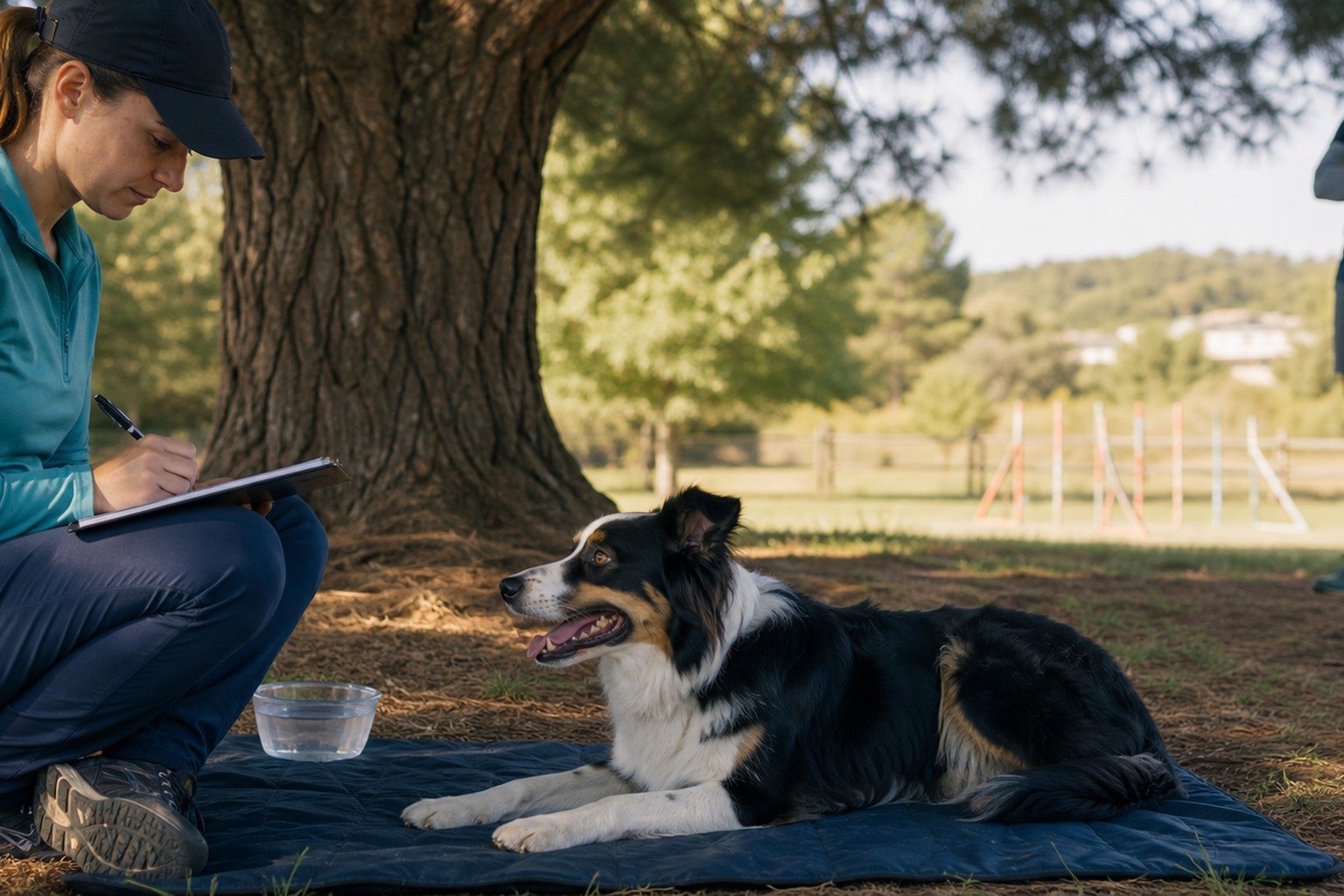
An active dog can be excited, focused, frustrated, fatigued, fearful, painful, overheated, or unable to settle, and several states can occur together. Visible intensity alone does not diagnose anxiety, and a cortisol value or competition result does not reveal whether one dog's experience was harmful. Sport research uses small, defined populations and specific settings, so owners should avoid universal recovery intervals or workload rules. Build an individual baseline across behavior, gait, technique, breathing, temperature context, appetite, hydration access, sleep, willingness, and next-day function. Increase demands gradually, protect decompression and rest, and investigate a dog who cannot return to baseline. Stop activity for lameness, collapse, heat illness, breathing distress, severe panic, or neurologic change. Do not use more exercise, punishment, supplements, or medication to push through a failed recovery pattern.
Short answer
Track arousal, physical load, and recovery as different data
Canine sport studies report behavioral, cortisol, hematologic, and biochemical changes in defined training or competition settings, but those measures do not create a universal stress diagnosis or recovery prescription. Interpret the individual dog with context and clinical assessment. [1] [2] [3]
- Start with the individual dog's baseline, history, environment, and veterinary plan.
- Record context, function, and recovery instead of assigning a diagnosis from one sign.
- Use calm management and reward-based support without forced exposure or punishment.
- Escalate sudden, severe, persistent, or rapidly worsening changes promptly.
Safety first
Stop for heat illness, collapse, lameness, or loss of control
End activity and seek prompt veterinary care for collapse, breathing difficulty, very high or rapidly worsening distress, heat-related signs, non-weight-bearing lameness, major trauma, severe pain, weakness, disorientation, vomiting with systemic change, or loss of coordination. Move to safety without forcing continued drills and do not give human medication.
- Do not use this article to diagnose anxiety, pain, digestive disease, or an orthopedic condition.
- Do not force movement, exposure, food, water, or handling when a dog is distressed or painful.
- Seek urgent veterinary care for collapse, breathing difficulty, severe pain, major trauma, or rapid decline.
Veterinary note
This article is educational and does not diagnose, treat, prescribe, or replace care from a licensed veterinarian. Your dog’s history, examination, diet, medications, and current signs determine what is appropriate.
Establish a complete training and behavior baseline
Record sport, age, development, health, prior injury, medications, food, body and muscle condition, resting behavior, sleep, gait, paw and nail condition, usual warm-up, typical workload, environment, travel, and time to recover. The baseline should include quiet days, not only competition performance.
Observe posture, scanning, startle, vocalization, mouth tension, refusal, displacement behavior, repeated errors, frantic movement, loss of normal cues, reactivity, appetite, and willingness to settle. Also watch stride, turning, jumping, footing, and next-day stiffness. A behavior change can be an early clue to pain or illness.
Use consistent short video when safe and a simple log. AAHA behavior guidance emphasizes recognizing distress and evaluating medical contributors. [4] A dog who suddenly avoids an obstacle or handler may need physical assessment before more training repetitions.
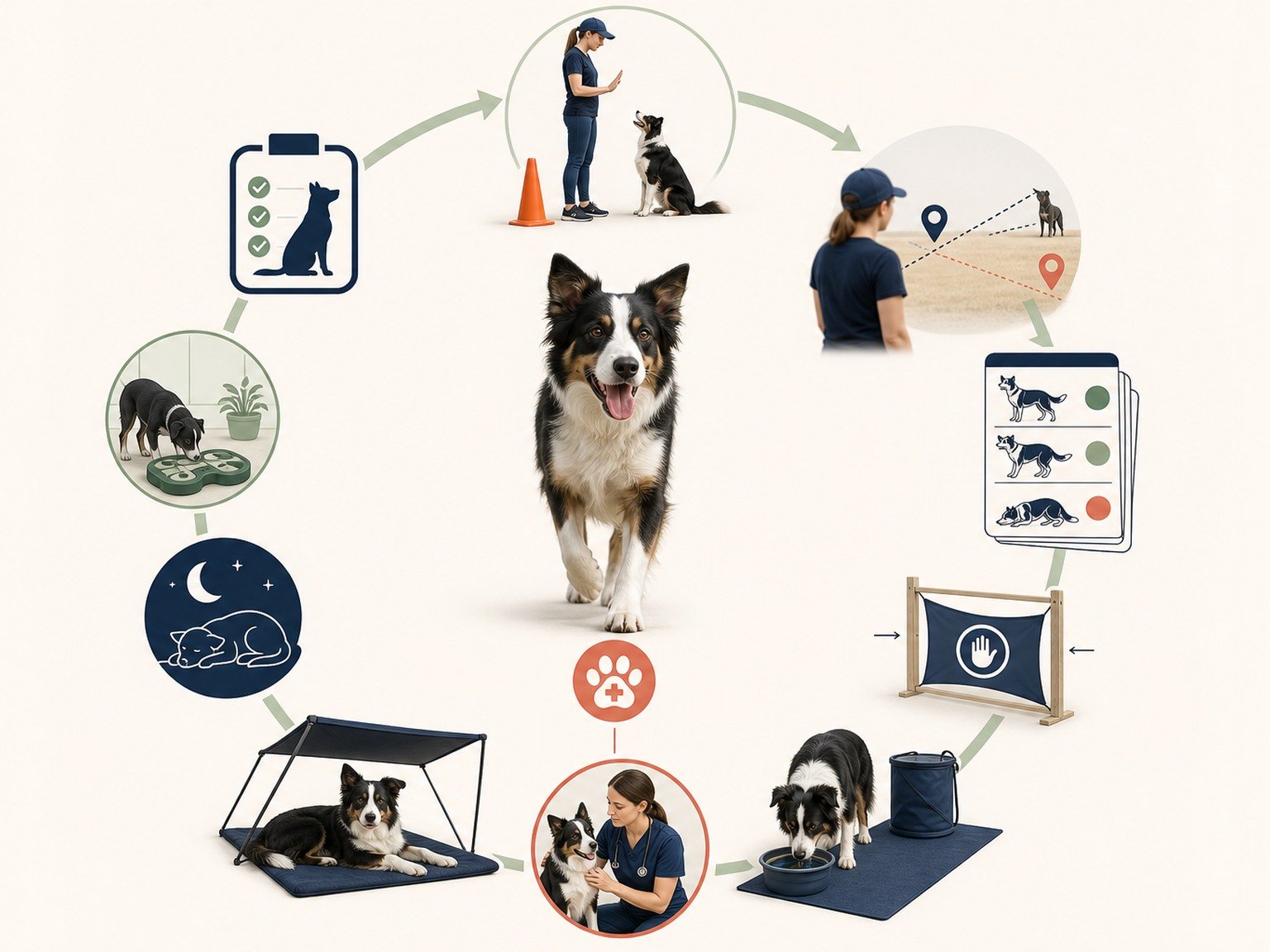
Separate workload from emotional arousal
Track duration, repetitions, acceleration, deceleration, turning, jumping, load, terrain, surface, weather, travel, waiting time, crowding, noise, unfamiliar dogs, and handler changes. Increasing several variables at once makes it hard to understand fatigue, fear, frustration, or performance decline.
Cortisol is one physiological measure influenced by timing, context, individual variation, lifestyle, and sampling. Studies in agility and German shepherd dogs do not establish a single normal value or prove that a behavior is anxiety. [1] [2] Avoid using a wearable score, heart rate, panting, or cortisol claim as a home diagnosis.
High enthusiasm does not guarantee physical or emotional readiness. A dog may continue because the activity is highly reinforcing. Conversely, temporary excitement is not automatically harmful. The meaningful question is whether the dog can perform safely, retain normal communication, and return to its individual baseline without accumulating change.
Design recovery before increasing demand
Provide shade or climate control, water access, secure footing, quiet distance from activity, comfortable rest, and predictable sleep. The exact sequence and duration depend on the sport, dog, conditions, and veterinary plan. Do not impose a universal cooldown or hydration formula from an article.
Recovery includes breathing and temperature context, but also gait, posture, appetite, interaction, toileting, sleep, settling, and next-day function. Competition research has documented measurable physiologic changes, reinforcing that intense activity affects more than behavior. [3] Those findings are not a license to self-test or calculate treatment.
Plan low-demand periods and reduce stacked stressors such as long travel, heat, novel lodging, crowded waiting, repeated runs, and poor sleep. Quiet sniffing or familiar enrichment may help some dogs, but no activity should be forced. A dog unable to settle despite adequate distance deserves reassessment rather than escalating exercise.
Respond to persistent overarousal without punishment
If barking, spinning, grabbing equipment, frantic scanning, escape attempts, or reactivity appears, increase safety and distance and review the trigger sequence. Do not assume the dog needs to be exhausted. More exercise can add physical load without addressing fear, frustration, pain, or the learned context.
Use reward-based methods and allow the dog to opt out. AVSAB warns that aversive techniques can increase anxiety, fear-related aggression, avoidance, and helplessness. [5] Flooding, corrections, intimidation, and restraint pressure can also hide signals needed to protect handlers and dogs.
Ask the veterinarian whether medical evaluation, rehabilitation, sports-medicine assessment, or veterinary behavior referral is appropriate. Resume or progress only through individualized criteria. Record setbacks honestly; changing the plan protects welfare and performance better than treating a pause as failure.
Prepare for a focused veterinary conversation
Bring a concise timeline, short natural-movement or symptom videos when safe, the exact names and photographs of every food, treat, medication, and supplement label, and notes about appetite, water intake, stool, sleep, activity, comfort, and behavior. Include recent injuries, travel, boarding, diet changes, missed medication, and previous test results. A complete record helps the veterinary team separate a repeatable pattern from a single impression.
Decide in advance what you need from the visit: an urgency decision, a diagnosis plan, a nutrition review, a pain or mobility assessment, or a monitored trial. Ask what result would change the plan and what finding would rule an option out. This keeps research and product information in the right role. Evidence can shape questions and expectations, but it cannot determine what is safe for an individual dog without the history and examination.
Owner tool
Build a sport-dog arousal and recovery cycle
On a phone, swipe across the table to see every column.
| Checkpoint | What to record | Why it helps |
|---|---|---|
| Workload | Reps, speed, turns, surface, climate | Quantifies demand |
| Behavior | Signals, willingness, focus, errors | Adds emotional context |
| Recovery | Settle, gait, sleep, appetite | Tests tolerance |
| Decision | Continue, reduce, stop, assess | Protects welfare |
Better questions, calmer next steps
Questions to ask your veterinarian
- Could pain, heat, illness, or fatigue explain this behavior?
- Which workload and environmental variables changed together?
- What is this dog's normal recovery pattern?
- Which signs require behavior or sports-medicine referral?
- What objective criteria govern return or progression?
FAQ
Does high excitement mean a dog is anxious?
Not necessarily. Context, body language, function, and recovery matter.
Can I exercise a dog until it calms down?
More load can worsen fatigue, pain, heat risk, or distress.
Does cortisol diagnose harmful stress?
No. It is context-dependent and not a standalone home diagnosis.
How long should recovery take?
There is no universal interval; establish an individual professional plan.
Should a sport dog be punished for refusing?
No. Stop and assess health, environment, learning, and welfare.
Sources
- Journal of Applied Animal Welfare Science: Stress During Agility Training. Behavioral and cortisol observations in a defined agility setting.
- Scientific Reports: Hair Cortisol, Season, Lifestyle and Human Interactions. Context and variation in German shepherd hair cortisol.
- Journal of Veterinary Internal Medicine: Changes During Canine Agility Competitions. Hematologic and biochemical changes in competition.
- American Animal Hospital Association: Canine and Feline Behavior Management Guidelines. Distress recognition, medical evaluation, and behavior care.
- American Veterinary Society of Animal Behavior: Humane Dog Training Position Statement. Reward-based training and risks of aversive methods.
