


Living with a dog who panics, cannot be left alone, reacts to people or animals, fears routine sounds, or struggles with handling can reshape the owner's day. Sleep, work, travel, visitors, housing, finances, and relationships may all become harder. Research does not support a simple claim that dog ownership always improves or always harms human wellbeing; outcomes vary with the dog, owner, relationship, support, and practical demands. Behavioral signs can also reflect pain or disease, so the dog needs veterinary assessment while the owner deserves nonjudgmental support. Guilt, frustration, grief, exhaustion, or reduced freedom do not mean the bond is weak. They signal that the current care burden and safety plan need attention. This guide describes patterns and conversation tools without diagnosing either the dog or the person.
Short answer
A strong bond can coexist with real caregiver strain
Dog-owner studies describe both companionship benefits and burdens related to behavior, responsibility, restricted autonomy, worry, and unmet expectations. A practical response supports canine welfare, human wellbeing, and the relationship instead of treating owner distress as failure. [1] [2]
- Record observable changes, context, frequency, severity, recovery, and whole-dog function with dates.
- Use this guide to prepare a veterinary conversation, not to diagnose or choose treatment alone.
- Bring every medication, supplement, diet, prior result, and safe home video to the appointment.
- Agree on the next decision, measurable outcomes, reassessment timing, and urgent-contact signs.
Safety first
Safety risk, severe panic, or owner crisis needs prompt support
Contact a veterinarian promptly for sudden behavior change, self-injury, destructive escape, aggression, inability to eat or rest, or major functional decline. Use distance and barriers rather than confrontation. If an owner feels unsafe, overwhelmed, or at risk of self-harm, contact local emergency or crisis support immediately; veterinary care is not a substitute for human healthcare.
- Do not delay care because a change seems like normal aging, stress, or a minor accident.
- Do not start, stop, combine, or calculate medication or treatment from this article.
- Protect comfort and safety while arranging appropriate veterinary evaluation.
Veterinary note
This article is educational and does not diagnose, treat, prescribe, or replace care from a licensed veterinarian. Your dog’s history, examination, diet, medications, and current signs determine what is appropriate.
How anxiety changes daily life and the relationship
An anxious dog may need careful scheduling, trigger avoidance, supervised departures, quieter routes, visitor management, or repeated cleanup and repair. The owner may lose sleep, decline invitations, miss work, or worry about housing and complaints. These are concrete constraints, not merely attitude problems.
A cross-sectional dog-owner study found that relationships can contribute to wellbeing while management demands and behavioral issues can reduce autonomy and create worry, guilt, frustration, or exhaustion. The design cannot prove cause and effect, but it supports asking about both benefits and burdens. [1]
Behavior is also associated with relationship quality in complex ways. A family study linked trainability, separation problems, excitability, and attention seeking with some attachment measures, while effects differed among owners. No single behavior score defines the quality of a bond. [2]
Avoid blame and unrealistic expectations
Anxiety is not evidence that an owner failed to love, socialize, train, or exercise a dog correctly. Genetics, early development, learning history, pain, sensory change, illness, environment, and unpredictable events may interact. Precise assessment is more useful than blame.
Research on adoption expectations shows that mismatches between anticipated and actual behavior can strain relationships and contribute to return decisions. Setting realistic expectations and obtaining post-adoption support may help owners respond earlier. [3]
Do not promise that one trainer, supplement, device, medication, or exposure exercise will restore a previous lifestyle. A humane plan identifies the dog's diagnosis and safety needs, then builds achievable goals for both dog and household.
Build a plan that protects both sides of the bond
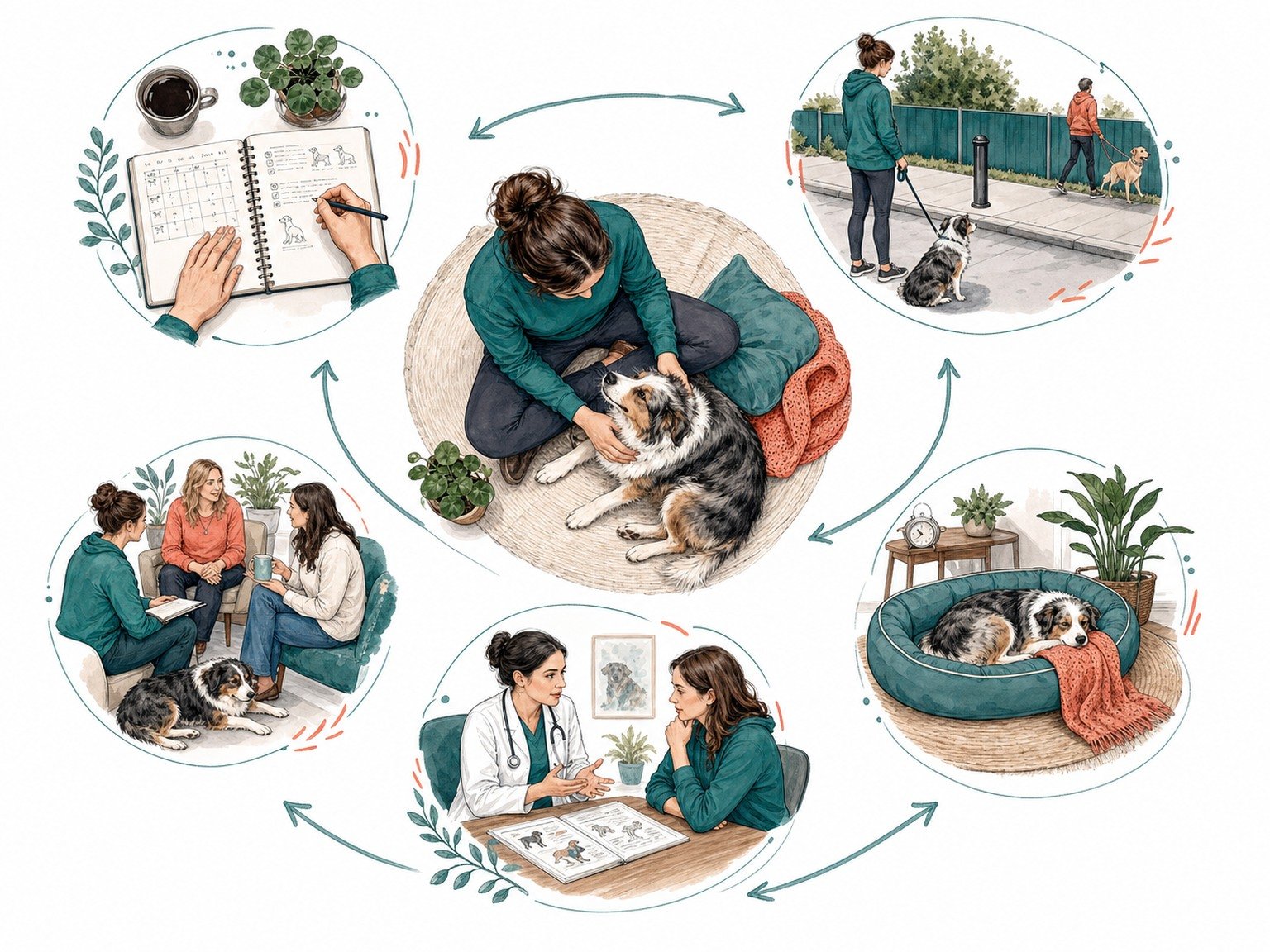
Start by reducing preventable trigger exposure and assigning immediate safety roles. Decide who handles departures, visitors, walks, medication, logs, and veterinary communication. When one person carries every task, care can become inconsistent and resentment can grow.
Behavior treatment commonly combines medical evaluation, management, gradual behavior modification, and medication when indicated. Merck emphasizes that changing emotional response requires appropriate intensity and that punishment or flooding can worsen fear and risk. [4]
The broader human-dog bond literature treats welfare as relational and multidimensional. Quality, predictability, reciprocity, and the fit between dog and owner matter; support should preserve safe positive interactions that are still enjoyable. [5]
Make caregiver support part of veterinary follow-up
Tell the veterinary team what the plan costs in time, sleep, money, conflict, and physical effort. A theoretically ideal plan that cannot be carried out safely is not an effective plan. Ask which steps are essential now and which can wait.
Use a shared calendar and one short outcome measure, such as recovery after a trigger, safe alone time, sleep, or ability to complete a routine. Record owner burden alongside dog behavior so improvement is not declared while the household becomes less sustainable.
Seek human support through trusted family, respite care, a therapist or physician, community resources, or crisis services as appropriate. The veterinarian can coordinate canine care but cannot diagnose or treat a person's mental health.
Prepare for a focused veterinary conversation
Bring a concise timeline, short natural-movement or symptom videos when safe, the exact names and photographs of every food, treat, medication, and supplement label, and notes about appetite, water intake, stool, sleep, activity, comfort, and behavior. Include recent injuries, travel, boarding, diet changes, missed medication, and previous test results. A complete record helps the veterinary team separate a repeatable pattern from a single impression.
Decide in advance what you need from the visit: an urgency decision, a diagnosis plan, a nutrition review, a pain or mobility assessment, or a monitored trial. Ask what result would change the plan and what finding would rule an option out. This keeps research and product information in the right role. Evidence can shape questions and expectations, but it cannot determine what is safe for an individual dog without the history and examination.
Owner tool
Map the shared burden without blame
On a phone, swipe across the table to see every column.
| Checkpoint | Record | Why it helps |
|---|---|---|
| Dog pattern | Trigger, response, recovery | Guides treatment |
| Owner load | Sleep, work, cost, safety | Shows feasibility |
| Support | People, clinic, respite, barriers | Shares care |
| Goal | One dog and owner outcome | Measures progress |
Better questions, calmer next steps
Questions to ask your veterinarian
- Could pain or disease be contributing?
- What diagnosis and risk plan fit the behavior?
- Which management steps reduce burden now?
- What outcome matters for both dog and household?
- When should we seek referral or crisis support?
FAQ
Does feeling frustrated mean I do not love my dog?
No. Caregiver strain and attachment can coexist.
Can dog anxiety affect owner sleep and work?
Yes, depending on triggers and care demands.
Should I force normal activities to protect the bond?
No. Forced exposure can worsen fear and risk.
Can a veterinarian treat owner anxiety?
No. Human health concerns need human healthcare.
Is rehoming always a failure?
No. Complex safety and welfare decisions require compassionate professional support.
Sources
- Frontiers in Psychology: Dogs and the Good Life. Dog-owner relationship benefits, burdens, autonomy, and wellbeing.
- Human-Animal Interaction Bulletin: Dog Behavioral Characteristics and Owner Relationship Quality. Associations between behavior characteristics and attachment.
- Animals: Returning a Shelter Dog: Expectations and Behavior. Owner expectations, behavior problems, and support needs.
- Merck Veterinary Manual: Treatment of Behavior Problems in Animals. Integrated medical, management, behavior, and medication care.
- Animals: Welfare of Dogs and the Human-Dog Bond. Multidimensional bond and canine welfare review.
