


Short answer: Some dogs may benefit from a carefully chosen supplement, but many healthy dogs eating a complete and balanced diet do not need one. The right decision depends on the dog’s age, diet, symptoms, medical history, medications, and the evidence behind the specific ingredient and formulation. Start with the health question, not the product shelf, and involve your veterinarian before adding a supplement for a puppy, senior dog, ongoing symptom, diagnosed condition, or dog taking medication.
Use This Guide in Three Steps
- Define the goal. Write down the exact change you hope to support and what you are observing now.
- Check the care boundary. Rule out urgent or persistent signs that need veterinary assessment rather than a product trial.
- Compare transparently. Review ingredients, amounts, directions, warnings, quality information, and how you will judge whether the product is helping.
Take the product label, your dog’s current food and medication list, and your notes to the veterinary conversation.
When a Supplement Should Not Be the First Step
Contact your veterinarian promptly for repeated vomiting, persistent or bloody diarrhea, black stool, severe bloating, collapse, trouble breathing, marked pain, sudden weakness, inability to stand, toxin exposure, a seizure, or a major sudden behavior change. Do not use a supplement to delay care. Puppies, senior dogs, pregnant or nursing dogs, and dogs with chronic disease or current medications deserve extra caution.
What Dog Supplements Are, and What They Are Not
Products sold as dog supplements may come as chews, powders, capsules, liquids, oils, or food toppers. In the United States, products characterized as dietary supplements for animals do not occupy the same regulatory category as human dietary supplements; depending on intended use, they may be regulated as animal food or as a new animal drug. Claims that a product cures, treats, prevents, or mitigates disease deserve particular scrutiny.
A supplement may support a defined wellness goal within a broader care plan. It does not replace a complete diet, a diagnosis, prescribed treatment, pain control, behavior care, or a veterinary examination.
Choose the Right Learning Path
Gut and Digestion
Use the Gut & Digestion Supplements for Dogs guide to understand probiotics, prebiotics, digestive enzymes, stool tracking, and digestive red flags. Continue with what research currently shows about probiotics for dogs or the prebiotics versus probiotics comparison.
Joint and Mobility
Use the Joint & Mobility Supplements for Dogs guide to put ingredients in the context of body weight, movement, pain assessment, home access, and veterinary care. For deeper reading, see glucosamine and chondroitin research and omega-3 fatty acids and canine joint support.
Calming and Anxiety
Use the Calming & Anxiety Supplements for Dogs guide to distinguish short-term situational support from a complete behavior plan. The dog anxiety types and triggers guide and counter-conditioning and desensitization guide explain the non-product parts of care.
Supplement Safety and Label Literacy
Use How to Read a Dog Supplement Label before comparing options. Then review dog supplement safety, supplement interaction questions, and what third-party testing can and cannot tell you.
Does Your Dog Need a Supplement?
| Situation | Better first step | Where a supplement may fit |
|---|---|---|
| Healthy dog eating a complete and balanced diet | Continue routine wellness and nutrition checks | Often unnecessary unless a specific need is identified |
| New mild, non-urgent change | Track timing, food, stool, movement, behavior, and exposures | Only after the likely cause and care boundary are discussed |
| Persistent, worsening, painful, or multi-system signs | Veterinary assessment | Only as part of the resulting care plan |
| Dog taking medication or multiple supplements | Review the complete list with the veterinary team | After dose overlap and interaction concerns are considered |
| Puppy, senior, pregnant or nursing dog, or dog with chronic disease | Individualized veterinary and nutrition guidance | Only when the product and goal fit that dog’s needs |
How to Compare a Dog Supplement
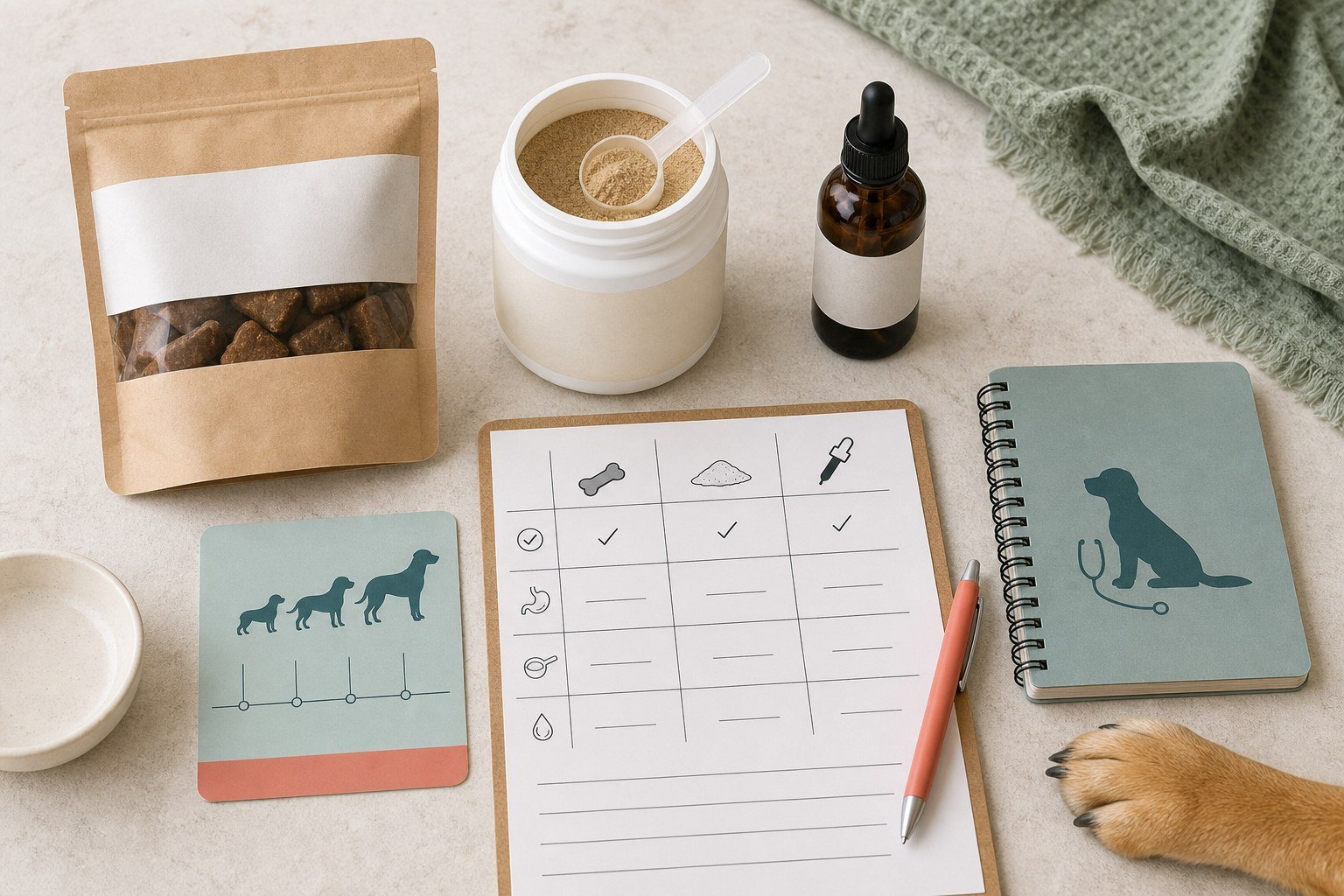
Begin with a label you can understand and a manufacturer willing to answer specific questions. Look for the exact active ingredients and amounts, serving directions by body weight, inactive ingredients, lot information, expiration or best-by date, storage instructions, warnings, and a way to contact the company. Marketing terms such as “natural,” “premium,” or “holistic” do not establish that a product is safe, effective, or appropriate for your dog.
Questions Worth Asking
- What specific goal does this product address for my dog?
- What evidence supports the ingredient, dose, and formulation for dogs?
- Could any ingredient duplicate the food, treats, medications, or other supplements my dog already receives?
- Who formulated the product, and what quality-control or testing documentation is available?
- How will we measure progress, over what period, and what would make us stop?
The vet discussion checklist for dog supplements turns these questions into a practical appointment plan.
Common Supplement Categories
- Digestive support: probiotics, prebiotics, fiber, and selected enzyme products.
- Joint support: products containing omega-3 fatty acids, glucosamine, chondroitin, or other mobility-focused ingredients.
- Calming support: ingredients or non-drug aids intended for predictable stress, used alongside humane behavior and environmental support.
- Skin and coat support: often fatty-acid focused, although persistent itch, hair loss, wounds, odor, or ear disease needs veterinary assessment.
- Vitamins and minerals: not automatically beneficial when a complete diet already supplies appropriate nutrients; excesses can be harmful.
Start One Change at a Time
If your veterinarian agrees with a trial, record the product name, lot, dose, start date, target outcome, and baseline observations. Introduce only one new product at a time unless instructed otherwise. Monitor appetite, stool, vomiting, energy, movement, comfort, sleep, behavior, skin, and any new sign. Stop and contact your veterinarian if the dog worsens or develops a concerning reaction.
Use the supplement monitoring framework to define a review date and avoid continuing an unhelpful product by habit.
Dog Supplement FAQs
Do most healthy dogs need supplements?
Many healthy dogs eating a complete and balanced diet do not need extra supplements. A targeted product may make sense when a specific goal, evidence, safety profile, and follow-up plan align.
Can “natural” dog supplements cause problems?
Yes. Natural origin does not guarantee safety, an appropriate dose, ingredient purity, or freedom from interactions. Evaluate the actual formulation and the individual dog.
Can dogs take several supplements together?
Sometimes, but overlapping ingredients and cumulative doses can be difficult to recognize. Have the veterinary team review every food, treat, medication, and supplement together.
How long should a supplement trial last?
That depends on the ingredient, goal, and dog. Agree on a reasonable evaluation period and measurable outcome with your veterinarian rather than continuing indefinitely without reassessment.
Can a supplement replace medication or veterinary care?
No. A supplement may support a broader plan, but it should not replace diagnosis, prescribed treatment, pain control, emergency care, or qualified behavior support.
Medical and Veterinary Disclaimer
This guide is educational and is not a substitute for veterinary diagnosis, treatment, medication, nutrition planning, or individualized care. Always ask your veterinarian before starting a supplement, especially for puppies, senior dogs, dogs taking medication, dogs with health conditions, or dogs with ongoing symptoms. Read the full medical and veterinary disclaimer.