

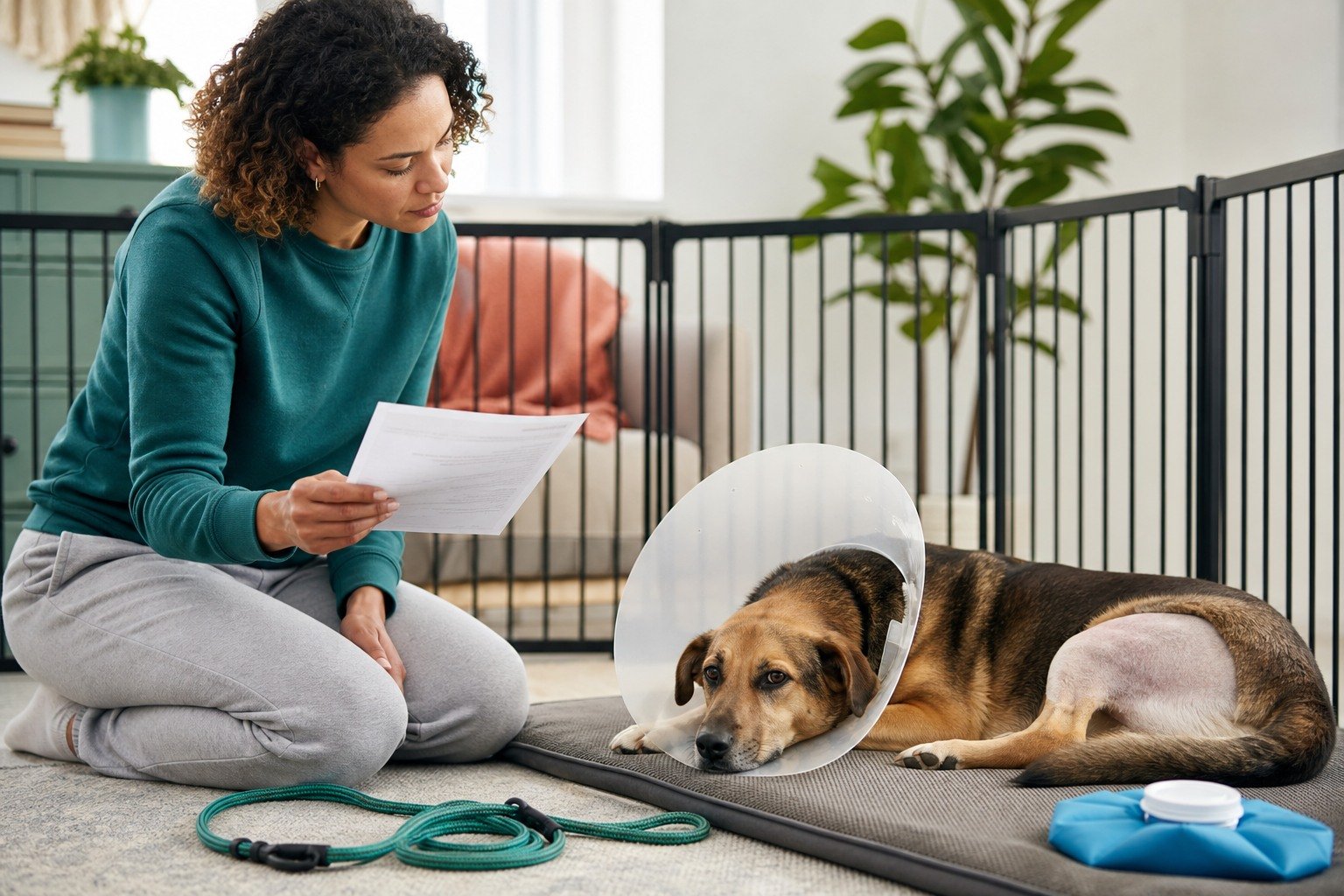
Recovery after joint surgery is not one generic timeline. The procedure, repaired tissue, fixation, surgeon's technique, dog, other diseases, medication response, home environment, and recheck findings determine what is safe. A dog may feel better before bone, tendon, ligament, capsule, or soft tissues are ready for unrestricted activity. The most important document is the treating surgeon's discharge plan. Owners can prepare a secure recovery area, block stairs and jumping, supervise toileting, give only prescribed medicines, inspect the incision as directed, record appetite and function, attend rechecks, and begin rehabilitation only when the surgical team clears it. This article helps organize that plan; it does not replace procedure-specific instructions or authorize any exercise.
Short answer
Follow the surgeon's restrictions even when the dog appears eager to move
Orthopedic recovery depends on the procedure and tissue healing, and premature loading can compromise repair. Pain guidelines and rehabilitation evidence support individualized multimodal care with repeated assessment rather than a universal exercise calendar. [1] [2]
- Record the dog's baseline, current routine, exact diet and products, and any recent change.
- Use observations to support veterinary assessment, not to diagnose or choose treatment at home.
- Keep every household member working from the same written plan and restrictions.
- Agree on measurable outcomes, a review date, and clear urgent-contact signs.
Safety first
A change in incision, pain, function, or general health can require immediate advice
Contact the surgical team for increasing redness, swelling, discharge, odor, opening, bleeding, worsening pain, new lameness, medication problems, vomiting, diarrhea, appetite loss, or unexpected decline. Seek urgent care for collapse, breathing difficulty, severe uncontrolled pain, major trauma, inability to urinate, repeated vomiting, pale gums, neurologic weakness, or sudden loss of limb use.
- Do not delay care for sudden, severe, escalating, or function-limiting signs.
- Do not start, stop, combine, divide, or calculate treatment from this article.
- Preserve exact labels, discharge instructions, exposure details, and a concise timeline.
Veterinary note
This article is educational and does not diagnose, treat, prescribe, or replace care from a licensed veterinarian. Your dog’s history, examination, diet, medications, and current signs determine what is appropriate.
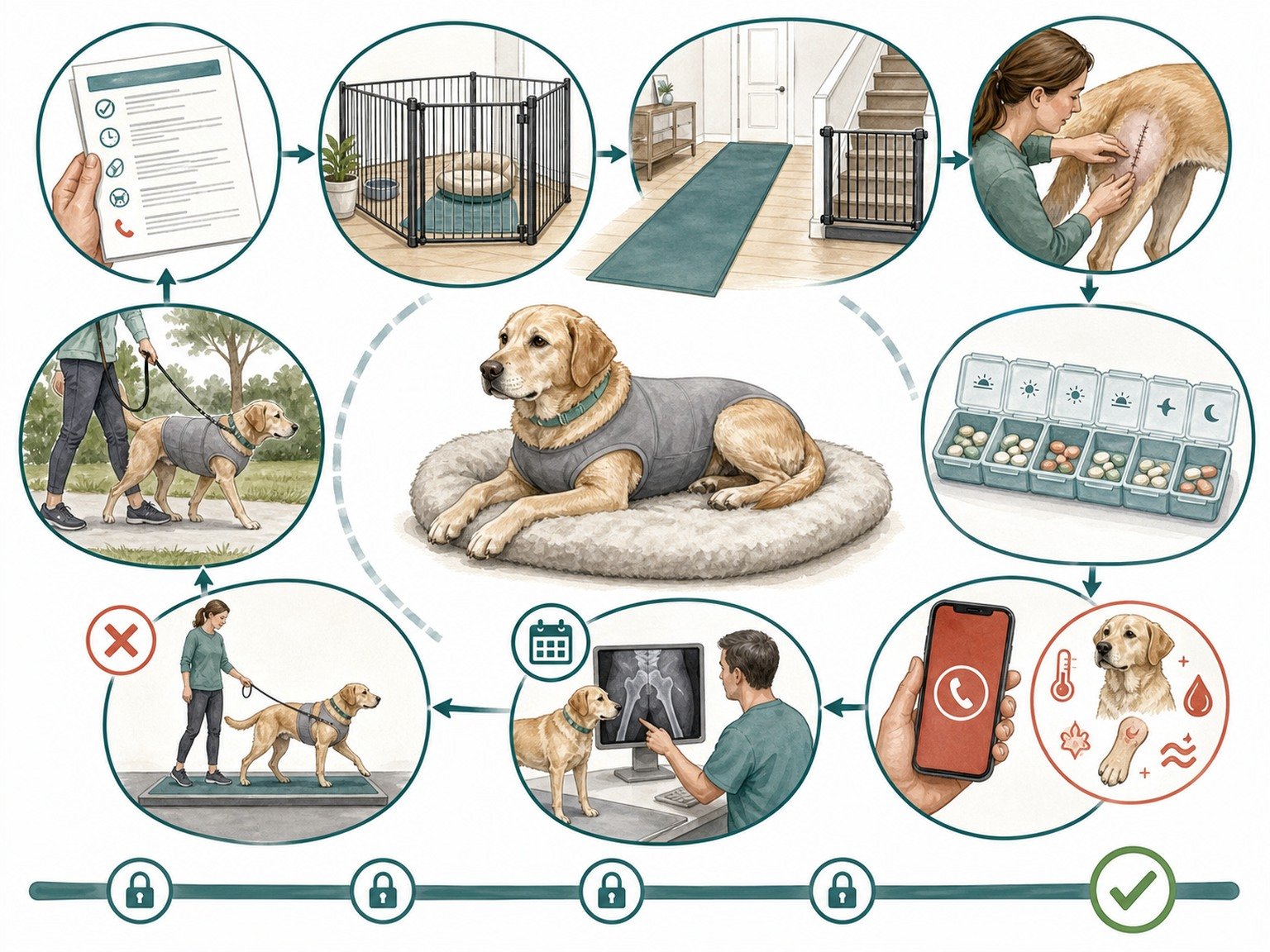
Translate discharge instructions into a physical home plan
Before arrival, choose a level, temperature-controlled recovery area with nonslip footing, washable bedding, controlled entry, and enough room for prescribed positions without running or jumping. Use gates or closed doors to block stairs and furniture; do not rely on verbal commands when one impulsive movement can matter.
Plan the exact toileting route, leash, harness or support device approved by the team, door thresholds, vehicle exit, and other pets. Keep children and visitors from exciting or bumping the dog. Ask how to handle unavoidable steps before attempting them.
Place the written instructions, clinic numbers, recheck date, medication chart, and emergency transport plan together. If generic advice conflicts with the surgical team, the surgical instructions win because they reflect the actual procedure and findings.
Give medication accurately and observe comfort without testing the repair
Record each prescribed drug, strength, amount, time, food instruction, and purpose. Use one responsible schedule to prevent missed or duplicate doses. Do not add aspirin, ibuprofen, acetaminophen, another dog's medication, supplements, sedatives, or topical products without approval.
Pain can appear as panting at rest, trembling, guarding, altered posture, inability to settle, withdrawal, irritability, appetite change, vocalization, or reluctance. Sedation can also change behavior and balance. Report the pattern rather than increasing or stopping medication independently. [1]
Do not test the leg with stairs, jumping, running, slippery walking, forced range of motion, or repeated sit-to-stand tasks. Willingness to use the limb is useful information only within the permitted activity.
Protect the incision and monitor the whole patient
Inspect the incision at the frequency and in the manner the team directs. Use the prescribed collar or barrier continuously if required; licking can damage tissue quickly. Keep the site dry and do not apply cleansers, creams, bandages, heat, or cold unless instructed.
Record appetite, water, urination, stool, vomiting, sleep, breathing, medication response, swelling, bruising, weight-bearing, slips, and any unplanned activity. Photograph the incision under similar light when the team requests images, without manipulating it.
A dog recovering from surgery is still a whole patient. Gastrointestinal signs, urinary changes, coughing, marked lethargy, fever concern, or behavior changes may relate to medication, anesthesia, stress, infection, or another condition and deserve clinical interpretation.
Let rechecks and qualified rehabilitation control progression
Attend scheduled wound, suture, orthopedic, and imaging rechecks even when recovery appears smooth. The external incision cannot show whether internal structures or implants are ready for more load. Ask what finding permits each next stage.
Rehabilitation may support pain management, controlled mobility, strength, and function, but protocols vary. Systematic reviews report promising yet heterogeneous evidence, which reinforces the need for procedure-specific exercises and progression from a veterinarian or qualified rehabilitation professional. [2] [3]
Keep a written progression of allowed confinement, leash walking, exercises, surfaces, and duration. If pain, swelling, gait, incision, or recovery worsens after a change, stop the new element and contact the team rather than pushing through.
Prepare for a focused veterinary conversation
Bring a concise timeline, short natural-movement or symptom videos when safe, the exact names and photographs of every food, treat, medication, and supplement label, and notes about appetite, water intake, stool, sleep, activity, comfort, and behavior. Include recent injuries, travel, boarding, diet changes, missed medication, and previous test results. A complete record helps the veterinary team separate a repeatable pattern from a single impression.
Decide in advance what you need from the visit: an urgency decision, a diagnosis plan, a nutrition review, a pain or mobility assessment, or a monitored trial. Ask what result would change the plan and what finding would rule an option out. This keeps research and product information in the right role. Evidence can shape questions and expectations, but it cannot determine what is safe for an individual dog without the history and examination.
Owner tool
Turn discharge instructions into a recovery board
On a phone, swipe across the table to see every column.
| Checkpoint | Record | Why it helps |
|---|---|---|
| Restriction | Area, stairs, leash, supervision | Protects repair |
| Medication | Drug, amount, time, response | Prevents errors |
| Observation | Incision, appetite, pain, function | Detects change |
| Progression | Recheck, clearance, rehab stage | Controls loading |
Better questions, calmer next steps
Questions to ask your veterinarian
- Which movements and surfaces are prohibited right now?
- What should I do after a missed or vomited dose?
- Which incision or pain change requires an immediate call?
- When are rechecks or imaging required?
- Who should design and progress rehabilitation?
FAQ
Can my dog use stairs after surgery?
Only if the surgeon gives specific instructions.
When can the cone come off?
Follow the team's wound-protection direction.
Is using the leg proof it is healed?
No. Comfort can improve before tissue is ready.
Should I start home exercises immediately?
Only exercises explicitly prescribed for this procedure.
Can supplements speed healing?
Do not add them without surgical-team review.
Sources
- American Animal Hospital Association: 2022 AAHA Pain Management Guidelines. Pain recognition, multimodal care, and reassessment.
- Veterinary Medicine and Science: Physiotherapy for Canine Osteoarthritis: Systematic Review. Rehabilitation evidence and heterogeneity.
- Frontiers in Veterinary Science: COAST Consensus Guidelines. Stage-based rehabilitation and reassessment context.
- American College of Veterinary Surgeons: Canine Cranial Cruciate Ligament Disease. Surgical recovery and follow-up context.
- BMC Veterinary Research: Risk Factors for Canine Osteoarthritis. Joint disease and injury risk context.
