

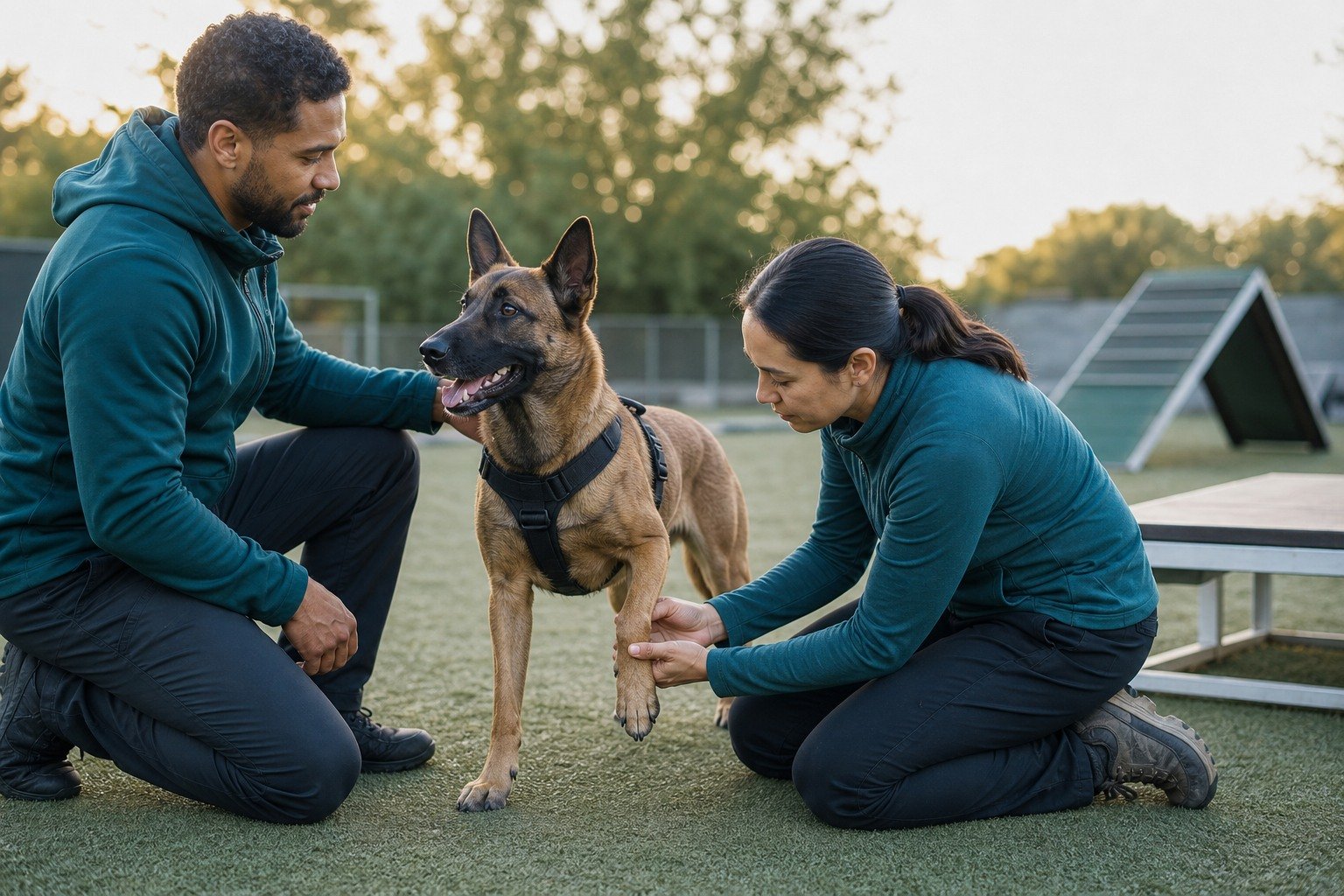
Working dogs may search, detect, guide, assist, herd, retrieve, guard livestock, compete, perform therapy work, or support public safety. Each role creates a different mix of speed, jumping, traction, turning, load, repetition, weather, travel, and recovery demands. Drive and training can also keep a dog performing despite discomfort, so completing a task is not proof that joints and muscles are healthy. A useful program starts with the job description, individual conformation and health, progressive conditioning, lean body and strong muscle, safe surfaces and equipment, pre- and post-work observations, planned recovery, and veterinary or rehabilitation input. Research on exact conditioning protocols remains limited, which makes individualized measurement and conservative progression more important, not less.
Short answer
Match conditioning and monitoring to the actual job, not the label working dog
AAHA working-dog guidance recommends role-specific history, preventive care, physical and behavioral assessment, conditioning, travel planning, and recognition of occupational hazards. It also acknowledges that evidence is incomplete across diverse working populations. [1] [2]
- Record the dog's baseline, current routine, exact diet and products, and any recent change.
- Use observations to support veterinary assessment, not to diagnose or choose treatment at home.
- Keep every household member working from the same written plan and restrictions.
- Agree on measurable outcomes, a review date, and clear urgent-contact signs.
Safety first
Performance pressure should never override pain, heat, trauma, or neurologic signs
Stop work and contact a veterinarian for persistent lameness, altered gait, reluctance, repeated task errors, reduced speed, unusual recovery, pain with handling, swelling, or behavior change. Seek urgent care for collapse, heat illness signs, inability to bear weight, major trauma, breathing difficulty, severe pain, dragging limbs, or rapid deterioration.
- Do not delay care for sudden, severe, escalating, or function-limiting signs.
- Do not start, stop, combine, divide, or calculate treatment from this article.
- Preserve exact labels, discharge instructions, exposure details, and a concise timeline.
Veterinary note
This article is educational and does not diagnose, treat, prescribe, or replace care from a licensed veterinarian. Your dog’s history, examination, diet, medications, and current signs determine what is appropriate.
Write the occupational history before designing fitness
Describe the dog's role in verbs: accelerate, decelerate, turn, climb, jump, balance, brace, pull, carry, swim, track, stand, travel, or work on unstable surfaces. Add frequency, duration, terrain, temperature, altitude, vehicle time, equipment, sleep, and recovery between shifts.
Record breed or mix, age, body and muscle condition, prior injury or surgery, medications, diet, paw and nail health, heat tolerance, fear or arousal patterns, and current skills. AAHA guidance treats working dogs as individuals whose medical and occupational requirements must be integrated. [1]
A police dog, mobility-assistance dog, livestock guardian, agility dog, and therapy dog do not share one ideal program. Even dogs with the same title may work on different surfaces and schedules. Build around actual exposure instead of copying a sport or breed template.
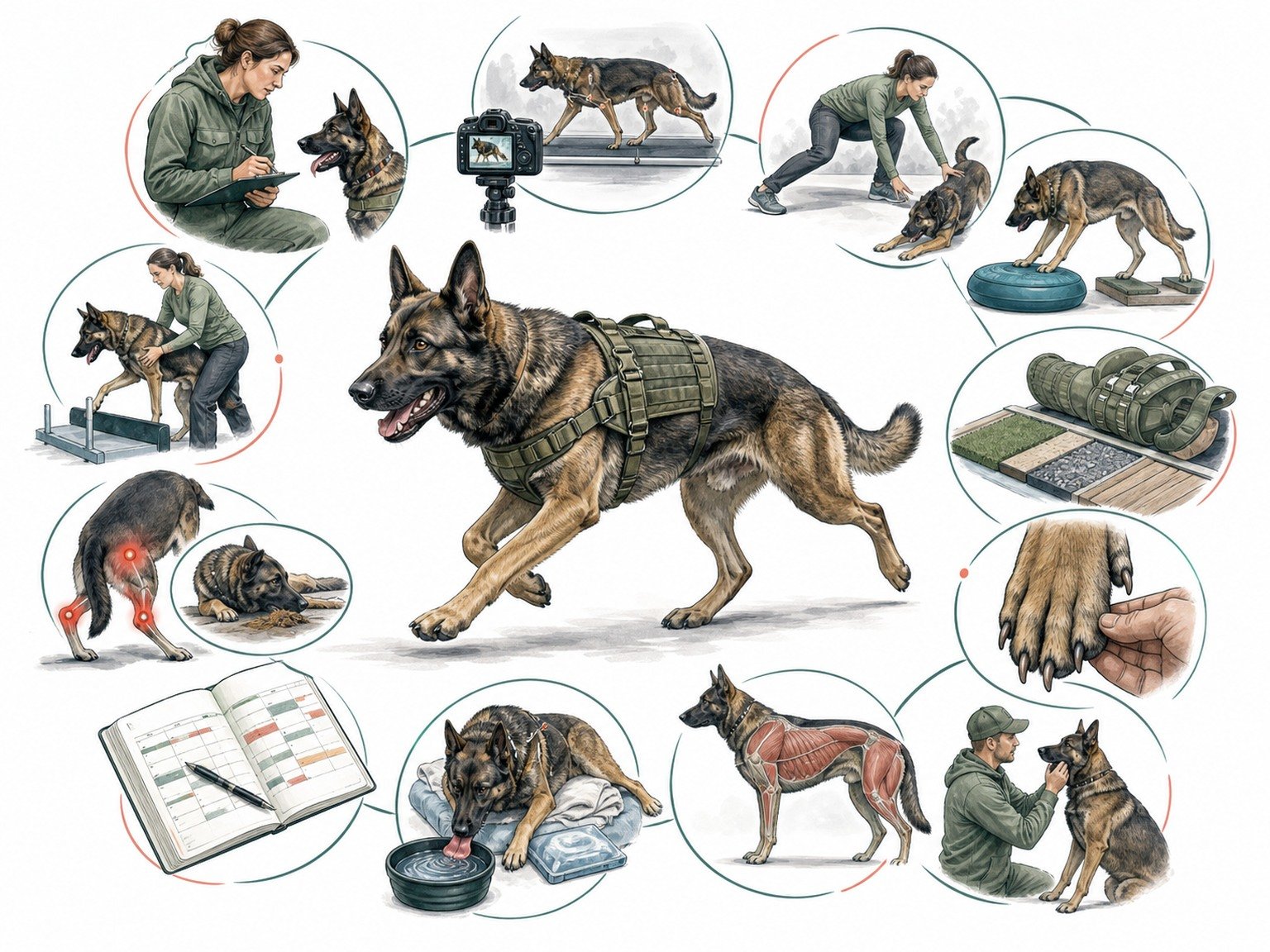
Condition progressively and observe quality, not only completion
Develop aerobic capacity, strength, balance, coordination, flexibility, and task skill in a gradual sequence appropriate to the role. Increase one meaningful variable at a time when possible and allow adaptation after breaks, illness, travel, or seasonal change.
Use a calm warm-up that moves from easy locomotion to job-specific patterns, then a cooldown that supports observation and recovery. No universal duration fits every job, climate, or patient. The goal is prepared movement and a visible baseline, not exhausting the dog before work.
Watch stride symmetry, foot placement, turning, jumping, hesitation, slips, handler cues, breathing, focus, and recovery. A motivated dog may compensate. Video comparable tasks periodically and stop when quality changes rather than waiting for outright refusal.
Manage surfaces, paws, equipment, heat, and recovery
Inspect flooring, terrain, debris, ice, mud, vehicle entries, ramps, landing zones, and kennel setup. Traction and impact can change during a shift. Match harnesses, vests, boots, and protective gear to the dog and task, checking fit and skin after use.
Examine nails, pads, webbing, limbs, and equipment before and after work. Keep a record of small abrasions, heat exposure, appetite, hydration, stool, sleep, and next-day stiffness because repeated minor changes may reveal an accumulating problem.
Plan rest, quiet sleep, hydration, nutrition, and low-demand days as part of performance care. Working-dog guidelines specifically address environmental and travel hazards; acclimation and emergency planning matter alongside orthopedic fitness. [2]
Treat injury and return to work as staged clinical decisions
When function changes, pause the provoking task and obtain veterinary assessment. Do not mask pain to pass a test or use a handler-designed challenge to prove readiness. Orthopedic, neurologic, soft-tissue, systemic, and behavioral causes can look similar during work.
Rehabilitation should be diagnosis-specific and measurable. Evidence for canine osteoarthritis physiotherapy supports potential benefit while also showing heterogeneity and limitations, so exercises, loading, equipment, and progression should come from qualified assessment rather than a generic circuit. [3]
Return-to-work criteria should reflect the actual role: comfortable daily function, examination findings, task components, endurance, recovery, and repeatability. Pain-management guidance emphasizes reassessment and an integrated plan; a cleared dog may still need modified duties or monitoring. [4]
Prepare for a focused veterinary conversation
Bring a concise timeline, short natural-movement or symptom videos when safe, the exact names and photographs of every food, treat, medication, and supplement label, and notes about appetite, water intake, stool, sleep, activity, comfort, and behavior. Include recent injuries, travel, boarding, diet changes, missed medication, and previous test results. A complete record helps the veterinary team separate a repeatable pattern from a single impression.
Decide in advance what you need from the visit: an urgency decision, a diagnosis plan, a nutrition review, a pain or mobility assessment, or a monitored trial. Ask what result would change the plan and what finding would rule an option out. This keeps research and product information in the right role. Evidence can shape questions and expectations, but it cannot determine what is safe for an individual dog without the history and examination.
Owner tool
Build a working-dog joint and recovery log
On a phone, swipe across the table to see every column.
| Checkpoint | Record | Why it helps |
|---|---|---|
| Demand | Task, terrain, gear, weather, duration | Defines load |
| Quality | Gait, turns, jumps, errors, fatigue | Detects change |
| Recovery | Paws, appetite, sleep, next-day function | Shows adaptation |
| Decision | Stop rule, exam, rehab, clearance | Protects return |
Better questions, calmer next steps
Questions to ask your veterinarian
- Which job demands create the highest orthopedic load?
- What pre-work baseline and stop rules should we use?
- How should conditioning progress after time off?
- Does this dog need imaging or rehabilitation assessment?
- What objective criteria determine return to full work?
FAQ
Does high drive mean a dog is pain-free?
No. Motivation can mask or override discomfort.
How long should warm-up last?
It depends on dog, task, weather, and health.
Are boots always protective?
Only when fit, surface, heat, and task are appropriate.
Can a handler diagnose a soft-tissue injury?
No. Veterinary assessment is needed.
Should every working dog take joint supplements?
No. Use a defined indication and individual review.
Sources
- American Animal Hospital Association: 2021 AAHA Working, Assistance, and Therapy Dog Guidelines. Occupational history, preventive care, conditioning, hazards, and retirement.
- American Animal Hospital Association: Working, Assistance, and Therapy Dog Guidelines: Introduction. Scope and evidence limitations.
- Veterinary Medicine and Science: Physiotherapy for Canine Osteoarthritis: Systematic Review. Rehabilitation evidence and limits.
- Journal of Feline Medicine and Surgery: 2022 AAHA Pain Management Guidelines. Assessment, multimodal care, and reassessment.
- BMC Veterinary Research: Risk Factors for Canine Osteoarthritis: A Systematic Review. Risk-factor context.
