

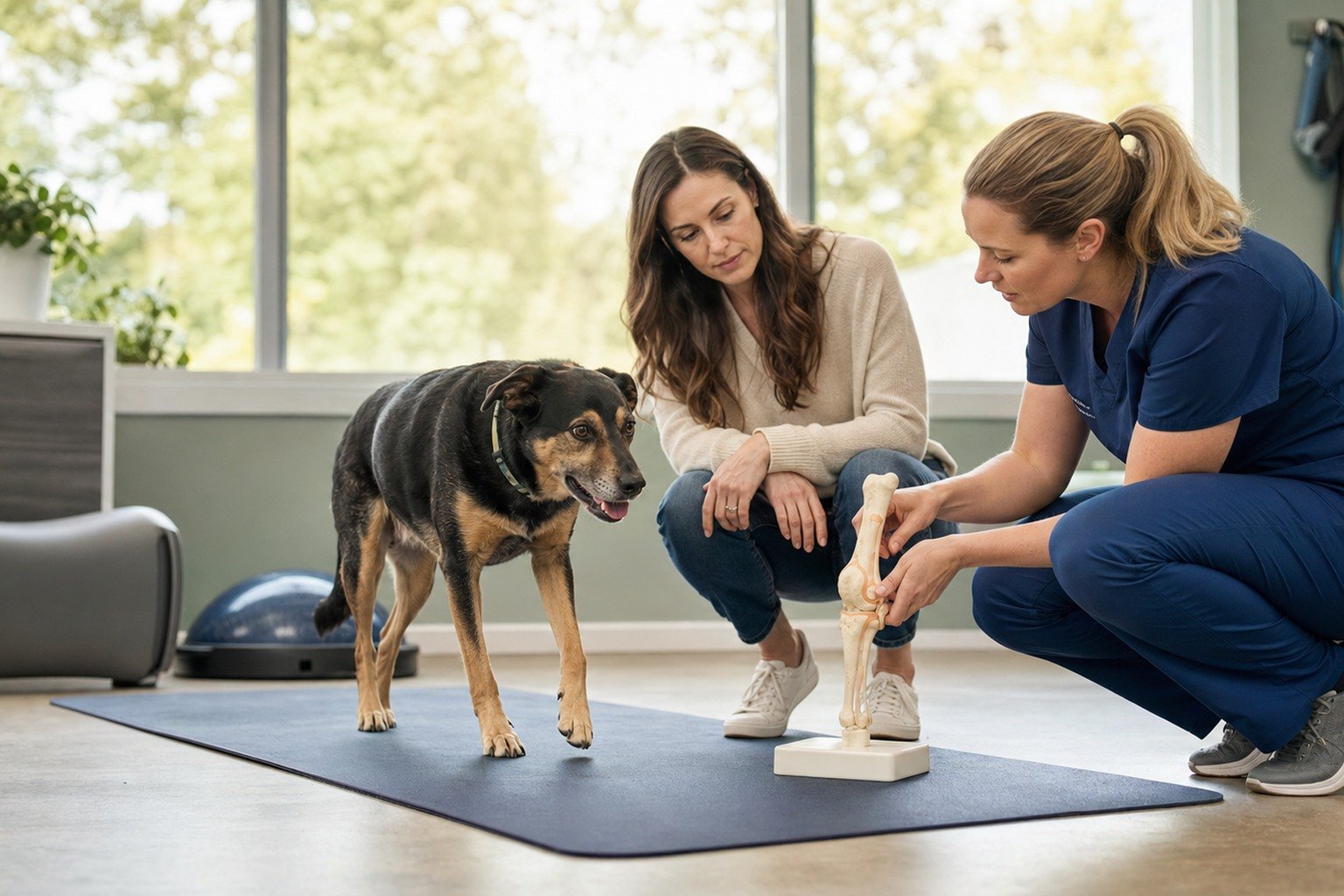
This glossary translates common canine joint-health language into careful owner terms. It is a reference layer, not an orthopedic examination, imaging interpretation, diagnosis, prognosis, exercise prescription, or product guide. The same word can describe anatomy, an owner observation, a clinician finding, an imaging feature, a disease process, or a treatment goal. Preserve the exact source and surrounding sentence, then ask how the term applies to this dog.
Short answer
Definitions support clearer questions, not home orthopedic decisions
Cornell and ACVS describe osteoarthritis, signs, diagnosis, and multimodal care. MSD shows that several joint disorders can share outward features. AAHA emphasizes pain assessment through history, observation, examination, and reassessment. These sources support plain-language translation while preserving professional interpretation. [1] [2] [3] [4]
- Start with the individual dog's ordinary baseline and full context.
- Observe without provoking fear, pain, conflict, or a stronger example.
- Use terminology and research only within their intended limits.
- Escalate sudden, severe, progressive, dangerous, or function-limiting changes promptly.
Safety first
A glossary cannot downgrade sudden or severe movement change
Seek urgent care for major trauma, inability to stand, severe or escalating pain, a dangling or unstable limb, non-weight-bearing lameness, dragging or knuckling, loss of coordination, collapse, fever with joint pain, or new loss of bladder or bowel control.
- Do not delay urgent veterinary care while completing a log or reading this guide.
- Do not corner, restrain, flood, punish, or deliberately trigger behavior for testing or video.
- Do not start, stop, combine, divide, or calculate medication or supplements from this article.
Veterinary note
This article is educational and does not diagnose, treat, prescribe, or replace care from a licensed veterinarian. Your dog’s history, examination, diet, medications, and current signs determine what is appropriate.
Joint anatomy and movement terms
Joint: the place where bones meet. Structures may include cartilage, capsule, synovial membrane and fluid, ligaments, tendons, and surrounding muscle. Anatomy varies by joint, so one diagram cannot localize one dog's problem.
Cartilage covers portions of joint surfaces; synovial fluid supports lubrication; ligaments connect bone to bone; tendons connect muscle to bone. A named structure in a report does not establish severity or prognosis by itself.
Gait means the pattern of movement. Stride, stance, weight bearing, range of motion, proprioception, and muscle condition are different observations or findings. Owners may record natural function but should not manipulate a limb or perform orthopedic tests.

Sign, pain, and function terms
Lameness describes altered use of a limb and has many possible causes. Stiffness, slower rising, hesitation, changed posture, slips, altered play, sleep disruption, and social change may accompany pain but are not specific to arthritis.
Acute means sudden or short-duration in context; chronic means persistent or recurring. Intermittent means signs come and go. Progressive means worsening over time. These terms describe pattern, not cause or safe waiting time.
Pain is a multidimensional experience. Nociception refers to neural processing of potentially harmful stimuli and is not identical to the dog's full pain experience. Function describes meaningful daily tasks and is a useful monitoring target. [4]
Diagnostic and imaging terms
Orthopedic examination evaluates movement and musculoskeletal structures; neurologic examination evaluates nervous-system function. Findings can overlap, and professional technique matters. Differential diagnosis means a reasoned list of possibilities, not confirmed disease.
Radiographs use X-rays and show bones and some joint changes; ultrasound, CT, MRI, arthroscopy, laboratory tests, and joint-fluid analysis answer different questions. An imaging finding may not explain all pain or functional change.
Sensitivity, specificity, reference interval, false positive, and false negative describe test limits. Interpretation depends on history, examination, image quality, disease probability, and whether the result would change the plan.
Osteoarthritis, rehabilitation, and care terms
Osteoarthritis is a whole-joint disease associated with structural change, pain, and impaired function; it is not simply old age. Degenerative joint disease is often used in related contexts, but patient-specific meaning belongs with the clinician. [1]
Multimodal care combines selected approaches for the individual dog. Rehabilitation is a professionally directed process; therapeutic exercise has a defined purpose, starting point, progression, stop criteria, and reassessment. Ordinary activity is not automatically therapy.
Body condition and muscle condition are separate assessments. Outcome measure means a structured way to track change. Clinically meaningful improvement is not the same as a statistically different research result.
Supplement and evidence terms
Active ingredient, formulation, finished product, dose form, purity, potency, contaminant, lot, and quality control describe different parts of a supplement decision. Ingredient evidence does not automatically validate every finished product.
Randomized, controlled, blinded, systematic review, association, causation, adverse event, and conflict of interest describe study design or interpretation. No single label guarantees strong evidence or patient fit.
Copy the exact term, source, date, and surrounding statement. Ask whether it describes anatomy, a sign, finding, diagnosis, risk factor, option, or goal; what supports it; what remains uncertain; and what would change interpretation.
Build a personal term record without creating a diagnosis
Keep a simple two-column note: the exact term and the veterinary team's explanation for this dog. Add the date, source document, affected body area when identified professionally, and the follow-up question. Do not rewrite a possibility as a confirmed condition.
When a term changes between visits, ask whether the change reflects new evidence, different wording, disease progression, a revised differential list, or another clinician's scope. Similar-sounding words may not be interchangeable.
Archive superseded instructions but keep them labeled by date. The current plan should be easy to identify, and urgent changes should be reported rather than added silently to a glossary note.
Prepare for a focused veterinary conversation
Bring a concise timeline, short natural-movement or symptom videos when safe, the exact names and photographs of every food, treat, medication, and supplement label, and notes about appetite, water intake, stool, sleep, activity, comfort, and behavior. Include recent injuries, travel, boarding, diet changes, missed medication, and previous test results. A complete record helps the veterinary team separate a repeatable pattern from a single impression.
Decide in advance what you need from the visit: an urgency decision, a diagnosis plan, a nutrition review, a pain or mobility assessment, or a monitored trial. Ask what result would change the plan and what finding would rule an option out. This keeps research and product information in the right role. Evidence can shape questions and expectations, but it cannot determine what is safe for an individual dog without the history and examination.
Owner tool
Use a joint-health term without overinterpreting it
On a phone, swipe across the table to see every column.
| Checkpoint | What to record | Why it helps |
|---|---|---|
| Term | Exact source and wording | Preserves meaning |
| Role | Anatomy, sign, finding, diagnosis | Sets scope |
| Limit | What it cannot establish | Controls certainty |
| Question | How it applies to this dog | Routes review |
Better questions, calmer next steps
Questions to ask your veterinarian
- How is this term being used in the record?
- Does it describe a sign, finding, diagnosis, or goal?
- What evidence supports the interpretation?
- What uncertainty remains?
- What observation or test would change the plan?
FAQ
Is lameness a diagnosis?
No.
Does an X-ray show all sources of pain?
No.
Is stiffness normal aging?
Do not assume so.
Does multimodal mean every option at once?
No.
Can a glossary choose treatment?
No.
Sources
- Cornell University College of Veterinary Medicine: Osteoarthritis. OA signs, diagnosis, and multimodal care.
- MSD Veterinary Manual: Other Joint Disorders in Dogs. Joint disorders and overlapping signs.
- American College of Veterinary Surgeons: Osteoarthritis in Dogs. Joint anatomy, diagnosis, and care context.
- American Animal Hospital Association: Pain Management Guidelines. Pain assessment and individualized management.
