

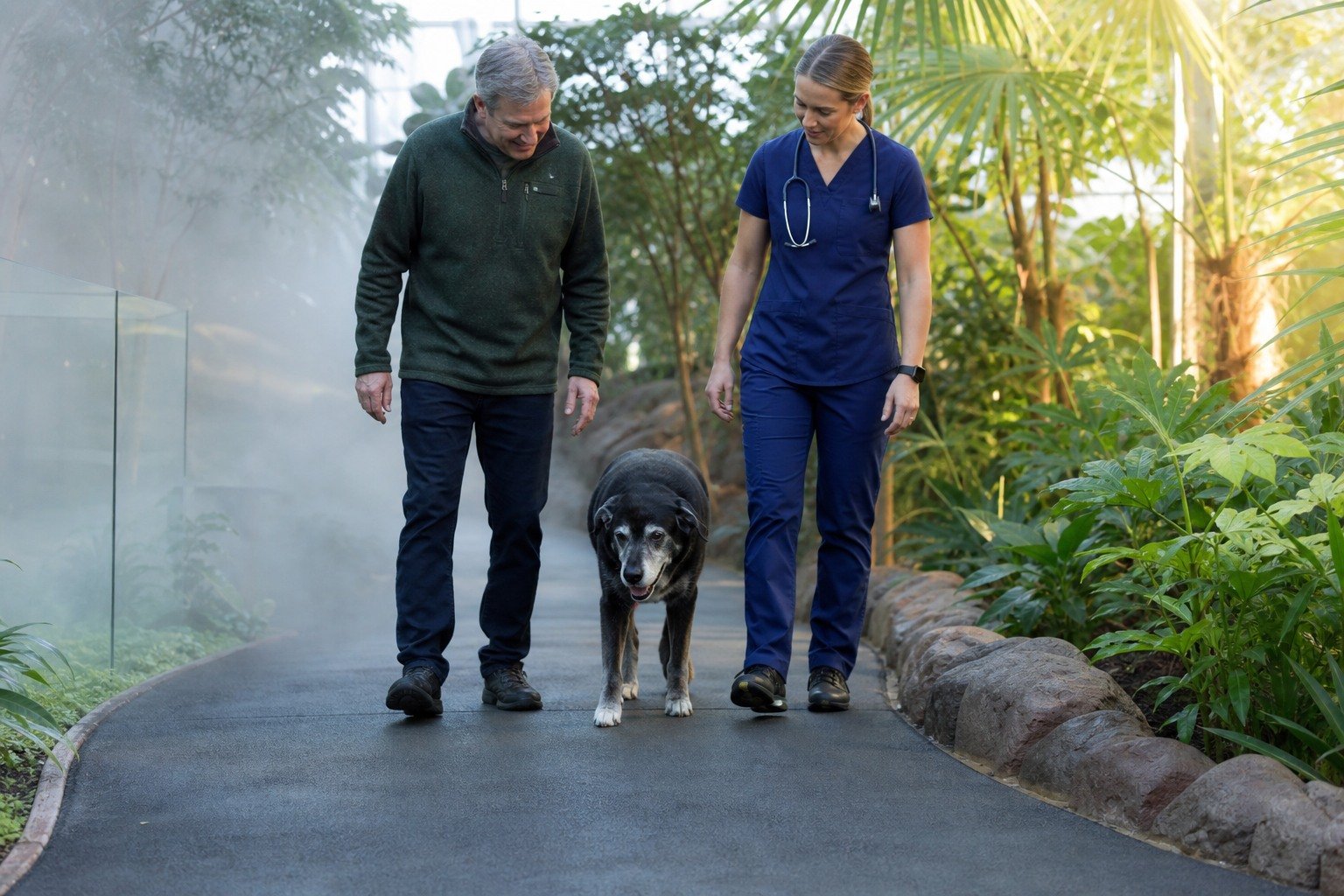
Owners often notice that a dog seems stiffer during cold mornings, humid spells, hot afternoons, or abrupt weather changes. The observation may be real, but the explanation is not settled by the calendar. Activity, surface traction, sleep, routine, body condition, injury, disease progression, medication timing, and other medical problems can change at the same time. Direct canine evidence does not establish one universal weather variable that predicts pain for every dog. A better approach is to record weather beside function, compare repeated observations with the dog's baseline, and ask the veterinary team whether the pattern changes assessment or management.
Short answer
Treat weather as context, not a joint diagnosis
AAHA guidance supports consistent owner observations, comparison with baseline, validated questionnaires, and activity-specific videos. COAST combines caregiver information with veterinary observation, examination, staging, and reassessment. These tools can document a seasonal pattern, but they do not prove that cold, heat, humidity, or barometric pressure caused a mobility change. [1] [2] [3]
- Start with the individual dog's baseline, complete history, and current veterinary plan.
- Use repeated observations to improve a veterinary discussion, not to diagnose or treat at home.
- Keep associations, population findings, and research endpoints within their actual limits.
- Escalate sudden, severe, persistent, progressive, or function-limiting signs promptly.
Safety first
Do not wait on a weather theory when function changes
Seek prompt veterinary guidance for sudden inability to bear weight, severe or escalating pain, collapse, trauma, swelling, dragging or knuckling a limb, inability to rise, loss of bladder or bowel control, fever, or rapid decline. Persistent, progressive, or recurring changes also deserve reassessment even when they seem seasonal.
- Do not delay urgent care while completing a log, testing a theory, or looking for a lower-cost option.
- Do not start, stop, combine, divide, or calculate medication or supplements from this article.
- After a possible toxin, foreign object, overdose, or hazardous ingestion, contact veterinary or poison help promptly.
Veterinary note
This article is educational and does not diagnose, treat, prescribe, or replace care from a licensed veterinarian. Your dog’s history, examination, diet, medications, and current signs determine what is appropriate.
Establish the dog's normal mobility baseline
Describe ordinary gait, posture, rising, lying down, stairs, jumping, play, walks, sleep, toileting, and willingness to join household activity. Baseline is individual: age, body shape, diagnosis, prior injury, conditioning, and home layout all matter. Compare the dog with itself rather than with another dog or an online video.
AAHA chronic-pain guidance encourages owners and clinicians to compare normal and abnormal behavior and to use repeated observations and videos for activity-specific change. [1] A single slow morning can be noise. Repeated change under similar conditions provides a clearer history, though it still does not identify the cause.
Validated questionnaires can improve consistency for defined uses, but scores have interpretability and transfer limits. [4] Do not invent a diagnostic cutoff, safe waiting period, or medication decision from a home score. Use it to show trend and support a veterinary conversation.
Record weather beside activity and surfaces
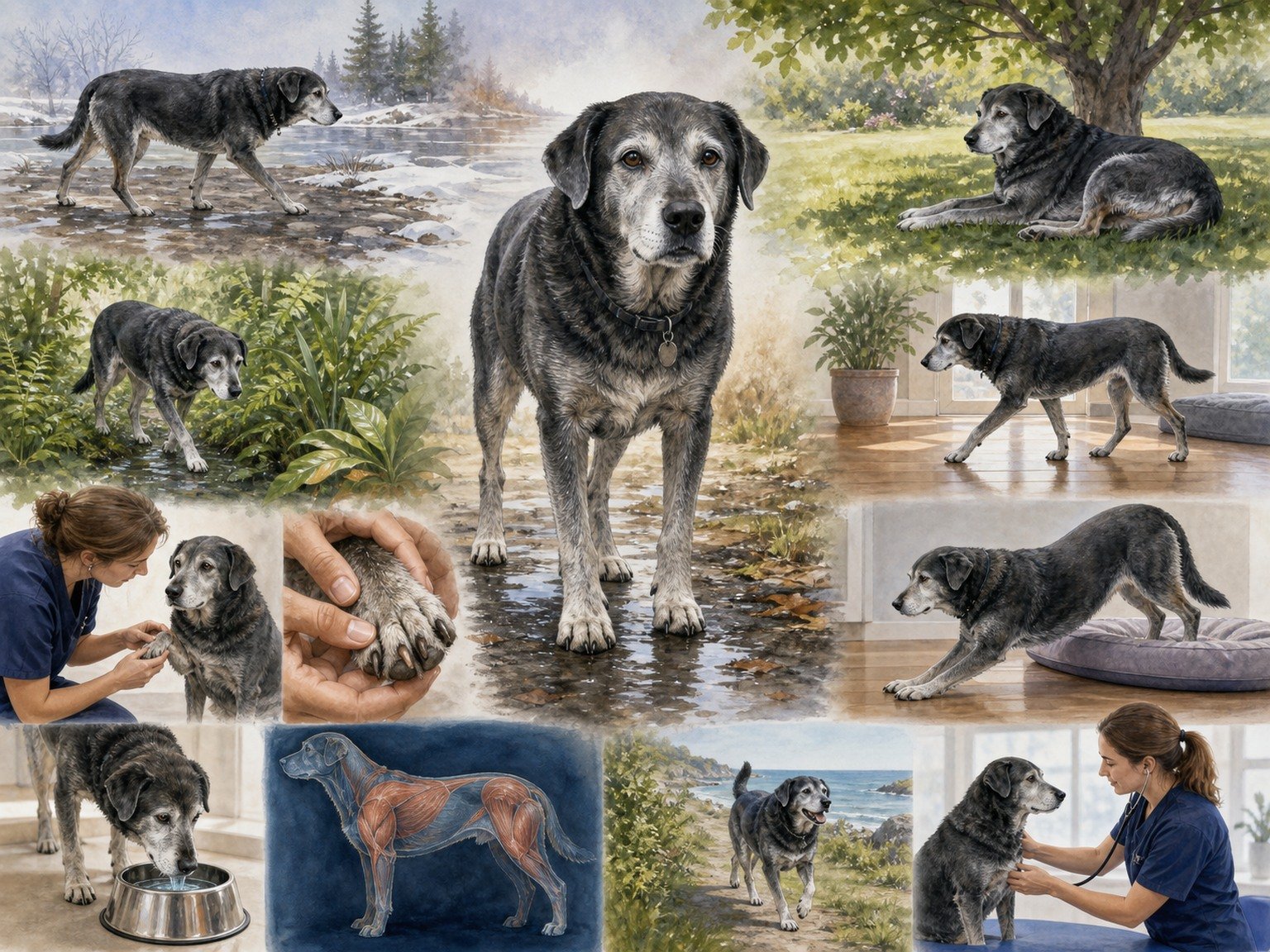
On the same dated line, note temperature, humidity, precipitation, unusual pressure change if known, time outdoors, walk duration, pace, play, stairs, slippery floors, mud, ice, heat, and changes in sleep or routine. This prevents weather from becoming the only variable in the story.
A dog may move less during extreme weather, lose conditioning, walk on different surfaces, sleep in a different place, or have altered toileting opportunities. Conversely, a pleasant day may increase activity and reveal soreness later. These are plausible context questions, not proof of a weather mechanism.
Use short videos of ordinary activities only when they can be captured without provoking pain: walking away and toward the camera on a safe surface, rising naturally, or completing a routine task. Do not force stairs, jumping, running, limb manipulation, or repeated trials to make a sign appear.
Review comfort and environment with the veterinary team
COAST guidance places caregiver observations within a broader process that includes posture, motion, hands-on examination, patient-specific staging, and reassessment. [3] Environmental modification may be one part of care when a specific barrier is identified, but a generic seasonal equipment list is not a treatment plan.
Ask whether floor traction, access to toileting, resting location, heat exposure, cold exposure, altered activity, or another factor is relevant for this dog. The safest change depends on diagnosis, neurologic and orthopedic function, cardiopulmonary health, skin, cognition, medication, and household constraints.
Do not start heating devices, cooling protocols, braces, ramps, exercise programs, pain medication, or supplement changes from seasonal timing alone. Some seemingly simple measures can create burns, falls, overexertion, interactions, or delayed diagnosis.
Use repeated seasons to improve reassessment
Bring a concise comparison: what changed, when, under which conditions, how long it lasted, what function was affected, and whether the same pattern occurred before. Include medication timing, activity, slips, travel, illness, appetite, sleep, and behavior changes.
AAHA senior-care guidance treats pain management as individualized and multimodal, with ongoing monitoring rather than a fixed seasonal formula. [2] A plan may need reassessment because the disease, environment, caregiver capacity, or response has changed, not because every winter or summer requires the same intervention.
The useful conclusion is bounded: a repeatable context exists, the dog's function changed, and the veterinary team has better evidence for the next decision. That is more reliable than claiming weather caused a flare or promising that one seasonal routine will prevent it.
Prepare for a focused veterinary conversation
Bring a concise timeline, short natural-movement or symptom videos when safe, the exact names and photographs of every food, treat, medication, and supplement label, and notes about appetite, water intake, stool, sleep, activity, comfort, and behavior. Include recent injuries, travel, boarding, diet changes, missed medication, and previous test results. A complete record helps the veterinary team separate a repeatable pattern from a single impression.
Decide in advance what you need from the visit: an urgency decision, a diagnosis plan, a nutrition review, a pain or mobility assessment, or a monitored trial. Ask what result would change the plan and what finding would rule an option out. This keeps research and product information in the right role. Evidence can shape questions and expectations, but it cannot determine what is safe for an individual dog without the history and examination.
Owner tool
Build a seasonal mobility comparison
On a phone, swipe across the table to see every column.
| Checkpoint | What to record | Why it helps |
|---|---|---|
| Weather | Temperature, humidity, precipitation, time | Adds context |
| Function | Gait, rising, stairs, sleep, toileting | Shows change |
| Environment | Surface, traction, activity, resting place | Finds co-variables |
| Response | Duration, recovery, veterinary plan | Supports reassessment |
Better questions, calmer next steps
Questions to ask your veterinarian
- Does this pattern warrant examination or updated diagnostics?
- Which activity and surface details are most useful?
- Could another condition resemble a seasonal joint change?
- Are any home changes appropriate for this dog's risks?
- What change should prompt urgent or earlier contact?
FAQ
Does cold weather cause arthritis?
Timing alone does not prove cause or diagnose arthritis.
Can humidity predict my dog's pain?
Not reliably for an individual dog.
Should I change supplements seasonally?
Not without veterinary guidance.
Are videos useful?
Yes, when they show ordinary activity without provoking pain.
When should I call?
For sudden, severe, persistent, progressive, or concerning change.
Sources
- American Animal Hospital Association: Chronic Pain Assessment in Dogs. Baseline comparison, observations, questionnaires, and videos.
- American Animal Hospital Association: Pain Management: 2023 AAHA Senior Care Guidelines. Individualized multimodal care and monitoring.
- Frontiers in Veterinary Science: COAST Consensus Guidelines for Canine Osteoarthritis. Caregiver observations, examination, staging, environment, and reassessment.
- Veterinary Surgery: Evidence-Based Evaluation of Owner-Reported Outcome Measures. Measurement value and interpretability limits.
