

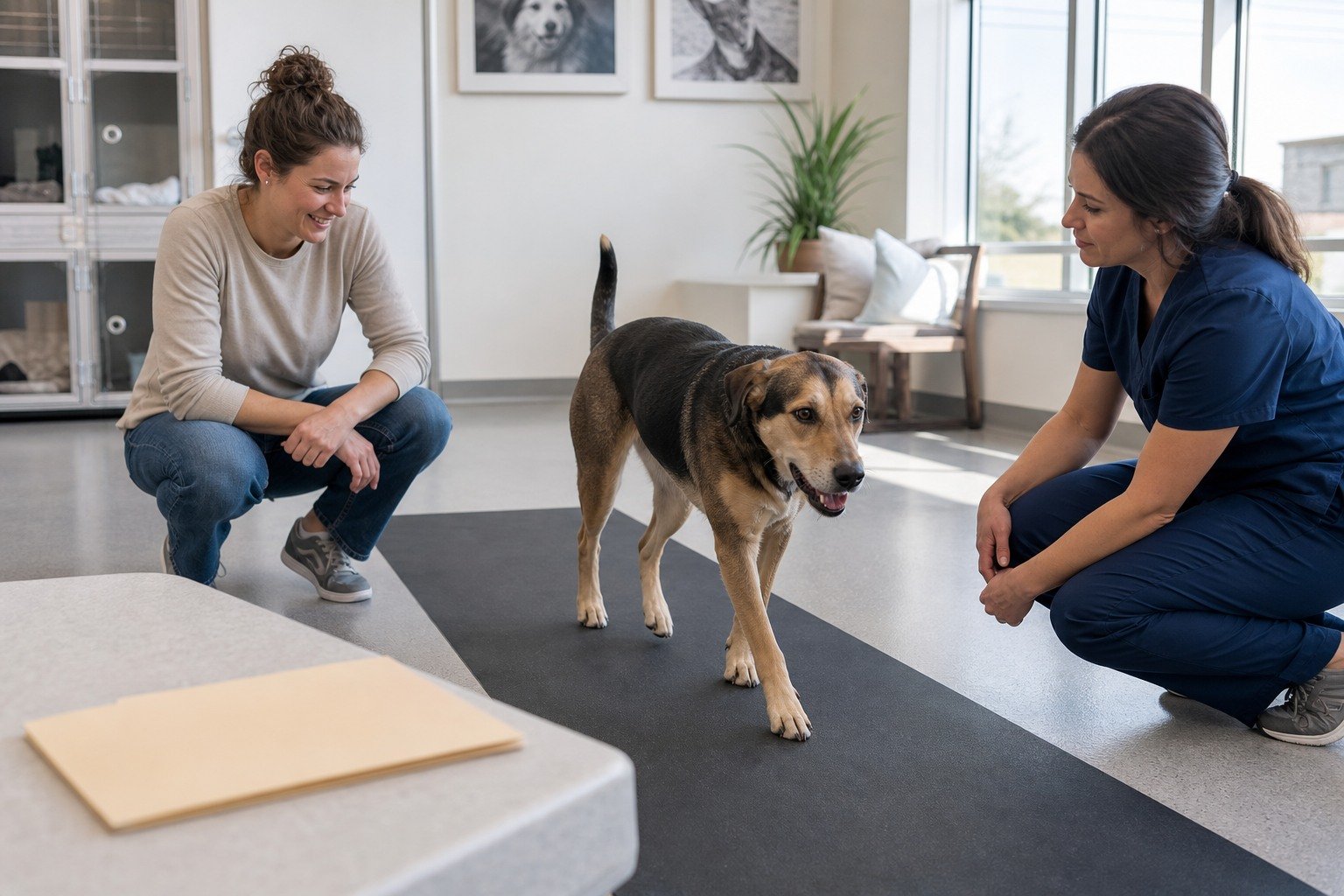
A newly adopted dog may arrive with detailed medical records, a partial history, or very little information. Missing history is not evidence of neglect or hidden joint disease, and rescue status does not explain every hesitant step, low activity period, or defensive response. Changes can reflect pain, orthopedic or neurologic disease, fatigue, fear, learning, surfaces, unfamiliar routines, or several factors together. The useful first steps are to request available records, allow calm observation of ordinary activities, document change over time, and share concerns with a veterinarian. Owners should not palpate, flex, extend, stress, or repeatedly test a dog's limbs.
Short answer
Collect records and observe ordinary movement without testing joints
Shelter-care guidance applies across shelters, rescues, fosters, and related settings. Veterinary orthopedic assessment combines history, gait observation, systematic examination, and selected testing. Owner videos and baseline comparisons can help when a sign is intermittent, but adoption history and home manipulation cannot identify the painful structure or diagnosis. [1] [2] [3] [4]
- Start with the individual dog's baseline, complete history, and current veterinary plan.
- Use repeated observations to improve a veterinary discussion, not to diagnose or treat at home.
- Keep associations, population findings, and research endpoints within their actual limits.
- Escalate sudden, severe, persistent, progressive, or function-limiting signs promptly.
Safety first
Sudden or severe mobility change should not be labeled adjustment behavior
Seek prompt care for inability to bear weight, severe pain, trauma, swelling, collapse, dragging or knuckling a limb, inability to rise, loss of bladder or bowel control, fever, or rapid decline. Contact the veterinary team for persistent limping, stiffness, reluctance, pain, muscle loss, or progressive functional change.
- Do not delay urgent care while completing a log, testing a theory, or looking for a lower-cost option.
- Do not start, stop, combine, divide, or calculate medication or supplements from this article.
- After a possible toxin, foreign object, overdose, or hazardous ingestion, contact veterinary or poison help promptly.
Veterinary note
This article is educational and does not diagnose, treat, prescribe, or replace care from a licensed veterinarian. Your dog’s history, examination, diet, medications, and current signs determine what is appropriate.
Request what is available without judging what is missing
Ask the shelter, rescue, foster, transport partner, and prior clinic for intake findings, vaccination and preventive history, medication, known injuries, surgery, imaging, laboratory results, activity restrictions, body weight, and observed mobility. Records may be incomplete for many practical reasons; treat gaps as unknown, not proof of poor care.
Association of Shelter Veterinarians guidance is designed for organizations across a wide range of settings and resources. [1] It supports organized health information and continuity, but it does not justify a stereotype that every rescue dog has trauma, pain, or orthopedic disease.
Create one current list of medications, supplements, food, and preventives. Note last known doses and who supplied them. Do not restart an old medication, combine products, or infer a diagnosis from a previous label without the current veterinary team's direction.
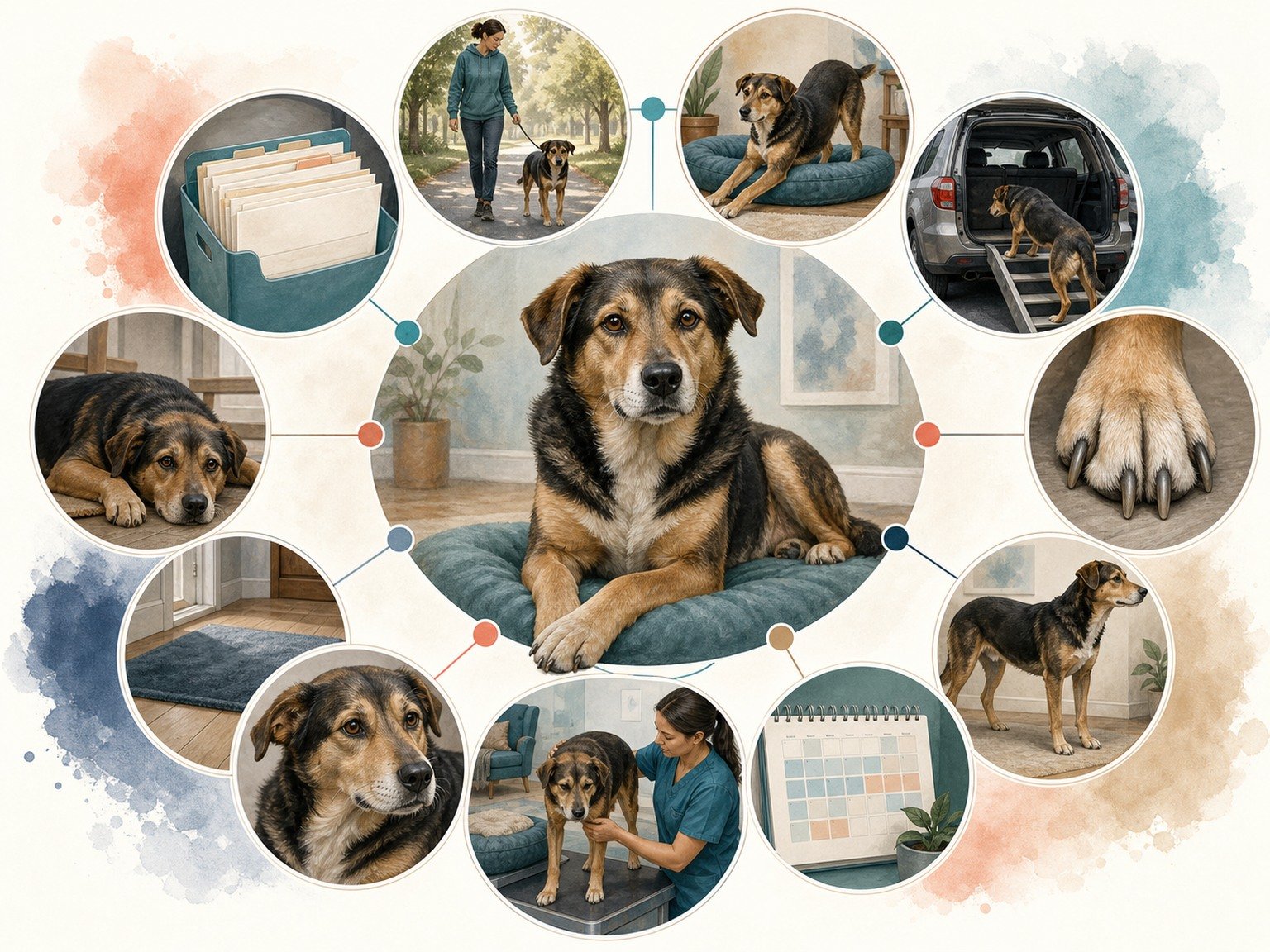
Build a calm baseline during ordinary life
Observe rest, rising, lying down, walking, turning, toileting, play, sleep, posture, stairs already required in the home, and willingness to join normal activity. Give the dog time to settle and record context such as surface, excitement, fatigue, and unfamiliar surroundings.
AAHA guidance supports comparison with the dog's own baseline and activity-specific videos when changes are intermittent. [3] Short clips of natural movement can be useful. Avoid staging repeated demonstrations, forcing stairs or jumping, or extending activity until a subtle sign becomes obvious.
Reluctance or defensive behavior can have pain, fear, learning, environmental, neurologic, or other medical contributors. Use neutral descriptions such as paused before rising or shortened the right hind step. Labels such as stubborn, lazy, abused, or dramatic obscure the observation and may lead to unsafe handling.
Understand what veterinary assessment adds
A veterinary orthopedic evaluation uses history, observation at rest and in motion, systematic hands-on examination, and selected testing. [2] These procedures require training because posture, compensation, neurologic signs, pain, and several affected structures can complicate interpretation.
MSD describes lameness as a sign with multiple possible causes rather than a diagnosis. [4] The visibly altered limb may not reveal the primary source, and an orthopedic-looking change can have neurologic or systemic explanations. Rescue history cannot resolve that differential.
Do not palpate for pain, flex and extend joints, compare range of motion, apply joint stress, or test a dog's tolerance. Besides creating fear or injury, home manipulation may generate misleading conclusions and damage the trust needed for handling and veterinary care.
Create a patient-specific support and follow-up plan
Share the most important functions for this dog and household: getting outside, entering the car, resting comfortably, navigating necessary steps, or joining short walks. Ask the veterinarian what can be assessed now, what requires follow-up, and what changes should prompt earlier care.
Home setup, activity, rehabilitation, body-condition goals, medication, and supplements must follow the dog's assessment and circumstances. A generic adoption decompression calendar, exercise progression, brace, ramp, bed, or supplement is not automatically safe or necessary.
Update the baseline as the dog settles. Improvement does not prove that an earlier sign was behavioral, and persistence does not prove an old injury. A respectful record keeps the dog out of a stereotype and gives the veterinary team concrete evidence for continuity and reassessment.
Prepare for a focused veterinary conversation
Bring a concise timeline, short natural-movement or symptom videos when safe, the exact names and photographs of every food, treat, medication, and supplement label, and notes about appetite, water intake, stool, sleep, activity, comfort, and behavior. Include recent injuries, travel, boarding, diet changes, missed medication, and previous test results. A complete record helps the veterinary team separate a repeatable pattern from a single impression.
Decide in advance what you need from the visit: an urgency decision, a diagnosis plan, a nutrition review, a pain or mobility assessment, or a monitored trial. Ask what result would change the plan and what finding would rule an option out. This keeps research and product information in the right role. Evidence can shape questions and expectations, but it cannot determine what is safe for an individual dog without the history and examination.
Owner tool
Prepare an adopted-dog mobility record
On a phone, swipe across the table to see every column.
| Checkpoint | What to record | Why it helps |
|---|---|---|
| Records | Injuries, surgery, imaging, medication, restrictions | Improves continuity |
| Baseline | Rest, rising, gait, stairs, play, sleep | Shows function |
| Context | Surface, fatigue, fear, routine, timing | Prevents assumptions |
| Follow-up | Videos, changes, questions, recheck | Supports care |
Better questions, calmer next steps
Questions to ask your veterinarian
- Which prior records are most important?
- Does this gait or behavior need prompt evaluation?
- What ordinary videos would be useful?
- Which activities should be limited until assessment?
- What change should trigger earlier follow-up?
FAQ
Does rescue history mean joint disease is likely?
No. It is context, not a diagnosis.
What if no medical records exist?
Document what is known and build a current baseline.
Can I test the joints at home?
No; avoid palpation and manipulation.
Could reluctance be behavioral?
Possibly, but pain and medical causes also require consideration.
Should every adopted dog receive a joint supplement?
No.
Sources
- Association of Shelter Veterinarians: Guidelines for Standards of Care in Animal Shelters. Health records and care across shelter and rescue settings.
- University of Illinois College of Veterinary Medicine: Orthopedic Exam: Forelimb. Professional history, observation, and examination context.
- American Animal Hospital Association: Chronic Pain Assessment in Dogs. Baseline, repeated observations, and videos.
- MSD Veterinary Manual: Lameness in Dogs. Multiple causes and veterinary evaluation.
