

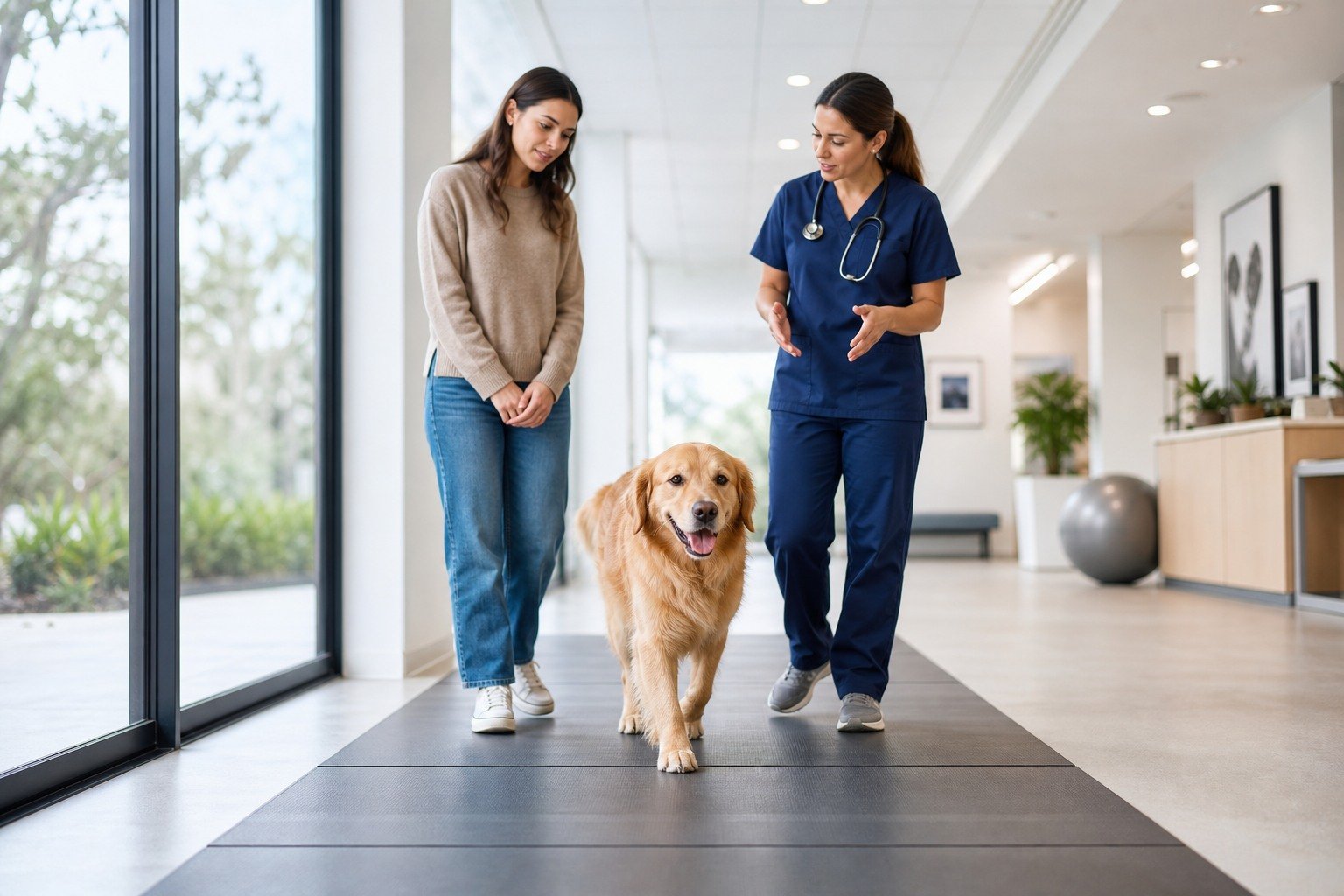
Joint health is visible through ordinary function, not a home orthopedic test. Watch how the dog rises, walks, turns, runs, uses stairs, jumps, plays, rests, and recovers. Record change from that dog's baseline plus surface, activity, fatigue, injury, health, body and muscle condition, medication, and behavior context. Age, breed, size, weight, activity, and conformation can affect risk without making disease inevitable. Do not manipulate joints, force exercise, prescribe rest, or start a joint product from a checklist. Bring safe natural-movement video and a concise history to the veterinarian.
Short answer
Start with the individual dog's ordinary movement
Cornell and ACVS describe osteoarthritis signs, diagnosis, and multimodal care. AAHA pain guidance emphasizes owner observation, examination, and reassessment. A systematic review identifies population risk factors while preserving uncertainty for individuals. These sources support baseline tracking, not home diagnosis or prevention guarantees. [1] [2] [3] [4]
- Start with the individual dog's baseline, complete history, and current veterinary plan.
- Observe ordinary function without provoking pain, distress, or a stronger example.
- Use terms, population evidence, tools, and studies only within their intended limits.
- Escalate sudden, severe, persistent, progressive, dangerous, or function-limiting changes promptly.
Safety first
Sudden, severe, traumatic, or neurologic change needs prompt care
Seek urgent care for major trauma, inability to stand, severe or escalating pain, a dangling or unstable limb, non-weight-bearing lameness, dragging or knuckling, loss of coordination, collapse, fever with joint pain, or new loss of bladder or bowel control. Do not test the movement again or give human pain medication.
- Do not delay urgent care while completing a log, reading definitions, or waiting for a routine appointment.
- Do not manipulate joints, force activity, or repeat a painful movement for testing or video.
- Do not start, stop, combine, divide, or calculate medication or supplements from this article.
Veterinary note
This article is educational and does not diagnose, treat, prescribe, or replace care from a licensed veterinarian. Your dog’s history, examination, diet, medications, and current signs determine what is appropriate.
Understand joints without testing them
A joint is where bones meet, with structures that may include cartilage, capsule, synovial fluid, ligaments, tendons, and surrounding muscle. Different joints and disorders affect movement differently. Anatomy knowledge does not authorize palpation, range-of-motion testing, or manipulation.
Pain may appear as altered gait, posture, willingness, sleep, social behavior, appetite, grooming, or function rather than crying. AAHA recommends combining owner observations with professional assessment and repeated reassessment. [2]
Developmental disease, instability, injury, neurologic disease, infection, immune disease, and osteoarthritis can overlap in outward signs. Only examination and appropriate diagnostics can determine cause.
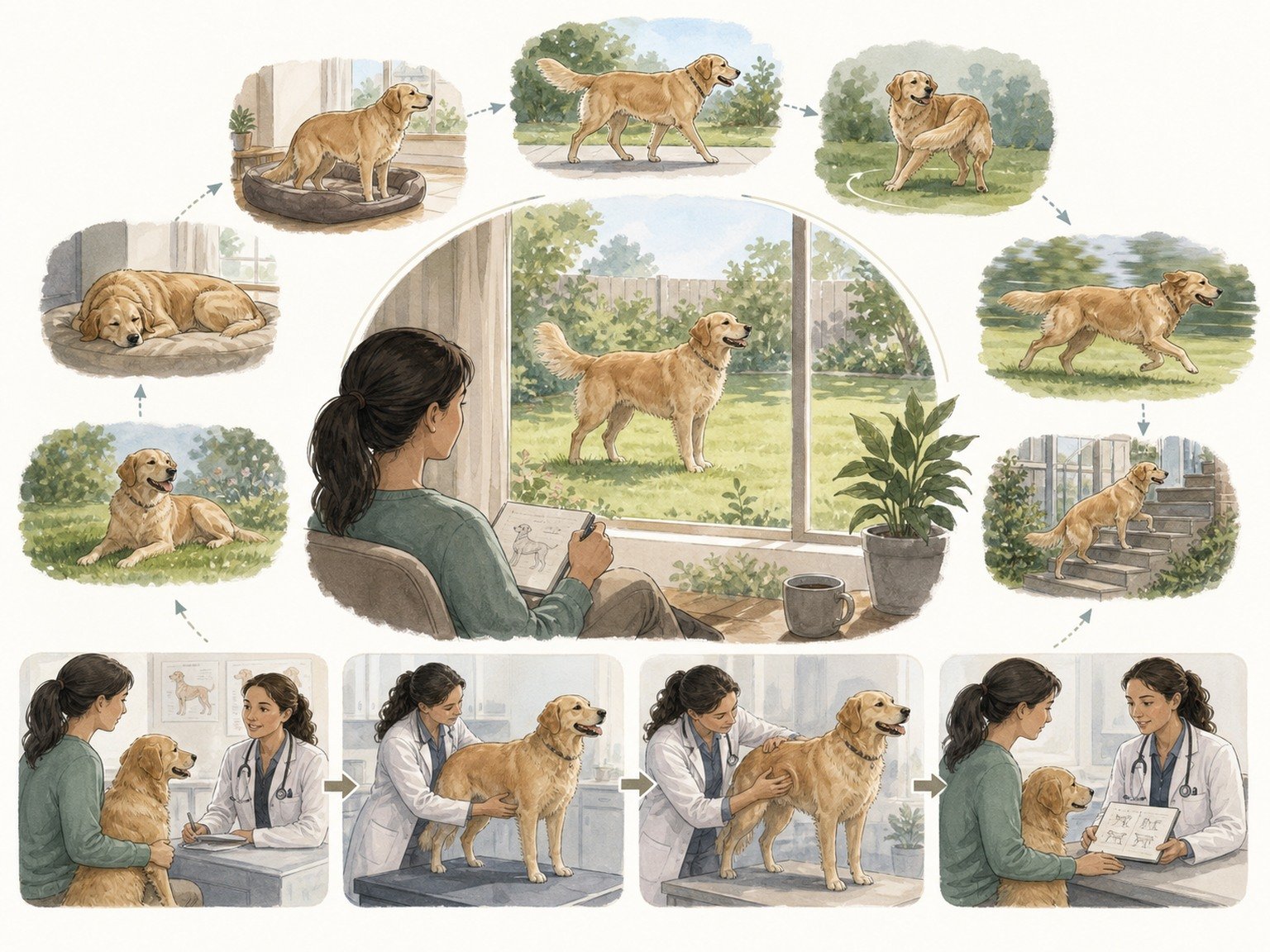
Build a repeatable movement baseline
Observe natural rising, standing, walking, turning, trotting only when ordinary, stairs already used, getting into familiar spaces, play, toileting, rest, and recovery. Note surface, time, weather, recent activity, fatigue, and medication timing.
Record stride symmetry when visible, head or hip movement, foot placement, slips, hesitation, posture, sitting, muscle symmetry, willingness, duration, and next-day function. A single awkward step may not define a trend, while repeated small changes can matter.
Use short video from front, side, and behind only when it occurs safely and naturally. Do not chase, lure, repeat stairs, jump, stretch, or provoke lameness to improve the recording.
Use risk factors as context, not destiny
Population research identifies associations involving breed, body weight, age, conformation, prior injury, and activity, but evidence strength and definitions vary. [3] A risk factor cannot predict an inevitable outcome for one dog.
Body condition and muscle condition are related but separate. Ask the veterinary team to demonstrate assessment and a patient-specific target. Do not sharply restrict food or add exercise from appearance alone.
Puppies, adults, athletes, working dogs, and seniors have different contexts, but no life stage automatically needs a joint supplement. Exercise, nutrition, prevention, and screening decisions remain individualized.
Prepare the first veterinary joint-health discussion
Bring onset, pattern, progression, injury history, activity, surfaces, recovery, video, diet, body and muscle trend, medication, supplements, and what daily task changed. Include what remains comfortable.
Ask what conditions are being considered, whether imaging or other diagnostics would change the plan, what activity and environment instructions apply, which outcome to track, and when follow-up occurs.
Cornell and ACVS describe osteoarthritis as a diagnosed condition managed through patient-specific multimodal care. [1] [4] No product, exercise, weight target, or home setup prevents or treats every joint problem.
Maintain the baseline as the dog grows and routines change
Repeat a small set of ordinary observations at sustainable intervals: rising from the usual bed, walking a familiar route, turning, play, stairs already used, toileting, rest, and recovery. Do not schedule performance tests or compare the dog with social-media clips.
Update the record after growth spurts, injury, surgery, major activity change, weight or muscle change, new medication, a different home surface, or a veterinary diagnosis. Mark changes in context so a new pattern is not attributed automatically to joints.
Ask at routine visits whether the current activity, nutrition, body and muscle goals, home environment, and monitoring still fit. A baseline is useful because it changes with the dog; it is not a permanent certificate that movement is normal.
Prepare for a focused veterinary conversation
Bring a concise timeline, short natural-movement or symptom videos when safe, the exact names and photographs of every food, treat, medication, and supplement label, and notes about appetite, water intake, stool, sleep, activity, comfort, and behavior. Include recent injuries, travel, boarding, diet changes, missed medication, and previous test results. A complete record helps the veterinary team separate a repeatable pattern from a single impression.
Decide in advance what you need from the visit: an urgency decision, a diagnosis plan, a nutrition review, a pain or mobility assessment, or a monitored trial. Ask what result would change the plan and what finding would rule an option out. This keeps research and product information in the right role. Evidence can shape questions and expectations, but it cannot determine what is safe for an individual dog without the history and examination.
Owner tool
Build a first joint-health baseline
On a phone, swipe across the table to see every column.
| Checkpoint | What to record | Why it helps |
|---|---|---|
| Movement | Rise, gait, turns, stairs, play | Defines normal |
| Context | Surface, activity, injury, fatigue | Explains variation |
| Whole dog | Pain clues, body, muscle, behavior | Widens assessment |
| Review | Video, questions, outcome, recheck | Supports care |
Better questions, calmer next steps
Questions to ask your veterinarian
- What is this dog's ordinary movement baseline?
- Which observations suggest pain or neurologic change?
- How should activity and surfaces be managed now?
- Are diagnostics indicated?
- What functional outcome and recheck apply?
FAQ
Is limping normal after play?
Do not assume so.
Does breed predict arthritis?
Risk is not destiny.
Should every puppy avoid stairs?
No universal rule fits every dog and environment.
Does every dog need joint supplements?
No.
Can I test range of motion?
Leave orthopedic testing to professionals.
Sources
- Cornell University College of Veterinary Medicine: Osteoarthritis. Signs, diagnosis, and multimodal care.
- American Animal Hospital Association: Pain Management Guidelines. Pain assessment and individualized management.
- Frontiers in Veterinary Science: Risk Factors for Canine Osteoarthritis. Population risk factors and evidence limits.
- American College of Veterinary Surgeons: Osteoarthritis in Dogs. OA causes, diagnosis, and treatment context.
