


Rescue or adoption history can mean incomplete records, several caregivers, an unfamiliar diet, transport, shelter exposure, or uncertain product timing. It does not prove malnutrition, microbiome damage, anxiety, joint disease, deficiency, or a need for a probiotic, multivitamin, calming aid, joint product, or broad stack. The safest first-year framework is records-first and patient-specific: preserve the handoff, identify what is known and unknown, document the complete current diet and every exposure, establish a health and functional baseline, and ask the veterinarian to reconcile exact products. Avoid changing several variables at once or using supplements to write a medical or behavioral story about the dog.
Short answer
Adoption status does not diagnose a supplement need
Shelter veterinary guidance supports coordinated records, health assessment, population-health practices, and individualized care. AAHA nutrition guidance evaluates medical and diet history, medications, supplements, body and muscle condition, and environment. AAFCO places supplements beside the complete diet and veterinary review. None supports a universal first-year adoption stack. [1] [2] [3] [4]
- Start with the individual dog's baseline, complete diet, medication and supplement history, and veterinary plan.
- Use repeated observations to improve a veterinary discussion, not to diagnose, prescribe, or prove an effect at home.
- Keep regulatory categories, product evidence, population findings, and study endpoints within their actual limits.
- Escalate sudden, severe, persistent, progressive, dangerous, or function-limiting changes promptly.
Safety first
Illness, medication uncertainty, or serious behavior change needs professional help
Seek urgent care for breathing difficulty, collapse, severe weakness or pain, seizure, repeated vomiting, repeated unproductive retching, inability to stand, or immediate danger from aggression. Contact the clinic promptly for poor intake, diarrhea, cough, discharge, painful movement, medication uncertainty, or progressive change. Do not use supplements to delay assessment.
- Do not delay urgent care while completing a log, changing the home, comparing costs, or waiting for a review date.
- Do not start, stop, cycle, combine, divide, increase, or rechallenge medication or supplements from this article.
- Do not use human products, leftover prescriptions, online dose conversions, or a supplement as a substitute for indicated care.
Veterinary note
This article is educational and does not diagnose, treat, prescribe, or replace care from a licensed veterinarian. Your dog’s history, examination, diet, medications, and current signs determine what is appropriate.
Preserve records and mark unknowns honestly
Collect shelter, rescue, foster, transport, prior veterinary, laboratory, vaccination, parasite, diet, medication, supplement, microchip, dental, surgery, and behavior records. Keep source and date. Mark unknown rather than guessing from appearance, origin, or a marketing claim.
Photograph every current product label and record reported purpose, administration, last known use, response, and adverse observations. Do not continue, restart, stop, combine, or substitute an uncertain product without receiving instructions from the veterinary team.
Shelter guidance supports organized records and health practices, but the adoption environment and population history do not establish an individual diagnosis. [1] [2] Treat records as evidence with limits, not a complete life story.
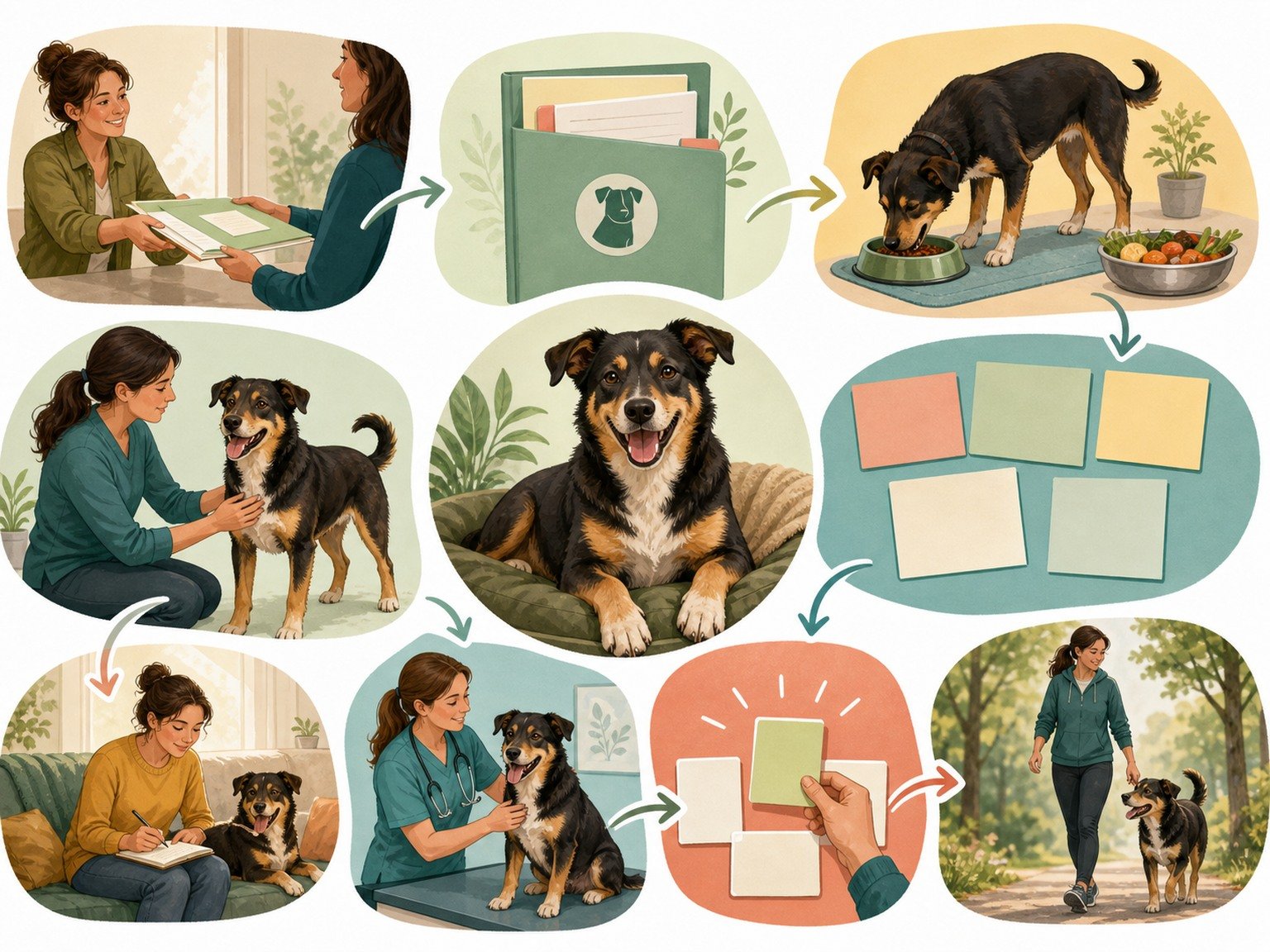
Map the complete diet and exposure list
Record exact food, formulation, measured amount, treats, chews, toppers, shared feeding, medication foods, preventives, prescriptions, over-the-counter products, and supplements. Package category or the word senior, calming, gut, or joint does not establish need.
AAFCO notes that a complete and balanced diet may already supply nutrients and that excess can matter. [4] AAHA recommends patient, diet, feeding, body, muscle, health, and environment assessment before nutritional recommendations. [3]
Avoid abrupt repeated diet changes or stacking products to address every uncertain sign. If immediate diet continuity is unclear, ask the receiving clinic or rescue medical contact for a safe handoff plan rather than improvising several additions.
Establish a neutral baseline
Observe appetite, water, urine, stool, vomiting, weight, body and muscle condition, rising, gait, activity, sleep, skin, grooming, breathing, cough, hearing, vision, social approach, retreat, and recovery from ordinary events. Use descriptive language without assigning trauma or deficiency.
Allow choice and predictable access to rest, food, water, toileting, traction, and safe separation. Do not force handling, introductions, exercise, crate exposure, or a trigger to evaluate whether a calming or mobility product is needed.
A baseline may change as the dog settles, receives care, and learns the household. Improvement or a new sign after adoption does not prove a supplement effect or a hidden prior condition. Bring trends to the veterinarian for interpretation.
Make one veterinarian-led decision at a time
Ask what problem or nutritional gap, if any, is being addressed; whether evidence matches the dog and exact finished product; what interactions, duplications, or quality concerns apply; and what outcome and review point will guide the decision.
When clinically appropriate, avoid changing diet, several supplements, medication, environment, and training at once. A single traceable change can make response easier to discuss, but it still does not prove causation or authorize a rechallenge.
Close the visit with a reconciled list, instructions, adverse signs, contact triggers, and follow-up. The first-year goal is not to accumulate products; it is to maintain an accurate health record and make decisions that fit the individual dog.
Prepare for a focused veterinary conversation
Bring a concise timeline, short natural-movement or symptom videos when safe, the exact names and photographs of every food, treat, medication, and supplement label, and notes about appetite, water intake, stool, sleep, activity, comfort, and behavior. Include recent injuries, travel, boarding, diet changes, missed medication, and previous test results. A complete record helps the veterinary team separate a repeatable pattern from a single impression.
Decide in advance what you need from the visit: an urgency decision, a diagnosis plan, a nutrition review, a pain or mobility assessment, or a monitored trial. Ask what result would change the plan and what finding would rule an option out. This keeps research and product information in the right role. Evidence can shape questions and expectations, but it cannot determine what is safe for an individual dog without the history and examination.
Owner tool
Build an adopted-dog supplement intake record
On a phone, swipe across the table to see every column.
| Checkpoint | What to record | Why it helps |
|---|---|---|
| Handoff | Records, dates, known and unknown | Preserves facts |
| Exposure | Diet, medication, prevention, supplements | Finds overlap |
| Baseline | Intake, function, body, behavior | Shows change |
| Decision | Goal, evidence, monitoring, review | Controls action |
Better questions, calmer next steps
Questions to ask your veterinarian
- Which record gaps matter before any product decision?
- Is the current diet complete at the amount fed?
- Are ingredients duplicated across exposures?
- What patient-specific goal would a product address?
- What observation requires earlier contact?
FAQ
Does every rescue dog need probiotics?
No.
Should I start a multivitamin while records are incomplete?
Not automatically; review diet and health first.
Does rescue status prove anxiety?
No.
Can I continue foster supplements?
Ask the receiving veterinary team to reconcile each exact product.
How long should I wait before deciding?
There is no universal timeline; urgent signs should not wait.
Sources
- Association of Shelter Veterinarians: Guidelines for Standards of Care in Animal Shelters. Records, population health, environment, and welfare practices.
- American Animal Hospital Association: 2023 Senior Care Guidelines. Individual history, examination, and multimorbidity context.
- American Animal Hospital Association: Nutritional Risk Factors. Medical, dietary, medication, supplement, body, and environment assessment.
- Association of American Feed Control Officials: Supplements. Complete-diet context, excess risk, and veterinary involvement.
