

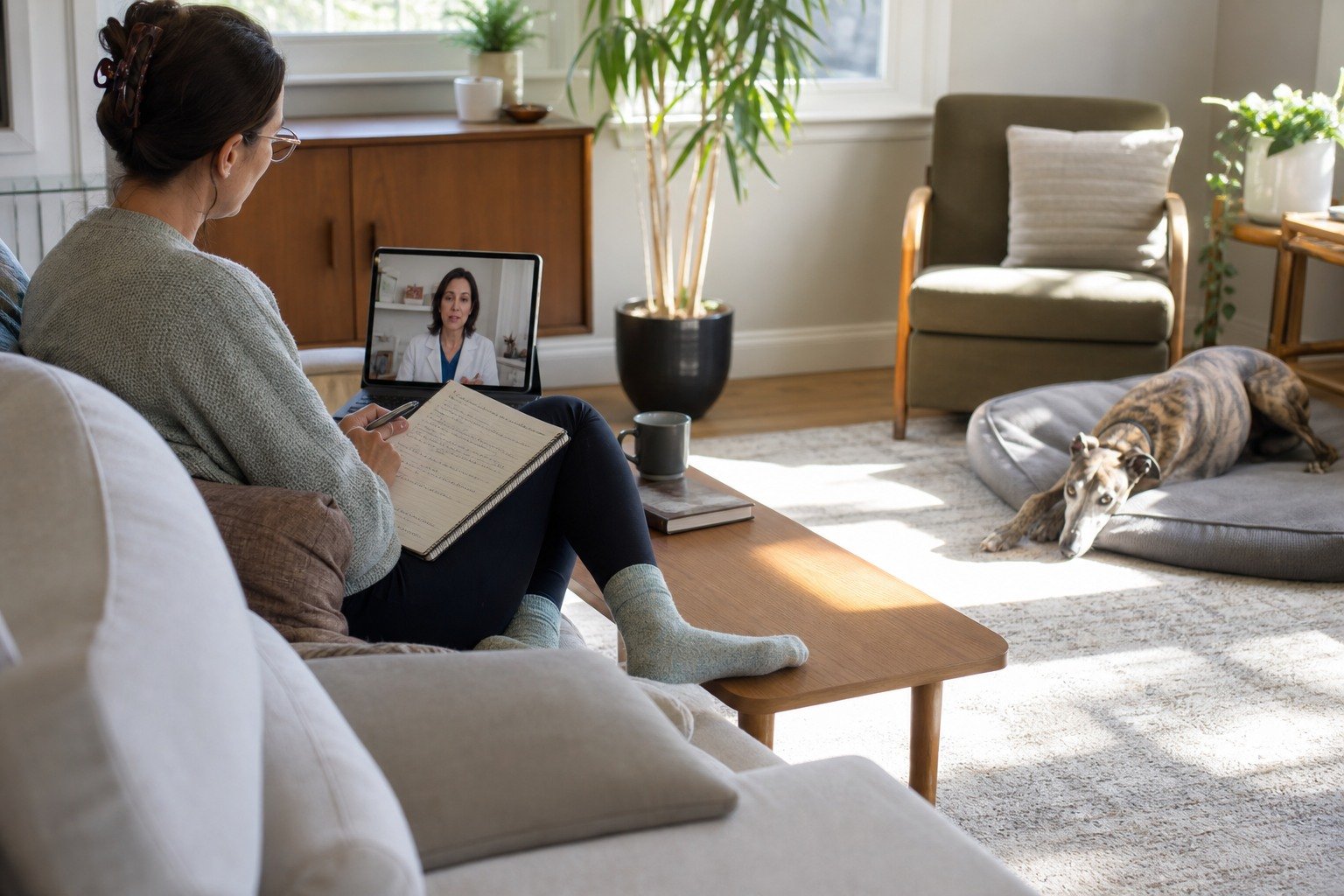
Adoption changes a dog's environment, routine, people, animals, sounds, movement, sleep, and access to resources. Behavior can change across the following weeks and months, but rescue or shelter status does not prove trauma, abuse, anxiety, or any diagnosis. Post-adoption studies support repeated observation and realistic follow-up rather than a universal decompression countdown. Predictable, low-pressure care can support welfare, while persistent distress, aggression, self-injury, inability to rest or eat, or loss of normal function needs veterinary and qualified behavior help. The first baseline should include ordinary calm moments as well as concerns. Record where the dog chooses to rest, how long recovery takes, whether eating and elimination remain normal, and which interactions the dog can comfortably leave. This produces a balanced history instead of a file made only from difficult events. Date each observation so change can be compared accurately.
Short answer
Expect change, not a fixed timetable
Longitudinal shelter-dog research found that owner-reported behavior can change during the first six months after adoption. Other studies describe varied adaptation patterns and post-adoption concerns. These findings do not validate a universal 3-3-3 rule or predict one dog's next week. Observe the individual across contexts and involve the veterinary team early when signs concern you. [1] [2] [3]
- Record context, frequency, duration, recovery, function, and recent change.
- Treat the article as preparation for professional assessment, not a diagnostic test.
- Agree on monitoring, reassessment, and urgent-response instructions with the veterinary team.
- Bring calm-day and difficult-day observations to each follow-up.
Safety first
Severe distress, self-injury, aggression, or inability to function needs prompt help
Contact a veterinarian promptly for persistent panic, inability to settle, major sleep or appetite disruption, house-soiling with illness concern, destructive escape, self-injury, aggression, sudden behavior change, or signs of pain. Immediate danger to people or animals requires separation with safe barriers and urgent professional guidance; do not attempt confrontation.
- Do not delay care for severe, persistent, escalating, or function-limiting signs.
- Do not start, stop, combine, or calculate treatment from this article.
- Preserve dated observations, safe videos, labels, prior records, and the dog's full health context.
Veterinary note
This article is educational and does not diagnose, treat, prescribe, or replace care from a licensed veterinarian. Your dog’s history, examination, diet, medications, and current signs determine what is appropriate.
Leave the dog's unknown story unknown
A shelter history may be complete, partial, or absent. Avoid filling gaps with a trauma narrative based on posture, shyness, startle, clinginess, barking, or avoidance. Similar behavior can reflect novelty, learning history, pain, illness, sensory change, sleep disruption, environment, or several factors.
Research populations differ by shelter, age, adoption pathway, measurement, and follow-up. Group percentages describe those cohorts and cannot forecast an individual's adjustment. Use them to normalize follow-up, not to promise that a concern will disappear on schedule. [1] [3]
Record facts from the shelter or rescue, including known medical care, medications, handling notes, previous environments, triggers, preferences, and behavior observations. Mark uncertain details as unknown rather than converting them into conclusions.

Build a low-pressure baseline
Record sleep, appetite, water, elimination, movement, play, rest, interactions, startle, avoidance, vocalization, destruction, and recovery. Note who was present, distance, location, sound, time, and what happened immediately before and after. Safe video can help when it does not provoke the dog.
Keep routines predictable enough to observe without forcing contact or exposure. Give access to a quiet retreat and manage interactions so the dog can disengage. This is a welfare principle, not a step-by-step treatment plan or promise that predictability alone resolves anxiety.
Nocturnal activity research illustrates that adaptation can be measured across settings, but activity and cortisol patterns do not create a home diagnostic test. Sleep disruption can also have medical or environmental contributors. [2]
Use the veterinarian as an early partner
A primary-care veterinarian can review pain, gastrointestinal or urinary disease, skin disease, neurologic or endocrine concerns, sensory change, medication effects, and other contributors. Behavior diagnosis requires more than a symptom label.
Bring shelter records, diet, medications, preventive care, sleep and elimination patterns, trigger logs, videos, and household layout. Ask whether examination, testing, pain assessment, or referral to a board-certified veterinary behaviorist is appropriate.
AAHA behavior guidance supports early assessment, low-stress handling, and coordinated care. Training credentials vary, so ask about education, methods, veterinary collaboration, and emergency procedures. [4]
Avoid quick fixes and forced exposure
Punishment can increase fear, conflict, and risk while suppressing warning behavior. Do not flood the dog with visitors, handling, confinement, alone time, noise, or another trigger to make it get used to it. Do not test aggression or remove escape options.
A professional plan may use management, environmental change, behavior modification, medication, or other support depending on diagnosis and risk. This article provides no exposure hierarchy, timing, medication, supplement, or training protocol.
Track recovery as well as the reaction. Shorter recovery, broader function, improved rest, and safer choices may be meaningful, but progress can be uneven. New or escalating behavior should trigger reassessment rather than a longer waiting period.
Prepare for a focused veterinary conversation
Bring a concise timeline, short natural-movement or symptom videos when safe, the exact names and photographs of every food, treat, medication, and supplement label, and notes about appetite, water intake, stool, sleep, activity, comfort, and behavior. Include recent injuries, travel, boarding, diet changes, missed medication, and previous test results. A complete record helps the veterinary team separate a repeatable pattern from a single impression.
Decide in advance what you need from the visit: an urgency decision, a diagnosis plan, a nutrition review, a pain or mobility assessment, or a monitored trial. Ask what result would change the plan and what finding would rule an option out. This keeps research and product information in the right role. Evidence can shape questions and expectations, but it cannot determine what is safe for an individual dog without the history and examination.
Owner tool
Build a post-adoption observation record
On a phone, swipe across the table to see every column.
| Checkpoint | Record | Why it helps |
|---|---|---|
| Context | People, animals, place, sound, distance | Finds patterns |
| Response | Body, movement, vocalization, escape | Describes behavior |
| Recovery | Time, rest, appetite, sleep | Shows impact |
| Health | Pain, elimination, drugs, exam | Keeps medical causes visible |
Better questions, calmer next steps
Questions to ask your veterinarian
- Could pain or illness contribute?
- Which observations are most useful?
- What management keeps everyone safe now?
- Which professional credentials fit this case?
- What change requires urgent reassessment?
FAQ
Does rescue status prove trauma?
No. It is background, not a diagnosis or known history.
Is the 3-3-3 rule evidence-based?
It should not be treated as a fixed validated timetable.
Should I force social contact?
No. Avoid forced exposure and preserve safe disengagement.
When should a veterinarian be involved?
Early when behavior is persistent, severe, sudden, or affects normal function.
Can behavior change after months?
Yes. Repeated observation remains useful.
Sources
- PLOS ONE: Shelter Dog Behavior After Adoption. Behavior change across six months.
- Animals: Nocturnal Activity During Shelter and Adoption Adaptation. Adaptation measures without a universal timeline.
- Animals: Post-Adoption Problem Behaviours. Varied concerns and follow-up needs.
- American Animal Hospital Association: Behavior Management Guidelines. Veterinary assessment and low-stress care.
