

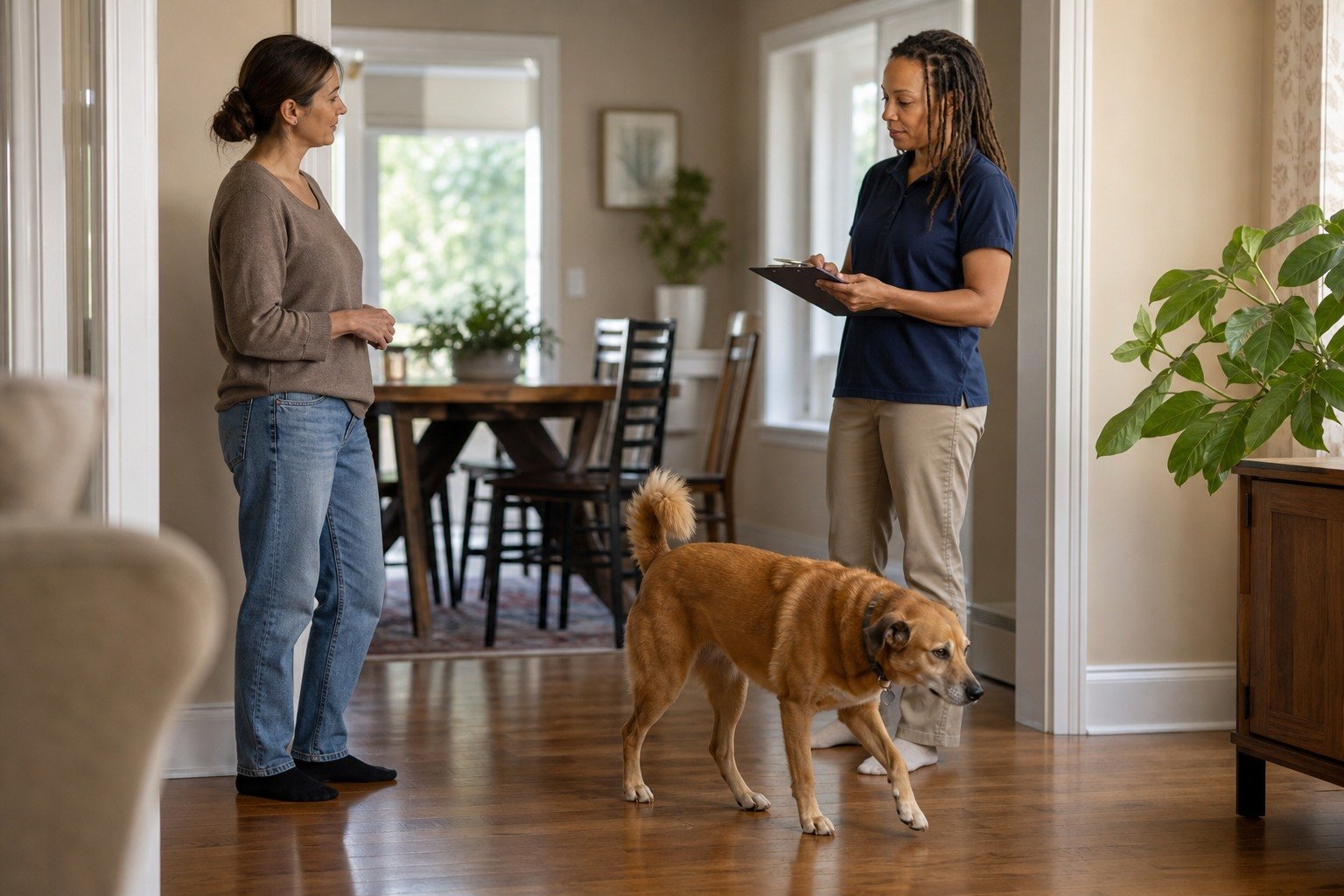
The home is not automatically a neutral setting, and an environmental change is not automatically treatment. Sound, sight lines, visitors, other animals, resource locations, confinement, exits, handling, sleep, and routine can shape what a dog can see, hear, predict, avoid, or choose. The same room may feel manageable at one time and difficult at another. Pain, illness, sensory change, medication effects, learning history, and social context may also contribute. A useful audit therefore maps observable patterns and immediate safety without assigning a diagnosis. Protect retreat and choice, avoid forced tests, change only what the veterinary or qualified behavior plan supports, and track the dog's function and recovery after each adjustment.
Short answer
Map the environment before prescribing a calming setup
AAHA, Merck, and AVSAB guidance supports complete history, medical assessment, humane management, choice, and reward-based care. Research on canine noise fears also shows that environmental exposure and responses vary widely. These sources support an individualized audit; they do not validate one calming room, sound level, crate, scent, product, or household layout for every dog. [1] [2] [3] [4]
- Start with the individual dog's baseline, complete history, and current veterinary plan.
- Use repeated observations to improve a veterinary discussion, not to diagnose or treat at home.
- Keep associations, population findings, and research endpoints within their actual limits.
- Escalate sudden, severe, persistent, progressive, dangerous, or function-limiting changes promptly.
Safety first
Protect people and animals before collecting more observations
Seek prompt professional help for serious aggression, self-injury, repeated escape attempts, inability to rest or eat, sudden behavior change, collapse, severe pain, seizure, disorientation, or rapidly worsening distress. Use distance and secure separation when safe. Do not corner the dog, block the only retreat, recreate a trigger, or remain in danger to complete the audit.
- Do not delay urgent care while completing a log, changing the environment, or seeking a lower-cost option.
- Do not provoke, corner, restrain, punish, flood, or force exposure to test a behavior or capture a video.
- Do not start, stop, combine, divide, or calculate medication or supplements from this article.
Veterinary note
This article is educational and does not diagnose, treat, prescribe, or replace care from a licensed veterinarian. Your dog’s history, examination, diet, medications, and current signs determine what is appropriate.
Walk the home as a pattern map
List the places the dog rests, eats, drinks, toilets, waits, watches, hides, greets, and passes through. Note doorways, windows, narrow routes, slippery surfaces, loud appliances, shared resources, gates, crates, yard boundaries, and locations where people or animals unexpectedly appear. Record the room and task rather than labeling the room good or bad.
Add time, day, weather event, household activity, visitor presence, another animal's location, recent exercise, sleep, food, medication, and health changes. Describe what the dog visibly did, how long it lasted, what increased distance or choice, and how recovery compared with baseline. An association can guide questions but does not prove cause.
Watch ordinary life without staging an event. A short representative video may help only when the behavior is already occurring and filming does not distract from safety. Do not knock, approach, leave, confine, release another animal, or repeat handling to obtain a stronger example.
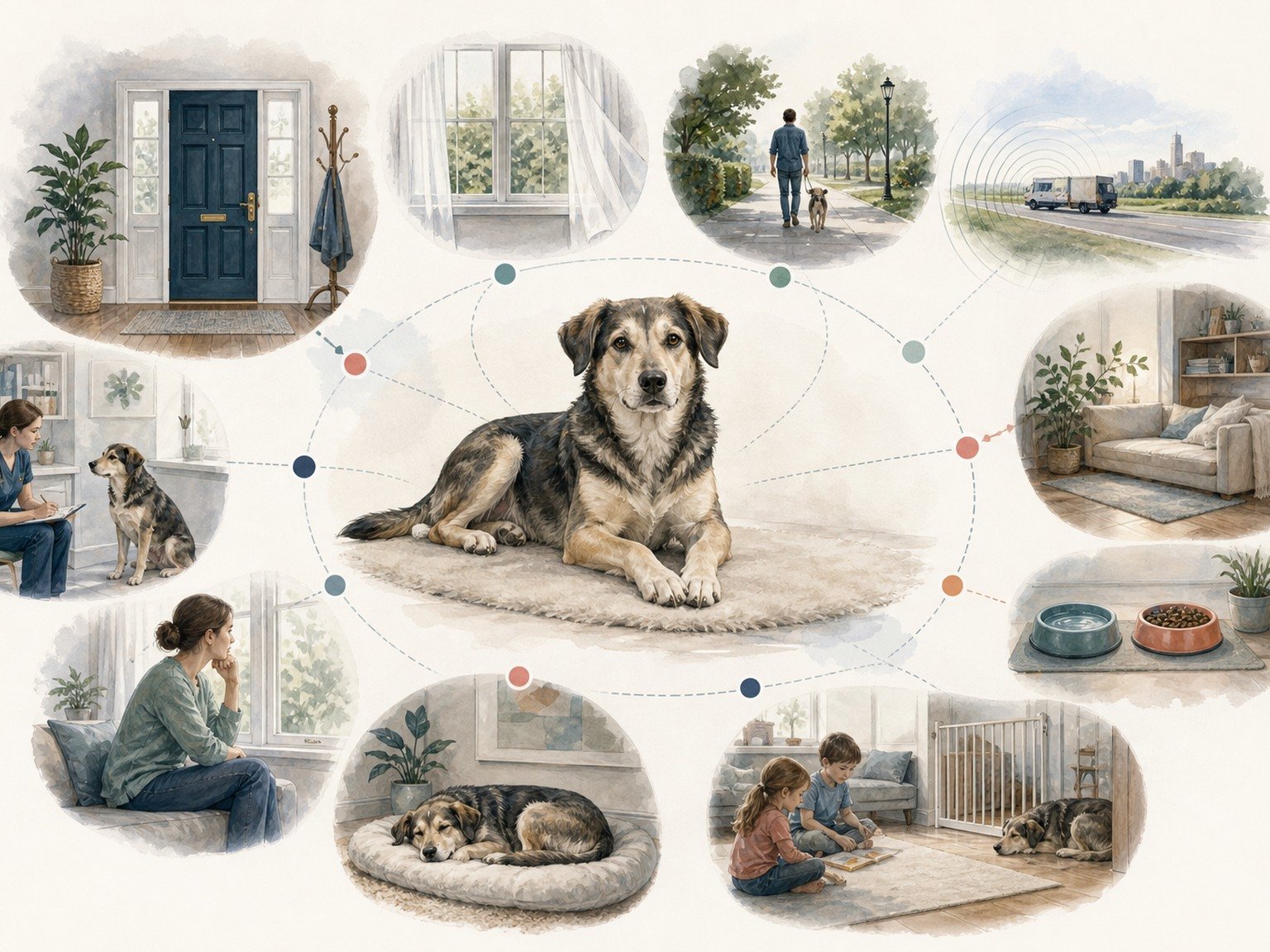
Audit retreat, choice, resources, and confinement
Identify whether the dog can move away from sound, sight, touch, people, and animals without being followed or trapped. A retreat should not become a place where the dog is cornered for handling. Children and visitors need clear boundaries around resting and feeding areas.
Map access to water, food, toileting, comfortable rest, and family contact. Competition, blocked paths, unpredictable handling, or an unsafe exit can matter. Resource placement should fit the household and dog's medical and behavior needs; moving everything at once can obscure what helped or introduced a new problem.
Crates, gates, closed rooms, tethering, and free access have different risks for different dogs. Confinement may increase panic or escape injury in some cases, while unmanaged access may be unsafe in others. Ask the professional team how separation should work and what signs mean the plan should stop.
Reduce exposure without flooding or punishment
Management can lower immediate exposure while assessment and treatment proceed. Examples for discussion include distance, visual barriers, predictable routines, quieter routes, secured separation, and choice-based departures. These are categories, not universal instructions, and they should not remove essential care or social contact.
AVSAB opposes aversive methods and flooding. [3] Do not use intimidation, shock, prong pressure, startling devices, forced proximity, or repeated exposure until the dog stops reacting. A quieter dog may be inhibited rather than comfortable, so measure function, choice, body language, and recovery rather than silence alone.
Household members should use the same simple safety plan. Record who was present, which management step was used, whether it was feasible, and what happened afterward. If the setup cannot be followed safely, tell the veterinary or behavior team rather than improvising stronger control.
Change one variable and plan reassessment
Choose one professionally supported change with a defined purpose: safer separation, easier retreat, reduced exposure, predictable care, or improved access. Record the starting pattern and the same observations after the change. Avoid combining new equipment, supplement, diet, schedule, and training approach at once.
Define a stop rule before the trial. Worsening distress, escape behavior, aggression, reduced eating or sleep, loss of toileting access, pain, or a new health sign warrants contact and may require reversal or urgent assessment. No fixed number of days is safe for every dog.
Bring the map, concise trend summary, representative video, medication and supplement list, and household constraints to the appointment. Ask what medical contributors should be assessed, whether qualified behavior referral is needed, and which functional outcome and recheck interval apply.
Prepare for a focused veterinary conversation
Bring a concise timeline, short natural-movement or symptom videos when safe, the exact names and photographs of every food, treat, medication, and supplement label, and notes about appetite, water intake, stool, sleep, activity, comfort, and behavior. Include recent injuries, travel, boarding, diet changes, missed medication, and previous test results. A complete record helps the veterinary team separate a repeatable pattern from a single impression.
Decide in advance what you need from the visit: an urgency decision, a diagnosis plan, a nutrition review, a pain or mobility assessment, or a monitored trial. Ask what result would change the plan and what finding would rule an option out. This keeps research and product information in the right role. Evidence can shape questions and expectations, but it cannot determine what is safe for an individual dog without the history and examination.
Owner tool
Build a room-by-room environment audit
On a phone, swipe across the table to see every column.
| Checkpoint | What to record | Why it helps |
|---|---|---|
| Place and time | Room, route, people, animals, routine | Locates pattern |
| Choice | Retreat, distance, exits, resources | Tests agency |
| Response | Observable behavior, duration, recovery | Tracks function |
| Change | One adjustment, outcome, stop rule | Supports review |
Better questions, calmer next steps
Questions to ask your veterinarian
- Could pain, illness, or sensory change contribute?
- Which locations or routines deserve priority?
- What separation plan protects everyone safely?
- Which single change should we test first?
- What response requires earlier contact or referral?
FAQ
Does every anxious dog need a safe room?
No. Retreat and management must fit the individual dog and household.
Should I play calming sounds?
Ask whether sound is appropriate and monitor the dog's response without assuming benefit.
Is a crate always calming?
No. Confinement can help some situations and worsen distress or injury risk in others.
Can I test the trigger to check progress?
Do not recreate exposure without a professional plan.
Does hiding confirm anxiety?
No. Hiding is an observation with several possible explanations.
Sources
- American Animal Hospital Association: Canine and Feline Behavior Management Guidelines. Medical assessment, history, environment, management, and referral.
- Merck Veterinary Manual: Behavior Problems of Dogs. Behavior assessment, context, management, and treatment boundaries.
- American Veterinary Society of Animal Behavior: Humane Dog Training Position Statement. Reward-based care and opposition to aversives and flooding.
- Veterinary Sciences: Noise Fears in Dogs: A Review. Noise-fear evidence and limits of generalization.
