

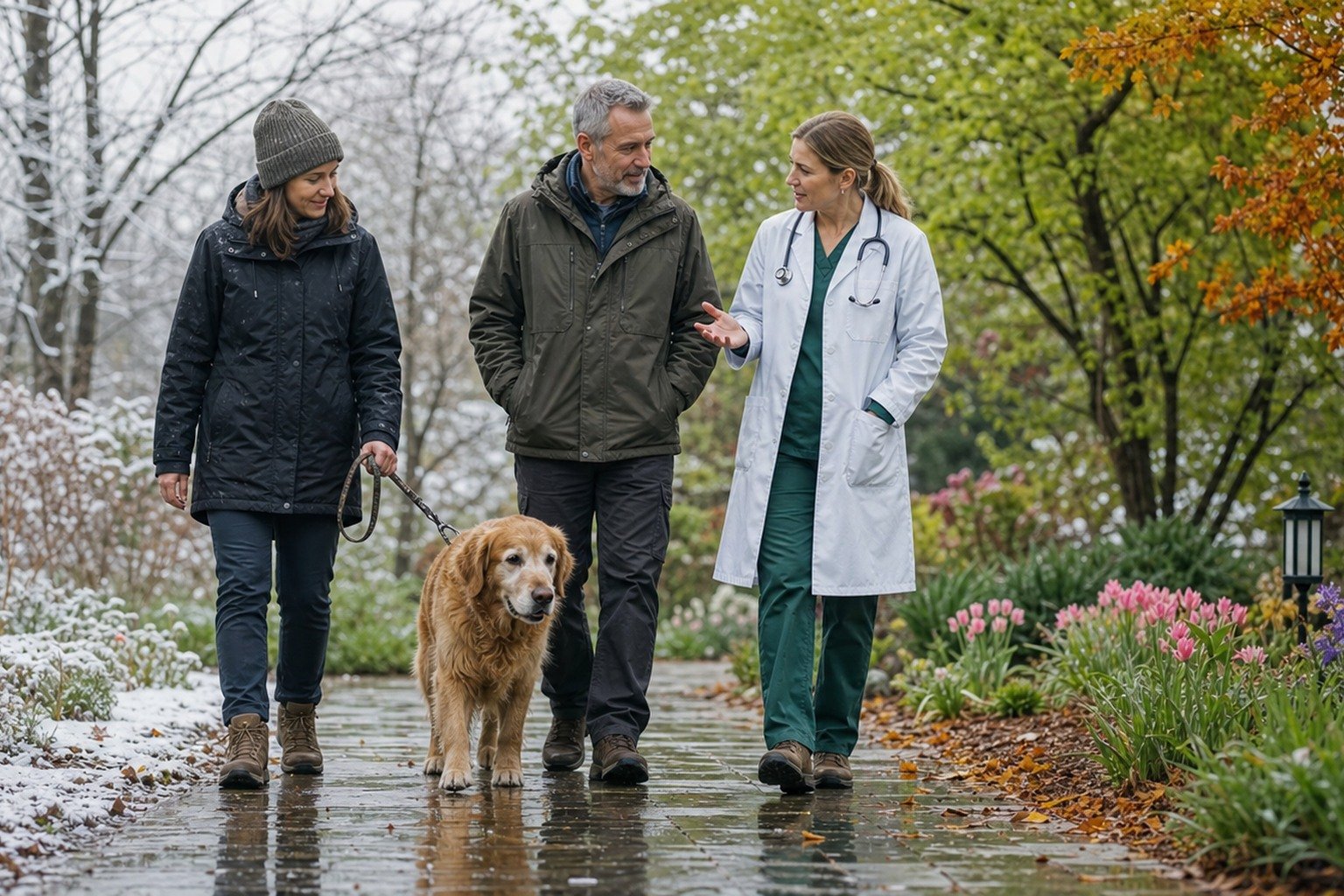
Heat, cold, storms, daylight, allergens, travel, holidays, household schedules, and surface conditions can change a senior dog's daily context. They do not explain every appetite, movement, breathing, skin, sleep, elimination, or behavior change. Older dogs often have multiple conditions, medications, sensory changes, or reduced reserve, so a calendar explanation can delay needed assessment. Keep a stable whole-dog baseline across the year, record environmental context alongside observable function, and ask the veterinary team for patient-specific precautions. There is no universal temperature cutoff, seasonal supplement, coat rule, or activity schedule that is safe for every senior dog.
Short answer
Season is context, not a diagnosis
AAHA senior-care guidance emphasizes baseline, multimorbidity, repeated assessment, and avoiding dismissal as normal aging. AVMA cold- and warm-weather resources describe exposure risks while stressing individual tolerance and supervision. Together they support seasonal planning, not a universal threshold or a conclusion that weather caused a senior dog's change. [1] [2] [3] [4]
- Start with the individual dog's baseline, complete history, and current veterinary plan.
- Use repeated observations to improve a veterinary discussion, not to diagnose or treat at home.
- Keep associations, population findings, and research endpoints within their actual limits.
- Escalate sudden, severe, persistent, progressive, dangerous, or function-limiting changes promptly.
Safety first
Breathing, collapse, severe weakness, or rapid change cannot wait
Seek urgent care for breathing difficulty, collapse, pale or blue gums, severe weakness, inability to stand, seizure, heat illness, hypothermia concerns, major trauma, repeated unproductive retching, or rapidly worsening pain. Contact the veterinarian promptly for persistent appetite, water, elimination, movement, skin, sleep, or behavior changes rather than waiting for the season to pass.
- Do not delay urgent care while completing a log, changing the environment, or seeking a lower-cost option.
- Do not provoke, corner, restrain, punish, flood, or force exposure to test a behavior or capture a video.
- Do not start, stop, combine, divide, or calculate medication or supplements from this article.
Veterinary note
This article is educational and does not diagnose, treat, prescribe, or replace care from a licensed veterinarian. Your dog’s history, examination, diet, medications, and current signs determine what is appropriate.
Keep one baseline through the whole year
Record appetite, measured intake, water, urine, stool, weight, body and muscle condition, rising, gait, stairs, activity, recovery, breathing, cough, sleep, behavior, grooming, skin, vision, hearing, medication, and supplements. A consistent set of observations makes seasonal comparison more useful.
Add temperature, humidity, precipitation, surface condition, daylight, travel, visitors, boarding, indoor heating or cooling, and unusual exposure as context. Do not convert the log into a home diagnostic score or assume two events occurring together establish causation.
AAHA recommends individualized senior assessment and repeated monitoring because older animals may have interacting conditions. [1] [2] A new change deserves whole-patient context even when it first appears during a heat wave, cold snap, storm season, holiday, or allergy season.
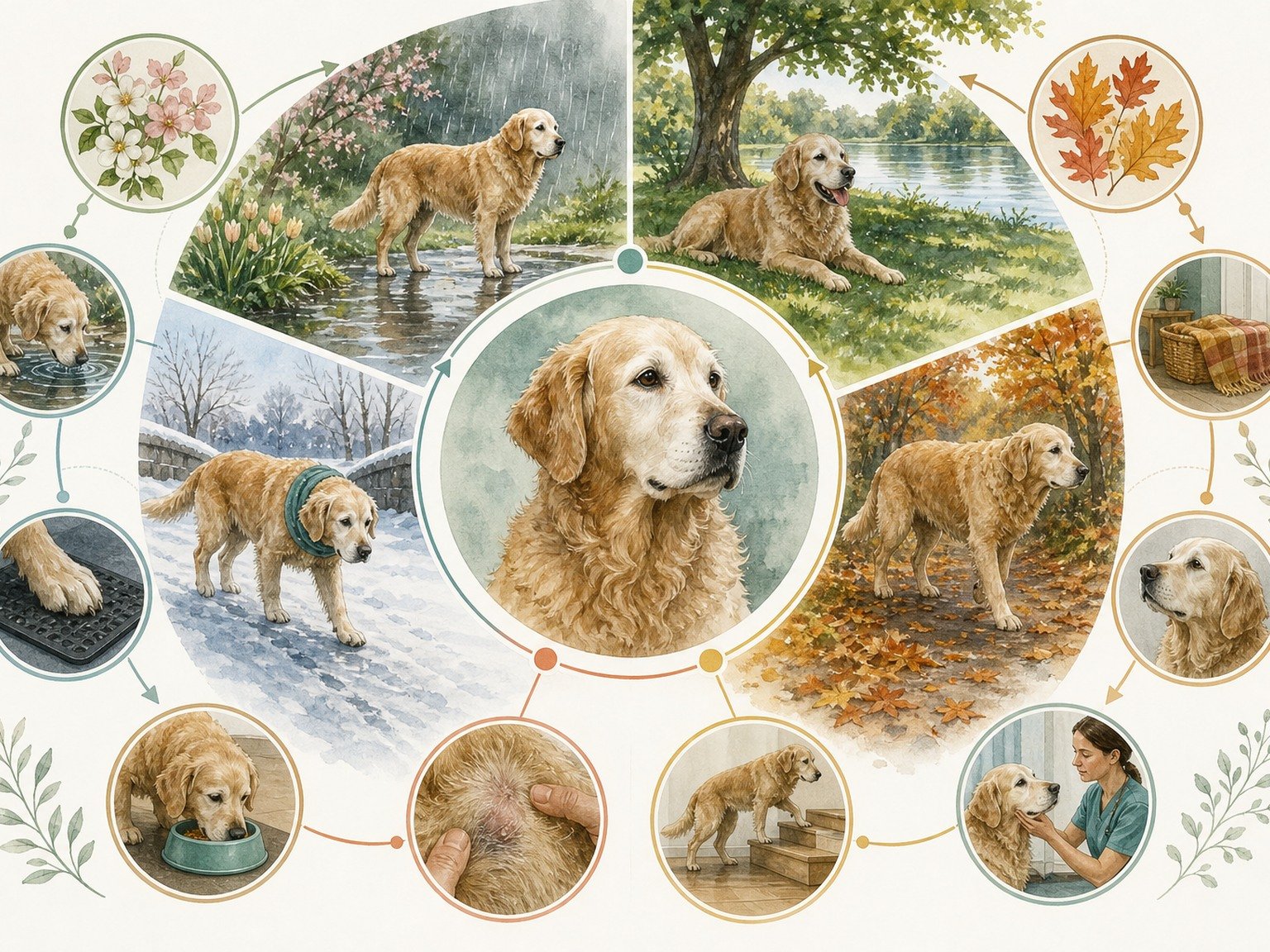
Plan for heat and cold without a universal cutoff
AVMA describes risks from hot surfaces, enclosed vehicles, heat, cold, wind, moisture, and inadequate shelter. [3] [4] Age, breed, coat, body size, acclimation, heart or lung disease, mobility, cognition, medication, and access to water or shelter affect tolerance.
Ask the veterinary team about patient-specific outdoor duration, exercise intensity, hydration, paw protection, grooming, clothing, and medication considerations. A coat, boot, cooling item, or supplement is not automatically needed or safe. Never use a parked vehicle as a waiting area.
Observe comfort and function before, during, immediately after, and later in the day. Stop for distress, weakness, disorientation, painful footing, breathing change, or inability to recover. Do not deliberately expose the dog to determine a limit.
Review seasonal routines and indoor changes
Heating, cooling, closed windows, open windows, floor surfaces, darkness, noise, guests, school schedules, travel, boarding, and altered walk times can change sleep, access, traction, toileting, social contact, and medication adherence. Map the practical change before assuming a medical or behavioral cause.
Maintain safe access to water, food, toileting, rest, traction, light, and familiar cues. A senior dog with sensory or cognitive change may need a more predictable route, but environment changes should fit current function and not create confinement, trip, or overheating risk.
Track skin, ears, paws, coat, scratching, licking, odor, and grooming tolerance without diagnosing an allergy from the season. Parasite prevention, vaccination, diet, and medication decisions remain veterinary decisions based on location, exposure, health, and product-specific factors.
Use trends to trigger reassessment
Summarize what changed, onset, frequency, duration, recovery, season and exposure context, concurrent health signs, and what remained normal. Include safe photos or video only when they capture ordinary function without repeating a difficult task.
Set a recheck schedule and earlier-call signs with the veterinary team. If a pattern returns each season, that history can guide assessment, but recurrence still does not establish a diagnosis or justify restarting old medication without instruction.
The goal is not to eliminate every seasonal variation. It is to preserve comfort and access, notice meaningful departure from baseline, and distinguish an environmental planning question from a change requiring examination, diagnostics, or treatment review.
Prepare for a focused veterinary conversation
Bring a concise timeline, short natural-movement or symptom videos when safe, the exact names and photographs of every food, treat, medication, and supplement label, and notes about appetite, water intake, stool, sleep, activity, comfort, and behavior. Include recent injuries, travel, boarding, diet changes, missed medication, and previous test results. A complete record helps the veterinary team separate a repeatable pattern from a single impression.
Decide in advance what you need from the visit: an urgency decision, a diagnosis plan, a nutrition review, a pain or mobility assessment, or a monitored trial. Ask what result would change the plan and what finding would rule an option out. This keeps research and product information in the right role. Evidence can shape questions and expectations, but it cannot determine what is safe for an individual dog without the history and examination.
Owner tool
Build a year-round senior baseline
On a phone, swipe across the table to see every column.
| Checkpoint | What to record | Why it helps |
|---|---|---|
| Whole dog | Intake, elimination, weight, movement, sleep | Defines baseline |
| Environment | Heat, cold, surface, light, routine | Adds context |
| Response | Function, comfort, recovery, later effects | Shows tolerance |
| Review | Trend, urgent signs, recheck plan | Guides care |
Better questions, calmer next steps
Questions to ask your veterinarian
- Which seasonal risks matter for this dog's conditions?
- What exposure or activity limits are patient-specific?
- Could medication or disease change temperature tolerance?
- Which recurring signs require diagnostics?
- What should trigger urgent or earlier contact?
FAQ
Is slowing down in winter normal?
Do not assume so; pain, footing, disease, and other factors need context.
Does every senior dog need a coat?
No. Need and fit are individual.
Can weather cause arthritis?
Weather may coincide with observations, but it does not diagnose arthritis or define treatment.
Should water intake rise in summer?
Monitor access and actual change; marked thirst deserves veterinary discussion.
Can I restart last season's medication?
Only under current veterinary direction.
Sources
- American Animal Hospital Association: 2023 Senior Care Guidelines. Whole-patient senior assessment and multimorbidity.
- American Animal Hospital Association: Evaluating the Healthy Senior Pet. Baseline, history, examination, and repeated monitoring.
- American Veterinary Medical Association: Cold Weather Animal Safety. Cold, wind, moisture, shelter, and exposure safety.
- American Veterinary Medical Association: Warm Weather Pet Safety. Heat, vehicles, surfaces, hydration, and warm-weather safety.
