

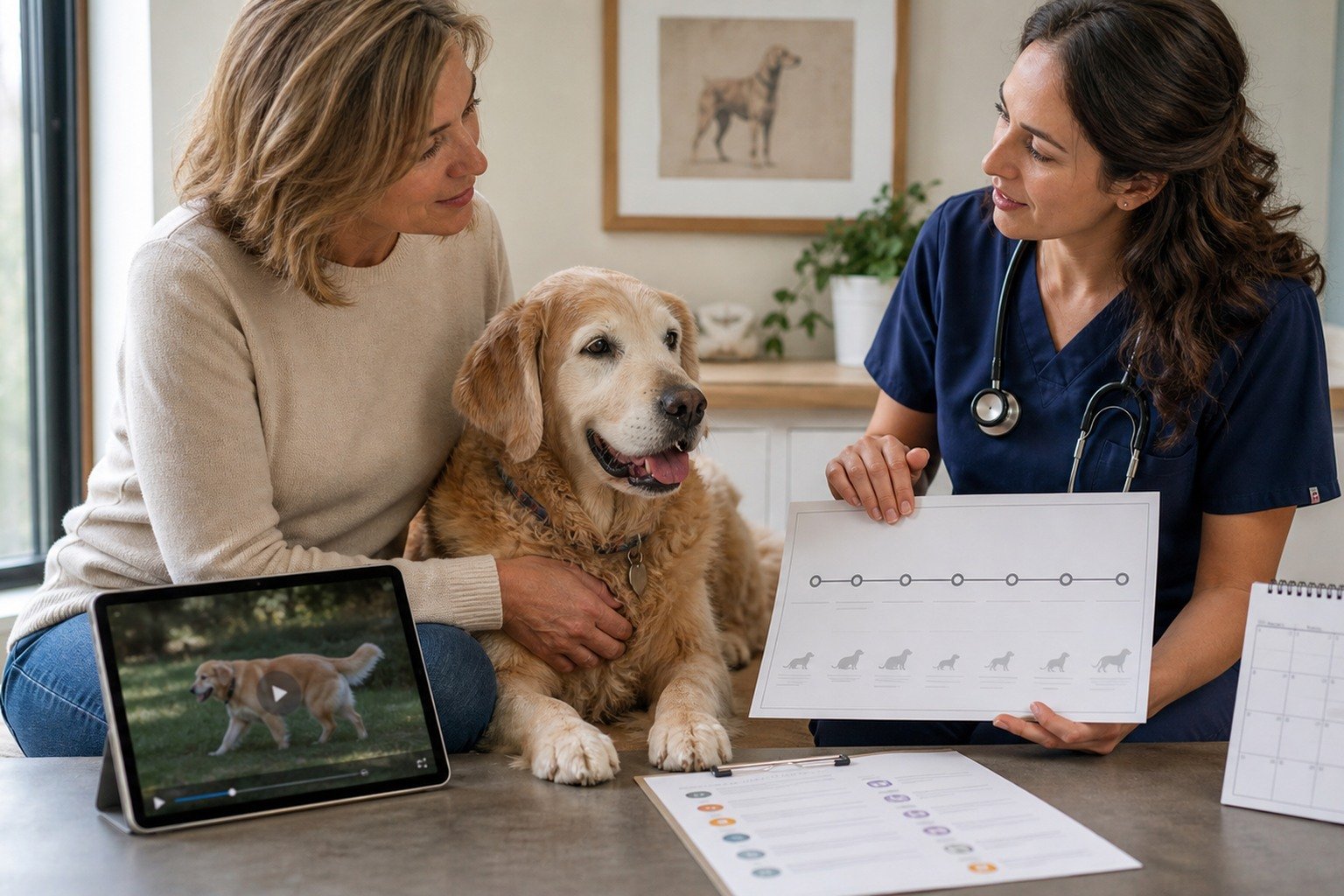
Owners observe ordinary days; veterinarians contribute examination, diagnostic reasoning, interpretation, treatment planning, and coordination. Senior care often involves several conditions and priorities at once. Productive communication uses one current record, a whole-dog timeline, explicit goals, honest constraints, and clear follow-up without asking the owner to diagnose aging or choose tests alone. Keep dates, sources, and the dog's affected daily function attached to every observation so later changes can be compared accurately without turning a trend into a home diagnosis. AAHA senior guidance supports this longitudinal whole-patient context. [1]
Short answer
Bring longitudinal function and priorities, not an age-based diagnosis
AAHA emphasizes individual variation, multimorbidity, history, examination, patient-specific diagnostics, and shared planning. Quality-of-life research supports structured owner observation while preserving measurement limits. [1] [2] [3] [4]
- Compare the dog with an individual whole-dog baseline.
- Observe ordinary function without provoking pain, fear, fatigue, or a stronger example.
- Treat age, terms, checklists, and population evidence as context rather than diagnosis.
- Escalate sudden, severe, progressive, dangerous, or function-limiting changes promptly.
Safety first
Do not dismiss urgent change as normal aging
Seek urgent care for collapse, breathing difficulty, seizure, severe pain, major trauma, inability to stand, sudden loss of coordination, repeated unproductive retching, a painful distended abdomen, major bleeding, suspected toxin exposure, or new inability to urinate. Contact the veterinarian promptly for rapid or progressive change.
- Do not delay urgent care while completing a log, FAQ, glossary, or routine appointment plan.
- Do not force activity, handling, food, water, or a home test to confirm a concern.
- Do not start, stop, combine, divide, or calculate medication or supplements from this article.
Veterinary note
This article is educational and does not diagnose, treat, prescribe, or replace care from a licensed veterinarian. Your dog’s history, examination, diet, medications, and current signs determine what is appropriate.
Prepare a whole-dog timeline
Record appetite, water, urination, stool, vomiting, weight, body and muscle condition, mobility, breathing, cough, sleep, behavior, senses, grooming, mouth, skin, social interaction, and recovery.
Add onset, pattern, progression, affected task, injuries, routine changes, medication, supplements, diet, prior results, and what remains comfortable.
Use dates and distinguish representative from unusual events. Short natural video can help when safe but cannot replace examination.
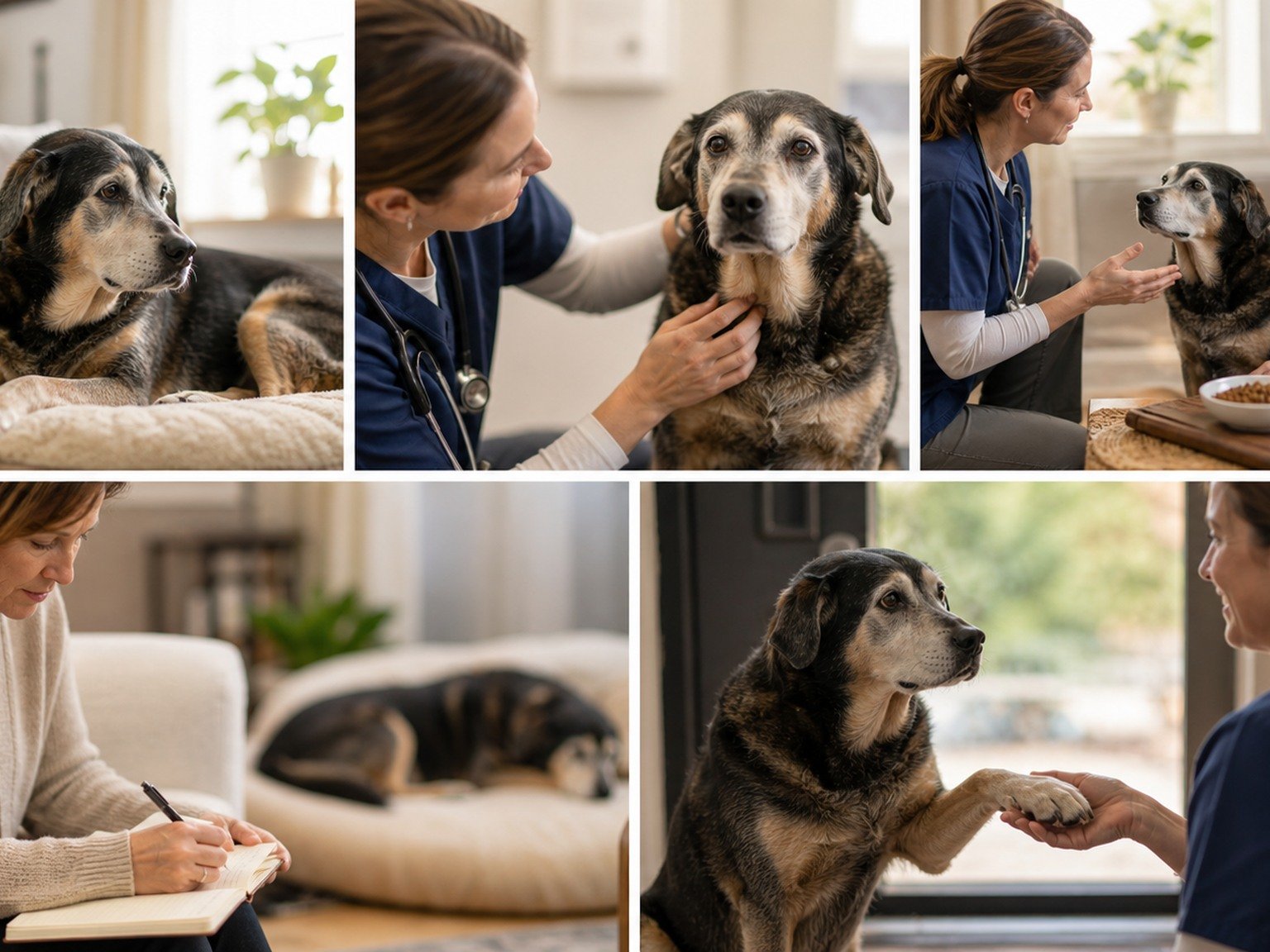
Maintain one current treatment and record list
List exact medication and supplement names, formulation, label directions, actual use, purpose, start date, prescriber, refill source, missed doses, and possible adverse effects.
Bring diet details, allergies, diagnoses, laboratory and imaging reports, specialists, emergency visits, and current instructions. Do not assume records transfer automatically.
Mark discontinued items and the reason, but keep the active list unmistakable. Never combine or adjust products to reconcile conflicting advice yourself.
Ask what each assessment is intended to clarify
Ask which conditions fit the pattern, what findings support or argue against them, which tests would change the plan, and what uncertainty remains.
For screening, ask why the test fits now and what trend matters. For a new concern, ask whether the test evaluates that problem or a broader baseline. [3]
Request plain-language benefits, risks, alternatives, tradeoffs, costs, and consequences of waiting when appropriate. Shared decisions do not guarantee one outcome.
Set whole-dog priorities and meaningful outcomes
Name the dog's valued activities and the caregiver's practical constraints. Priorities may include comfort, appetite, mobility, sleep, social engagement, toileting, medication tolerance, and safe daily routines.
Choose a small number of observable functional outcomes. A quality-of-life score can organize discussion but should not become a standalone diagnosis or irreversible cutoff. [4]
When several conditions compete, ask which issue is most urgent, which intervention may affect another condition, and how tradeoffs will be reassessed.
Close the follow-up loop
Write what changes now, what stays stable, contact triggers, adverse signs, monitoring, and the recheck date. Repeat the plan back in your own words.
Report worsening, new falls, appetite or water change, elimination change, breathing change, confusion, medication effects, or inability to carry out the plan promptly.
Ask which channel handles routine updates, urgent concerns, video, records, and refills. Identify who owns the next decision when several clinicians are involved.
Coordinate family and outside care
Share a concise current plan with household members, walkers, sitters, groomers, boarding staff, rehabilitation teams, emergency clinics, and specialists as relevant.
Use consistent units and descriptions. Conflicting logs, duplicate dosing, and unlabeled observations can obscure trends or create risk.
Ask clinicians to reconcile differing activity, nutrition, medication, or monitoring instructions. Preserve the date and source of every change.
Prepare for decisions across several conditions
When kidney, endocrine, cardiac, dental, orthopedic, neurologic, digestive, or cognitive concerns coexist, ask how one diagnostic or treatment choice affects the others. Multimorbidity can change priorities and monitoring.
Request a problem list that identifies confirmed diagnoses, active possibilities, current goals, responsible clinician, and next decision. Do not merge old and new instructions without review.
If recommendations compete, ask which risk is most important now, what compromise is being made, and what result or adverse sign would reopen the decision.
Document preferences before a crisis
Discuss transport, emergency clinic, hospitalization, procedures, caregiver limits, and decision-making roles while the dog is stable enough for a thoughtful conversation.
Preferences are not fixed predictions. New findings and the dog's response may appropriately change them, and urgent care still requires real-time clinical guidance.
Keep the current contact and preference summary accessible to household members without turning it into a substitute for veterinary consent or examination.
Keep the evidence boundary visible
AAHA frames senior care around the whole patient, individual variation, multimorbidity, and repeated reassessment. That guidance supports the questions in this article but does not prescribe one test, interval, diet, activity plan, or outcome for every older dog. [1]
Prepare for a focused veterinary conversation
Bring a concise timeline, short natural-movement or symptom videos when safe, the exact names and photographs of every food, treat, medication, and supplement label, and notes about appetite, water intake, stool, sleep, activity, comfort, and behavior. Include recent injuries, travel, boarding, diet changes, missed medication, and previous test results. A complete record helps the veterinary team separate a repeatable pattern from a single impression.
Decide in advance what you need from the visit: an urgency decision, a diagnosis plan, a nutrition review, a pain or mobility assessment, or a monitored trial. Ask what result would change the plan and what finding would rule an option out. This keeps research and product information in the right role. Evidence can shape questions and expectations, but it cannot determine what is safe for an individual dog without the history and examination.
Owner tool
Prepare a productive senior visit
On a phone, swipe across the table to see every column.
| Checkpoint | What to record | Why it helps |
|---|---|---|
| Timeline | Whole-dog change and function | Defines pattern |
| Records | Products, tests, clinicians | Supports continuity |
| Discussion | Possibilities, options, limits | Clarifies plan |
| Follow-up | Outcome, triggers, route | Closes loop |
Better questions, calmer next steps
Questions to ask your veterinarian
- Which conditions and priorities matter most now?
- What can each test establish or not establish?
- How might one condition or treatment affect another?
- Which functional outcome should we monitor?
- Who owns follow-up and when?
FAQ
Can a video diagnose a senior condition?
No.
Should I arrive with a diagnosis?
No; bring observations and questions.
Can one specialist see every record automatically?
Do not assume so.
Are quality-of-life tools definitive?
No.
What if the plan is hard to follow?
Report barriers promptly.
Sources
- American Animal Hospital Association: 2023 Senior Care Guidelines. Whole-patient senior assessment and multimorbidity.
- American Animal Hospital Association: Evaluating the Healthy Senior Pet. History, examination, baseline, and monitoring.
- American Animal Hospital Association: Diagnostic Tests and Recommended Frequencies. Patient-specific diagnostics and monitoring.
- Frontiers in Veterinary Science: Health-Related Quality of Life in Senior Dogs. Multidimensional owner reporting and measurement limits.
