

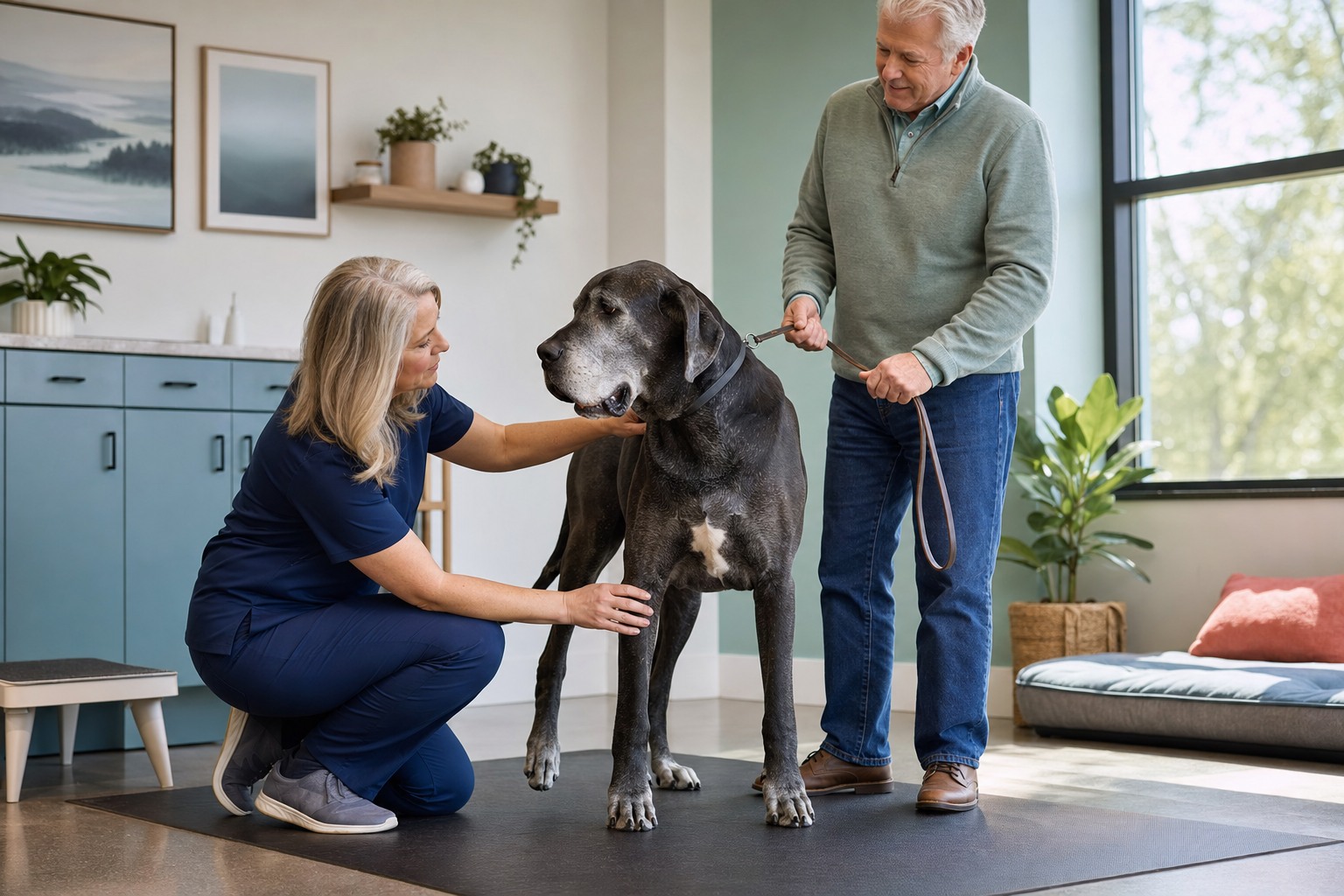
Large and giant dogs often reach the senior life stage earlier than smaller dogs at a population level, but no birthday or breed average can determine an individual dog's health, remaining lifespan, pain, or care plan. Aging is not a diagnosis. A useful senior baseline combines history, examination, weight, body and muscle condition, gait, rising, sleep, appetite, water intake, toileting, breathing, dental comfort, sensory function, cognition, behavior, medications, and appropriate diagnostic testing. Large size also changes practical questions: vehicle access, stairs, flooring, lifting capacity, restraint, clinic space, and the consequence of a fall or sudden weakness. Record small changes early and avoid dismissing them as normal for a big old dog. Multimorbidity is common, so nutrition, mobility, pain, medication, and environment decisions should be coordinated rather than handled one symptom at a time.
Short answer
Use size to plan earlier attention, not to predict an outcome
AAHA states that senior status varies by species, breed, size, and individual, and senior care should be tailored. Population studies find body-size and breed differences in life expectancy, but averages do not forecast one dog's lifespan or prove the cause of a current sign. [1] [2] [3]
- Start with the individual dog's baseline, complete history, and veterinary plan.
- Track change across function, comfort, appetite, sleep, and behavior instead of blaming age or breed.
- Use environment and routine as coordinated supports, not substitutes for diagnosis or care.
- Escalate sudden, severe, persistent, or rapidly worsening signs promptly.
Safety first
Do not call sudden weakness, breathing change, or inability to rise old age
Seek urgent care for collapse, breathing difficulty, pale or blue gums, a swollen painful abdomen, unproductive retching, major trauma, inability to stand, severe pain, sudden neurologic change, repeated vomiting, or rapid decline. Contact the veterinarian promptly for persistent lameness, cough, appetite loss, weight or muscle change, or new confusion.
- Do not use this article to diagnose anxiety, pain, cognitive change, or organ disease.
- Do not change prescribed medication, diet, or activity because of a general age or breed rule.
- Seek urgent veterinary care for collapse, breathing difficulty, severe pain, major trauma, or rapid decline.
Veterinary note
This article is educational and does not diagnose, treat, prescribe, or replace care from a licensed veterinarian. Your dog’s history, examination, diet, medications, and current signs determine what is appropriate.
Define senior status around the individual dog
Ask when the veterinary team considers this dog senior and what that changes in preventive care, screening, dental planning, nutrition assessment, pain evaluation, and visit frequency. AAHA emphasizes that the senior stage begins at different times and needs individualized planning rather than one age cutoff. [1]
Life expectancy tables and breed studies describe groups receiving veterinary care or registered populations. [2] [3] They can support early planning but are influenced by breed, size, sex, genetics, environment, access to care, and study design. Do not use an average to delay care or make a prognosis.
Build a baseline while the dog is stable. Record normal rising, gait, stairs, toileting, eating posture, breathing after usual activity, sleep, social behavior, response to sound and sight, and recovery. Photograph or video natural function periodically when safe.
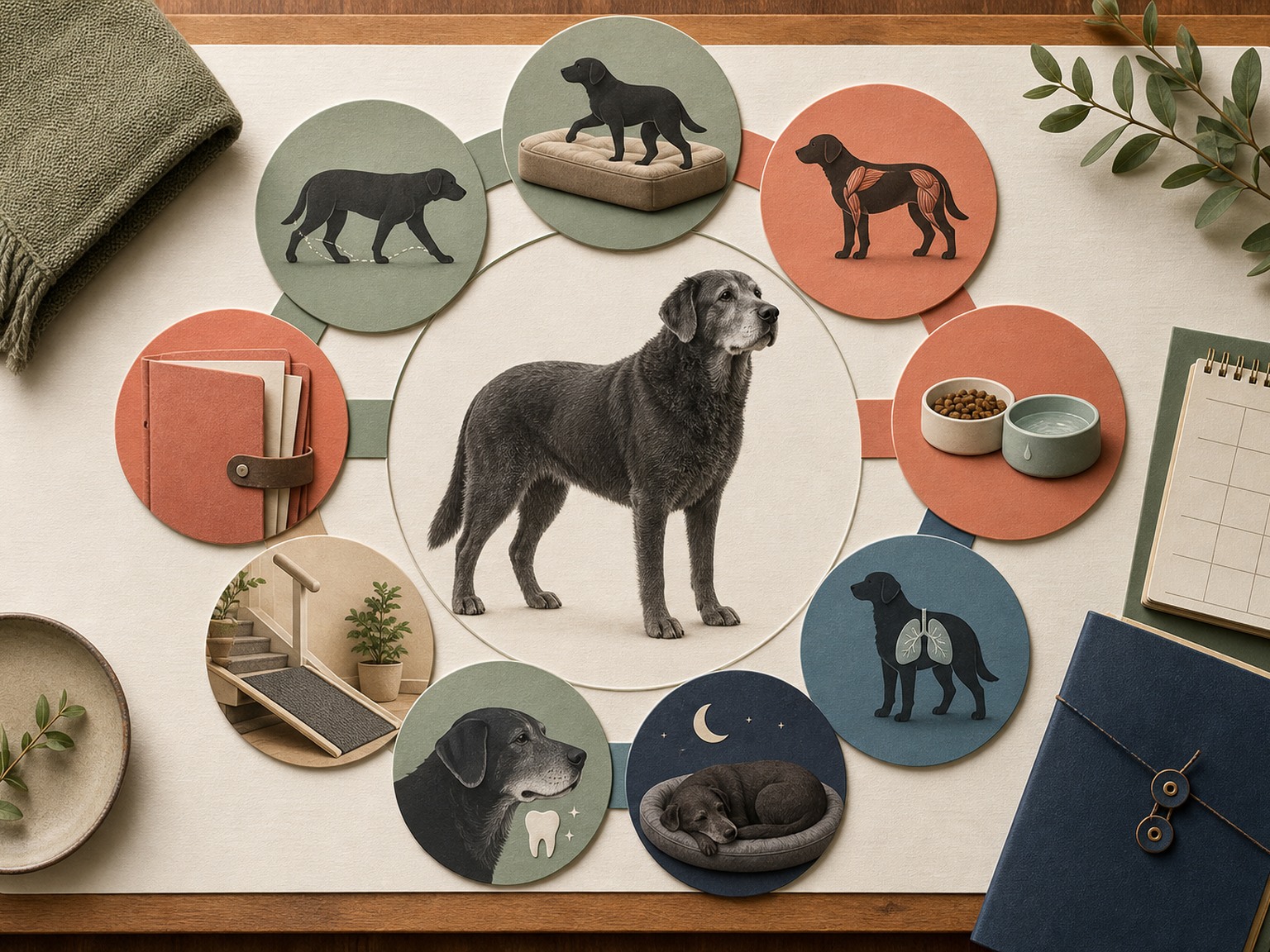
Screen across systems rather than chasing one symptom
Senior care is multifaceted and can include diagnostics, pain management, nutrition, dentistry, behavior, environmental modification, and management of several conditions together. [4] Share every medication and supplement so the team can assess interactions, administration burden, and whether one plan conflicts with another.
Ask which examination and diagnostic tests fit the dog's age, history, breed context, prior results, and current signs. Testing can reveal trends that are not visible from appearance alone, but no panel guarantees early detection of every disease. [5] Interpret results with the clinician and the dog's baseline.
Report changes in thirst, urination, appetite, weight, muscle, stool, vomiting, cough, breathing, exercise tolerance, skin, masses, mouth odor, chewing, sleep, house-soiling, and behavior. A change that seems minor may connect with another system or medication.
Protect mobility, traction, and caregiver feasibility
Large senior dogs may need wide clear paths, nonslip footing, stable rest areas, manageable vehicle access, and planned help for stairs or emergencies. An aid is only useful when it fits the dog, surface, vehicle, and caregiver. Do not improvise lifting by limbs or force a painful transfer.
Track body and muscle condition together. Excess body fat can add load, while muscle loss can reduce stability and make the dog harder to assist. Weight alone cannot show which tissue changed. Nutrition and movement plans should protect adequate nutrients, comfort, and feasible repetition.
Discuss pain even when the dog does not cry. Slower rising, shorter stride, reluctance, changed posture, sleep disturbance, withdrawal, irritability, or reduced activity can be clues. Large dogs may mask a gradual decline until home tasks become difficult.
Coordinate goals and rechecks as needs change
List the household's highest priorities: comfortable toileting, safe sleep, social engagement, appetite, manageable medication, mobility to important spaces, or participation in a favored routine. Goals make treatment tradeoffs clearer and help the team notice when a plan no longer fits.
Use a written recheck schedule and know which signs should trigger an earlier call. Bring logs and video plus exact food, treat, medication, and supplement labels. Senior care often requires adjustment as conditions, body composition, tolerance, or caregiver capacity change.
Avoid treating every change with a separate product. A new supplement, diet, brace, or calming aid can add calories, interaction risk, cost, and confusion without addressing the cause. Ask what problem an intervention targets, what evidence applies, what outcome will be monitored, and when it should stop.
Prepare for a focused veterinary conversation
Bring a concise timeline, short natural-movement or symptom videos when safe, the exact names and photographs of every food, treat, medication, and supplement label, and notes about appetite, water intake, stool, sleep, activity, comfort, and behavior. Include recent injuries, travel, boarding, diet changes, missed medication, and previous test results. A complete record helps the veterinary team separate a repeatable pattern from a single impression.
Decide in advance what you need from the visit: an urgency decision, a diagnosis plan, a nutrition review, a pain or mobility assessment, or a monitored trial. Ask what result would change the plan and what finding would rule an option out. This keeps research and product information in the right role. Evidence can shape questions and expectations, but it cannot determine what is safe for an individual dog without the history and examination.
Owner tool
Build a large-senior whole-dog baseline
On a phone, swipe across the table to see every column.
| Checkpoint | What to record | Why it helps |
|---|---|---|
| Function | Rise, gait, stairs, toilet, recovery | Finds mobility change |
| Body | Weight, fat, muscle, appetite | Tracks composition |
| Systems | Breathing, water, urine, stool, sleep | Connects signs |
| Plan | Tests, drugs, goals, recheck | Coordinates care |
Better questions, calmer next steps
Questions to ask your veterinarian
- When is this dog considered senior and why?
- Which screening and dental assessments fit the individual risk?
- Could pain or muscle loss explain this change?
- Which home-access plan is safe for dog and caregiver?
- How will several conditions and treatments be coordinated?
FAQ
What age is a large dog senior?
It varies by breed, size, health, and individual; ask the veterinary team.
Do large dogs always live shorter lives?
Population averages differ, but they do not predict one dog's lifespan.
Is slowing down normal?
A change deserves assessment rather than automatic attribution to age.
Should every senior take a joint supplement?
No. Supplements should address a defined need and be reviewed for safety.
Why measure muscle condition?
A dog can lose muscle even when scale weight is stable or high.
Sources
- American Animal Hospital Association: Defining the Senior Patient. Individual senior-stage definition and size context.
- Frontiers in Veterinary Science: Life Expectancy Tables for Dogs and Cats. Population life expectancy estimates and limits.
- Conservation Genetics: Body Size, Inbreeding, and Lifespan in Domestic Dogs. Breed-level size, genetics, and lifespan associations.
- American Animal Hospital Association: 2023 Senior Care Guidelines. Multifaceted individualized senior care.
- American Animal Hospital Association: Supporting Your Senior Pet. Owner monitoring, examinations, diagnostics, nutrition, and behavior assessment.
