

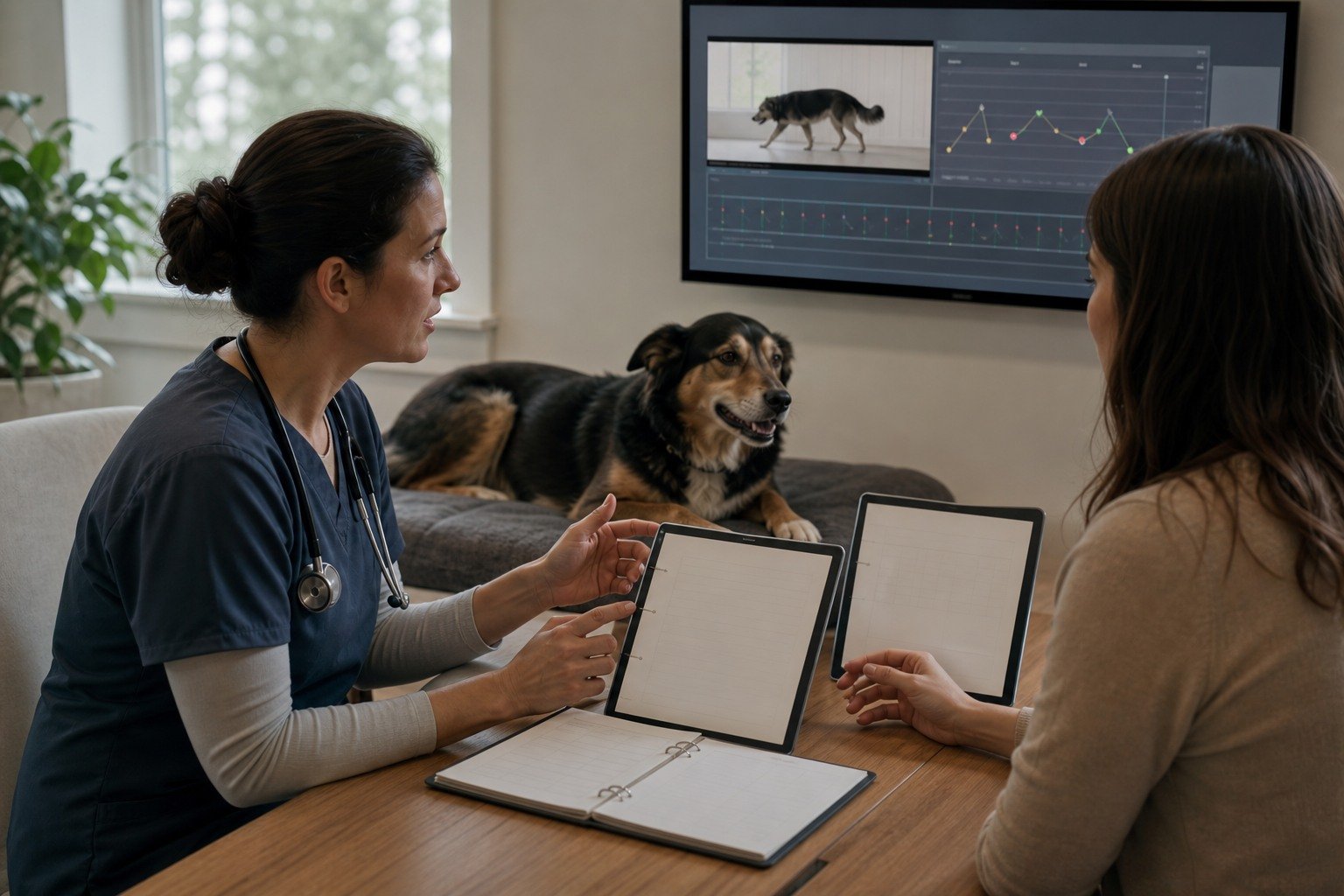
Owners see movement across ordinary days; clinicians contribute examination, diagnostic reasoning, imaging when indicated, interpretation, and treatment planning. A productive relationship combines those perspectives without asking the owner to perform orthopedic tests or arrive with a diagnosis. Record what changed, when, after which activity or event, how the dog rises and moves, and which daily function is affected. Bring safe natural video and every medication and supplement label. Ask what the assessment can and cannot establish, confirm the intended outcome, and close the follow-up loop. Preserve dates and source names when several care teams contribute. Keep the current plan easy to find, and note who should receive updates when movement, comfort, medication tolerance, or daily function changes.
Short answer
Bring longitudinal function, not a home diagnosis
AAHA emphasizes owner observation in chronic-pain assessment. Outcome-measure research shows that tools have intended uses and measurement limits. COAST supports staged reassessment, and Cornell describes OA diagnosis and multimodal care. These sources support collaboration, accurate change from baseline, and coordinated follow-up, not video diagnosis or a universal monitoring score. [1] [2] [3] [4]
- Start with the individual dog's baseline, complete history, and current veterinary plan.
- Observe ordinary function without provoking pain, distress, or a stronger example.
- Use terms, population evidence, tools, and studies only within their intended limits.
- Escalate sudden, severe, persistent, progressive, dangerous, or function-limiting changes promptly.
Safety first
Communication preparation cannot delay urgent movement changes
Seek urgent care for major trauma, inability to stand, severe or escalating pain, a dangling or unstable limb, non-weight-bearing lameness, dragging or knuckling, loss of coordination, collapse, fever with joint pain, or new loss of bladder or bowel control.
- Do not delay urgent care while completing a log, reading definitions, or waiting for a routine appointment.
- Do not manipulate joints, force activity, or repeat a painful movement for testing or video.
- Do not start, stop, combine, divide, or calculate medication or supplements from this article.
Veterinary note
This article is educational and does not diagnose, treat, prescribe, or replace care from a licensed veterinarian. Your dog’s history, examination, diet, medications, and current signs determine what is appropriate.
Prepare a mobility timeline
Record onset, sudden or gradual change, frequency, progression, affected limb when visible, gait, posture, rising, turning, stairs, jumping, toileting, play, rest, recovery, injury, activity, surface, weather, and next-day function.
Add sleep, appetite, behavior, grooming, breathing, cough, weight, body and muscle condition, diagnosed disease, medication, supplements, and concurrent changes. Pain and reduced function may appear outside an obvious limp.
Mark representative and unusual events. A longitudinal record supports pattern recognition but cannot diagnose arthritis, localize pain, or rule out neurologic or systemic disease.

Capture safe natural movement
Video only ordinary movement already occurring. Short front, side, and rear views plus a changed daily task may help. Keep the dog on a safe surface and stop if risk, pain, fatigue, or distress rises.
Do not chase, lure, repeat stairs, jump, extend a walk, stretch, palpate, or manipulate a joint. A stronger example is not worth worsening injury or discomfort.
Label date, surface, activity, medication timing, and whether the clip is typical. Video cannot replace hands-on examination, imaging when indicated, or clinician interpretation. [1]
Ask what the assessment is intended to clarify
Ask which conditions fit the pattern, which findings support or argue against them, whether diagnostic tests would change the plan, and what uncertainty remains. Request plain-language benefits, risks, alternatives, tradeoffs, and costs.
Owner-reported tools can structure function, but validation, reliability, responsiveness, and intended use differ. [2] Use the tool the team selects and do not turn a score into a diagnosis or medication decision.
COAST places diagnosis, stage, pain, body condition, activity, environment, medication, rehabilitation, and reassessment in coordinated care. [3] Ask how this dog's current plan fits the whole picture.
Confirm instructions and follow-up
Write what changes now, what stays stable, activity and environment instructions, medication and supplement directions, intended functional outcome, adverse signs, contact triggers, and recheck date. Repeat the plan back in your own words.
Report worsening, falls, new neurologic signs, adverse effects, adherence problems, and inability to carry out the plan. Do not stretch, stop, restart, or combine treatment silently.
Ask which route the clinic uses for routine updates, urgent concerns, video, outside records, and refills. Shared decisions and careful follow-up improve continuity but do not guarantee diagnosis, prognosis, cost, or outcome.
Keep information consistent across the care team
When primary care, emergency, surgery, rehabilitation, nutrition, or another service is involved, maintain one dated medication and supplement list, major findings, imaging and laboratory reports, activity instructions, home supports, response observations, and planned rechecks. Identify which clinician gave each instruction.
Do not blend conflicting instructions yourself. Ask the relevant teams to reconcile differences in activity, medication, diet, environment, or monitoring. Share changes promptly and avoid assuming that records transfer automatically between organizations.
Bring the updated summary to every visit and confirm who owns the next decision and follow-up. Continuity reduces avoidable gaps, but the newest clinical findings may appropriately change an earlier plan.
Prepare for a focused veterinary conversation
Bring a concise timeline, short natural-movement or symptom videos when safe, the exact names and photographs of every food, treat, medication, and supplement label, and notes about appetite, water intake, stool, sleep, activity, comfort, and behavior. Include recent injuries, travel, boarding, diet changes, missed medication, and previous test results. A complete record helps the veterinary team separate a repeatable pattern from a single impression.
Decide in advance what you need from the visit: an urgency decision, a diagnosis plan, a nutrition review, a pain or mobility assessment, or a monitored trial. Ask what result would change the plan and what finding would rule an option out. This keeps research and product information in the right role. Evidence can shape questions and expectations, but it cannot determine what is safe for an individual dog without the history and examination.
Owner tool
Prepare a productive joint-health visit
On a phone, swipe across the table to see every column.
| Checkpoint | What to record | Why it helps |
|---|---|---|
| Timeline | Onset, gait, task, progression | Defines pattern |
| Context | Activity, surface, body, products | Widens causes |
| Discussion | Possibilities, tests, options, limits | Clarifies plan |
| Follow-up | Outcome, triggers, route, recheck | Closes loop |
Better questions, calmer next steps
Questions to ask your veterinarian
- Which conditions fit the current pattern?
- What can the assessment establish or not establish?
- What is each proposed test intended to change?
- Which outcome should we monitor?
- How and when should I report follow-up?
FAQ
Can video diagnose arthritis?
No.
Should I manipulate the joint for the appointment?
No.
Are owner questionnaires definitive?
No.
Can I request imaging?
Ask what question it would answer; the team selects appropriate diagnostics.
What if the plan is hard to follow?
Report barriers promptly.
Sources
- American Animal Hospital Association: Chronic Pain Assessment in Dogs. Owner observation, function, and reassessment.
- Veterinary Surgery: Evaluation of Owner-Reported Orthopedic Outcome Measures. Measurement properties and limits of six instruments.
- Frontiers in Veterinary Science: COAST Canine Osteoarthritis Guidelines. Staged patient-specific management and reassessment.
- Cornell University College of Veterinary Medicine: Osteoarthritis. OA signs, diagnosis, and multimodal care.
