

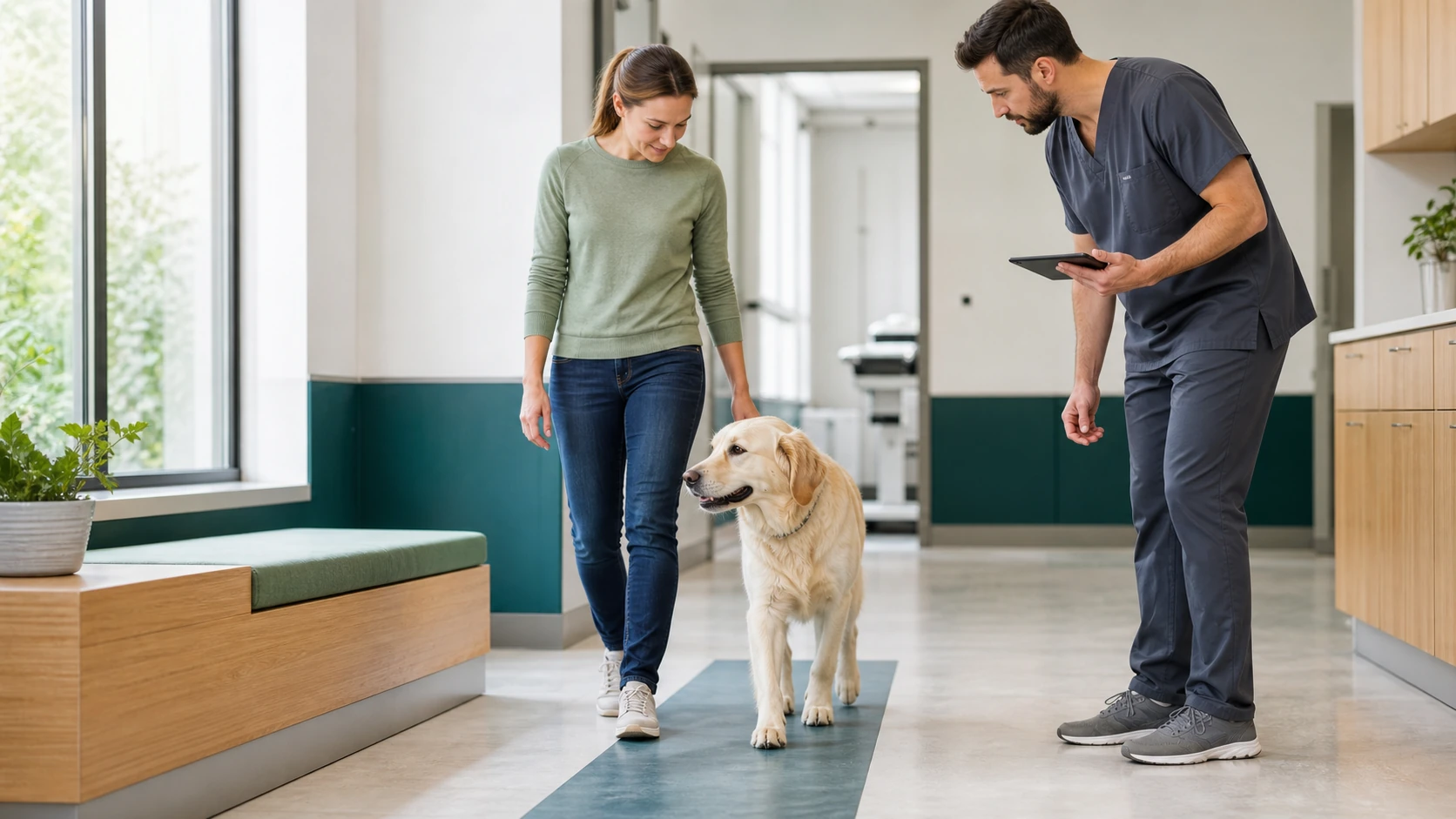
Canine hip dysplasia is a developmental orthopedic disorder in which abnormal hip joint laxity and incongruity can lead to instability, remodeling, pain, and osteoarthritis. Genetics are important, while growth, body condition, and loading can influence expression. Some dogs show signs when young, others later with arthritis, and some have substantial radiographic change with limited outward signs.
Short answer
Hip dysplasia is diagnosed through the whole clinical picture
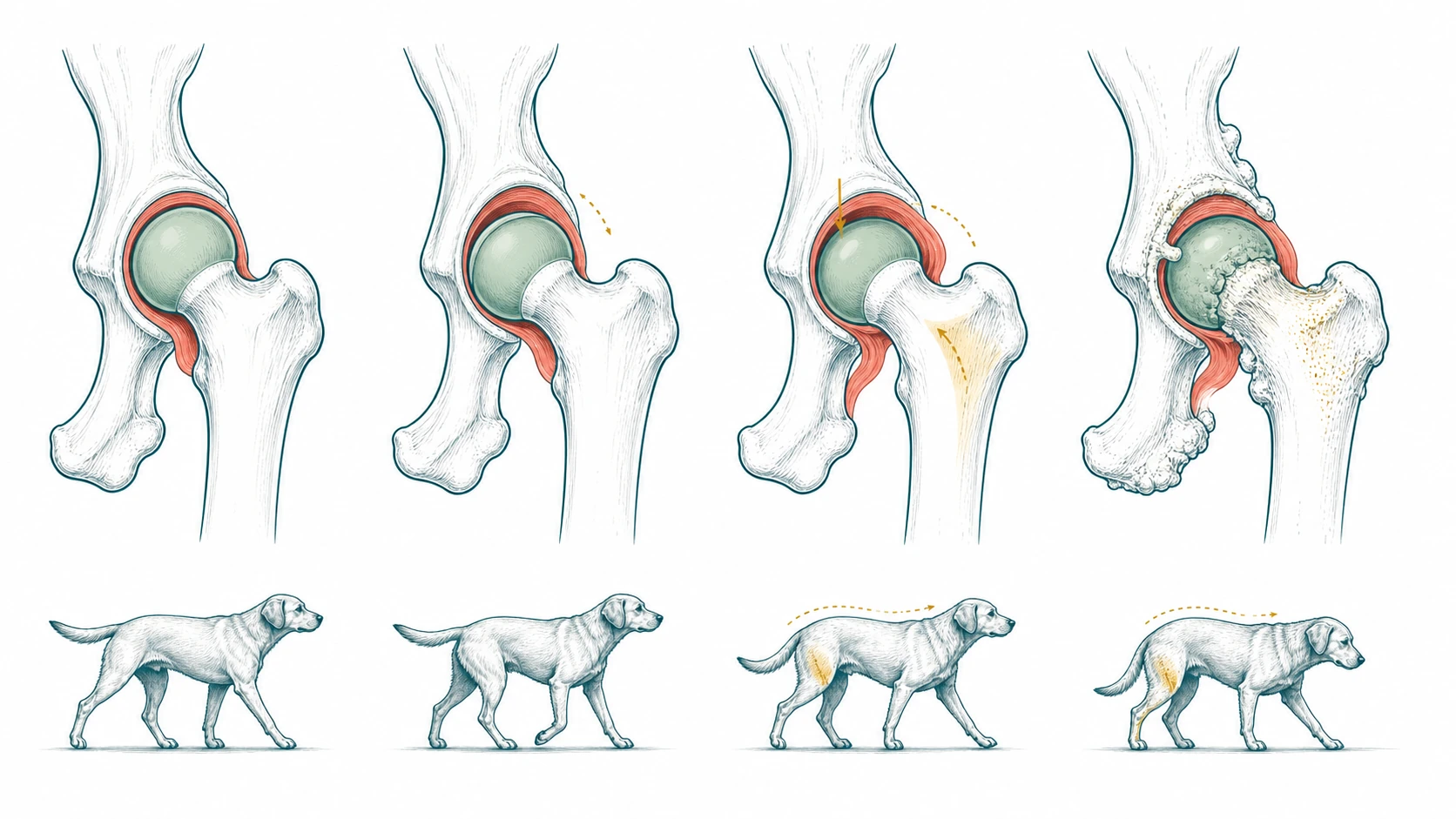
The hip is a ball-and-socket joint. In dysplasia, laxity allows abnormal movement between the femoral head and acetabulum during growth. Repeated loading can damage cartilage and reshape bone. Diagnosis combines history, gait and orthopedic examination with specialized radiographs; properly positioned studies often require sedation. [1] [2]
- Watch rising, running, jumping, stairs, sitting posture, stride, and recovery rather than waiting for a constant limp.
- Do not infer pain severity from an X-ray alone or dismiss pain because a dog still plays.
- Age, arthritis, body condition, lifestyle, and goals shape nonsurgical and surgical decisions.
Safety first
A sudden mobility crisis is not routine hip dysplasia
Seek prompt veterinary care for inability to stand, sudden non-weight-bearing lameness, severe pain, trauma, a swollen or unstable limb, dragging or knuckling paws, loss of bladder or bowel control, collapse, fever, or rapid decline. Restrict activity after acute injury and ask how to transport the dog safely.
- Do not give human pain medicines unless a veterinarian specifically directs them for this dog.
- Do not force hip extension, frog-leg positioning, running, stairs, or jumping to test the joint.
- Do not choose surgery, exercise, or a supplement from an imaging grade without clinical consultation.
Veterinary note
This article is educational and does not diagnose, treat, prescribe, or replace care from a licensed veterinarian. Your dog’s history, examination, diet, medications, and current signs determine what is appropriate.
Understand how dysplasia develops
Puppies are not born with osteoarthritis, but susceptible hips can become lax as they grow. The femoral head no longer remains tightly centered in the socket under load. Stretching of the capsule and abnormal contact concentrate forces, leading to inflammation, cartilage injury, thickening, and bone remodeling over time. [1] [3]
Breed and family history affect risk, especially in medium and large dogs, but any size can be affected. Rapid or excessive weight gain and inappropriate nutrition can worsen expression in genetically susceptible dogs. These factors modify risk; they do not create a guarantee that a puppy will or will not develop disease.
Recognize signs at different ages
Young dogs may show a swaying rear gait, bunny-hopping run, reduced endurance, reluctance to jump, difficulty rising, or pain with hip manipulation. Signs can fluctuate as inflammation changes. Mature dogs may show stiffness after rest, shorter steps, muscle loss over the hindquarters, difficulty with stairs or cars, or progressive osteoarthritis. [2] [3]
Behavior matters too. A dog may avoid slippery floors, become hesitant around handling, sleep differently, or choose less play. Record natural movement on video from the side and behind when safe. Do not repeatedly provoke a difficult transition for documentation.
Know what diagnostic imaging can and cannot show
The veterinarian first considers orthopedic and neurologic causes, palpates joints and muscles, observes gait, and evaluates pain and range of motion. Standard hip-extended radiographs assess congruity and arthritic change. Laxity-focused techniques such as PennHIP answer a different predictive question and require trained positioning. [1] [2]
Radiographs must be interpreted with age, signs, examination, and goals. Some dogs with marked changes function well, while others with less change are painful. Imaging also helps determine whether a young dog might be evaluated for a time-sensitive procedure or whether mature osteoarthritis management is the more relevant path.
Build an individualized management path
Conservative management commonly combines a lean body condition, consistent appropriate activity, rehabilitation, environmental traction, and veterinarian-directed pain control. The objective is comfortable function and muscle support, not complete inactivity. Acute flares may temporarily change the plan. [2] [4]
Surgical options vary with skeletal maturity, laxity, arthritis, body size, anatomy, and goals. Procedures intended to alter growth or joint orientation are time-sensitive, while femoral head and neck excision or total hip replacement address different mature-dog situations. Referral does not obligate surgery; it clarifies options, tradeoffs, prognosis, and timing. [1]
Monitor repeatable tasks such as rising, walking pace, stairs, car access, play, sleep, and recovery. Rechecks allow pain treatment, exercise, body condition, and home adaptations to change as the dog changes. No supplement corrects hip conformation.
Prepare for a focused veterinary conversation
Bring a concise timeline, short natural-movement or symptom videos when safe, the exact names and photographs of every food, treat, medication, and supplement label, and notes about appetite, water intake, stool, sleep, activity, comfort, and behavior. Include recent injuries, travel, boarding, diet changes, missed medication, and previous test results. A complete record helps the veterinary team separate a repeatable pattern from a single impression.
Decide in advance what you need from the visit: an urgency decision, a diagnosis plan, a nutrition review, a pain or mobility assessment, or a monitored trial. Ask what result would change the plan and what finding would rule an option out. This keeps research and product information in the right role. Evidence can shape questions and expectations, but it cannot determine what is safe for an individual dog without the history and examination.
Owner tool
Build a hip-mobility baseline
On a phone, swipe across the table to see every column.
| Task | Observe | Record safely |
|---|---|---|
| Rising | Push, slip, pause, symmetry | First rise after rest |
| Walking | Stride, hip sway, pace | Short natural video |
| Transitions | Stairs, car, jump hesitation | Choice without prompting |
| Recovery | Stiffness and fatigue | Time after usual activity |
Better questions, calmer next steps
Questions to ask your veterinarian
- Do the findings fit hip dysplasia, another orthopedic problem, neurologic disease, or more than one issue?
- Which radiographic method would answer the decision we face?
- Has osteoarthritis developed, and how does it relate to current pain?
- Is an orthopedic referral time-sensitive for this dog's age?
- How will we measure comfort and function over time?
FAQ
Can hip dysplasia occur in a young dog?
Yes. It is developmental, and signs or measurable laxity can appear before arthritis is advanced.
Does bunny hopping prove hip dysplasia?
No. It is a useful observation but not a diagnosis.
Can normal play rule it out?
No. Dogs may remain active despite discomfort or structural disease.
Do X-rays require sedation?
Special positioning commonly requires sedation for comfort, relaxation, and diagnostic accuracy.
Can supplements cure hip dysplasia?
No. They cannot correct joint conformation; evidence and safety vary for any adjunct product.
Sources
- American College of Veterinary Surgeons: Canine Hip Dysplasia. Development, diagnosis, imaging, treatment categories, and timing.
- Merck Veterinary Manual: Hip Dysplasia in Dogs. Pathophysiology, signs, diagnosis, and management.
- Cornell University College of Veterinary Medicine: Canine Hip Dysplasia. Owner-facing signs, risk, imaging, and care.
- American College of Veterinary Surgeons: Osteoarthritis in Dogs. Whole-joint osteoarthritis and multimodal management.
- Veterinary Journal: The Demographics of Canine Hip Dysplasia. Population and environmental risk-factor research context.
