

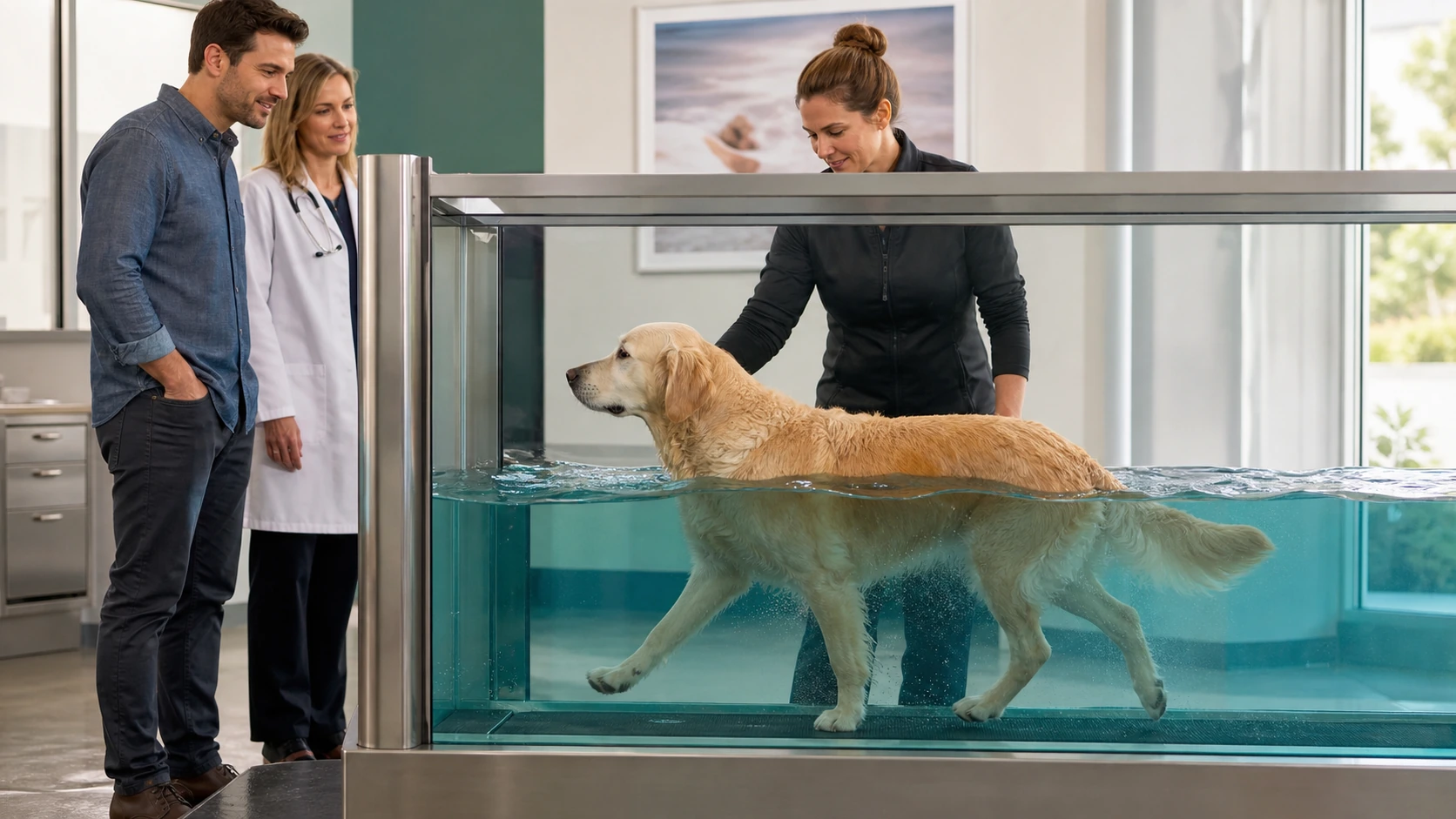
Hydrotherapy uses water's buoyancy, resistance, pressure, and temperature as part of rehabilitation or conditioning. An underwater treadmill allows controlled walking at selected depth and speed, while swimming produces a different movement pattern without foot contact. Both can be useful for selected dogs, but neither is automatically low risk, and neither replaces diagnosis, pain control, surgery, or land-based function.
Short answer
Hydrotherapy is a tailored exercise modality, not simply time in water
Water level changes canine joint motion and muscle demand. Studies in healthy dogs show that underwater treadmill depth alters flexion, extension, and range of motion; reviews find canine rehabilitation evidence promising but still limited for many conditions and protocols. A suitable plan begins with veterinary diagnosis, stability, contraindication screening, and measurable goals. [1] [2]
- Distinguish underwater treadmill walking from swimming and recreational water play.
- Ask who assesses the dog, sets variables, monitors fatigue and gait, and communicates with the veterinarian.
- Define a functional goal and reassessment plan rather than buying an open-ended package of sessions.
Safety first
Not every dog is ready or safe for water exercise
Stop a session and seek veterinary guidance for breathing difficulty, panic, collapse, marked weakness, blue or pale gums, repeated coughing, aspiration concern, severe pain, worsening lameness, loss of coordination, a wound problem, or unusual exhaustion. Emergency signs require immediate care.
- Do not use a home pool, lake, or bathtub as a substitute for prescribed rehabilitation.
- Do not begin with an unhealed incision, unstable fracture, uncontrolled pain, active infection, severe cardiopulmonary compromise, or other contraindication without clearance.
- Do not force a frightened dog into water or continue when gait quality deteriorates.
Veterinary note
This article is educational and does not diagnose, treat, prescribe, or replace care from a licensed veterinarian. Your dog’s history, examination, diet, medications, and current signs determine what is appropriate.
Understand what water changes
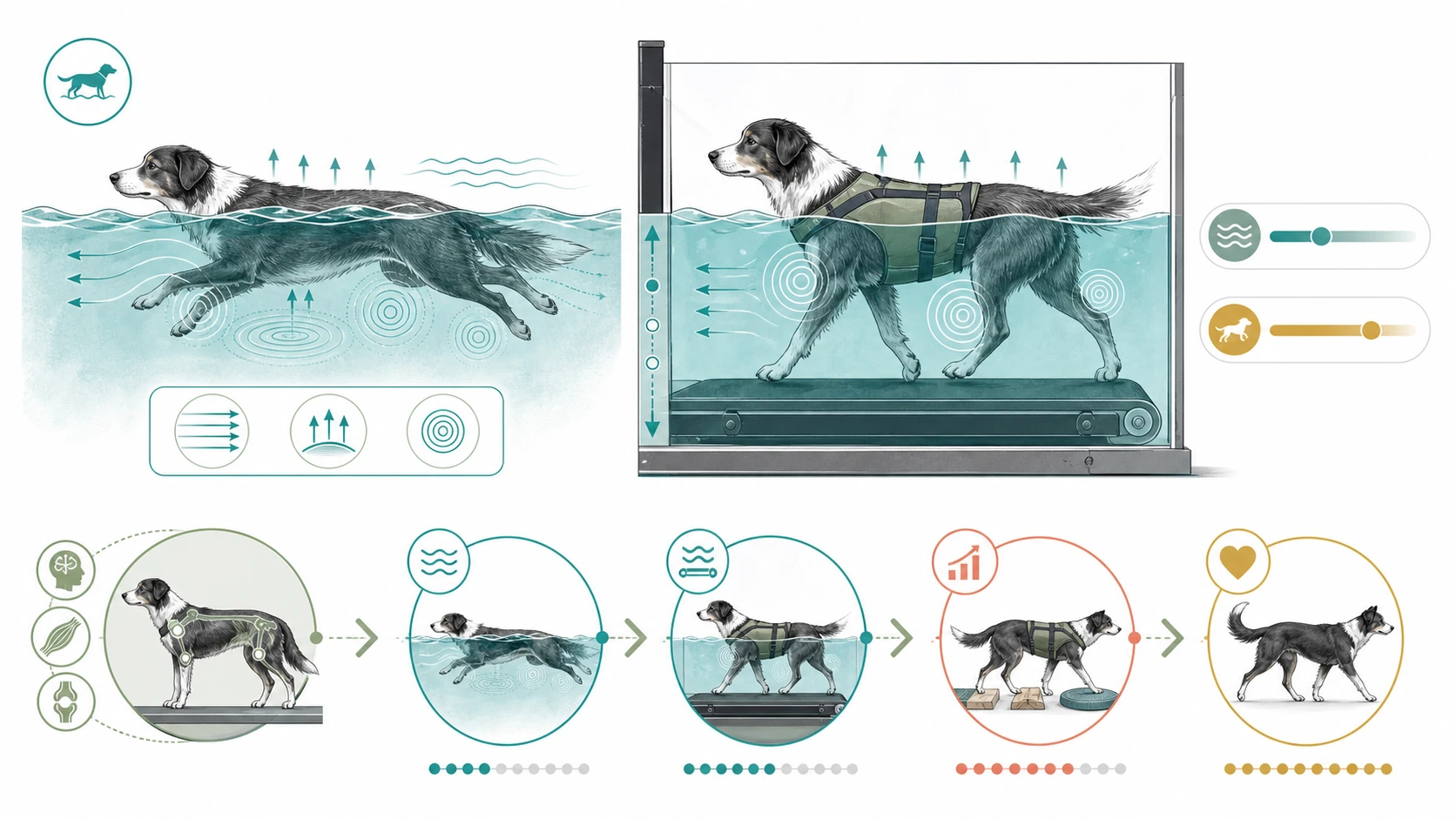
Buoyancy can reduce weight borne through the limbs as immersion increases, while water resistance increases the muscular work needed to move. Hydrostatic pressure and temperature can also affect tissues and comfort. These properties interact with speed, depth, direction, turbulence, and the dog's body shape. They do not produce one universal low-impact dose. [1] [3]
In an underwater treadmill, paws contact a moving belt and the therapist can observe gait. Swimming removes stance-phase loading and requires different limb and trunk patterns. A dog may be a good candidate for one and not the other. Recreational swimming adds uncontrolled entry, exit, current, temperature, water quality, and fatigue.
Read the evidence without promising outcomes
A kinematic study of ten healthy dogs found that water depth changed joint motion, with different effects across joints. That helps explain why settings matter, but healthy-dog biomechanics do not prove clinical benefit for a painful or postsurgical dog. [1]
A review of canine osteoarthritis physiotherapy describes aquatic exercise as a plausible component of multimodal care while emphasizing limited clinical evidence for many modalities. A newer retrospective pilot reported improved passive range of motion after ten underwater treadmill sessions in a mixed clinical population, but lacked a control group and cannot establish universal efficacy or an ideal protocol. [2] [4]
Screen the dog and the facility
The referring veterinarian and rehabilitation professional should review diagnosis, surgery date, wound status, pain, neurologic function, heart and lung disease, skin and ear disease, continence, infection risk, medications, endurance, body condition, and behavior. The dog's ability to enter, exit, stand, and recover safely matters as much as willingness to paddle.
Ask about professional credentials, emergency procedures, water sanitation and temperature monitoring, equipment maintenance, harness and flotation practices, drying, session documentation, and communication with the primary or surgical team. Water can hide poor foot placement, so close observation remains essential.
Turn sessions into a measurable rehabilitation plan
Choose a goal tied to function: improved weight bearing, joint range, controlled gait, endurance, muscle activation, or safe conditioning. Record baseline gait and a small number of repeatable home tasks. Session variables may include water depth, belt speed, duration, intervals, incline, assistance, and rest, but settings are clinical decisions rather than owner instructions. [1]
Monitor gait quality, symmetry, paw placement, breathing, posture, willingness, fatigue, pain during and after, skin, ears, and recovery time. More minutes are not always better. The therapist should stop or modify work when compensation, panic, exhaustion, or pain appears.
Hydrotherapy should connect to land function. Home traction, prescribed land exercise, body condition, pain treatment, and environmental support remain part of the plan. Reassess whether the modality is meeting the goal and whether the dog still needs, tolerates, and enjoys it.
Prepare for a focused veterinary conversation
Bring a concise timeline, short natural-movement or symptom videos when safe, the exact names and photographs of every food, treat, medication, and supplement label, and notes about appetite, water intake, stool, sleep, activity, comfort, and behavior. Include recent injuries, travel, boarding, diet changes, missed medication, and previous test results. A complete record helps the veterinary team separate a repeatable pattern from a single impression.
Decide in advance what you need from the visit: an urgency decision, a diagnosis plan, a nutrition review, a pain or mobility assessment, or a monitored trial. Ask what result would change the plan and what finding would rule an option out. This keeps research and product information in the right role. Evidence can shape questions and expectations, but it cannot determine what is safe for an individual dog without the history and examination.
Owner tool
Evaluate a hydrotherapy plan
On a phone, swipe across the table to see every column.
| Element | Ask | Monitor |
|---|---|---|
| Modality | Why pool or treadmill? | Gait and comfort |
| Settings | How are depth and speed chosen? | Fatigue and compensation |
| Safety | What contraindications were screened? | Breathing, wounds, panic |
| Outcome | Which function should change? | Baseline and recheck |
Better questions, calmer next steps
Questions to ask your veterinarian
- Is the diagnosis stable enough for water exercise now?
- Which modality best matches the functional goal?
- Who sets and adjusts water depth, speed, duration, and assistance?
- What signs require stopping a session or contacting the veterinarian?
- How will improvement transfer to comfortable land movement?
FAQ
Is swimming the same as an underwater treadmill?
No. Foot contact, joint motion, resistance, control, and body position differ.
Is hydrotherapy always low impact?
Water can reduce weight bearing, but resistance and movement demands can still cause fatigue or compensation.
Can it replace surgery or medicine?
No. It may complement a veterinary plan but does not replace indicated care.
Can any dog use a pool?
No. Medical, wound, breathing, neurologic, infectious, and behavior factors can make water unsafe.
How many sessions are needed?
There is no universal number; frequency and duration depend on diagnosis, response, goals, and reassessment.
Sources
- Veterinary Medicine and Science: Limb Kinematics at Different Underwater Treadmill Water Levels. Controlled healthy-dog joint kinematics by water depth.
- Veterinary Sciences: Physiotherapeutic Strategies and Current Evidence for Canine Osteoarthritis. Aquatic-exercise mechanisms, use, and evidence limits.
- American Animal Hospital Association: 2022 Pain Management Guidelines for Dogs and Cats. Rehabilitation within multimodal pain care.
- Animals: Pilot Study of a Ten-Session Underwater Treadmill Program. Recent retrospective clinical range-of-motion findings and limits.
- American College of Veterinary Surgeons: Osteoarthritis in Dogs. Diagnosis and multimodal mobility care context.
