

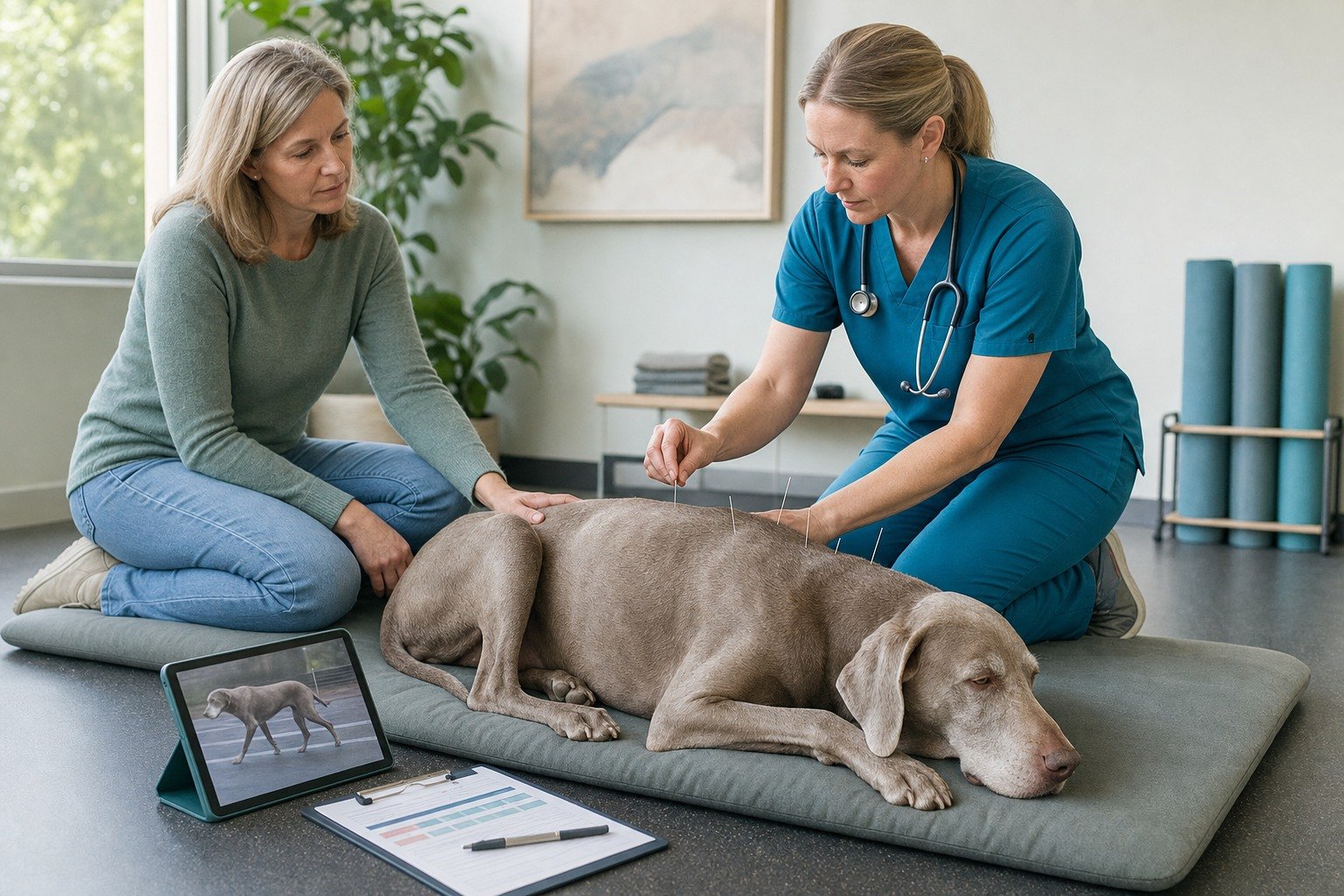
Veterinary acupuncture places fine needles at selected points as a clinician-delivered physical modality. It is sometimes considered within multimodal pain care, but plausibility, tradition, owner reports, and availability are not the same as demonstrated benefit. Canine osteoarthritis studies are limited by small samples, variable techniques, difficult blinding, different comparators, and outcomes that do not always agree. A randomized placebo-controlled trial using objective force, activity, and owner measures did not establish broad benefit for naturally occurring osteoarthritis, and AAHA notes that evidence-guided veterinary studies remain limited. A veterinarian should first diagnose the likely pain source and prioritize established options. If acupuncture is considered, define its adjunctive role, practitioner qualifications, dog tolerance, safety, measurable goal, and stop/reassessment rules. This guide provides no point map, needle technique, schedule, protocol, or promise.
Short answer
Current evidence does not support a universal joint-pain claim
AAHA treats acupuncture as a possible physical-modality adjunct while noting limited evidence and a canine OA trial that did not find benefit. The most defensible conclusion is that results are uncertain and condition-specific; acupuncture should not displace diagnosis, effective multimodal care, or safety monitoring. [1] [2]
- Record the trigger, distance or intensity, body language, recovery, and whole-dog function with dates.
- Use research to prepare a veterinary conversation, not to diagnose or run a treatment protocol alone.
- Bring every medication, supplement, diet, prior plan, and safe home video to the appointment.
- Agree on safety rules, measurable outcomes, reassessment timing, and urgent-contact signs.
Safety first
Acute severe pain or neurologic loss needs veterinary care, not an acupuncture appointment
Seek prompt care for sudden or worsening lameness, swelling, severe pain, appetite loss, weakness, repeated falling, or treatment adverse effects. Seek urgent care after major trauma, for an obvious deformity, collapse, dragging limbs, inability to stand, loss of bladder control with weakness, or rapid deterioration.
- Do not force exposure, punish fear, or prevent escape to make a dog appear calm.
- Do not start, stop, combine, or calculate medication or treatment from this article.
- Protect people and animals with distance, barriers, supervision, and qualified help.
Veterinary note
This article is educational and does not diagnose, treat, prescribe, or replace care from a licensed veterinarian. Your dog’s history, examination, diet, medications, and current signs determine what is appropriate.
What veterinary acupuncture is and is not
Acupuncture uses sterile fine needles placed by a trained clinician after assessment of the patient and objective. Techniques, point selection, stimulation, session length, and treatment context vary, which complicates comparison across studies.
It is not a diagnostic test and should not be presented as balancing energy, removing toxins, rebuilding cartilage, curing arthritis, or guaranteeing pain relief. A calm dog during a session does not prove analgesic benefit.
Pain care should remain diagnosis-led and multimodal. AAHA prioritizes interventions by evidence and clinical fit; physical modalities may be considered as adjuncts but are not automatically first-line choices. [3]
What the canine osteoarthritis research shows
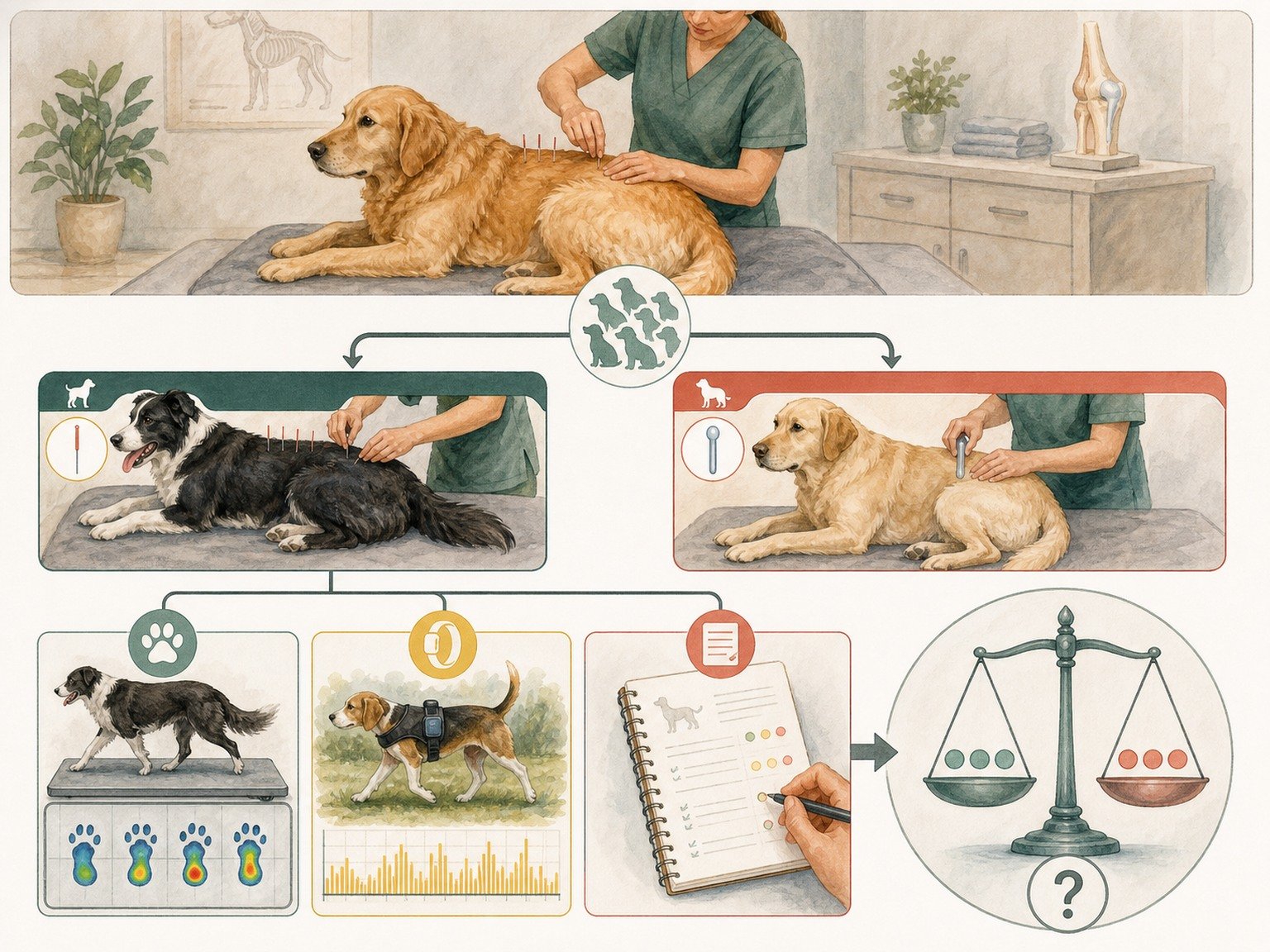
A prospective randomized blinded placebo-controlled canine OA trial measured ground-reaction forces, activity, orthopedic scores, and owner-reported outcomes. The design matters because subjective improvement can reflect expectation, natural fluctuation, concurrent care, or regression toward the mean. [2]
The trial did not establish consistent benefit across its outcomes, and one dog did not tolerate the protocol. A negative or uncertain study does not prove no dog can respond, but it limits claims about average efficacy and helps owners set realistic expectations.
Recent laser-acupuncture research reports selected changes but also calls for larger randomized trials and combines photobiomodulation with point-based treatment, so it cannot settle the question for traditional needle acupuncture or every joint condition. [4]
What a safe session and qualified provider discussion includes
Ask whether the provider is a licensed veterinarian, what training applies, how the pain diagnosis was established, and how acupuncture fits beside current medication, rehabilitation, weight, environmental, or surgical plans.
Discuss infection risk, bleeding risk, skin disease, immunosuppression, anticoagulant exposure, handling tolerance, needle fear, and whether positioning could worsen pain. The dog should be observed continuously and allowed to stop when distress or discomfort appears.
Do not attempt needling at home. Needles can injure tissue, introduce infection, break, migrate, or delay necessary care. A practitioner should use sterile single-use equipment and explain emergency and adverse-event procedures.
How to evaluate a monitored adjunct
Choose a baseline using a repeatable daily function, validated owner instrument, short natural-movement video, activity measure when appropriate, and adverse-effect record. Chronic-pain tools help separate one good day from a meaningful trend. [5]
Agree on how many sessions or what time point will trigger reassessment without turning that into a universal schedule. Keep other variables stable enough to interpret change and never stop prescribed care unless the veterinarian directs it.
Ask whether the observed change is clinically meaningful, sustained, and worth the burden, cost, travel, and handling. If benefit is absent or distress occurs, the plan should change rather than continuing because acupuncture is perceived as harmless.
Prepare for a focused veterinary conversation
Bring a concise timeline, short natural-movement or symptom videos when safe, the exact names and photographs of every food, treat, medication, and supplement label, and notes about appetite, water intake, stool, sleep, activity, comfort, and behavior. Include recent injuries, travel, boarding, diet changes, missed medication, and previous test results. A complete record helps the veterinary team separate a repeatable pattern from a single impression.
Decide in advance what you need from the visit: an urgency decision, a diagnosis plan, a nutrition review, a pain or mobility assessment, or a monitored trial. Ask what result would change the plan and what finding would rule an option out. This keeps research and product information in the right role. Evidence can shape questions and expectations, but it cannot determine what is safe for an individual dog without the history and examination.
Owner tool
Evaluate an acupuncture trial with evidence
On a phone, swipe across the table to see every column.
| Checkpoint | Record | Why it helps |
|---|---|---|
| Diagnosis | Pain source and current plan | Sets context |
| Protocol | Provider, technique, tolerance | Defines exposure |
| Outcome | Function, score, adverse signs | Measures response |
| Review | Date, threshold, next step | Prevents drift |
Better questions, calmer next steps
Questions to ask your veterinarian
- What diagnosis and goal support acupuncture?
- What evidence applies to this condition?
- What credentials and safety procedures apply?
- How will benefit and distress be measured?
- When should we stop or revise the plan?
FAQ
Is veterinary acupuncture proven for osteoarthritis?
Evidence is limited and mixed.
Can it replace pain medication?
Not by default; it is considered only within an individualized plan.
Is it risk-free?
No procedure is risk-free, and some dogs do not tolerate it.
Can owners perform it?
No. Needling requires licensed professional care.
How many sessions are needed?
No universal schedule is supported.
Sources
- American Animal Hospital Association: Nonpharmacologic Modalities for Pain Management. Acupuncture evidence limitations and adjunct context.
- BMC Veterinary Research: Randomized Placebo-Controlled Canine OA Acupuncture Trial. Design, outcomes, tolerance, and results.
- American Animal Hospital Association: Acute vs. Chronic Pain. Tiered evidence and multimodal decisions.
- Animals: Laser Acupuncture Randomized Controlled Trial. Emerging evidence and need for larger trials.
- American Animal Hospital Association: Chronic Pain Assessment in Dogs. Owner instruments and repeated outcome measurement.
