


Pain management for joint disease is not a single medication or a one-time decision. Veterinarians first identify likely pain sources, separate orthopedic from neurologic and other disease, and evaluate how pain changes function and quality of life. They then weigh patient health, diagnosis, evidence, adverse effects, interactions, owner ability, environment, and measurable goals. A multimodal plan may include pharmacologic and nonpharmacologic approaches because different contributors to pain and disability may need different tools. Each component still requires a reason, safety plan, and reassessment. Owners provide essential home observations, especially for chronic pain that may look different in the clinic. This guide explains decision factors without naming a regimen, drug, dose, supplement, exercise prescription, or device for an individual dog.
Short answer
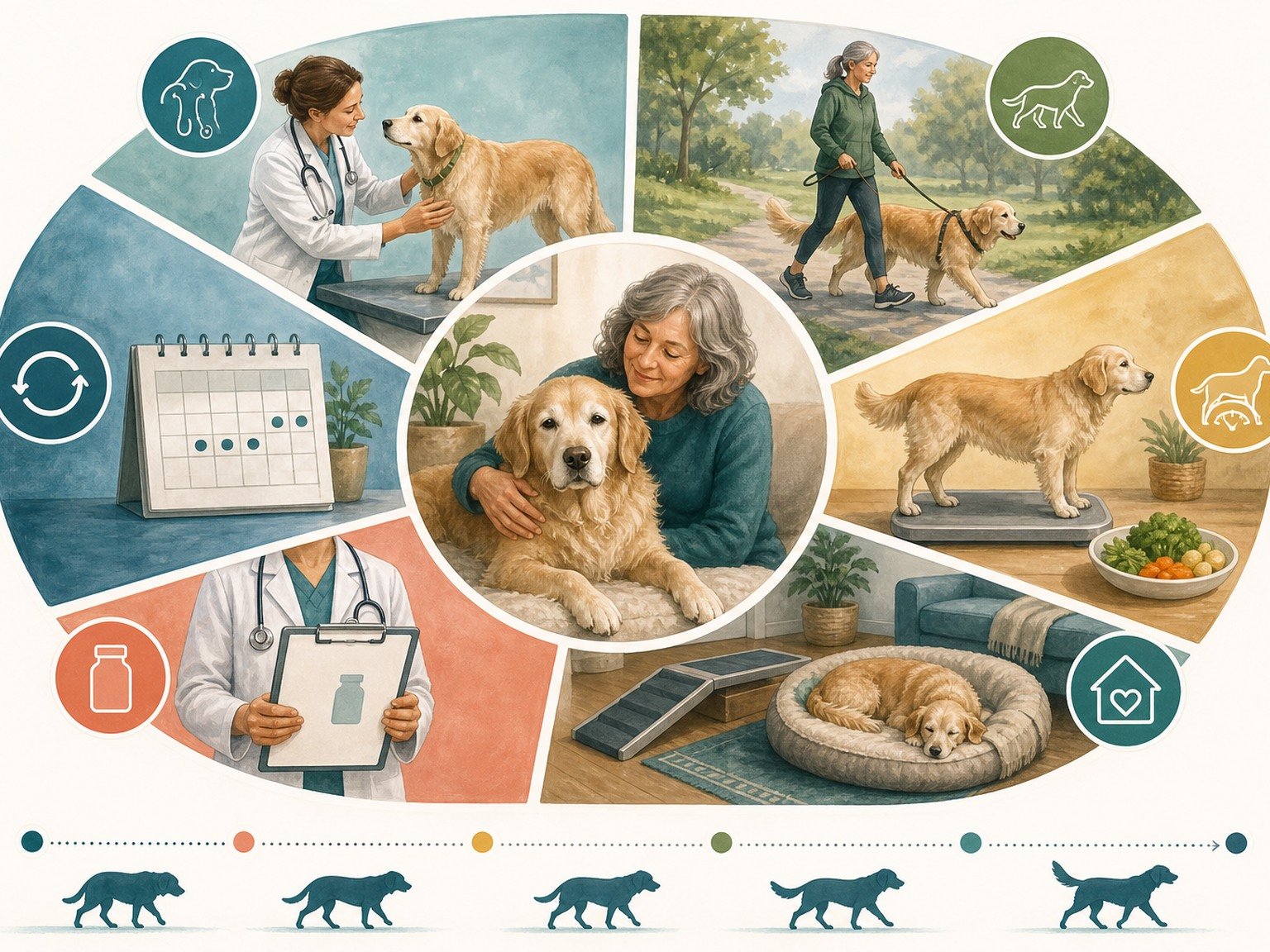
Good pain management is a cycle: assess, treat, reassess, revise
AAHA's guidelines frame pain care as a continuum built on recognition, owner input, multimodal options, and repeated plan revision. Chronic musculoskeletal pain can be subtle, and owner-reported function is central. No one modality is right for every dog or every stage. [1] [2]
- Record changes in movement, appetite, stool, sleep, behavior, and daily function with dates.
- Use research to prepare questions, not to diagnose a dog or select treatment at home.
- Bring current diets, medications, supplements, prior records, and short natural-movement videos when useful.
- Agree on what to monitor, when to reassess, and which change requires urgent care.
Safety first
Severe pain, trauma, or neurologic loss needs prompt care
Contact a veterinarian for new or worsening lameness, stiffness, difficulty rising, sleep disruption, panting at rest, guarding, appetite loss, reduced interaction, or treatment adverse effects. Seek urgent care after major trauma, for uncontrolled pain, an obvious deformity, collapse, dragging limbs, inability to stand, severe weakness, repeated vomiting, black stool, or rapid decline.
- Do not delay care for sudden, severe, escalating, or function-limiting signs.
- Do not start, stop, combine, or calculate treatment from this article.
- Keep an exact timeline and product or exposure record available for the veterinary team.
Veterinary note
This article is educational and does not diagnose, treat, prescribe, or replace care from a licensed veterinarian. Your dog’s history, examination, diet, medications, and current signs determine what is appropriate.
How veterinarians recognize and characterize pain
Pain assessment combines history, owner observations, behavior, posture, gait, palpation, range of motion, neurologic and orthopedic findings, and diagnostics when indicated. A dog may move differently from excitement, fear, or slippery clinic flooring, so home context matters. [1]
Chronic pain may appear as reduced activity, slower rising, hesitation, sleep disturbance, altered social behavior, irritability, withdrawal, licking, panting, or loss of previously enjoyed routines. These signs do not identify the cause by themselves.
Validated owner questionnaires and client-specific outcome measures can make change more visible. Choose a few important activities and record them consistently rather than relying on a global impression that the dog seems better or worse. [2]
What multimodal means and why options are prioritized
Multimodal care uses more than one selected approach when their mechanisms, benefits, and risks fit the patient. It does not mean adding every available therapy. AAHA provides tiered decision support so options are considered by evidence, impact, feasibility, and clinical context. [3]
Pharmacologic choices depend on diagnosis, organ health, concurrent medication, prior response, route, monitoring, and owner ability. Do not give human pain medicine, combine prescriptions, use leftover medication, or alter dosing without direct veterinary instruction.
Nonpharmacologic care can include weight optimization, controlled movement, rehabilitation, environmental change, and selected nutrition or physical modalities. Technique, timing, and evidence vary, and these approaches do not automatically replace effective medical treatment. [4]
How safety, interactions, and practical fit are weighed
Before starting a plan, provide every prescription, over-the-counter medicine, supplement, diet, and health condition. Ask what baseline testing is needed, what adverse effects are common or urgent, and what to do after a missed dose or accidental extra dose.
Feasibility matters. A theoretically useful plan may fail if the dog cannot tolerate handling, the owner cannot administer it safely, the home surface is hazardous, or follow-up is unavailable. The veterinary team can prioritize the highest-value steps and adapt them without abandoning safety.
Emerging therapies and supplements should be discussed with the same discipline as established care: exact formulation, evidence quality, target population, outcome, uncertainty, interactions, and monitoring. New or natural does not mean low risk or proven benefit. [5]
How owners support reassessment and plan revision
Record meaningful function, sleep, appetite, stool or vomiting, activity, body condition, behavior, and adverse effects. Short videos on a consistent route or task can help when captured safely. Note other changes that could influence behavior, including illness, travel, weather only as context, and household routine.
Ask when benefit should be assessed and which outcome would justify continuing, changing, or stopping an option under veterinary direction. Improvement in one activity does not cancel a serious adverse effect, and a difficult day does not prove the entire plan failed.
Contact the team earlier than scheduled if function declines, new pain appears, or an adverse sign develops. Long-term pain care is active management, not a prescription left unchanged indefinitely. Senior-care guidance likewise emphasizes integrative, multimodal care and quality-of-life monitoring. [5]
Prepare for a focused veterinary conversation
Bring a concise timeline, short natural-movement or symptom videos when safe, the exact names and photographs of every food, treat, medication, and supplement label, and notes about appetite, water intake, stool, sleep, activity, comfort, and behavior. Include recent injuries, travel, boarding, diet changes, missed medication, and previous test results. A complete record helps the veterinary team separate a repeatable pattern from a single impression.
Decide in advance what you need from the visit: an urgency decision, a diagnosis plan, a nutrition review, a pain or mobility assessment, or a monitored trial. Ask what result would change the plan and what finding would rule an option out. This keeps research and product information in the right role. Evidence can shape questions and expectations, but it cannot determine what is safe for an individual dog without the history and examination.
Owner tool
Create a chronic-pain monitoring record
On a phone, swipe across the table to see every column.
| Checkpoint | Record | Why it helps |
|---|---|---|
| Baseline | Daily tasks, sleep, behavior, score | Defines impact |
| Plan | Goal, component, risk, instructions | Clarifies purpose |
| Response | Function and adverse effects | Balances benefit and harm |
| Review | Date, trigger, test, revision | Keeps care active |
Better questions, calmer next steps
Questions to ask your veterinarian
- What is the likely source and type of pain?
- Which options have the strongest evidence for this dog?
- What testing and interaction review are needed?
- How will benefit and adverse effects be measured?
- What change requires urgent contact?
FAQ
Is pain always obvious?
No. Chronic pain often appears as function or behavior change.
Does multimodal mean many treatments?
No. It means a selected combination with defined roles.
Can I give human pain medicine?
No, unless the veterinarian specifically directs an exact product.
Should activity stop completely?
Not by default; movement advice must be individualized.
Why reassess if the dog seems better?
Safety, function, and disease can change over time.
Sources
- American Animal Hospital Association: 2022 Pain Management Guidelines. Assessment, multimodal care, owner input, and reassessment.
- American Animal Hospital Association: Pain Management Guidelines Overview. Chronic-pain recognition and measurement.
- American Animal Hospital Association: Acute vs. Chronic Pain. Tiered decision support and chronic-pain principles.
- American Animal Hospital Association: Nonpharmacologic Modalities. Weight, movement, environment, and physical modalities.
- American Animal Hospital Association: Senior Care Pain Management. Integrative care, rehabilitation, quality of life, and monitoring.
