

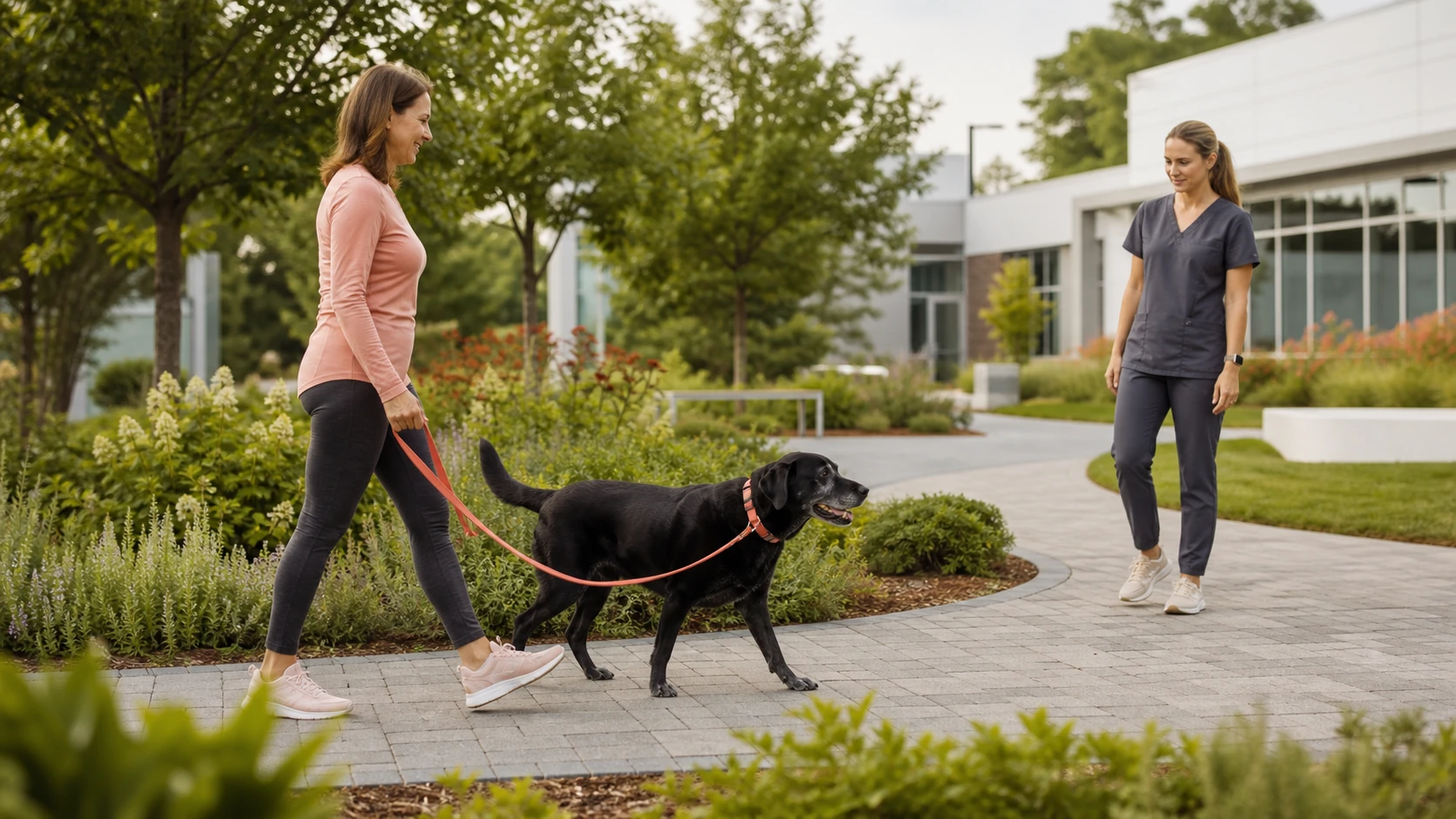
Healthy joints allow a dog to rise, turn, climb, play, and walk without obvious hesitation. Joint health depends on more than cartilage alone: bone shape, ligaments, muscles, body weight, nervous-system input, past injury, and daily loading all influence movement and comfort.
Short answer
Joint health is a movement system, not a supplement category
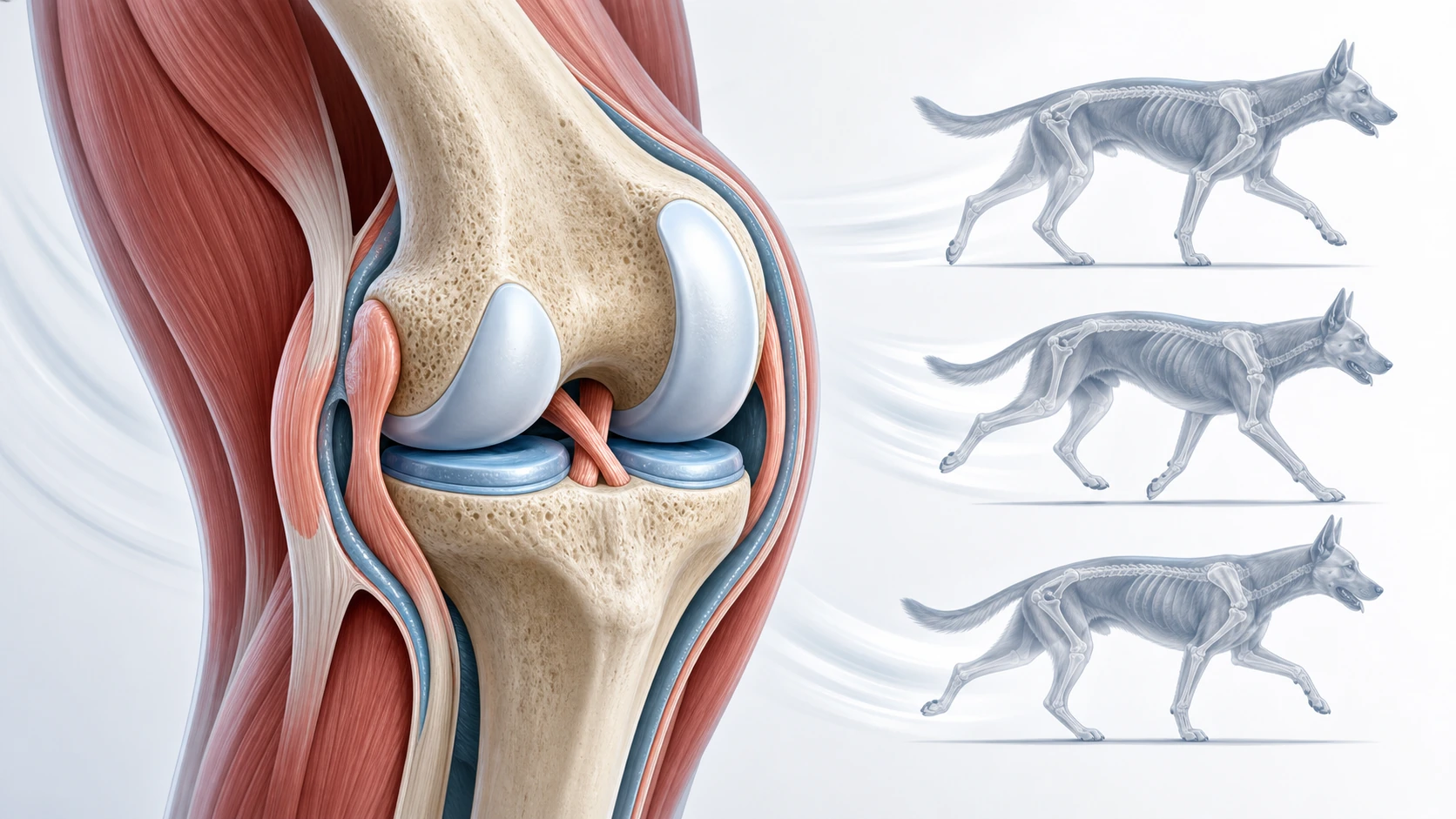
A synovial joint brings two or more bones together with smooth cartilage surfaces, lubricating joint fluid, a stabilizing capsule, ligaments, tendons, and surrounding muscles. Osteoarthritis can affect the whole joint and may develop after dysplasia, ligament injury, fracture, abnormal loading, or other orthopedic disease. It can occur before old age. [1] [2]
- Subtle changes in rising, stairs, jumping, pace, posture, and recovery can matter before a persistent limp appears.
- Veterinary assessment connects the owner history with gait, orthopedic and neurologic exams, and imaging when indicated.
- Management is usually multimodal and individualized; no supplement replaces diagnosis, weight planning, pain control, or rehabilitation.
Safety first
Sudden or severe mobility loss needs prompt care
Contact a veterinarian urgently for inability to stand, sudden non-weight-bearing lameness, severe pain, a swollen or unstable limb, major trauma, dragging or knuckling a paw, loss of bladder or bowel control, collapse, or rapid decline. Do not assume an abrupt change is routine arthritis.
- Do not give human pain medicines unless a veterinarian specifically directs their use for this dog.
- Restrict activity after an acute injury and ask the clinic how to transport the dog safely.
- Do not force stretching, stairs, or exercise through pain to test whether the joint loosens up.
Veterinary note
This article is educational and does not diagnose, treat, prescribe, or replace care from a licensed veterinarian. Your dog’s history, examination, diet, medications, and current signs determine what is appropriate.
What a joint needs to work well
Articular cartilage covers the ends of bones and helps distribute load with very low friction. Synovial fluid contributes lubrication and nutrient movement. The capsule and ligaments help constrain motion, while muscles absorb forces and stabilize the limb dynamically. A problem in any part of this system can alter the way a dog moves.
Osteoarthritis is not simply worn cartilage. It is a chronic whole-joint process involving cartilage loss, bone change, inflammation, pain, stiffness, and altered use of the limb. The inciting problem may be developmental, traumatic, or sometimes unclear. [1] [2]
Risk is broader than age
Age can reduce the joint's capacity to recover, but younger dogs may develop joint disease because of hip or elbow dysplasia, patellar instability, cruciate ligament injury, osteochondrosis, fracture, or repetitive high-impact loading. Body condition also matters because excess weight increases mechanical load and adipose tissue contributes inflammatory mediators. [1]
Breed and size can influence risk, but they do not diagnose a problem. Flooring, activity pattern, conditioning, nail and paw health, and prior injuries can change how forces move through the limbs. Prevention therefore means appropriate growth and nutrition, maintaining a lean body condition, sensible conditioning, and addressing injuries rather than buying a universal preventive product.
What owners often notice first
Early changes may be inconsistent: taking longer to rise after rest, choosing a shorter route, slowing on stairs, shifting weight while standing, sitting to one side, hesitating before jumping, lagging late in a walk, or needing longer to recover after play. Some dogs become quieter, sleep differently, lick a joint, or avoid handling without showing a dramatic limp. [2] [3]
Compare the dog with its own baseline and record the context. A short phone video of rising, walking away and toward the camera, turning, and using steps can help the veterinarian see a pattern that does not appear in the clinic. Never provoke pain or repeat a difficult movement for the video.
How veterinarians build a plan
The examination may include gait and posture observation, palpation, joint range of motion, muscle comparison, paw and nail evaluation, and a neurologic screen. Radiographs can identify many bone and joint changes, but imaging findings and pain do not always align perfectly. Additional imaging or joint testing is reserved for cases where it may change the decision. [1]
Management commonly combines weight control, appropriate activity, rehabilitation, environmental support, and veterinary pain treatment. Surgery may address a correctable orthopedic cause or severely affected joint. Evidence for nutraceuticals varies by ingredient; they should be considered only as one possible part of a documented plan. [4] [5]
Prepare for a focused veterinary conversation
Bring a concise timeline, short natural-movement or symptom videos when safe, the exact names and photographs of every food, treat, medication, and supplement label, and notes about appetite, water intake, stool, sleep, activity, comfort, and behavior. Include recent injuries, travel, boarding, diet changes, missed medication, and previous test results. A complete record helps the veterinary team separate a repeatable pattern from a single impression.
Decide in advance what you need from the visit: an urgency decision, a diagnosis plan, a nutrition review, a pain or mobility assessment, or a monitored trial. Ask what result would change the plan and what finding would rule an option out. This keeps research and product information in the right role. Evidence can shape questions and expectations, but it cannot determine what is safe for an individual dog without the history and examination.
Owner tool
Build a mobility baseline before the visit
On a phone, swipe across the table to see every column.
| Daily task | What to observe | Useful comparison |
|---|---|---|
| Rising | Time, effort, slipping, front-versus-rear push | After sleep versus later in the day |
| Walking | Pace, stride symmetry, head or hip movement, lagging | Start versus end of the same route |
| Transitions | Stairs, turns, jumping, car entry | Willingness and smoothness without prompting |
| Recovery | Stiffness, panting, rest, soreness after activity | Typical activity versus an unusually active day |
Better questions, calmer next steps
Questions to ask your veterinarian
- Does the pattern look orthopedic, neurologic, or possibly both?
- Which joints or other structures seem involved, and would imaging change the plan?
- What is an appropriate body-condition and activity target for this dog?
- Which pain, rehabilitation, and home-support options have the best role here?
- How will we measure response and know when the plan needs adjustment?
FAQ
Is stiffness always arthritis?
No. Joint disease is one possibility, but muscle injury, neurologic disease, paw problems, systemic illness, and other causes can alter movement. A veterinary examination is needed.
Can young dogs have osteoarthritis?
Yes. Developmental orthopedic disease, joint instability, and previous injury can lead to osteoarthritis before a dog is senior.
Should a stiff dog rest completely?
Acute injuries may require restriction, but chronic joint plans often use controlled, consistent activity. Ask the veterinarian what level is safe for the individual dog.
Do X-rays show how much pain a dog has?
Not perfectly. Radiographs show structural changes, while pain and function also require history and examination. The two must be interpreted together.
Is one supplement enough for joint health?
No supplement can substitute for diagnosis or a multimodal plan. Evidence and product quality vary, and safety depends on the dog and other treatments.
Sources
- American College of Veterinary Surgeons: Osteoarthritis in Dogs. Joint structure, signs, risk factors, diagnosis, and multimodal management.
- Cornell University College of Veterinary Medicine: Osteoarthritis. Owner-facing overview of causes, signs, diagnosis, and management.
- AAHA: Mobility Matters: Recognizing and Managing Osteoarthritis. Practical mobility observations and veterinary assessment.
- Frontiers in Veterinary Science: Systematic Review of Enriched Diets and Nutraceuticals in Canine and Feline Osteoarthritis. Comparative evidence and limitations for nutritional interventions.
- AAHA/AAFP: Pain Management Guidelines for Dogs and Cats. Multimodal pain assessment and management principles.
