

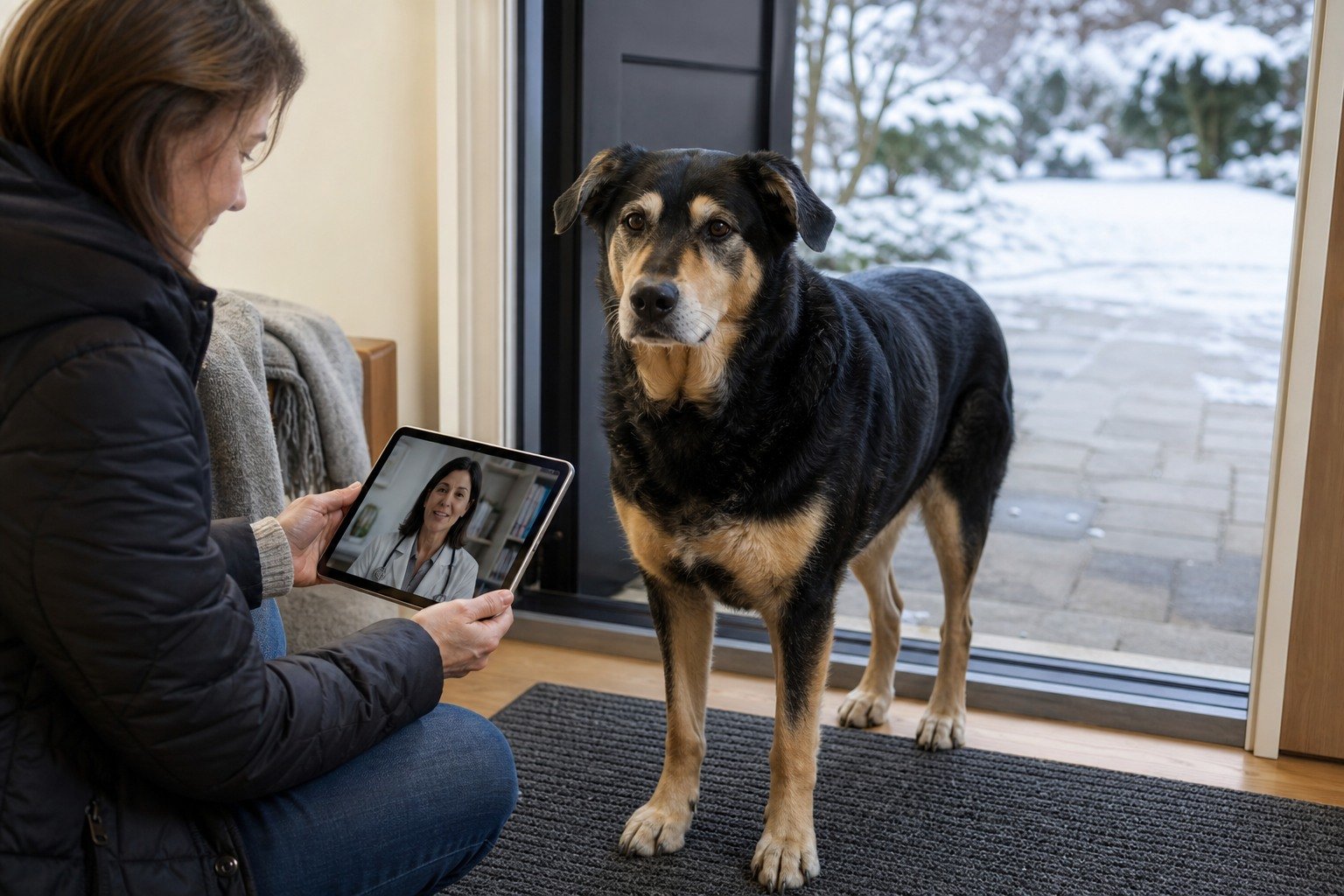
Some owners report that a dog's stiffness or willingness to move seems different in cold or damp weather. That observation deserves a place in the record, but the repaired canine evidence set does not establish weather as a direct cause of joint pain or a predictable effect in every dog. Exercise duration, footing, indoor time, routine, rest, treatment timing, disease fluctuation, and caregiver attention can change at the same time. Track those variables together and use the pattern to support veterinary reassessment. Include ordinary good days as well as difficult days so the record does not capture only the moments that confirm the initial weather theory.
Short answer
Record weather beside function, not instead of it
A forecast cannot diagnose pain or direct medication, supplements, heat, or exercise. Owner observations, repeatable functional tasks, and short videos can support canine pain and osteoarthritis assessment, while management remains staged, multimodal, and patient-specific. No direct canine causal evidence in this source set proves that temperature, dampness, pressure, or season independently worsens joint pain. [1] [2] [3] [4]
- Record the exact pattern, timing, exposures, function, and recent changes.
- Separate population evidence from what can be concluded about one dog.
- Use the veterinary team to define evaluation, monitoring, and urgent-response steps.
Safety first
New, severe, or rapidly changing mobility signs are not a weather problem to watch at home
Contact a veterinarian for persistent or worsening stiffness, limping, pain, falls, reduced activity, behavior change, or difficulty rising. Seek urgent or emergency care for major trauma, sudden non-weight-bearing lameness, inability to stand, severe pain, dragging or knuckling paws, collapse, breathing difficulty, or rapid deterioration.
- Do not use general information to delay care for severe, persistent, or worsening signs.
- Do not start, stop, combine, or calculate treatment from this article.
- Keep labels, dates, videos, and a concise observation timeline available for the veterinary team.
Veterinary note
This article is educational and does not diagnose, treat, prescribe, or replace care from a licensed veterinarian. Your dog’s history, examination, diet, medications, and current signs determine what is appropriate.
Separate the observation from the explanation
Write what changed: time to rise, stride, turning, stairs, jumping, toileting, sleep, play, touch response, or willingness to walk. Add date, temperature, precipitation, surface condition, and location. A repeated association is worth discussing, but correlation does not establish weather as the cause.
Look for confounders. Winter may mean shorter walks, slippery ground, more indoor rest, different footwear or handling, less daylight, changed medication timing, visitors, travel, or weight change. The dog may also have ordinary day-to-day disease variation unrelated to conditions outside.
Human weather-and-arthritis studies cannot be transferred to dogs as proof. Avoid explanations about pressure, fluid, circulation, or cold joints unless a canine source and clinical context support the specific claim.
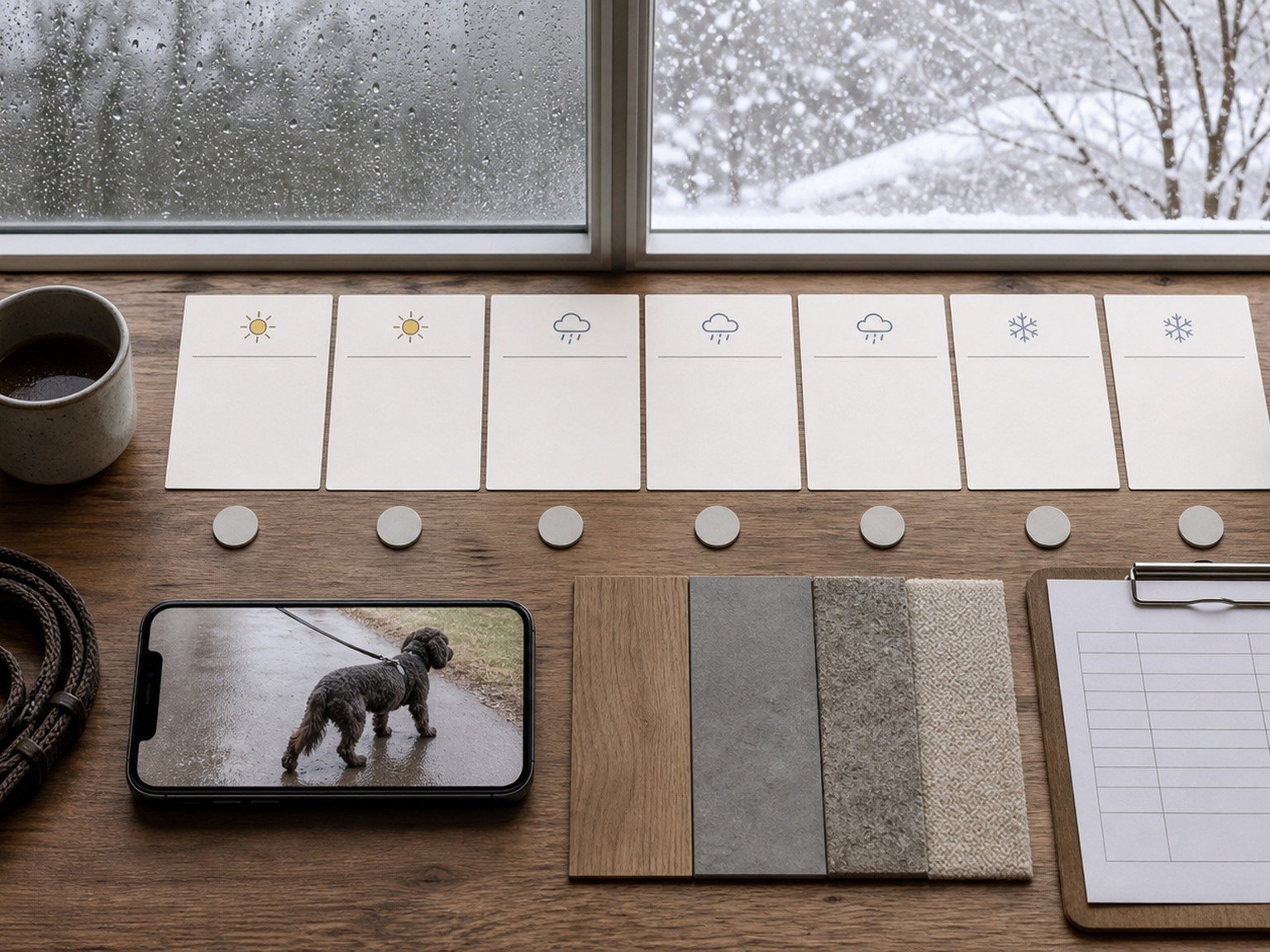
Use repeatable owner observations
Choose a few familiar activities the dog performs voluntarily and safely: rising from the usual bed, walking across the same level surface, turning, toileting, or approaching a routine outing. Record assistance, slips, pauses, posture, and recovery without forcing the activity.
AAHA pain and senior-care guidance values owner videos and daily-life observations. A brief clinic gait may look different because of excitement, flooring, or the limited sample. Videos should document normal routines, not stage a difficult task or provoke pain. [1] [2]
Validated owner-reported outcome measures can help assess pain and function, but each tool has measurement limits. Use the instrument selected by the veterinary team consistently rather than inventing a score or comparing unrelated online checklists. [4]
Discuss environment inside the care plan
Traction, resting surfaces, ramps, access routes, assistance, and temperature comfort may be discussed as parts of an individualized plan. A helpful environmental change reduces a defined barrier; it is not evidence that weather caused the underlying disease or that a product treats it.
Check that routes are stable, dry, well lit, and free of trip hazards. Ask the veterinary team how to assist this dog and whether a rehabilitation professional should assess the home. Do not improvise heating, wrapping, stretching, massage, or exercise from general guidance.
COAST consensus guidance describes osteoarthritis management as staged and patient-specific, integrating caregiver input, veterinary assessment, and reevaluation. No single context variable should replace the whole plan. [3]
Know when the plan needs review
A pattern that repeats over several conditions can support a scheduled recheck. A new deficit, escalating pain, falls, weakness, neurologic change, or loss of familiar function deserves faster contact regardless of the forecast. Do not wait for warmer weather to see whether a serious change resolves.
Bring medication and supplement labels, dosing times supplied by the veterinarian, recent health changes, body-weight trend, activity, surfaces, videos, and the weather log. Do not change treatment timing or amount to test a theory.
The aim is not to disprove an owner's observation. It is to place that observation among enough variables that the veterinary team can make a safer decision and measure whether the revised plan improves comfort and function.
Prepare for a focused veterinary conversation
Bring a concise timeline, short natural-movement or symptom videos when safe, the exact names and photographs of every food, treat, medication, and supplement label, and notes about appetite, water intake, stool, sleep, activity, comfort, and behavior. Include recent injuries, travel, boarding, diet changes, missed medication, and previous test results. A complete record helps the veterinary team separate a repeatable pattern from a single impression.
Decide in advance what you need from the visit: an urgency decision, a diagnosis plan, a nutrition review, a pain or mobility assessment, or a monitored trial. Ask what result would change the plan and what finding would rule an option out. This keeps research and product information in the right role. Evidence can shape questions and expectations, but it cannot determine what is safe for an individual dog without the history and examination.
Owner tool
Build a weather-and-mobility log
On a phone, swipe across the table to see every column.
| Checkpoint | Record | Why it helps |
|---|---|---|
| Conditions | Date, temperature, precipitation | Records context |
| Activity | Duration, surface, route, rest | Finds confounders |
| Function | Rise, walk, turn, slips, video | Shows change |
| Care | Treatment timing and veterinary plan | Supports review |
Better questions, calmer next steps
Questions to ask your veterinarian
- Which functional measures should I repeat?
- What variables could mimic a weather pattern?
- Would a validated owner tool help?
- Which environmental changes are appropriate for this dog?
- What change means contact you promptly?
FAQ
Does cold weather cause joint pain in dogs?
This source set does not establish a direct causal effect.
Should I change medication with the forecast?
No. Follow the treating veterinarian's instructions.
Are owner videos useful?
Yes, when they record safe familiar activities without provoking signs.
Can traction help?
It may address a slipping barrier within an individualized plan, not treat the underlying disease.
Should I wait for warm weather?
Not for new, severe, or worsening mobility changes.
Sources
- American Animal Hospital Association: 2022 Pain Management Guidelines. Owner evaluation and reassessment.
- American Animal Hospital Association: 2023 Senior Care Guidelines: Pain Management. Videos, mobility observations, and environment.
- Frontiers in Veterinary Science: COAST Canine Osteoarthritis Consensus Guidelines. Staged patient-specific management.
- Veterinary Surgery: Evaluation of Owner-Reported Orthopedic Outcome Measures. Measurement value and limits.
