

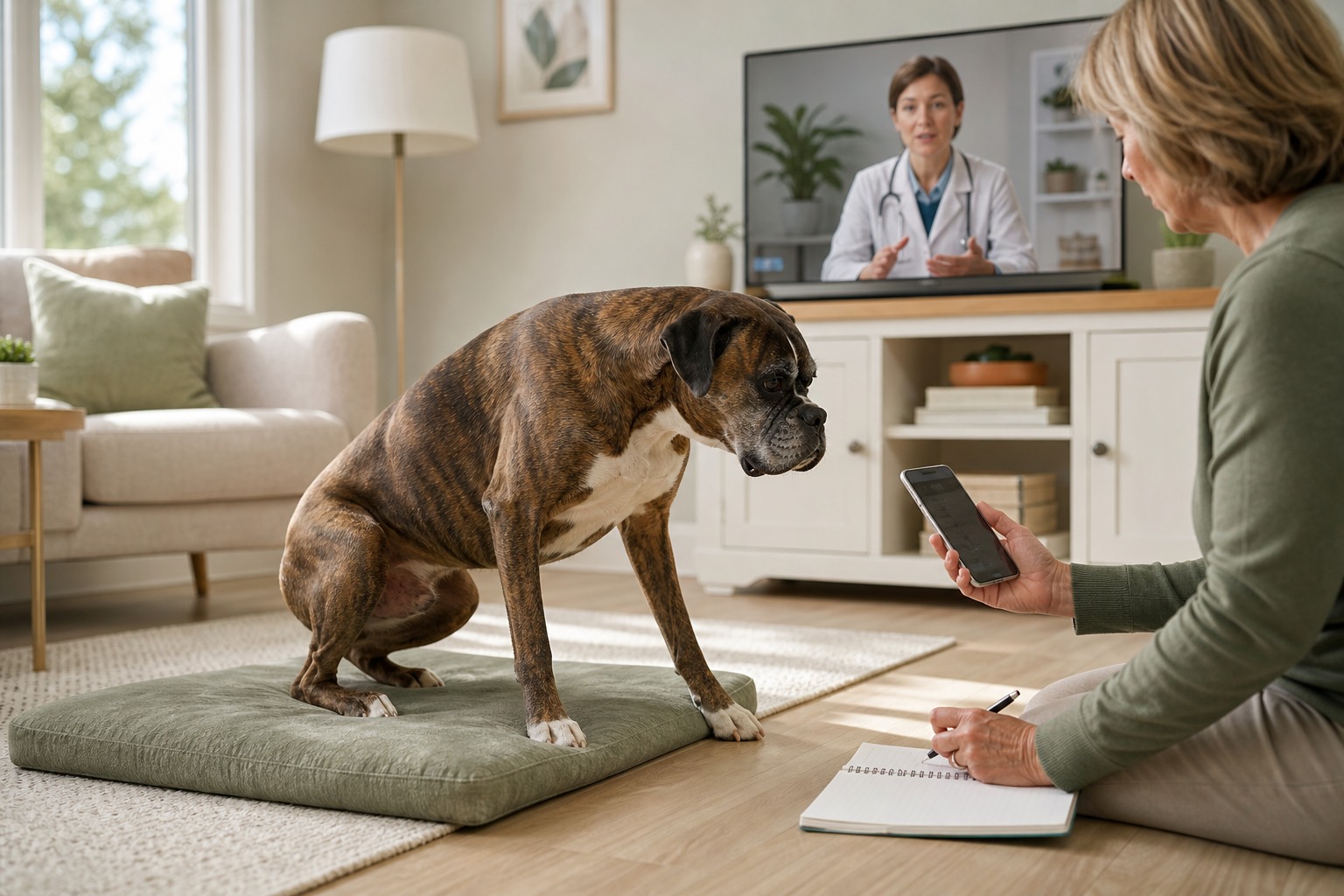
Canine osteoarthritis is a chronic, progressive joint disorder, not a harmless or inevitable feature of normal aging. Older dogs may show stiffness, altered gait, slower rising, difficulty with stairs or jumping, reduced activity, changed posture, disrupted sleep, or different social behavior. Those signs are important but nonspecific: orthopedic, neurologic, medical, sensory, and environmental problems can look similar. Owners should document changes and seek veterinary assessment rather than attempting a home diagnosis. A veterinarian may use history, examination, and selected imaging or other tests to determine the cause. Care is individualized and often multimodal, with ongoing reassessment. This guide does not select medication, supplements, procedures, rehabilitation, or exercise for an individual dog.
Short answer
Observe function; let the veterinary team diagnose the cause
Cornell describes osteoarthritis as a chronic, progressive joint disease that can affect dogs beyond the senior stage. AAHA pain guidance emphasizes owner observations, questionnaires, safe photos or videos, examination, and repeated reassessment. A limp, stiffness, stair hesitation, or behavior change cannot diagnose arthritis at home. [1] [2]
- Record timing, context, frequency, recovery, and effect on ordinary daily function.
- Use observations to prepare for assessment, not to assign a diagnosis or treatment at home.
- Bring current health, diet, medication, supplement, and prior-response details to the veterinary team.
- Agree on what to monitor, when to recheck, and which change requires faster care.
Safety first
Sudden inability to bear weight, severe pain, or neurologic change needs urgent care
Seek prompt veterinary care for persistent or worsening lameness, swelling, pain, repeated falls, inability to rise, marked sleep or appetite change, or loss of normal function. Seek urgent or emergency care after major trauma, for sudden non-weight-bearing lameness, severe pain, collapse, dragging or knuckling paws, inability to stand, breathing difficulty, or rapid deterioration.
- Do not delay care for severe, sudden, escalating, or function-limiting changes.
- Do not start, stop, combine, or calculate treatment from a general article.
- Keep people and animals safely separated when behavior creates an immediate injury risk.
Veterinary note
This article is educational and does not diagnose, treat, prescribe, or replace care from a licensed veterinarian. Your dog’s history, examination, diet, medications, and current signs determine what is appropriate.
Recognize patterns without calling every change arthritis
Osteoarthritis can affect gait, joint motion, activity, muscle, comfort, and behavior, but presentation varies by joint, stage, concurrent disease, environment, and individual coping. It is common in older dogs but not exclusive to them, and aging alone does not establish the diagnosis. [1]
Watch ordinary functions: rising, lying down, turning, walking on different household surfaces, stairs, toileting posture, getting into usual resting places, sleep, play, and social interaction. Record what changed, when, and whether it is consistent or intermittent.
Similar signs may arise from spinal or neurologic disease, ligament injury, muscle or tendon problems, paw or nail pain, infection, cancer, weakness, sensory loss, or medication effects. Keep the description factual so alternatives remain visible.

Build a safe longitudinal record
Use dates and concrete examples rather than labels such as slowing down. Note which activity changed, how often, duration, surface, weather, recent exertion, rest response, and recovery. Include both better and harder days to avoid a one-sided record.
Capture short videos of voluntary level walking, rising, or turning only when the dog is comfortable and the activity would happen anyway. Do not repeatedly climb stairs, jump, run, manipulate joints, or withhold help to reproduce a sign. [2]
Pain questionnaires can add structure when chosen and interpreted by the veterinary team. A score supports follow-up but does not identify the painful structure or replace examination. Ask whether the same tool should be repeated under similar conditions.
Understand the diagnostic pathway
The veterinarian may review gait, posture, joint range, pain response, muscle condition, neurologic function, feet, spine, and general health. Findings determine whether radiographs, laboratory work, referral, or other evaluation could change the plan.
Imaging can identify structural changes, but radiographic severity and observed function do not always align neatly. Imaging must be interpreted with history and examination, and not every dog needs every test.
Ask what diagnosis is most likely, which alternatives remain, what each proposed test could answer, and whether the current signs require urgent stabilization. Keep copies of reports and images for comparison.
Expect individualized multimodal care and reassessment
Consensus and pain guidance describe patient-specific, multimodal planning rather than one universally best intervention. The plan may address pain, body condition, movement, rehabilitation, environment, medication, procedures, or other factors depending on the dog. [2] [3] [4]
This article does not name or compare drugs, supplements, injections, surgery, rehabilitation exercises, or activity schedules. Human pain medicine and another pet's prescription can be dangerous. Start, stop, and combine treatments only with veterinary direction.
Define functional outcomes that matter: easier rising, more settled sleep, comfortable toileting, safer walks, or restored participation in a valued routine. Record adverse effects and setbacks, and schedule reassessment because needs can change as disease and life circumstances evolve.
Prepare for a focused veterinary conversation
Bring a concise timeline, short natural-movement or symptom videos when safe, the exact names and photographs of every food, treat, medication, and supplement label, and notes about appetite, water intake, stool, sleep, activity, comfort, and behavior. Include recent injuries, travel, boarding, diet changes, missed medication, and previous test results. A complete record helps the veterinary team separate a repeatable pattern from a single impression.
Decide in advance what you need from the visit: an urgency decision, a diagnosis plan, a nutrition review, a pain or mobility assessment, or a monitored trial. Ask what result would change the plan and what finding would rule an option out. This keeps research and product information in the right role. Evidence can shape questions and expectations, but it cannot determine what is safe for an individual dog without the history and examination.
Owner tool
Create an osteoarthritis observation log
On a phone, swipe across the table to see every column.
| Checkpoint | Record | Why it helps |
|---|---|---|
| Movement | Rise, turn, walk, stairs, posture | Shows functional pattern |
| Context | Surface, activity, time, weather | Finds variation |
| Recovery | Rest, sleep, next-day function | Shows burden |
| Follow-up | Plan, response, adverse effects | Supports reassessment |
Better questions, calmer next steps
Questions to ask your veterinarian
- What other causes could explain these signs?
- Which observations or videos are most useful?
- Would imaging or referral change the plan?
- Which functional outcome should we track?
- What change requires urgent reassessment?
FAQ
Is arthritis normal aging?
No. Osteoarthritis is a disease, not a harmless aging change.
Can stiffness diagnose arthritis?
No. Stiffness is nonspecific.
Should I exercise the dog to test the joint?
No. Do not provoke signs.
Does an x-ray decide the whole plan?
No. History, examination, function, and imaging are considered together.
Is there one best treatment?
No. Care is individualized and reassessed.
Sources
- Cornell University College of Veterinary Medicine: Osteoarthritis. Disease definition, signs, and diagnosis.
- American Animal Hospital Association: 2022 Pain Management Guidelines. Owner observations and reassessment.
- American Animal Hospital Association: Senior Care Guidelines: Pain Management. Senior pain recognition and multimodal planning.
- Frontiers in Veterinary Science: COAST Osteoarthritis Consensus Guidelines. Patient-specific staged care and reassessment.
