

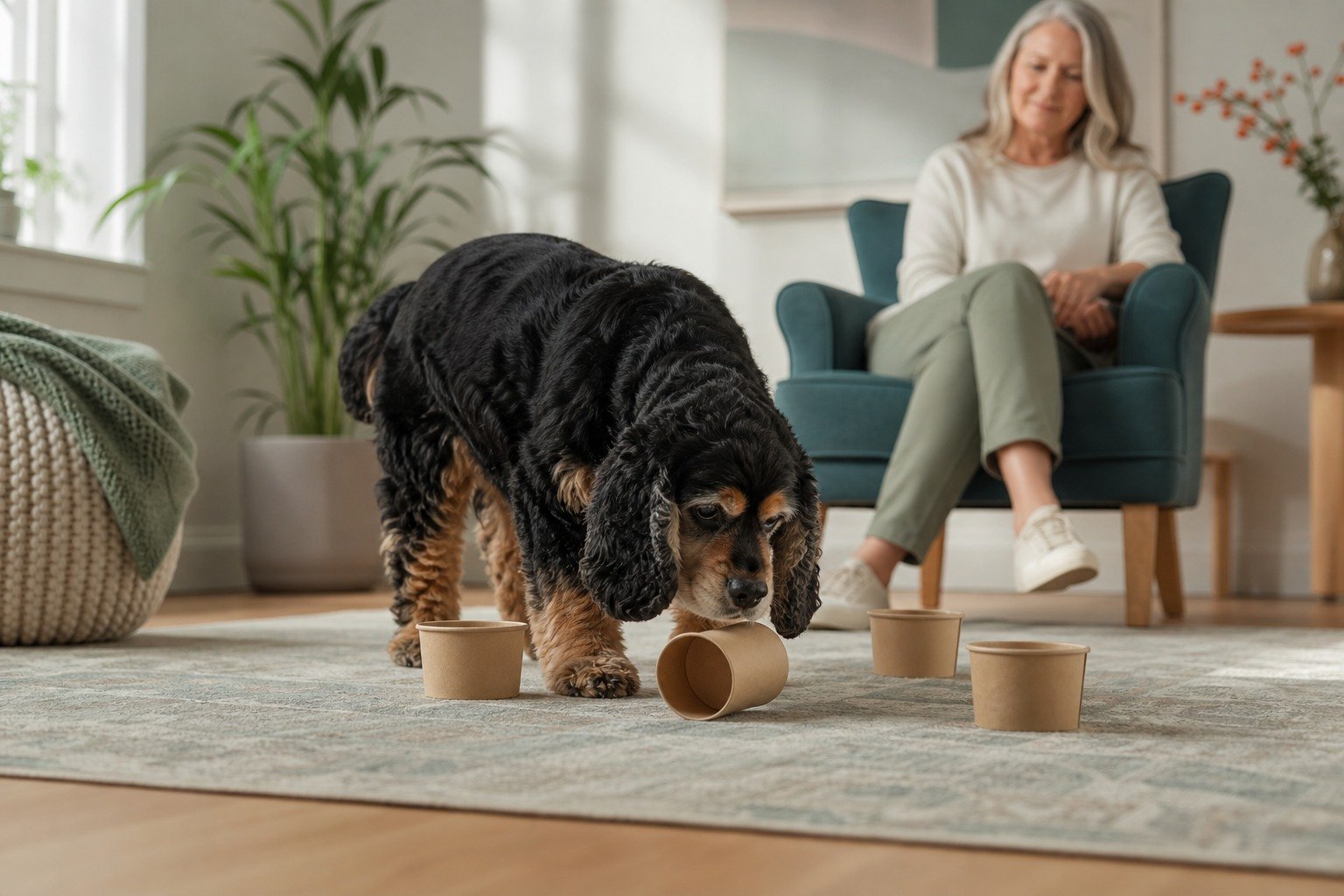
Mental engagement for a senior dog means offering safe, low-pressure opportunities for exploration, social connection, gentle movement, scent use, and simple problem-solving that fit the dog today. Enrichment may support welfare and participation, but current evidence does not prove that games prevent, reverse, or treat canine cognitive dysfunction. New behavior changes also require veterinary assessment because pain, illness, sensory loss, sleep disruption, medication effects, and environmental change can look cognitive. Activity choice should reflect mobility, vision, hearing, stamina, health, temperament, environment, and preference. The dog's response is the guide: relaxed engagement and comfortable recovery support continuing, while fear, frustration, fatigue, pain, or withdrawal mean adapt or stop.
Short answer
Offer choice and observe comfort rather than chasing performance
AAHA life-stage guidance includes age-, health-, and temperament-appropriate mental stimulation. Controlled studies in older pet dogs report age-related differences and mixed, task-specific intervention results. They do not establish a universal activity dose or prove prevention or treatment of cognitive dysfunction. [1] [3] [4]
- Record timing, context, frequency, recovery, and effect on ordinary daily function.
- Use observations to prepare for assessment, not to assign a diagnosis or treatment at home.
- Bring current health, diet, medication, supplement, and prior-response details to the veterinary team.
- Agree on what to monitor, when to recheck, and which change requires faster care.
Safety first
Sudden, progressive, or function-limiting behavior change needs veterinary assessment
Contact a veterinarian for new confusion, getting stuck, altered sleep-wake patterns, house-soiling, loss of learned routines, withdrawal, agitation, vocalization, appetite change, falls, pain, or reduced function. Seek urgent care for collapse, inability to stand, seizures, breathing difficulty, severe distress, or rapid deterioration. Do not assume more games will solve a medical or cognitive problem.
- Do not delay care for severe, sudden, escalating, or function-limiting changes.
- Do not start, stop, combine, or calculate treatment from a general article.
- Keep people and animals safely separated when behavior creates an immediate injury risk.
Veterinary note
This article is educational and does not diagnose, treat, prescribe, or replace care from a licensed veterinarian. Your dog’s history, examination, diet, medications, and current signs determine what is appropriate.
Define enrichment as welfare support
Enrichment creates opportunities to express behavior, explore, make choices, and engage with the environment. For an older dog, the goal is not speed, difficulty, novelty for its own sake, or proof of cognitive ability. It is a comfortable and meaningful experience.
AAHA recommends mental stimulation that fits age, breed, temperament, health, and behavior. That broad principle leaves room for individual preference and veterinary restrictions; it does not supply one required schedule or intensity. [1]
Separate enrichment from treatment claims. A pleasant scent walk or simple search may support engagement, but response cannot diagnose cognitive dysfunction or show that a disease process has been prevented.
Screen health, senses, and mobility first
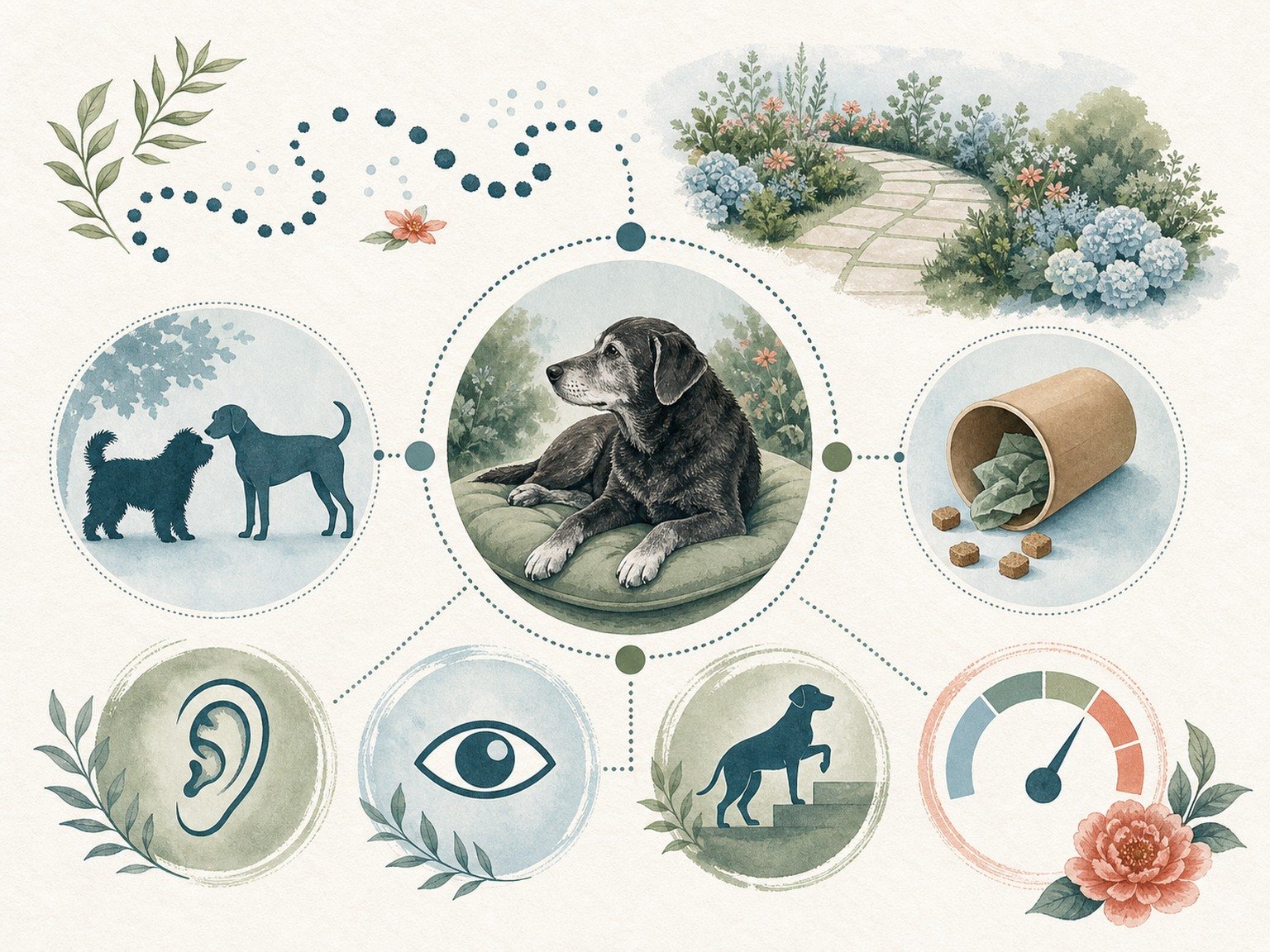
Pain can reduce willingness to move, bend, paw, turn, or persist. Vision or hearing change can make a familiar activity confusing. Dental disease, gastrointestinal upset, urinary urgency, weakness, and medication effects can also alter interest or tolerance.
Canine cognitive dysfunction is a diagnosis of exclusion, so a veterinarian should assess new behavior for medical, sensory, pain-related, and environmental contributors. Enrichment may be one part of a broader plan after those questions are considered. [2]
Use stable footing, clear paths, accessible rest, and easy exits. Do not place food or objects where the dog must jump, climb, balance, twist, or compete. Follow individual dietary and mobility restrictions from the veterinary team.
Choose from flexible noncommercial categories
Safe exploration can include a slower sniff-focused route, a supervised garden pause, or noticing a new object from a comfortable distance. Social connection may be quiet companionship, gentle consent-based interaction, or observing household activity from a preferred resting place.
Simple cognitive engagement can involve finding a few pieces of the dog's approved food in open containers, choosing between two familiar routes, or practicing an already-comfortable cue. Keep the task easy enough that the dog can succeed without prolonged effort or frustration.
Novelty is optional. Some seniors prefer familiar routines, and repetition can itself be enriching when the dog remains interested. Avoid branded-device assumptions; household materials can work when they are clean, stable, non-toxic, large enough not to swallow, and supervised.
Read evidence and the individual response carefully
A study of older pet dogs found age-related behavioral and cognitive differences but no detected protective effect from lifelong training on measured changes. This does not mean training lacks welfare value; it limits a claim that training eliminates aging effects. [3]
A three-month intervention study reported mixed, task-specific changes and no universal superiority of the combined intervention. Defined samples, tasks, and durations cannot create a prescription for every dog. [4]
Watch approach, body softness, persistence, ability to disengage, and recovery. Stop or simplify when the dog freezes, startles, pants, avoids, vocalizes, repeatedly fails, becomes fatigued, loses footing, or appears painful. Record the response and discuss persistent change with the veterinarian.
Prepare for a focused veterinary conversation
Bring a concise timeline, short natural-movement or symptom videos when safe, the exact names and photographs of every food, treat, medication, and supplement label, and notes about appetite, water intake, stool, sleep, activity, comfort, and behavior. Include recent injuries, travel, boarding, diet changes, missed medication, and previous test results. A complete record helps the veterinary team separate a repeatable pattern from a single impression.
Decide in advance what you need from the visit: an urgency decision, a diagnosis plan, a nutrition review, a pain or mobility assessment, or a monitored trial. Ask what result would change the plan and what finding would rule an option out. This keeps research and product information in the right role. Evidence can shape questions and expectations, but it cannot determine what is safe for an individual dog without the history and examination.
Owner tool
Plan a senior-friendly enrichment choice
On a phone, swipe across the table to see every column.
| Checkpoint | Record | Why it helps |
|---|---|---|
| Health | Pain, stamina, diet, restrictions | Sets boundaries |
| Senses | Vision, hearing, scent comfort | Adapts the task |
| Choice | Approach, leave, rest, repeat | Protects agency |
| Response | Engagement, frustration, recovery | Guides adjustment |
Better questions, calmer next steps
Questions to ask your veterinarian
- Could pain, illness, sleep, or sensory change affect interest?
- Which activities fit this dog's restrictions?
- What signs mean the task is too hard?
- How should I track behavior change?
- When does this pattern need cognitive assessment?
FAQ
Can enrichment prevent dementia?
Current evidence does not prove prevention or reversal.
Must activities be new?
No. Familiar activities can be valuable when the dog enjoys them.
How long should a session last?
There is no universal duration; follow comfort and individual guidance.
What if the dog walks away?
Respect the choice and simplify or stop.
Can enrichment replace a veterinary assessment?
No. New or progressive behavior change needs medical evaluation.
Sources
- American Animal Hospital Association: Canine Life Stage Checklists. Individualized stimulation and senior assessment.
- American Animal Hospital Association: Managing Cognitive Dysfunction and Behavioral Anxiety. Diagnosis of exclusion and evidence limits.
- Scientific Reports: Behavioral and Cognitive Changes in Aged Pet Dogs. Age effects and lifelong-training limits.
- GeroScience: Short-Term Cognitive and Physical Interventions in Old Dogs. Mixed task-specific intervention results.
