

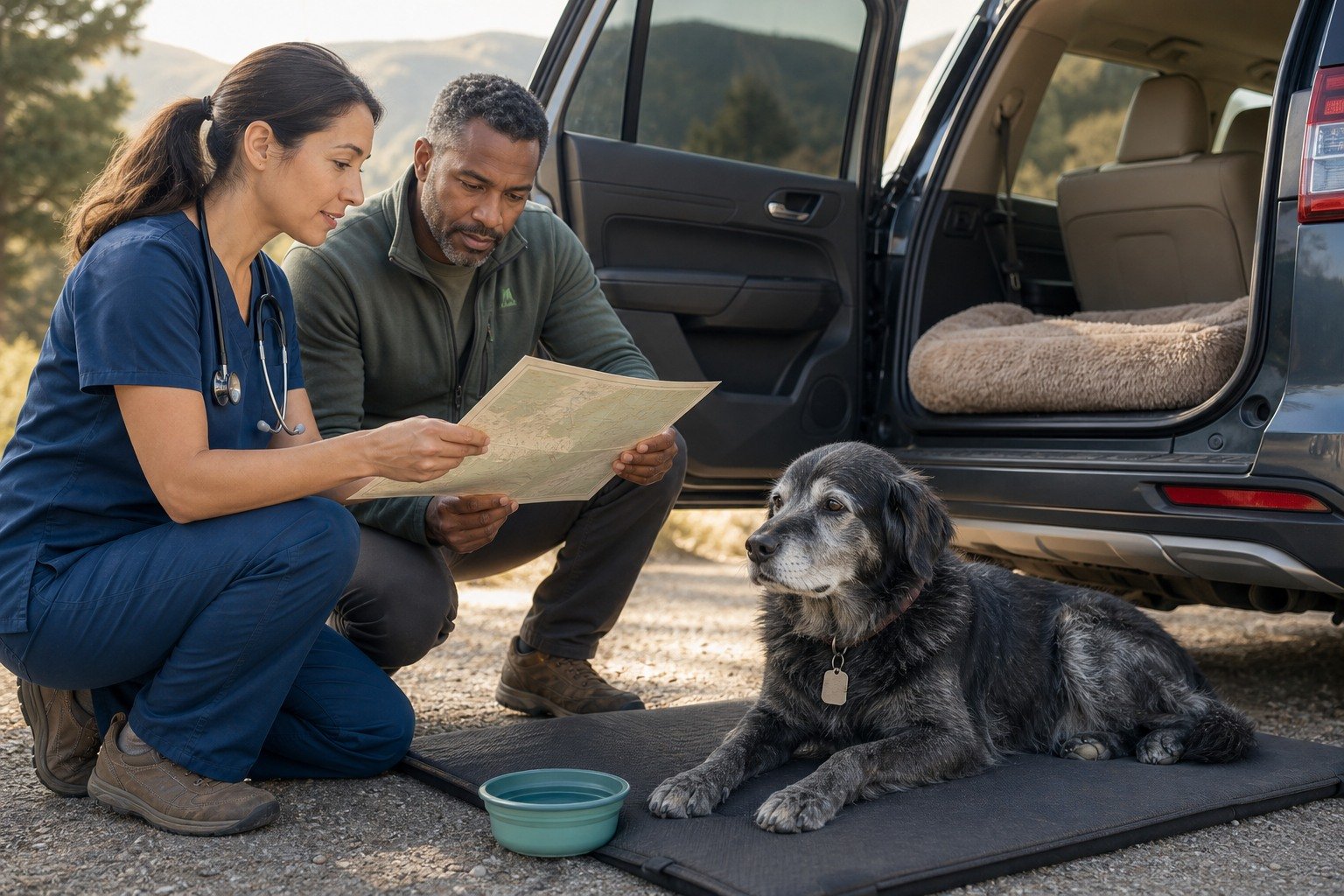
Travel can change motion, footing, temperature, sleep, food, toileting, medication timing, social exposure, and access to care. A senior label neither prohibits travel nor proves that a dog is fit for a specific journey. Pain, frailty, heart or breathing disease, gastrointestinal illness, sensory loss, cognitive change, anxiety, and several conditions together can alter risk. Start with the dog's current baseline and the exact route, transport mode, duration, destination, and veterinary access. Preserve prescriptions and routine rather than improvising them. Plan stable entry, secure transport, rest, climate control, elimination, and a realistic contingency. If the trip cannot protect comfort, essential care, or safe recovery, staying with a trusted caregiver may be the better welfare decision.
Short answer
Fitness for one trip is an individual veterinary decision
AAHA and Merck travel guidance recommends advance veterinary review, records, identification, secure transport, familiar supplies, destination planning, and monitoring. Requirements depend on the destination and can change. Senior and pain guidance adds function, comorbidity, medication, mobility, and baseline comparison. None provides an age-only travel rule. [1] [2] [3] [4]
- Start with the individual dog's baseline, complete diet, health history, and veterinary plan.
- Record exact products, ingredients, timing, purpose, and observed change instead of relying on category labels.
- Keep general evidence separate from a product-specific recommendation or treatment decision.
- Escalate sudden, severe, persistent, or rapidly worsening signs promptly.
Safety first
Collapse, breathing distress, severe pain, or rapid decline should stop travel
Seek urgent care for collapse, breathing difficulty, pale or blue gums, severe pain, repeated vomiting, inability to stand, major trauma, heat-related distress, seizure, sudden disorientation, or rapid deterioration. Move to a safe setting and contact care. Do not continue the route to test whether the dog settles or change a prescription without instructions.
- Do not start, stop, combine, split, or calculate a product or medication from this article.
- Do not use a supplement to delay diagnosis, prescribed care, or urgent veterinary assessment.
- After a possible overdose, wrong-product exposure, or toxic ingestion, contact a veterinarian or animal poison service promptly.
Veterinary note
This article is educational and does not diagnose, treat, prescribe, or replace care from a licensed veterinarian. Your dog’s history, examination, diet, medications, and current signs determine what is appropriate.
Assess the dog and the proposed journey together
Bring the destination, route, dates, transport method, lodging, climate, expected walking and stairs, carrier or restraint, and local veterinary options to the pre-trip visit. Add diagnoses, recent test results, mobility, pain, stamina, breathing, appetite, elimination, cognition, sensory function, behavior, and prior travel response. The same dog may be suited to one journey but not another.
Ask whether the dog is stable enough to travel and which examination or testing questions apply. Chronological age alone cannot answer that. Senior guidance emphasizes multimorbidity and individualized goals, while pain assessment compares posture, gait, activity, demeanor, and lifestyle with the dog's baseline. [3] [4]
Record normal rising, walking, resting respiration, eating, drinking, toileting, sleep, social engagement, and recovery before departure. Short natural video may help when it does not require a painful task. A stable baseline gives the owner and destination clinic something meaningful to compare with a change.
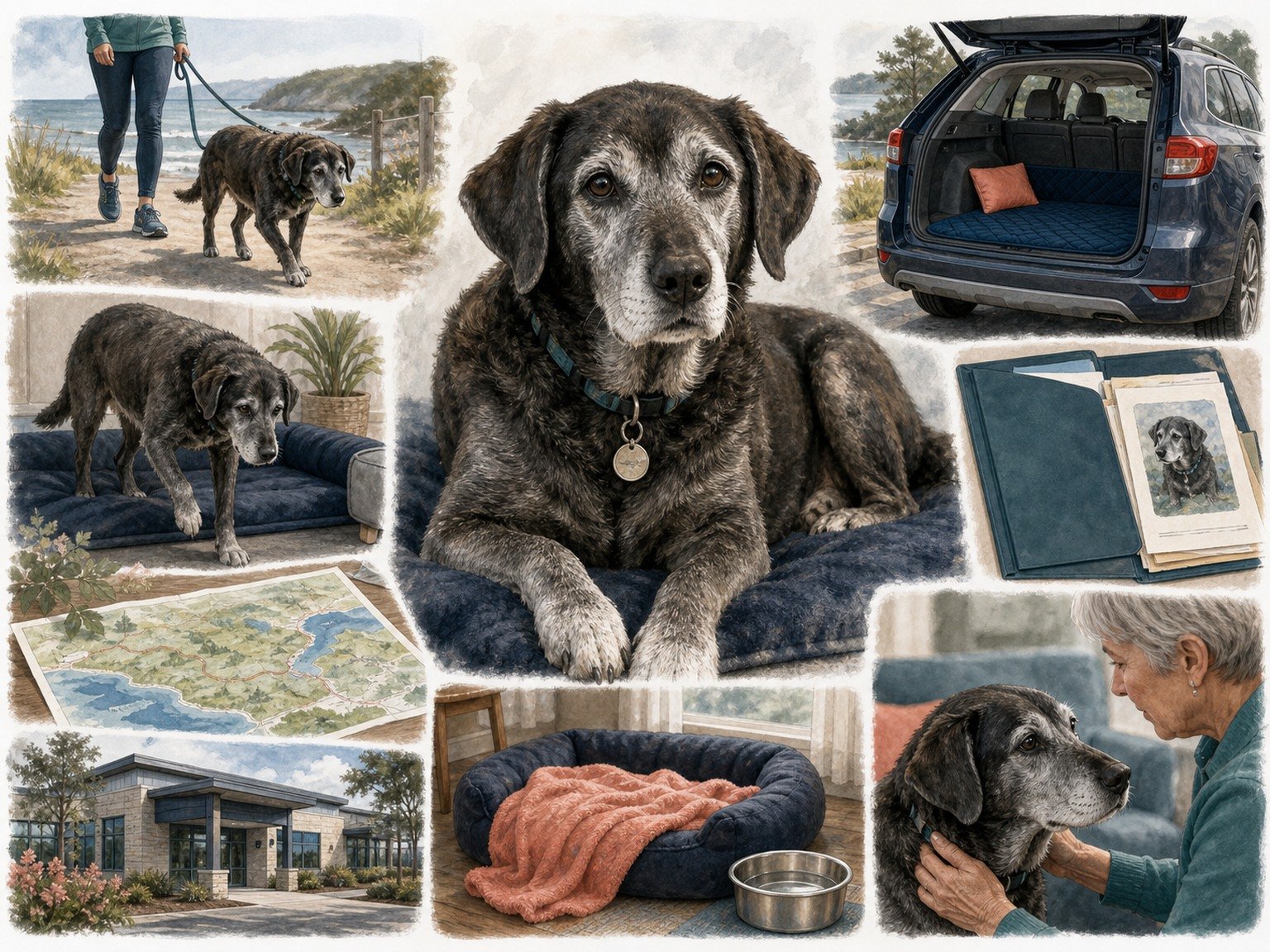
Separate medical documents, destination rules, and carrier policies
Carry a current health summary, vaccination and identification records, clinic contacts, prescription list, and enough correctly stored medication for the planned period plus an agreed contingency. Keep instructions readable and maintain original labels. Do not combine pills into an unmarked container if doing so removes identity or administration information.
For international travel, check current destination-government, veterinary-certificate, and carrier requirements and start early enough for every required step. Merck travel guidance emphasizes advance veterinary discussion, current records, identification, destination research, and local veterinary contacts. [2] Entry rules, carrier policies, lodging rules, and medical fitness remain separate questions.
Ask the carrier directly about current crate, restraint, temperature, breed, documentation, and check-in requirements. This article does not establish one safe carrier, break interval, feeding schedule, or transport mode. The veterinary plan and current official rules govern the specific case.
Protect access, routine, and recovery
Practice safe vehicle or carrier access only if the veterinary team considers it appropriate. Use stable nonslip surfaces, adequate space and ventilation, secure restraint, and familiar bedding without forcing a painful climb or trapping a frightened dog. An access aid must fit the dog, vehicle, surface, and caregiver and should be practiced before travel.
Plan food, water, elimination, rest, temperature control, and medication around exact veterinary and carrier instructions. Avoid last-minute supplements, sedatives, rich treats, or diet changes. Familiarity can reduce avoidable disruption, but it cannot make a medically unsuitable trip safe.
During and after travel, record gait, rising, posture, breathing, appetite, water, elimination, vomiting, sleep, confusion, distress, medication administration, and time to return to baseline. A delayed decline still matters. Contact the veterinary team rather than repeating a difficult exposure to collect better evidence.
Make the stay-home option a planned form of care
Compare the demands of travel with the demands of staying home. A trusted caregiver, familiar environment, clear handoff, and local clinic access may protect welfare better for a dog with unstable disease, severe pain, poor recovery, difficult transport, or distress that cannot be managed safely.
If the dog stays, leave one current record, named responsibility for every time-sensitive task, food and medication supplies, handling instructions, transport authorization, payment plan, and emergency contacts. A home plan needs the same precision as a travel plan.
Reassess after every trip or major health change. Note what worked, what did not, and whether the total load was acceptable. The next decision should use the dog's new baseline rather than assuming that one successful or difficult journey predicts all future travel.
Prepare for a focused veterinary conversation
Bring a concise timeline, short natural-movement or symptom videos when safe, the exact names and photographs of every food, treat, medication, and supplement label, and notes about appetite, water intake, stool, sleep, activity, comfort, and behavior. Include recent injuries, travel, boarding, diet changes, missed medication, and previous test results. A complete record helps the veterinary team separate a repeatable pattern from a single impression.
Decide in advance what you need from the visit: an urgency decision, a diagnosis plan, a nutrition review, a pain or mobility assessment, or a monitored trial. Ask what result would change the plan and what finding would rule an option out. This keeps research and product information in the right role. Evidence can shape questions and expectations, but it cannot determine what is safe for an individual dog without the history and examination.
Owner tool
Build a senior-dog travel readiness record
On a phone, swipe across the table to see every column.
| Checkpoint | What to record | Why it helps |
|---|---|---|
| Fitness | Health, pain, mobility, stamina, cognition | Frames suitability |
| Logistics | Route, access, records, rules, clinics | Prevents gaps |
| During | Routine, signs, doses, recovery | Tracks change |
| Contingency | Stop signs, safe place, stay-home plan | Protects welfare |
Better questions, calmer next steps
Questions to ask your veterinarian
- Is this dog fit for this exact route and destination?
- Which records, tests, and prescription instructions apply?
- What access and restraint questions should we resolve?
- Which signs should stop the trip?
- Would staying home be safer or more comfortable?
FAQ
Is a senior dog too old to travel?
Age alone does not decide; health, function, route, and destination matter.
Should medication timing change across time zones?
Ask the prescribing veterinarian for an exact written plan.
Do health papers prove fitness to travel?
No. Documentation and medical suitability are separate questions.
Can a familiar bed make travel safe?
It may support comfort but cannot correct medical or transport risk.
What should I track after returning?
Compare mobility, appetite, breathing, sleep, behavior, elimination, and recovery with baseline.
Sources
- American Animal Hospital Association: Traveling Safely With Your Pet. Veterinary planning, records, secure transport, supplies, and destination care.
- Merck Veterinary Manual: Planning for Travel With Pets. Advance planning, records, identification, destination rules, and local care.
- American Animal Hospital Association: 2023 Senior Care Guidelines. Individualized senior assessment and multimorbidity.
- American Animal Hospital Association: Chronic Pain Assessment in Dogs. Baseline function, owner observations, and repeated pain assessment.
- American Veterinary Medical Association: Traveling With Your Pet FAQ. Travel preparation, records, identification, and transport questions.
