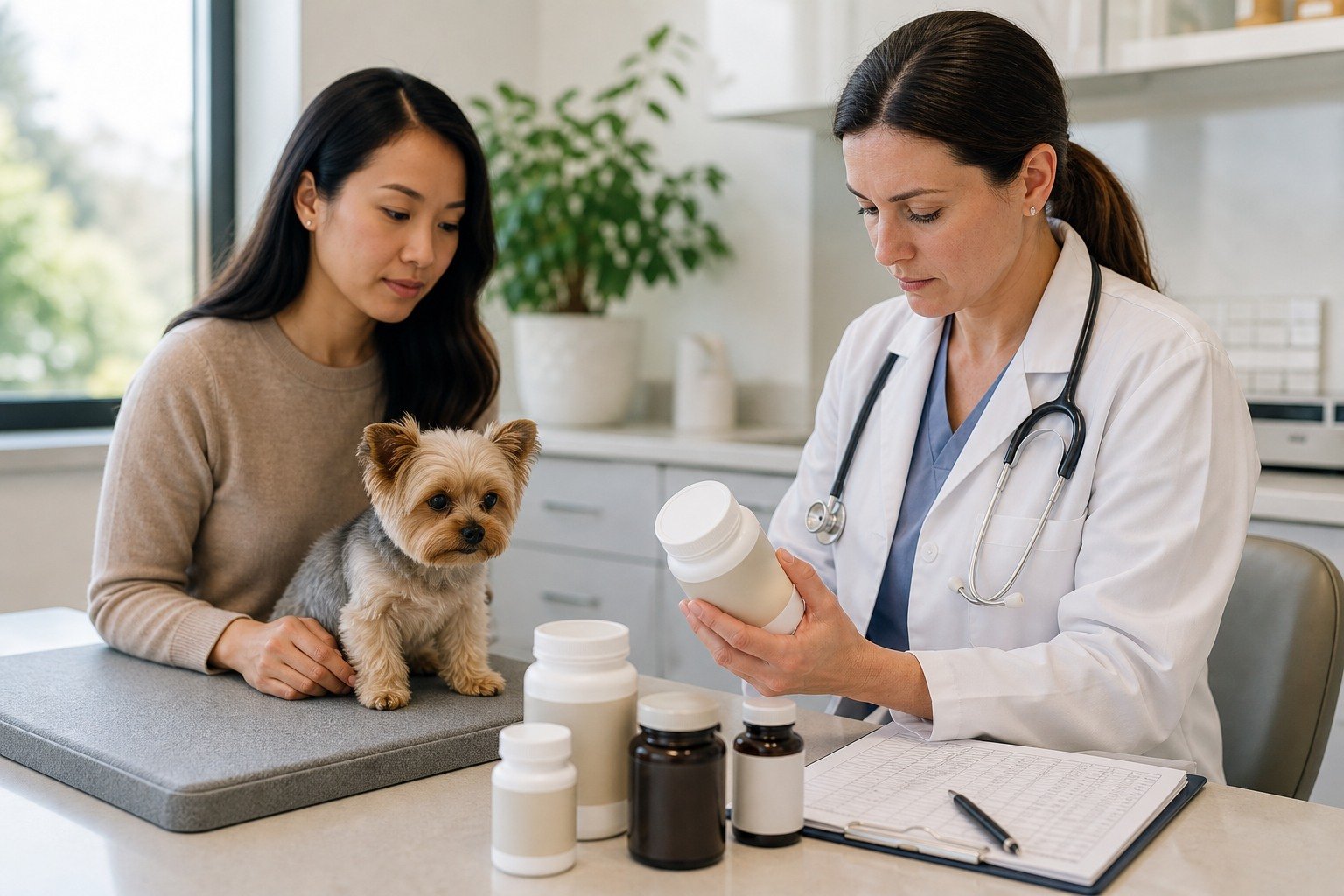
A tiny dog is not simply a scaled-down large dog, but body weight alone cannot establish a supplement dose, treatment, or outcome. The exact ingredient, concentration, chemical form, formulation, amount, timing, health history, diet, and concurrent products all matter. Tablet splitting can be inaccurate or inappropriate, and a human chewable may contain sweeteners or other ingredients that were never intended for dogs. Xylitol is one important example because it can occur in human vitamins, medicines, and dietary supplements and requires immediate professional contact after a suspected exposure. That example does not mean every supplement is uniquely dangerous to small dogs. It shows why original packages, secure storage, precise caregiver handoffs, and veterinarian-selected products are essential.
Short answer
Small size increases the need for precision, not home dose conversion
AAHA recommends a complete history of diet, supplements, and medications. FDA warns that xylitol may occur in human vitamins, medicines, and supplements and advises immediate veterinary or poison-control contact after suspected ingestion. Product-specific identity and patient context remain essential. [1] [2]
- Start with the individual dog's baseline, complete diet, health history, and veterinary plan.
- Record exact products, ingredients, timing, purpose, and observed change instead of relying on category labels.
- Keep general evidence separate from a product-specific recommendation or treatment decision.
- Escalate sudden, severe, persistent, or rapidly worsening signs promptly.
Safety first
Do not wait for symptoms after a possible hazardous ingestion
Call a veterinarian, emergency clinic, or animal poison service immediately after a possible xylitol, human supplement, medication, unknown chewable, overdose, or wrong-dog exposure. Bring the package, amount, time, dog weight, health history, and signs. Do not induce vomiting, give food, or perform home treatment unless a professional specifically directs it.
- Do not start, stop, combine, split, or calculate a product or medication from this article.
- Do not use a supplement to delay diagnosis, prescribed care, or urgent veterinary assessment.
- After a possible overdose, wrong-product exposure, or toxic ingestion, contact a veterinarian or animal poison service promptly.
Veterinary note
This article is educational and does not diagnose, treat, prescribe, or replace care from a licensed veterinarian. Your dog’s history, examination, diet, medications, and current signs determine what is appropriate.
Identify the exact product before discussing safety
Photograph the front, ingredient panel, guaranteed or supplement facts, inactive ingredients, directions, lot, expiration, and manufacturer contact. Record the form: chew, liquid, powder, capsule, tablet, gummy, or multi-ingredient blend. Similar names can hide different concentrations and excipients.
List every food, treat, topper, supplement, medication, preventive, and human product the dog can access. AAHA nutrition history guidance includes all exposures and caregiver practices because the safety question depends on the whole record, not a small-breed label. [1]
Never assume a scored tablet is suitable to split or that an unscored chew contains evenly distributed ingredients. Do not convert a human serving or another dog's plan by body weight. The veterinarian must evaluate formulation, measurement accuracy, purpose, and patient factors.

Use xylitol as a lesson in formulation-specific risk
FDA lists chewable vitamins, medicines, and dietary supplements among products that may contain xylitol and advises immediate professional contact after suspected ingestion. [2] Check the exact ingredient list, including alternate names identified by the authority, and keep such products inaccessible.
A retrospective series of 192 canine xylitol exposures documented varied clinical findings and management. [3] It does not provide a home threshold or permission to wait. The amount may be uncertain, products differ, and prompt case-specific assessment is needed.
The lesson is not that every small dog will be poisoned by every supplement. It is that one unexpected ingredient can dominate the risk and that the same absolute amount can represent a different bodyweight-relative exposure. Exact identity and timing matter more than reassurance from package size.
Prevent storage and handoff errors
Keep human and animal products in original closed containers inside a high locked or securely latched space. Do not leave chews, weekly organizers, handbags, delivery boxes, or prepared doses where a dog can reach them. Small dogs can enter narrow spaces and ingest dropped fragments unnoticed.
When several people provide care, assign each administration to one person and require immediate sign-off. Record product, formulation, amount, time, and dog. Prepare one animal's items at a time and separate pets until consumption is confirmed.
Maintain current clinic, emergency, and poison-control contacts where every caregiver can find them. Include the dog's current weight, diagnoses, medications, and allergies, but do not use that record to calculate treatment. Its purpose is to speed accurate professional assessment.
Evaluate need and evidence without size-based marketing
Ask what problem the supplement is intended to address, whether the dog has that problem, and whether evidence applies to the exact ingredient form and formulation. A small-breed package or tiny chew does not prove necessity, content accuracy, clinical benefit, or compatibility.
Veterinary reviews describe substantial variation in evidence, product quality, formulation, regulation, and safety. [4] Merck toxicology guidance for xylitol reinforces that exposure assessment is ingredient- and case-specific. [5] Neither supports universal tablet splitting, dose conversion, or a safe-list shortcut.
Agree on a baseline, outcome, adverse signs, and review date before any veterinarian-approved trial. Reassess when weight, diet, health, medication, or formulation changes. The safest product may be no product when a defined need or reliable evidence is absent.
Prepare for a focused veterinary conversation
Bring a concise timeline, short natural-movement or symptom videos when safe, the exact names and photographs of every food, treat, medication, and supplement label, and notes about appetite, water intake, stool, sleep, activity, comfort, and behavior. Include recent injuries, travel, boarding, diet changes, missed medication, and previous test results. A complete record helps the veterinary team separate a repeatable pattern from a single impression.
Decide in advance what you need from the visit: an urgency decision, a diagnosis plan, a nutrition review, a pain or mobility assessment, or a monitored trial. Ask what result would change the plan and what finding would rule an option out. This keeps research and product information in the right role. Evidence can shape questions and expectations, but it cannot determine what is safe for an individual dog without the history and examination.
Owner tool
Build a small-dog product safety record
On a phone, swipe across the table to see every column.
| Checkpoint | What to record | Why it helps |
|---|---|---|
| Identity | Full label, form, lot, expiration | Defines product |
| Exposure | Amount, time, access, other items | Frames risk |
| Patient | Weight, health, drugs, signs | Adds context |
| Response | Clinic, poison contact, instructions | Avoids delay |
Better questions, calmer next steps
Questions to ask your veterinarian
- Is this exact formulation appropriate for this dog?
- Can it be measured accurately without splitting or conversion?
- Could inactive ingredients or other products change risk?
- How should it be stored and handed off?
- Who do we call immediately after a suspected exposure?
FAQ
Can I cut a larger-dog chew for a small dog?
Not unless the veterinarian approves that exact formulation and division.
Are human vitamins safe in smaller pieces?
No. Formulation and inactive ingredients may be unsuitable or dangerous.
Should I wait for symptoms after xylitol exposure?
No. Contact veterinary or poison help immediately.
Does small size prove a supplement is needed?
No. Need is based on the individual problem and evidence.
Is body weight enough to determine toxicity?
No. Product, amount, timing, health, and other factors matter.
Sources
- American Animal Hospital Association: Gathering a Comprehensive Nutrition History. Complete diet, supplement, medication, patient, and caregiver history.
- U.S. Food and Drug Administration: Paws Off Xylitol; It Is Dangerous for Dogs. Xylitol sources and immediate contact guidance.
- Journal of Veterinary Emergency and Critical Care: Retrospective Evaluation of Xylitol Ingestion in 192 Dogs. Clinical exposure series and case-specific assessment context.
- Nutrition Today: Veterinary Pet Supplements and Nutraceuticals. Product evidence, formulation, quality, and safety limitations.
- Merck Veterinary Manual: Xylitol Toxicosis in Dogs. Ingredient-specific canine toxicology and veterinary management context.
