

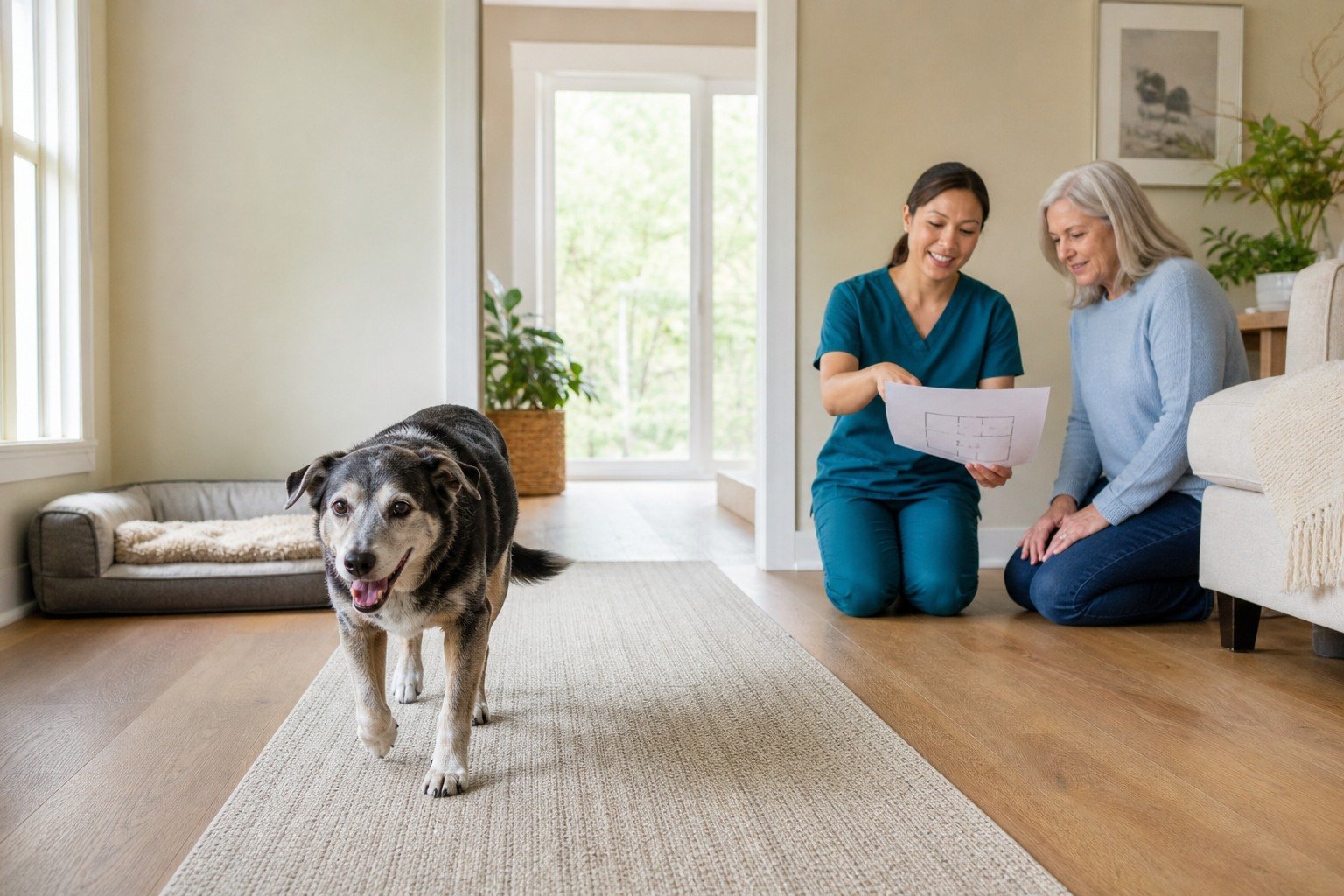
This guide is deliberately narrower than a broad senior-mobility or at-home comfort guide. Its job is to help owners map the physical environment: where an older dog slips, hesitates, collides, becomes stranded, cannot reach an essential resource, or needs assistance with an ordinary task. It does not prescribe a shopping list, installation, ramp angle, lifting method, exercise, or rehabilitation plan. A safe change depends on diagnosis, pain, strength, balance, vision, cognition, size, behavior, household layout, caregiver capacity, and response. Record the barrier, review it with the veterinary or rehabilitation team, trial only an appropriate change, and reassess function and safety.
Short answer
Audit the barrier before selecting the adaptation
AAHA senior and pain guidance recognizes physical-space barriers and environmental modification within individualized care. COAST places environmental modification inside staged and reassessed osteoarthritis management, while a physiotherapy review identifies evidence limitations. These sources support a structured audit, not one universal setup or a guarantee that an environmental change prevents falls or treats pain. [1] [2] [3] [4]
- Start with the individual dog's baseline, complete diet, medication and supplement history, and veterinary plan.
- Use repeated observations to improve a veterinary discussion, not to diagnose, prescribe, or prove an effect at home.
- Keep regulatory categories, product evidence, population findings, and study endpoints within their actual limits.
- Escalate sudden, severe, persistent, progressive, dangerous, or function-limiting changes promptly.
Safety first
A home change cannot make a sudden decline routine
Seek urgent care for collapse, severe pain, inability to rise, non-weight-bearing lameness, trauma, dragging or knuckling, loss of coordination, breathing difficulty, or new loss of bladder or bowel control. Do not repeat a difficult movement, test stairs, improvise lifting, or install equipment while the dog's capacity is uncertain.
- Do not delay urgent care while completing a log, changing the home, comparing costs, or waiting for a review date.
- Do not start, stop, cycle, combine, divide, increase, or rechallenge medication or supplements from this article.
- Do not use human products, leftover prescriptions, online dose conversions, or a supplement as a substitute for indicated care.
Veterinary note
This article is educational and does not diagnose, treat, prescribe, or replace care from a licensed veterinarian. Your dog’s history, examination, diet, medications, and current signs determine what is appropriate.
Map every essential route and transition
Walk the route from the usual resting place to water, food, toileting, exits, family spaces, and transport. Mark loose rugs, slick flooring, thresholds, narrow turns, clutter, steep or unstable transitions, poor lighting, blocked paths, and places where household traffic surprises the dog.
Observe ordinary rising, stopping, turning, stepping, settling, and recovery without creating a test. Record location, task, surface, time, recent activity, fatigue, medication timing, weather, and what assistance was already needed. A pause or slip is a finding, not a diagnosis.
AAHA emphasizes patient-specific assessment and avoiding dismissal as old age. [1] [2] The same doorway can affect two dogs differently because orthopedic, neurologic, sensory, cardiopulmonary, cognitive, and behavioral factors differ.
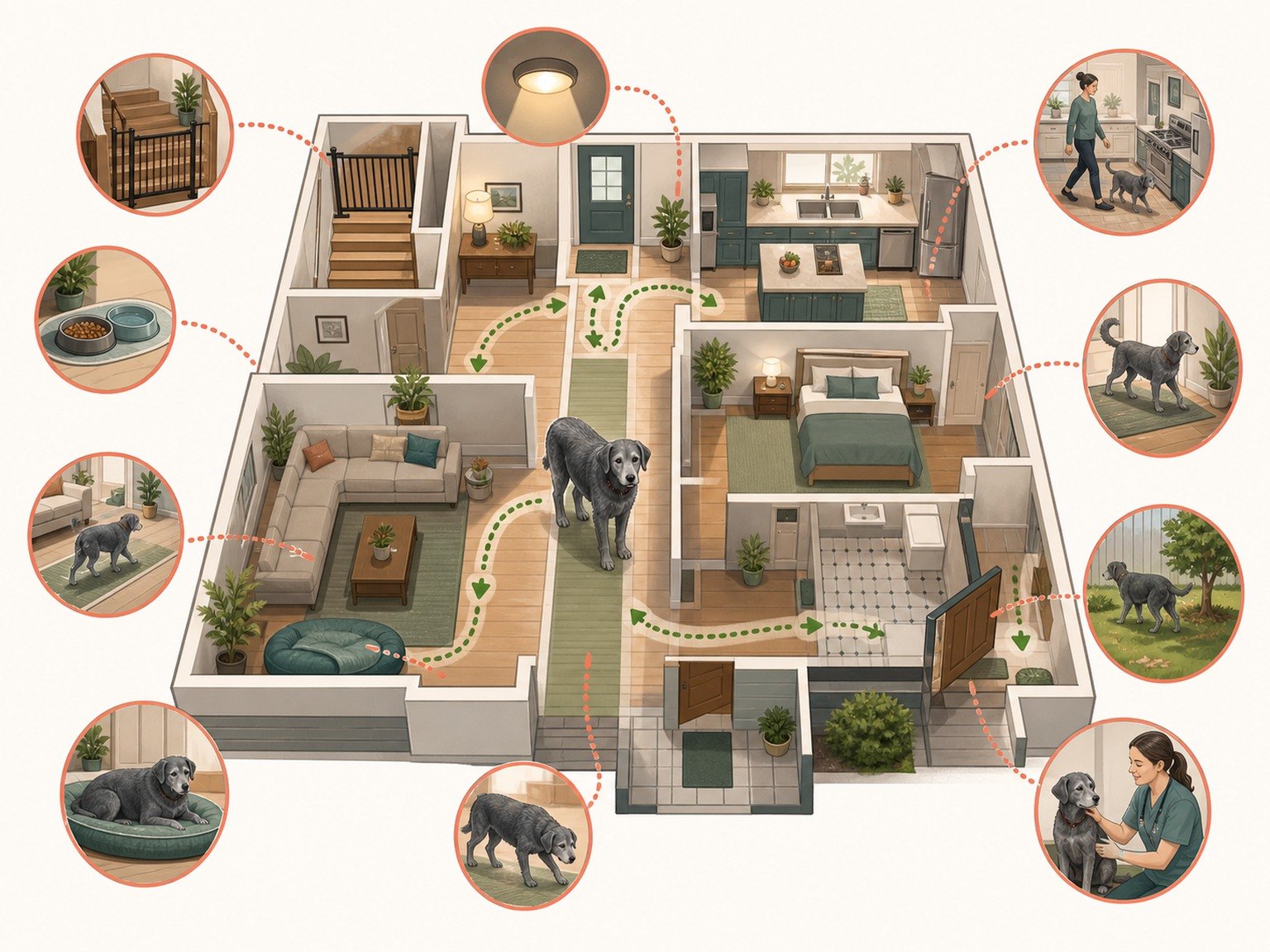
Review access, rest, toileting, and household traffic
Check whether the dog can reach water, food, a stable resting place, toileting, and social contact without a hazardous route. Note bed entry and exit, bowl stability, door timing, night lighting, surface changes, steps, yard conditions, and vehicle access.
Map where children, visitors, other animals, doors, gates, cords, and furniture create unpredictable movement or blocked retreat. A gate may prevent a fall but also block toileting or social access. A soft bed may look comfortable but be difficult to exit. Function matters more than appearance.
Photograph the barrier and add measurements only when the professional team requests them. Capture short natural video only when safe. Do not make the dog repeat a painful task or continue after hesitation, weakness, fatigue, distress, or loss of balance.
Discuss modification categories without a shopping list
Possible discussion categories include secured traction on necessary paths, removal of loose hazards, improved lighting, stable rest, protected transitions, easier access to essentials, and professionally selected assistive options. These are categories, not product endorsements or installation instructions.
COAST places environmental modification within a broader individualized plan that may include diagnosis, pain management, body condition, activity, rehabilitation, medication, and reassessment. [3] Flooring or layout cannot identify or treat the underlying condition by itself.
Ask whether the dog's vision, balance, neurologic function, pain, cognition, body size, medications, and caregiver handling ability change the safest option. Avoid copying another dog's ramp, harness, lift, exercise, or room setup.
Trial one change with a stop rule
Define the barrier, intended function, starting observation, one approved change, and how response will be measured. Keep other variables stable when clinically appropriate so a new slip, difficulty, or improvement can be described clearly.
Stop and contact the team for worsening pain, falls, escape risk, inability to access water or toileting, skin injury, refusal, distress, or reduced function. A change that solves one route but creates another hazard needs revision.
The physiotherapy evidence base contains important limitations. [4] Use environmental adaptation as monitored support, not a guaranteed outcome. Set a recheck interval and ask what finding requires examination, diagnostics, rehabilitation reassessment, or a different plan.
Prepare for a focused veterinary conversation
Bring a concise timeline, short natural-movement or symptom videos when safe, the exact names and photographs of every food, treat, medication, and supplement label, and notes about appetite, water intake, stool, sleep, activity, comfort, and behavior. Include recent injuries, travel, boarding, diet changes, missed medication, and previous test results. A complete record helps the veterinary team separate a repeatable pattern from a single impression.
Decide in advance what you need from the visit: an urgency decision, a diagnosis plan, a nutrition review, a pain or mobility assessment, or a monitored trial. Ask what result would change the plan and what finding would rule an option out. This keeps research and product information in the right role. Evidence can shape questions and expectations, but it cannot determine what is safe for an individual dog without the history and examination.
Owner tool
Build a room-by-room senior environment audit
On a phone, swipe across the table to see every column.
| Checkpoint | What to record | Why it helps |
|---|---|---|
| Route | Surface, transition, light, traffic | Locates barrier |
| Task | Rise, turn, reach, toilet, rest | Defines function |
| Context | Pain, fatigue, senses, medication | Widens assessment |
| Trial | One change, response, stop rule | Supports review |
Better questions, calmer next steps
Questions to ask your veterinarian
- Which medical or functional factors shape this barrier?
- Which route should be addressed first?
- What change is appropriate for this dog?
- How should response and adverse effects be tracked?
- When is professional reassessment needed?
FAQ
Does every senior dog need nonslip flooring?
No. Assess the actual route, dog, material stability, and household.
What ramp angle is safe?
There is no universal answer; design and fit require patient-specific professional guidance.
Can a harness prevent falls?
No aid guarantees safety and fitting or handling may introduce risk.
Should I lift my dog?
Ask for hands-on instruction specific to the dog and caregiver.
Do home changes treat arthritis?
No. They may support selected functions within veterinary care.
Sources
- American Animal Hospital Association: Pain Management in Senior Pets. Individualized pain care, owner monitoring, and environmental support.
- American Animal Hospital Association: Creating a Senior-Friendly Hospital. Physical-space barriers, access, traction, and observation.
- Frontiers in Veterinary Science: COAST Canine Osteoarthritis Treatment Guidelines. Staged, patient-specific, reassessed management.
- Veterinary Sciences: Physiotherapeutic Strategies for Canine Osteoarthritis. Evidence and limitations for physiotherapy and environmental strategies.
