
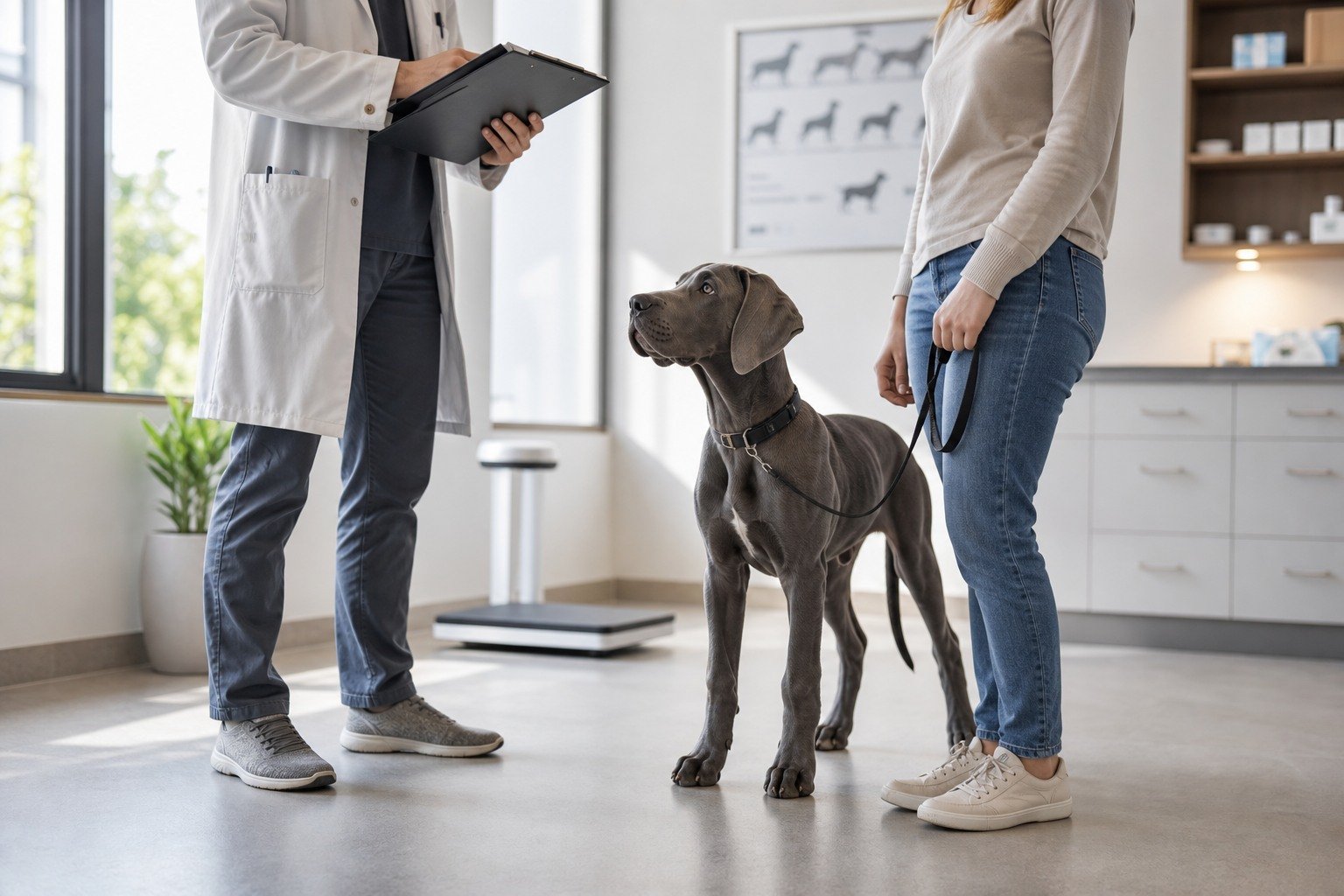
Large- and giant-breed puppies have growth and skeletal-development considerations that differ from adult dogs and smaller puppies. Evidence supports a complete growth-appropriate diet, controlled energy intake, lean body condition, and avoidance of excessive calcium exposure. Developmental joint disease remains multifactorial, so no supplement, food label, growth curve, or exercise rule can guarantee prevention. The veterinary team should review the exact diet, treats, supplements, feeding method, growth trend, expected adult size, activity, gait, and family history together.
Short answer
Support controlled growth; do not chase maximum size
The goal is appropriate growth and lean body condition, not the fastest gain or a chunky appearance. AAHA describes growth-appropriate nutrition and calcium considerations for large and giant breeds, while research links overnutrition and excessive calcium exposure with developmental skeletal risk in susceptible puppies. These principles do not supply one calorie target, calcium amount, meal schedule, or adult-food switch date for every puppy. [1] [2]
- Record the exact pattern, timing, exposures, function, and recent changes.
- Separate population evidence from what can be concluded about one dog.
- Use the veterinary team to define evaluation, monitoring, and urgent-response steps.
Safety first
Lameness, pain, weakness, or rapid change in a growing puppy needs veterinary evaluation
Contact a veterinarian for recurring limping, stiffness, altered gait, pain, swelling, reluctance to rise or play, appetite change, or concerning growth. Seek urgent or emergency care after major trauma, for sudden non-weight-bearing lameness, inability to stand, severe pain, collapse, breathing difficulty, pale gums, or rapid deterioration.
- Do not use general information to delay care for severe, persistent, or worsening signs.
- Do not start, stop, combine, or calculate treatment from this article.
- Keep labels, dates, videos, and a concise observation timeline available for the veterinary team.
Veterinary note
This article is educational and does not diagnose, treat, prescribe, or replace care from a licensed veterinarian. Your dog’s history, examination, diet, medications, and current signs determine what is appropriate.
Think in terms of development, not supplements
Bone, cartilage, muscle, tendons, ligaments, coordination, and body size change quickly during puppy growth. Large and giant breeds may mature skeletally later than smaller dogs. The relevant plan integrates nutrition, genetics, health, body condition, activity, and examination rather than treating joints as an isolated ingredient problem. [1]
A complete diet formulated for growth, including the growth of large-size dogs when applicable, is designed to supply nutrients in balance. Adding calcium, vitamins, minerals, joint ingredients, toppers, or substantial treats can alter that balance. Do not supplement a balanced growth diet without veterinarian or qualified veterinary nutrition guidance.
Record the exact product and formula, label, lot, measured amount, treats, chews, table food, supplements, feeding method, appetite, and gastrointestinal tolerance. The front of a package or the word puppy is not enough for a patient-specific nutrition assessment.

Use body condition and growth trends together
AAHA emphasizes lean body condition during growth. A single scale number cannot show whether a puppy is growing appropriately because breed, sex, frame, body composition, and age matter. Repeated weights and body-condition assessments interpreted by the veterinary team are more useful than comparing the puppy with unrelated dogs. [1]
Research on feeding large-breed puppies identifies energy and calcium as important growth considerations. Overnutrition can accelerate gain, while excessive calcium exposure can increase developmental skeletal risk in susceptible puppies. That evidence supports controlled planning, not a numeric prescription in a general article. [2]
Ask how often the puppy should be weighed and body condition assessed, what growth trend is expected, and what would prompt nutrition referral. If intake, stool, appetite, or growth changes, contact the clinic rather than compensating with supplements or an improvised restriction.
Understand multifactorial orthopedic risk
ACVS describes canine hip dysplasia as a multifactorial developmental condition in which heredity is important and growth-related environmental factors may influence expression. Good care can address modifiable factors but cannot override genetics or guarantee that hip, elbow, cartilage, or osteoarthritis problems will not occur. [3]
Risk-factor reviews identify both modifiable and nonmodifiable associations with osteoarthritis and predisposing disorders, while noting uneven evidence and incomplete interactions. Breed or family history can guide discussion and screening without predicting one puppy's diagnosis or outcome. [4]
Keep breeder or rescue records, parent screening information when available, prior examinations, imaging, gait videos, and growth records. Ask whether breed-specific screening or orthopedic referral is appropriate and when it would be informative.
Make activity an individualized discussion
Movement supports skill, strength, confidence, and normal life, but the evidence does not provide one universal exercise limit for every large-breed puppy. Surface, speed, repetition, forced versus self-selected activity, fatigue, terrain, temperature, growth stage, health, and prior signs all change the question.
Do not impose a generic distance formula, force repetitive impact, begin a conditioning program, or confine a healthy puppy for joint prevention based on this guide. Ask the veterinarian what activities fit the puppy now, which signs mean stop and call, and how advice changes after illness, injury, or a growth concern.
Record ordinary gait, slips, reluctance, asymmetry, recovery after activity, sleep, appetite, and willingness to participate. A short safe video can help. Never provoke a limp, manipulate joints, or delay care because the puppy is still playful.
Prepare for a focused veterinary conversation
Bring a concise timeline, short natural-movement or symptom videos when safe, the exact names and photographs of every food, treat, medication, and supplement label, and notes about appetite, water intake, stool, sleep, activity, comfort, and behavior. Include recent injuries, travel, boarding, diet changes, missed medication, and previous test results. A complete record helps the veterinary team separate a repeatable pattern from a single impression.
Decide in advance what you need from the visit: an urgency decision, a diagnosis plan, a nutrition review, a pain or mobility assessment, or a monitored trial. Ask what result would change the plan and what finding would rule an option out. This keeps research and product information in the right role. Evidence can shape questions and expectations, but it cannot determine what is safe for an individual dog without the history and examination.
Owner tool
Build a large-breed puppy growth record
On a phone, swipe across the table to see every column.
| Checkpoint | Record | Why it helps |
|---|---|---|
| Diet | Exact formula, treats, supplements | Defines intake |
| Growth | Weight trend and body-condition review | Shows development |
| Mobility | Gait, activity, recovery, video | Finds change |
| History | Breed, family, exam, screening | Adds risk context |
Better questions, calmer next steps
Questions to ask your veterinarian
- Is this diet appropriate for large-size growth?
- How should we assess body condition and growth trend?
- Are any supplements disrupting the diet balance?
- What activity fits this puppy's current stage?
- Does breed history support screening or referral?
FAQ
Should a large-breed puppy grow as fast as possible?
No. Appropriate controlled growth and lean condition are the goals.
Should I add calcium?
Not without veterinarian or veterinary nutrition guidance.
Can diet prevent dysplasia?
No. Developmental joint disease is multifactorial.
Is there one exercise formula?
No. Activity guidance is individualized and evidence for exact universal limits is incomplete.
What should I track?
Diet, treats, supplements, weight, body condition, activity, gait, and veterinary findings.
Sources
- American Animal Hospital Association: Age-Specific and Breed-Specific Diets. Growth diet, lean condition, and calcium context.
- Compendium on Continuing Education: Feeding Large-Breed Puppies. Energy, calcium, and developmental skeletal risk.
- American College of Veterinary Surgeons: Canine Hip Dysplasia. Multifactorial developmental disease.
- Frontiers in Veterinary Science: Risk Factors for Canine Osteoarthritis. Risk evidence and uncertainty.
