

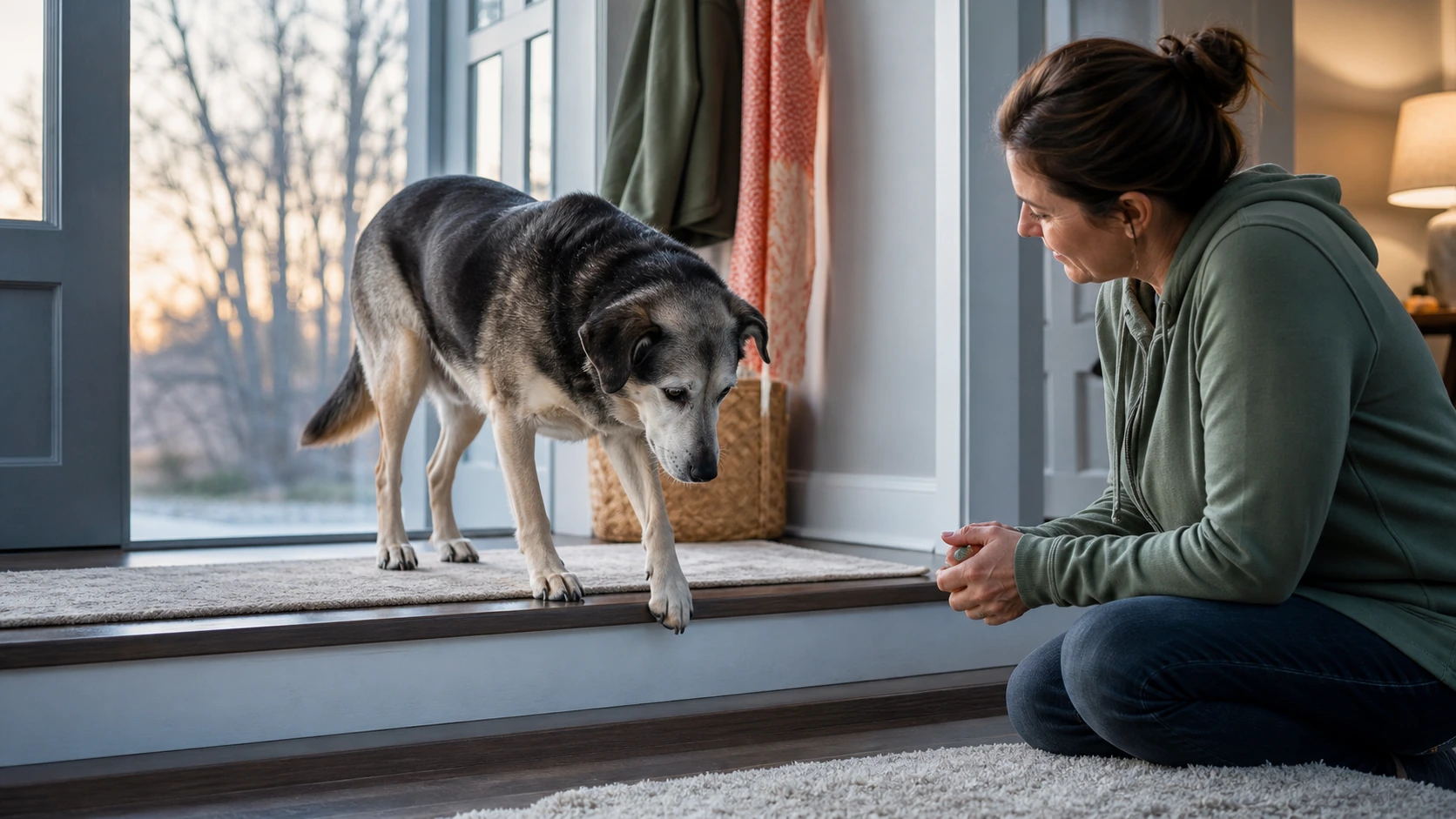
Joint stiffness may first look like hesitation, a changed routine, or a dog quietly opting out. Owners are well positioned to notice these small differences because they see the same rising, walking, stair, play, and rest patterns every day.
Short answer
Look for a repeated change from your dog's normal
Possible early signs include slower rising, stiffness after rest, shorter strides, reluctance on stairs or slippery floors, changed sitting posture, hesitation before jumping, reduced play, or a longer recovery after activity. These observations do not diagnose arthritis, but a repeatable pattern deserves a veterinary conversation. [1] [2]
- Observe natural movement; do not force a dog to repeat a painful task for testing or video.
- Record timing, surface, activity, duration, affected limb if visible, and whole-dog changes.
- Sudden severe lameness, trauma, neurologic signs, or inability to stand is urgent rather than an early-stiffness question.
Safety first
Some movement changes cannot wait for a routine appointment
Seek prompt veterinary care for sudden inability to bear weight, severe or escalating pain, major swelling, a dangling or unstable limb, trauma, inability to rise, dragging or knuckling paws, loss of coordination, collapse, fever with joint pain, or loss of bladder or bowel control.
- Do not give ibuprofen, naproxen, acetaminophen, aspirin, or another human pain product unless the veterinarian specifically directs it.
- Keep the dog from running, jumping, or using stairs after an acute injury until the clinic advises you.
- Use a blanket or rigid support for transport only if the clinic recommends it and you can do so safely.
Veterinary note
This article is educational and does not diagnose, treat, prescribe, or replace care from a licensed veterinarian. Your dog’s history, examination, diet, medications, and current signs determine what is appropriate.
Why early signs are easy to miss
Dogs can redistribute weight, shorten a stride, move more slowly, or avoid a task without vocalizing. Changes may be most obvious after sleep, after an unusually active day, in cold conditions, or on slick flooring. A dog may look nearly normal once warmed up, which does not mean the earlier stiffness was unimportant.
Chronic joint pain can also affect behavior. A dog may sleep more, become reluctant to be handled, stop following family members between rooms, or appear less enthusiastic about play. These signs are nonspecific, so they should be recorded as observations rather than labeled as arthritis. [2] [3]
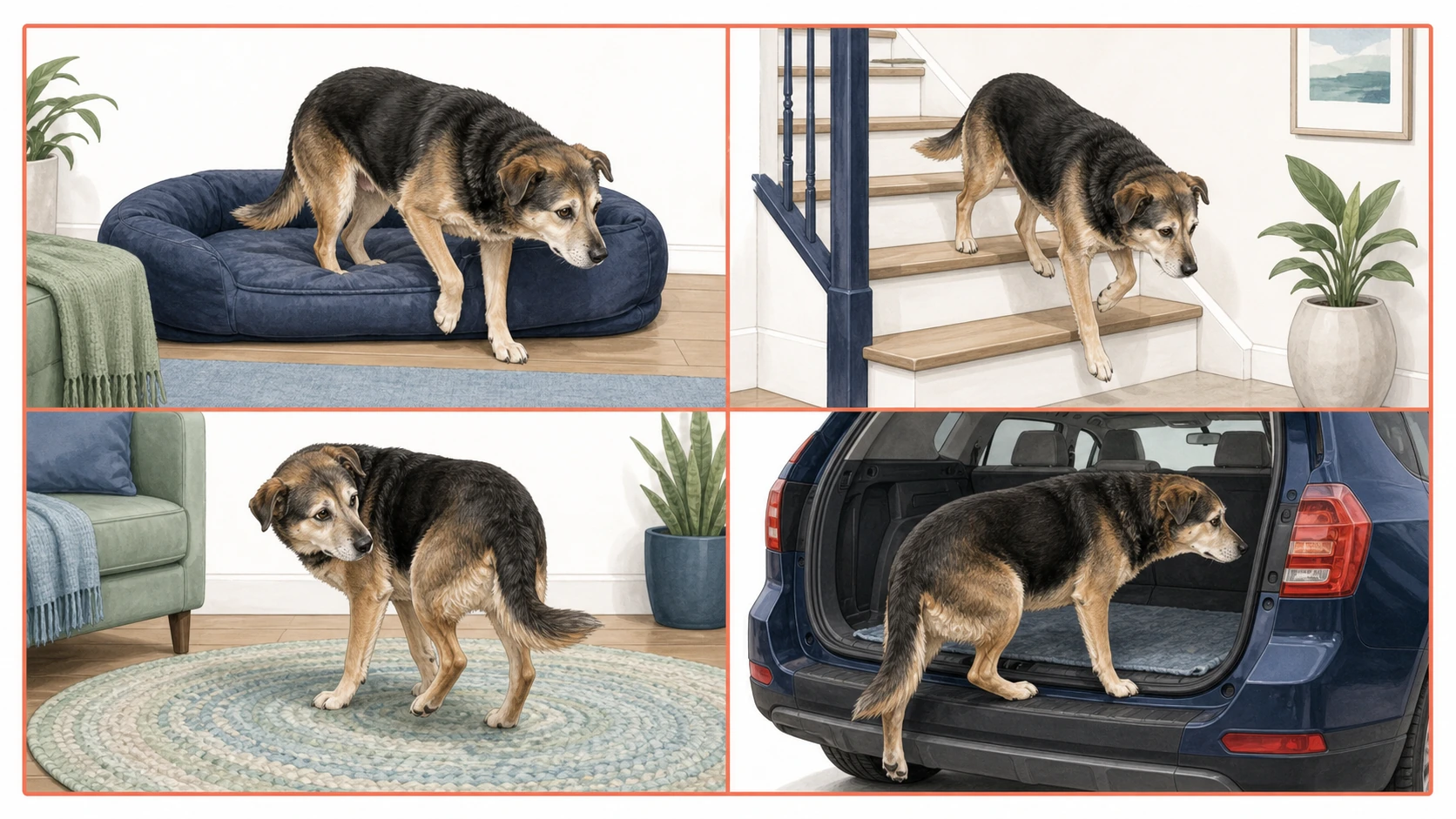
Watch transitions, not only straight-line walking
Rising from a bed, sitting, turning tightly, stepping over a threshold, using stairs, jumping into a car, squatting to eliminate, and settling back down often reveal more than a short level walk. Compare both directions and note whether the dog uses momentum, shifts weight forward, slips, pauses, or chooses a different route.
Paw and nail problems can mimic or compound stiffness. Check for a broken nail, worn pad, foreign material between toes, or excessive nail length without manipulating a painful limb. Neurologic problems can also change foot placement and coordination, which is why dragging, scuffing, knuckling, or crossing limbs should be reported promptly.
A useful video is short and natural
If the dog is safe to move, capture a few seconds of rising, walking away, walking toward you, turning, and using a familiar transition. Film at the dog's level in good light and include the whole body. Do not lure the dog onto stairs, make repeated attempts, or extend activity just to capture a clearer limp.
Add context: date, time, activity before the clip, surface, medications, and whether the pattern improved with gentle normal movement or worsened later. Videos cannot replace palpation, neurologic examination, or imaging, but they can preserve an intermittent pattern for the appointment.
What veterinary assessment may include
The veterinarian may observe gait and posture, compare muscle mass, examine paws and nails, palpate the spine and limbs, move selected joints, and perform a neurologic screen. Radiographs or other testing depend on the history and examination. Joint stiffness is a sign, not a final diagnosis. [1] [2]
Early identification matters because weight management, activity planning, rehabilitation, environmental changes, pain treatment, and treatment of an underlying orthopedic problem work best when tailored to the dog. Avoid making several home changes at once; doing so can hide whether the dog is improving or simply avoiding the task.
Prepare for a focused veterinary conversation
Bring a concise timeline, short natural-movement or symptom videos when safe, the exact names and photographs of every food, treat, medication, and supplement label, and notes about appetite, water intake, stool, sleep, activity, comfort, and behavior. Include recent injuries, travel, boarding, diet changes, missed medication, and previous test results. A complete record helps the veterinary team separate a repeatable pattern from a single impression.
Decide in advance what you need from the visit: an urgency decision, a diagnosis plan, a nutrition review, a pain or mobility assessment, or a monitored trial. Ask what result would change the plan and what finding would rule an option out. This keeps research and product information in the right role. Evidence can shape questions and expectations, but it cannot determine what is safe for an individual dog without the history and examination.
Owner tool
Use the same four checkpoints each week
On a phone, swipe across the table to see every column.
| Checkpoint | Record | Avoid |
|---|---|---|
| Rise | Time, effort, slipping, limb position | Calling one difficult rise a diagnosis |
| Walk | Stride, pace, head/hip motion, distance tolerance | Extending the walk to provoke a sign |
| Transition | Stairs, turns, car, furniture, thresholds | Forcing a refused task |
| Recover | Stiffness later, sleep, panting, soreness | Changing exercise and products together |
Better questions, calmer next steps
Questions to ask your veterinarian
- Does this look more like a joint, muscle, paw, spine, or neurologic problem?
- Which natural movements would be useful to video before the visit?
- Should activity be restricted now, or kept consistent at a lower level?
- Would radiographs or another test change the plan?
- What signs mean the scheduled visit should become urgent?
FAQ
Does a dog need to limp before joint stiffness matters?
No. Slower rising, hesitation, changed posture, or reduced willingness may appear before a persistent limp.
Can stiffness improve after warming up?
Yes, some patterns are most visible after rest. Improvement with movement does not identify the cause or mean the change should be ignored.
Is stiffness normal in an older dog?
Age increases risk, but pain and mobility loss should not be dismissed as normal aging. Older dogs deserve assessment and comfort planning.
Could behavior change be related to pain?
Possibly. Pain can affect sleep, handling tolerance, activity, and social behavior, but these changes have other causes too.
What is the safest first home change?
Prevent slips and avoid forced high-impact activity while you contact the veterinarian. Do not begin human medication or an unreviewed supplement stack.
Sources
- American College of Veterinary Surgeons: Osteoarthritis in Dogs. Clinical signs, risk factors, diagnosis, and management.
- Cornell University College of Veterinary Medicine: Osteoarthritis. Owner-observed signs and veterinary diagnosis.
- AAHA: Mobility Matters. Practical recognition of mobility and behavior changes.
- Orthopedic Foundation for Animals: Hip Dysplasia. Developmental orthopedic context and screening.
- AAHA/AAFP: Pain Management Guidelines for Dogs and Cats. Pain assessment and multimodal management principles.
