


Inflammatory bowel disease has historically been used broadly for dogs with chronic gastrointestinal signs and intestinal inflammation, but current veterinary language often favors chronic inflammatory enteropathy and response-based classification. Chronic vomiting, diarrhea, weight loss, appetite change, or protein loss can have infectious, parasitic, dietary, endocrine, pancreatic, structural, neoplastic, and other causes. Symptoms alone do not diagnose IBD. Veterinary evaluation may involve history, examination, baseline laboratory and fecal testing, selected imaging, nutrition trials, specialized tests, and endoscopy with biopsy when indicated. Even biopsy identifies a pattern that must be interpreted with the full case. Management and prognosis vary; this guide provides no diet, medication, probiotic, supplement, or treatment protocol.
Short answer
IBD is not a diagnosis owners can make from chronic diarrhea
Merck notes that the term inflammatory bowel disease has historically described chronic enteropathy, but the diagnosis does not automatically select one treatment. The 2026 ACVIM-endorsed statement evaluates a structured diagnostic approach, disease classification, biomarkers, nutrition, endoscopy, biopsy, and histopathology. [1] [2]
- Record exact timing, pattern, exposures, diet, products, and recent changes.
- Use the record to prepare for veterinary assessment, not to diagnose or prescribe at home.
- Bring labels, medications, supplements, prior results, and safe photos or video when useful.
- Agree on monitoring, reassessment, and urgent-response instructions.
Safety first
Weight loss, blood, dehydration, persistent vomiting, or severe weakness needs prompt assessment
Contact a veterinarian promptly for chronic or recurring gastrointestinal signs, weight or muscle loss, appetite decline, black or bloody stool, repeated vomiting, swelling or fluid accumulation, pain, dehydration, or reduced function. Seek urgent care for collapse, severe weakness, breathing difficulty, distended painful abdomen, or rapid deterioration.
- Do not delay care for sudden, severe, escalating, or function-limiting signs.
- Do not start, stop, combine, or calculate treatment from this article.
- Keep a concise timeline and exact product or exposure details available.
Veterinary note
This article is educational and does not diagnose, treat, prescribe, or replace care from a licensed veterinarian. Your dog’s history, examination, diet, medications, and current signs determine what is appropriate.
Use precise chronic-enteropathy language
Chronic enteropathy is a syndrome category for persistent or recurring gastrointestinal signs after appropriate consideration of other causes. It does not mean every case has the same inflammation, trigger, severity, or response.
The IBD label can imply a confirmed inflammatory diagnosis, yet signs and routine tests are nonspecific. Ask the veterinarian which term is being used, what evidence supports it, and which alternatives remain.
Food-responsive and other response-based categories describe what happened under a controlled veterinary plan; they are not diagnoses owners should assign after casually changing foods or adding products. [2]
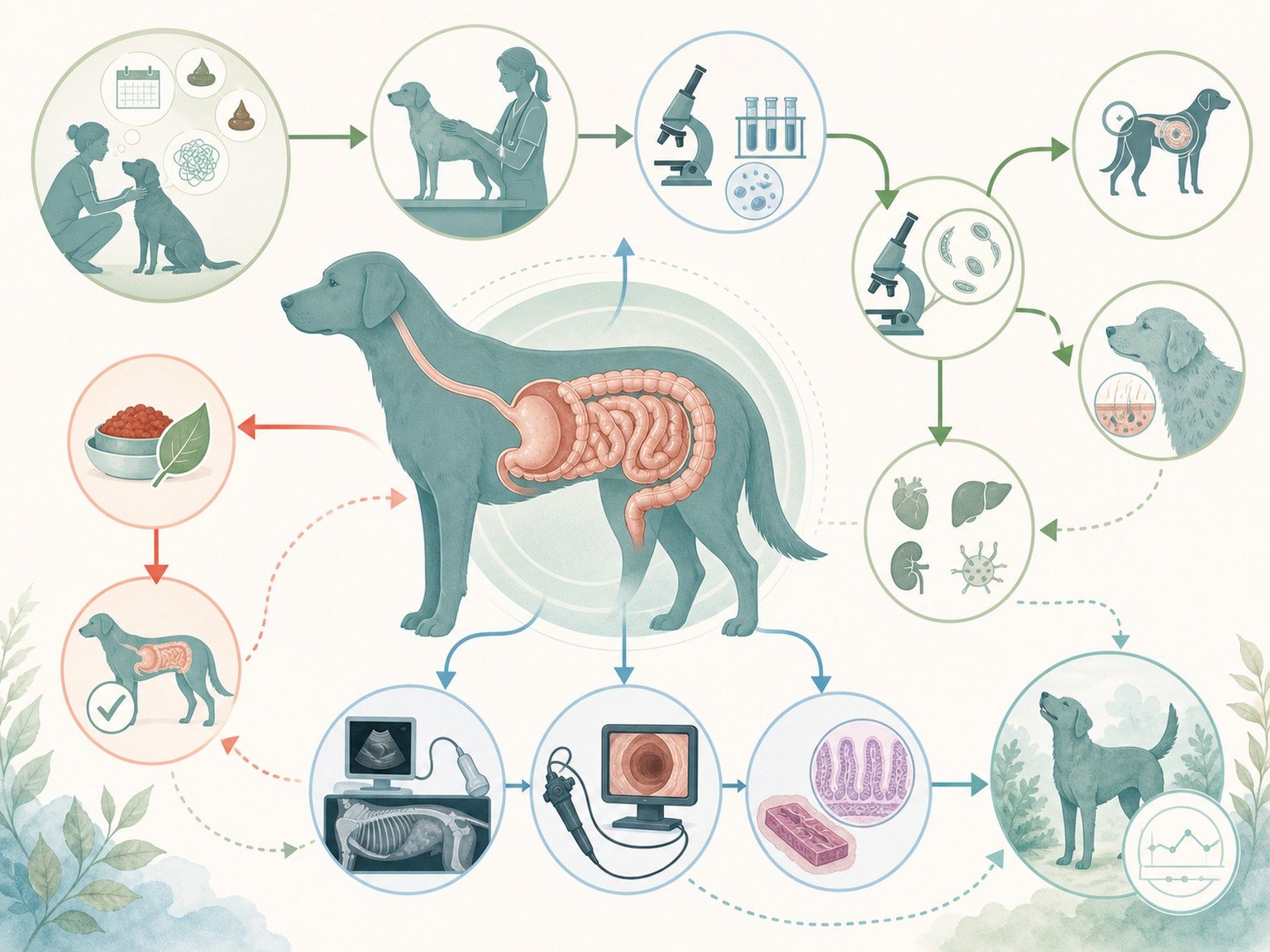
Follow a staged diagnostic pathway
The clinician uses age, breed, duration, severity, body and muscle condition, hydration, examination, diet, drugs, exposures, and prior response to prioritize tests. Baseline evaluation may look for parasites, systemic disease, pancreatic or absorption disorders, and protein loss.
Imaging can identify wall changes, lymph nodes, obstruction, masses, fluid, or other features, but it cannot reliably label every inflammatory pattern or replace tissue evaluation when biopsy is needed.
ACVIM's endorsed statement describes a severity- and chronicity-informed sequence rather than one mandatory list. Ask what each step could change and why it is appropriate now. [1]
Understand endoscopy, biopsy, and histopathology
WSAVA gastrointestinal standardization work supports consistent endoscopic, biopsy, and histopathologic evaluation. Technique, site, sample quality, handling, and interpretation matter. [3]
Biopsy can document inflammatory patterns and help exclude or identify other disease, but histology rarely reveals the single cause by itself. Results must be integrated with clinical findings and response. [4]
Ask whether referral to a board-certified veterinary internal-medicine specialist is appropriate, how samples will be collected and reviewed, and whether results could change the management plan.
Expect individualized management and monitoring
Plans may involve nutrition, medications, correction of deficiencies, management of protein loss, or other support depending on diagnosis and severity. This article names no diet, drug, dose, supplement, or sequence.
Define outcomes such as stool pattern, vomiting frequency, appetite, weight, muscle condition, activity, laboratory trends, and quality of life. Improvement in one measure does not erase adverse effects or another worsening sign.
Relapse or limited response should prompt reassessment of adherence, exposures, diagnosis, complications, and evidence rather than random stacking. Keep diet and treatment changes controlled enough that response can be interpreted.
Keep the care record current
Long-term records are especially useful in chronic enteropathy because signs and treatment response can fluctuate. Keep weight and muscle-condition trends, stool and vomiting logs, diet batches, medication changes, laboratory results, and adverse effects in one dated record. Do not compare one unusually good or difficult day with a distant memory. Comparable observations across defined periods help the internal-medicine team decide whether improvement is durable, partial, or accompanied by a new concern. Record unplanned treats, scavenging, missed doses, travel, and intercurrent illness because each can complicate interpretation without proving that it caused a relapse.
Prepare for a focused veterinary conversation
Bring a concise timeline, short natural-movement or symptom videos when safe, the exact names and photographs of every food, treat, medication, and supplement label, and notes about appetite, water intake, stool, sleep, activity, comfort, and behavior. Include recent injuries, travel, boarding, diet changes, missed medication, and previous test results. A complete record helps the veterinary team separate a repeatable pattern from a single impression.
Decide in advance what you need from the visit: an urgency decision, a diagnosis plan, a nutrition review, a pain or mobility assessment, or a monitored trial. Ask what result would change the plan and what finding would rule an option out. This keeps research and product information in the right role. Evidence can shape questions and expectations, but it cannot determine what is safe for an individual dog without the history and examination.
Owner tool
Track a chronic-enteropathy evaluation
On a phone, swipe across the table to see every column.
| Checkpoint | Record | Why it helps |
|---|---|---|
| Pattern | Duration, stool, vomiting, appetite, weight | Defines syndrome |
| Exclusions | Parasites, systemic, pancreatic, structural | Prevents premature label |
| Testing | Labs, imaging, endoscopy, biopsy | Answers selected questions |
| Response | Diet, plan, function, labs, recheck | Guides classification |
Better questions, calmer next steps
Questions to ask your veterinarian
- Which chronic-enteropathy term applies and why?
- What alternatives still need exclusion?
- What would imaging or biopsy change?
- Is internal-medicine referral appropriate?
- Which outcomes and complications should we track?
FAQ
Is IBD the same as food sensitivity?
No. Food response is one part of a broader differential pathway.
Can symptoms diagnose it?
No. Signs are nonspecific.
Does every dog need endoscopy?
No. The pathway depends on severity, chronicity, and prior findings.
Does biopsy identify the cause?
Not always; it must be interpreted in context.
Is there one cure?
No. Management and response vary.
Sources
- Journal of Veterinary Internal Medicine: ACVIM-Endorsed Chronic Inflammatory Enteropathy Guidelines. Diagnostic and treatment guideline framework.
- Merck Veterinary Manual: Chronic Enteropathies in Small Animals. Terminology, classification, and management context.
- World Small Animal Veterinary Association: Gastrointestinal Guidelines. Endoscopy, biopsy, and histopathology standardization.
- Merck Veterinary Manual: Malabsorption Syndromes in Small Animals. Protein loss, biopsy, and diagnostic limits.
