

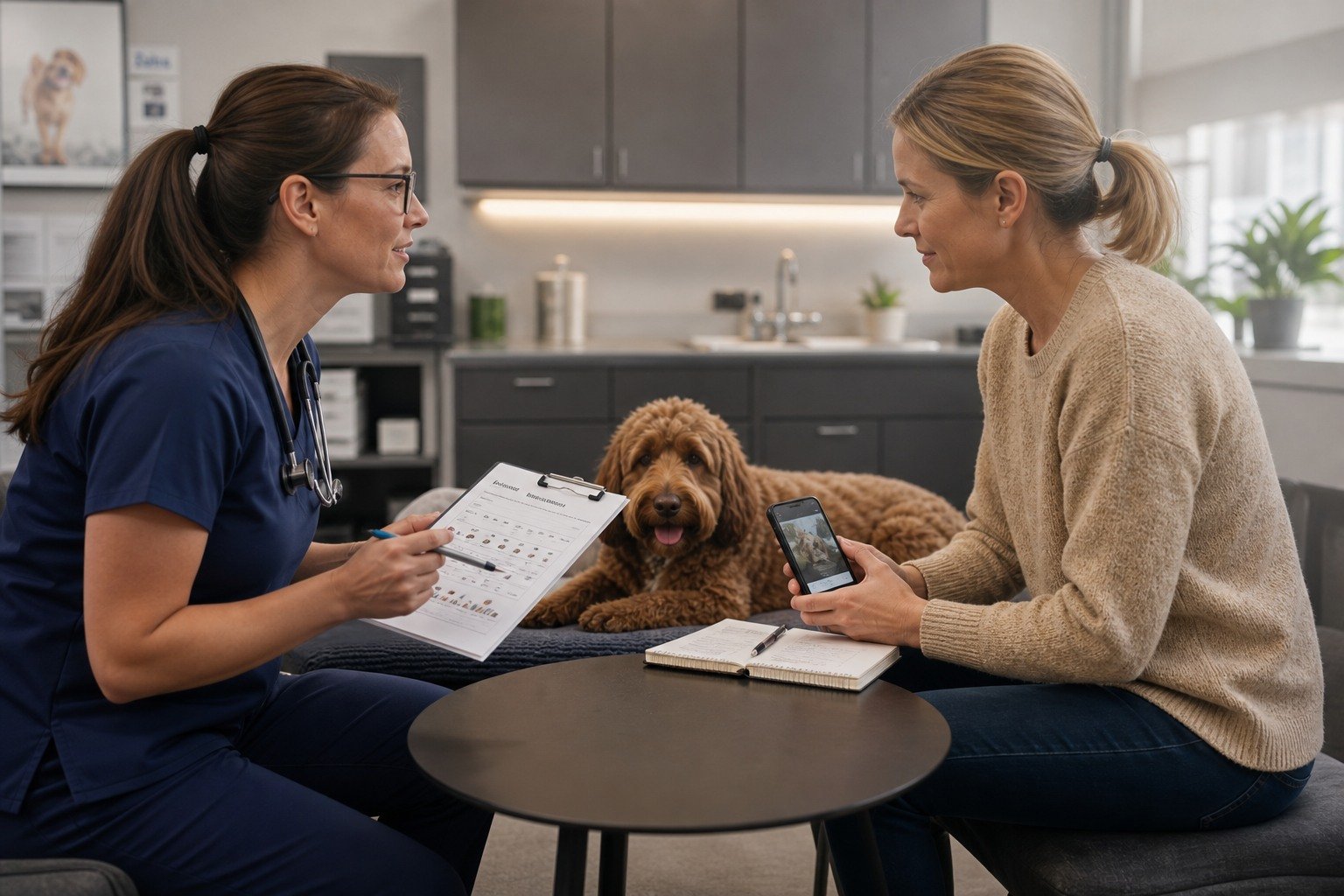
Digestive signs often change over time and can arise from digestive or nondigestive causes. A productive veterinary relationship does not require the owner to arrive with a diagnosis. It requires accurate observations, a complete food and product inventory, a clear timeline, practical constraints, open questions, and reliable follow-up. The veterinary team contributes examination, diagnostic reasoning, interpretation, options, and patient-specific instructions. Confirm what the plan is intended to clarify, which changes matter, and how to contact the clinic. Shared decisions improve continuity but cannot guarantee a diagnosis, treatment, cost, or outcome. Accurate follow-up also includes what was difficult to administer, afford, observe, or keep stable at home.
Short answer
Bring a usable history, not a conclusion
AAHA nutrition guidance supports comprehensive history and clear communication around foods, treats, supplements, feeding, activity, environment, body and muscle condition, and health. MSD emphasizes broad digestive and nondigestive causes. FDA adverse-event guidance highlights exact product and clinical information. These sources support continuity, not owner diagnosis. [1] [2] [3] [4]
- Start with the individual dog's baseline, complete diet, medication and supplement history, and veterinary plan.
- Use repeated observations to improve a veterinary discussion, not to diagnose, prescribe, or prove an effect at home.
- Keep regulatory categories, product evidence, population findings, and study endpoints within their actual limits.
- Escalate sudden, severe, persistent, progressive, dangerous, or function-limiting changes promptly.
Safety first
Communication planning cannot delay urgent care
Seek urgent care for collapse, severe weakness, pale gums, repeated unproductive retching, a painful distended abdomen, major bleeding, breathing difficulty, suspected obstruction or toxin exposure, or inability to keep water down. Contact the clinic promptly for repeated signs, blood, pain, dehydration concerns, appetite or weight change, or progressive decline.
- Do not delay urgent care while completing a log, changing food, comparing claims, or waiting for a routine appointment.
- Do not start, stop, combine, divide, increase, or rechallenge medication or supplements from this article.
- Do not use human products, leftover prescriptions, online dose conversions, or a supplement as a substitute for indicated care.
Veterinary note
This article is educational and does not diagnose, treat, prescribe, or replace care from a licensed veterinarian. Your dog’s history, examination, diet, medications, and current signs determine what is appropriate.
Prepare the timeline before the visit
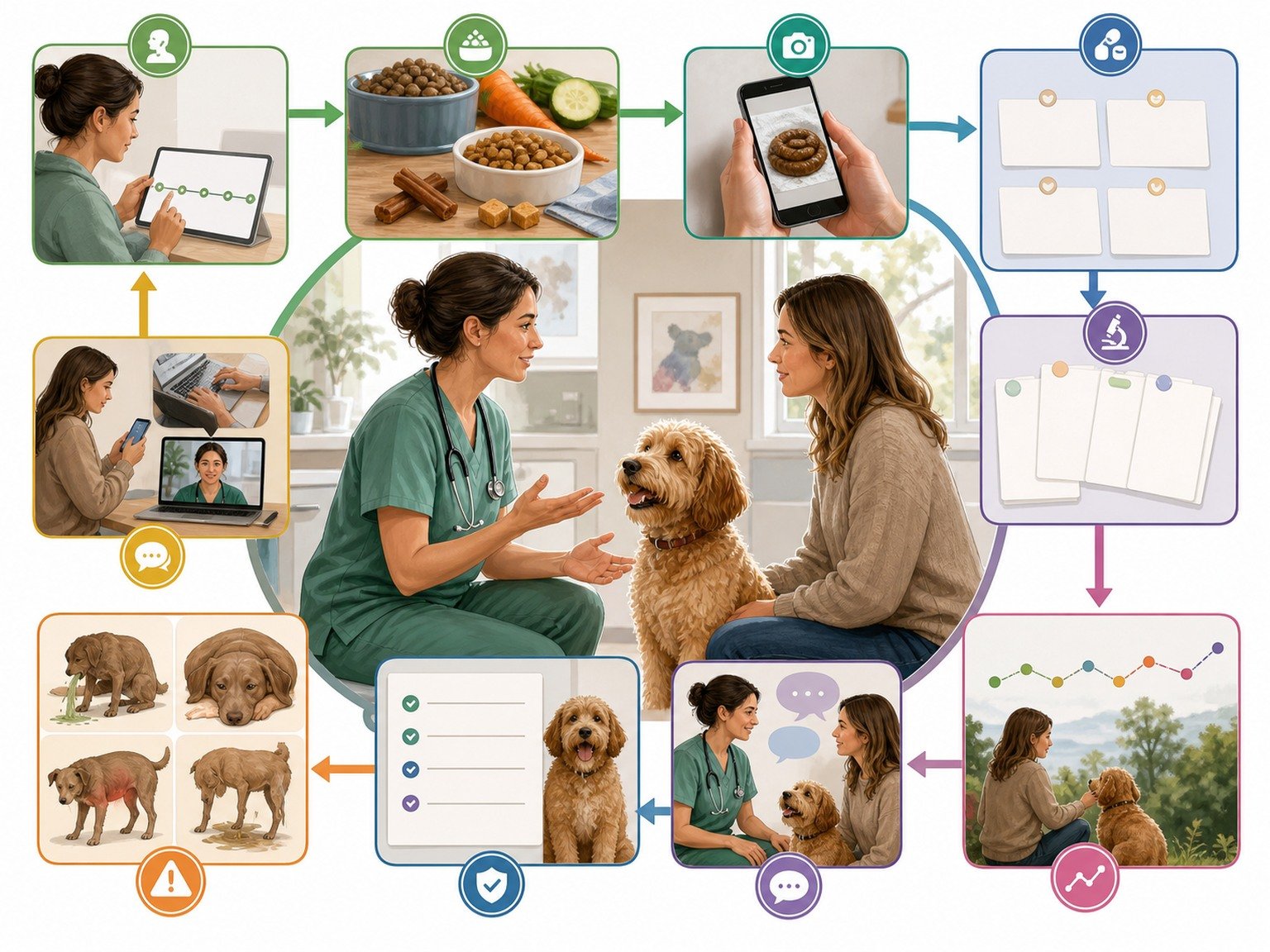
Record what changed, onset, frequency, duration, progression, recovery, food timing, stool, vomiting or regurgitation, appetite, water, urine, weight, pain, activity, behavior, travel, boarding, scavenging, and household changes. Include what remains normal.
Use neutral observations rather than diagnoses such as allergy, intolerance, dysbiosis, pancreatitis, or stress gut. Safe photos or short video can add context when they already exist; do not provoke a sign or delay care to document it.
MSD describes broad causes and case-specific evaluation. [3] A concise timeline helps the team choose questions and examination priorities, but it cannot rule out serious disease or dictate tests.
Bring the complete exposure and prior-care record
List exact food, formulation, measured amount, treats, chews, toppers, table food, access to other bowls, medications, vitamins, preventives, and supplements. Bring label photographs and lot information when relevant.
Add prior diagnoses, examinations, laboratory results, fecal tests, imaging, diet trials, medication or supplement changes, response, adverse effects, and adherence. Mark unknowns honestly and identify which record came from which clinic or date.
AAHA emphasizes comprehensive nutrition history across patient, diet, feeding, environment, activity, body and muscle condition, and health. [1] [2] Complete information reduces avoidable guesswork and duplicated interventions.
Ask open and clarifying questions
Ask what possibilities are being considered, which findings support or argue against them, what the proposed examination or test is intended to clarify, and what uncertainty will remain. Avoid demanding one diagnosis, test, diet, antibiotic, or supplement from an online source.
Discuss benefits, risks, alternatives, cost, administration burden, diet practicality, monitoring, and follow-up. State constraints early. Shared decision-making means an informed patient-specific plan, not guaranteed agreement with a preferred protocol.
Repeat instructions back in your own words: what changes now, what stays stable, how food or medication is given, what adverse signs matter, and when results or response will be reviewed.
Close the follow-up loop
Ask for the clinic's preferred route for routine updates, urgent concerns, photographs, records, refills, and outside results. Record the contact trigger and expected response window without assuming email or portal messages are monitored for emergencies.
Report worsening, new signs, suspected adverse events, adherence problems, and response accurately. Do not change diet, stop medication, add a product, or repeat a prior prescription without current direction.
FDA requests exact drug, device, food, clinical, and patient information for applicable problem reports. [4] Preserve labels and dates and ask the veterinary team whether and how to report. A longitudinal record supports care only when it returns to professional review.
Prepare for a focused veterinary conversation
Bring a concise timeline, short natural-movement or symptom videos when safe, the exact names and photographs of every food, treat, medication, and supplement label, and notes about appetite, water intake, stool, sleep, activity, comfort, and behavior. Include recent injuries, travel, boarding, diet changes, missed medication, and previous test results. A complete record helps the veterinary team separate a repeatable pattern from a single impression.
Decide in advance what you need from the visit: an urgency decision, a diagnosis plan, a nutrition review, a pain or mobility assessment, or a monitored trial. Ask what result would change the plan and what finding would rule an option out. This keeps research and product information in the right role. Evidence can shape questions and expectations, but it cannot determine what is safe for an individual dog without the history and examination.
Owner tool
Prepare a productive gut-health visit
On a phone, swipe across the table to see every column.
| Checkpoint | What to record | Why it helps |
|---|---|---|
| Timeline | Onset, frequency, associated signs | Defines pattern |
| Exposure | Food, medication, supplements, travel | Widens context |
| Discussion | Possibilities, tests, options, uncertainty | Clarifies plan |
| Follow-up | Triggers, route, response, records | Closes loop |
Better questions, calmer next steps
Questions to ask your veterinarian
- Which possibilities fit the current history?
- What is each proposed step intended to clarify?
- What should remain stable while we monitor?
- Which changes require prompt contact?
- How and when should I send the follow-up record?
FAQ
Should I arrive with a diagnosis?
No.
Can I request a specific test?
You can ask about its purpose and fit; the team chooses patient-specific diagnostics.
Should I bring food labels?
Yes, exact labels and amounts can help.
Can portal messages handle emergencies?
Do not assume so; use the clinic's urgent route.
What if the plan is hard to follow?
Report barriers promptly so it can be reconsidered.
Sources
- American Animal Hospital Association: Nutrition and Weight Management Guidelines. Comprehensive nutrition history and communication.
- American Animal Hospital Association: Nutrition Guidelines Executive Summary. Open questions, recommendations, feedback, and follow-up.
- MSD Veterinary Manual: Introduction to Digestive Disorders of Dogs. Broad signs, causes, and evaluation context.
- U.S. Food and Drug Administration: Report Animal Drug and Device Side Effects. Product and clinical information for applicable reports.
