

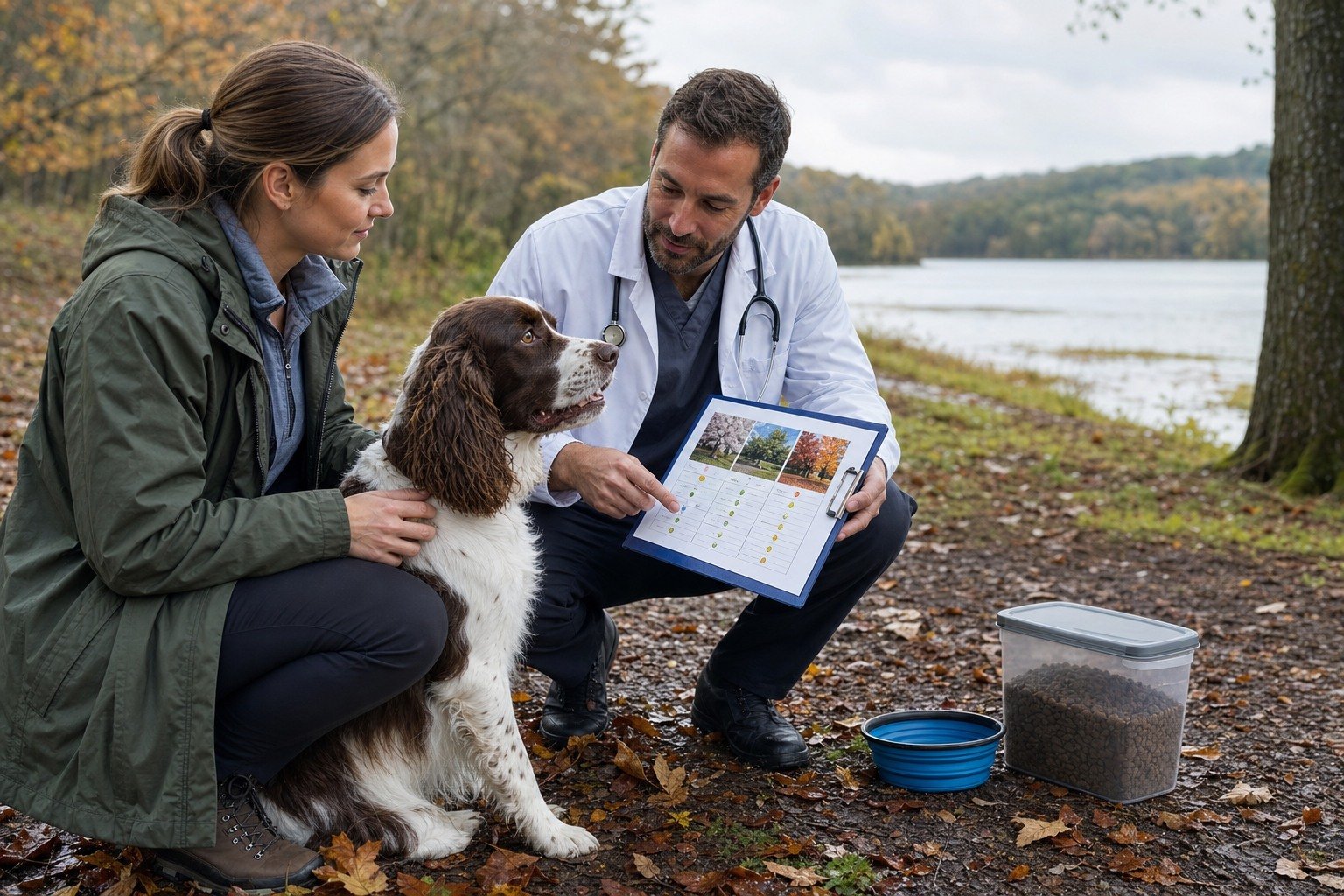
A digestive episode that appears in the same season can be a useful pattern, but season is not a diagnosis. Food and treat access, travel, boarding, standing water, wildlife, soil, parasite exposure, activity, medications, and holiday objects can all change across the year. The safest next step is to document the whole context and let the veterinary team evaluate recurring or concerning signs. This guide stays focused on environmental and dietary exposures; stress and gut-brain mechanisms are covered separately.
Short answer
Treat the calendar as a clue, not the cause
Population studies can find seasonal patterns for specific parasites, yet those patterns vary by organism, geography, climate, testing, and year. CAPC still recommends year-round parasite control and testing based on local and individual risk. A repeated month or season should prompt a better exposure record, not a seasonal supplement, a gut reset, or an assumption that the same cause is responsible every time. [1] [4]
- Record the exact pattern, timing, exposures, function, and recent changes.
- Separate population evidence from what can be concluded about one dog.
- Use the veterinary team to define evaluation, monitoring, and urgent-response steps.
Safety first
Severe digestive signs or a known hazard exposure need prompt care
Contact a veterinarian for persistent or recurring vomiting or diarrhea, appetite loss, weight change, pain, fever, or blood. Seek emergency care for collapse, severe weakness, repeated vomiting, profuse or bloody diarrhea, a swollen painful abdomen, pale gums, breathing difficulty, seizures, inability to stand, suspected obstruction, toxin exposure, or rapid decline.
- Do not use general information to delay care for severe, persistent, or worsening signs.
- Do not start, stop, combine, or calculate treatment from this article.
- Keep labels, dates, videos, and a concise observation timeline available for the veterinary team.
Veterinary note
This article is educational and does not diagnose, treat, prescribe, or replace care from a licensed veterinarian. Your dog’s history, examination, diet, medications, and current signs determine what is appropriate.
Map what changes with the season
Start with observable changes. Record the exact food and formula, treats, chews, table food, garbage access, visitors, travel, boarding, day care, water sources, wildlife, soil, medications, preventives, and household illness. Add dates, locations, and weather only as context. A calendar label cannot identify infection, parasites, food exposure, foreign material, pancreatitis, chronic enteropathy, or disease outside the gastrointestinal tract.
Holiday periods can change what enters the home. FDA identifies foods, bones, treats, toys, and xylitol-containing products as exposure-specific hazards that may cause gastrointestinal injury or other emergencies. The practical lesson is not that a holiday causes illness; it is that the exact object, amount, time, package, and signs matter when a professional assesses the event. [3]
Travel and outdoor routines may also change water, surfaces, scavenging, exercise, feeding times, and contact with other animals. Record which dog was exposed and which dog became ill. Shared timing can support an exposure question, but it does not prove a shared cause without veterinary evaluation.
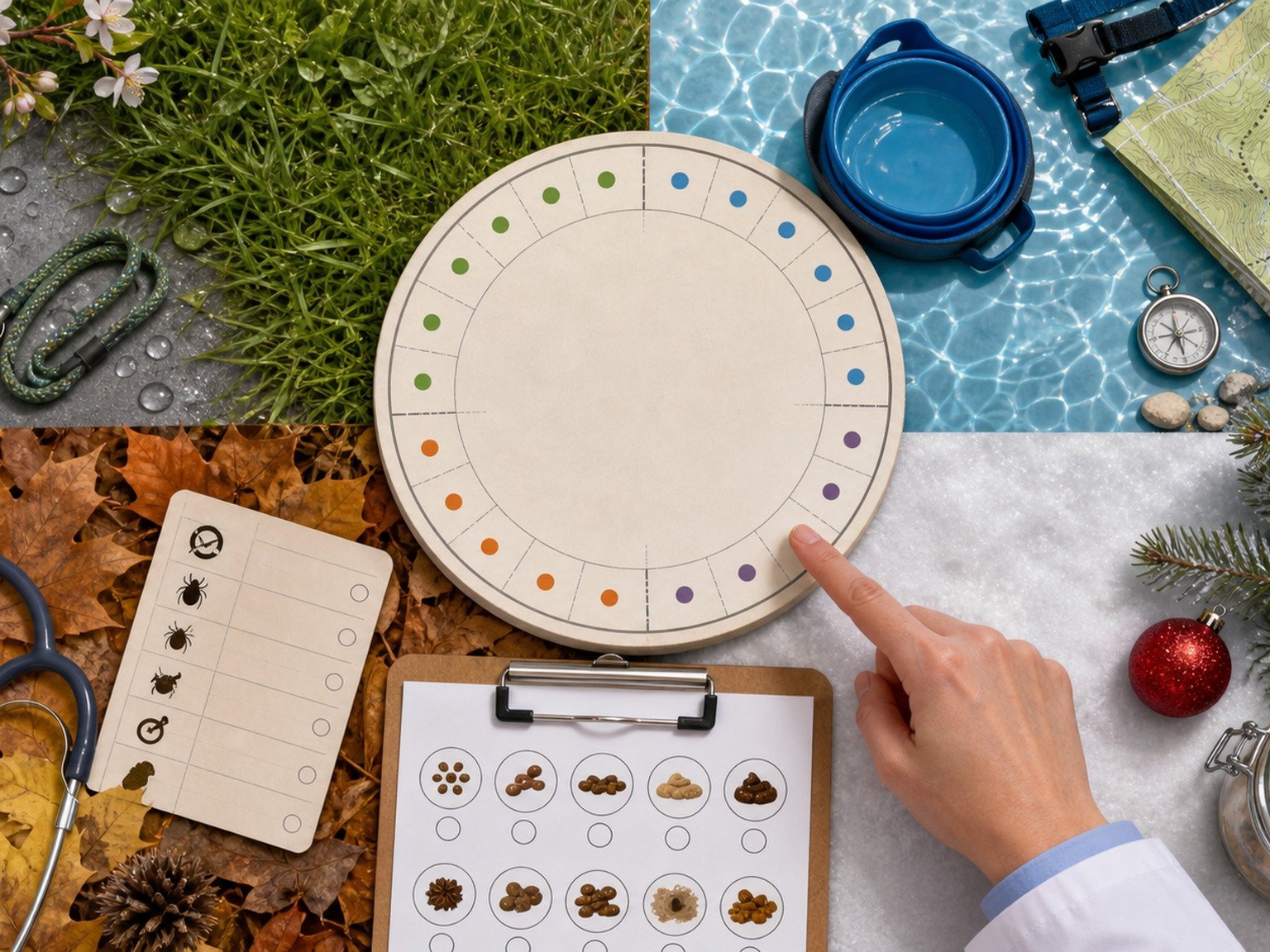
Interpret parasite seasonality carefully
A large U.S. fecal-exam dataset reported parasite-specific seasonal prevalence patterns. Population prevalence is not an individual diagnosis, and the study period, geography, test submissions, climate, and preventive use affect interpretation. It does not support stopping prevention in a low month or assuming that diarrhea in a high month is parasitic. [4]
CAPC recommends year-round broad-spectrum parasite control and repeated testing shaped by individual and local risk. Travel, hunting, wildlife, standing water, dog-group settings, age, health, and previous findings can change the plan. Use the product and schedule supplied by the veterinary team rather than a calendar inferred from an article. [1]
CDC explains that dogs can encounter Giardia through contaminated feces, soil, surfaces, and water. Environmental survival can be influenced by conditions, but a location or season cannot confirm infection. Persistent diarrhea needs veterinary assessment, and testing or treatment choices belong to the clinician. [2]
Build a pattern the clinic can interpret
Record every episode with start and end time, stool frequency and consistency, vomiting, appetite, water intake, activity, pain behavior, urination, and recovery. Add food and treat lots, medications, parasite prevention, travel, visitors, water sources, scavenging, weather, and veterinary findings. A clear baseline between episodes helps show whether the dog fully returns to normal.
Keep prior laboratory, fecal, imaging, diet-trial, and medication-response records together. Note what changed before improvement, but avoid assigning causation when several variables changed. A response after a food switch, medication, rest, or travel return can generate a clinical question without proving the explanation.
Ask the clinic whether testing should occur during an episode, what sample or package to preserve, which signs require same-day care, and when referral is appropriate. Do not induce vomiting, use leftover medication, change parasite treatment, or impose a restrictive diet unless a veterinarian gives case-specific instructions.
Keep this topic distinct from stress-related gut signs
Seasonal routines can coincide with noise, visitors, schedule disruption, or time alone, but this article does not use those associations to explain gut-brain mechanisms. If behavior and digestive signs appear together, document both and use the dedicated stress-and-gut guide plus veterinary assessment rather than combining two broad explanations into one label.
Direct evidence for a single seasonal canine gut syndrome is limited. Environmental, dietary, infectious, and routine factors may overlap, and a different problem can occur in the same month the next year. Recurrence should increase the quality of the history and the need for assessment, not confidence in self-diagnosis.
The useful outcome is a year-round preventive plan, an exposure-aware household, and a concise record that can be compared with examination and testing. There is no evidence basis here for seasonal supplement stacking, detoxification, or a guaranteed gut reset.
Prepare for a focused veterinary conversation
Bring a concise timeline, short natural-movement or symptom videos when safe, the exact names and photographs of every food, treat, medication, and supplement label, and notes about appetite, water intake, stool, sleep, activity, comfort, and behavior. Include recent injuries, travel, boarding, diet changes, missed medication, and previous test results. A complete record helps the veterinary team separate a repeatable pattern from a single impression.
Decide in advance what you need from the visit: an urgency decision, a diagnosis plan, a nutrition review, a pain or mobility assessment, or a monitored trial. Ask what result would change the plan and what finding would rule an option out. This keeps research and product information in the right role. Evidence can shape questions and expectations, but it cannot determine what is safe for an individual dog without the history and examination.
Owner tool
Build a seasonal digestive record
On a phone, swipe across the table to see every column.
| Checkpoint | Record | Why it helps |
|---|---|---|
| Timing | Date, season, duration, recovery | Shows recurrence |
| Exposure | Diet, water, travel, soil, objects | Defines context |
| Prevention | Product, date, testing, travel | Supports risk review |
| Whole dog | Stool, vomit, appetite, pain, weight | Shows severity |
Better questions, calmer next steps
Questions to ask your veterinarian
- Which exposures matter most in this dog's pattern?
- Does local risk change parasite testing or prevention?
- What should I preserve during the next episode?
- Could a different condition recur at the same time of year?
- Which signs require same-day or emergency care?
FAQ
Does the same season prove the same cause?
No. Timing is history, not a diagnosis.
Why use year-round parasite prevention?
Risk varies, and CAPC recommends year-round control shaped by the dog and location.
Can seasonal supplements prevent episodes?
This source set does not support that claim.
Should I record weather?
Yes, as one context alongside diet, water, travel, activity, and exposures.
What makes a log useful?
Exact dates, exposures, signs, recovery, prevention, and veterinary findings.
Sources
- Companion Animal Parasite Council: General Guidelines for Dogs and Cats. Year-round parasite control and risk-based testing.
- Centers for Disease Control and Prevention: About Giardia and Pets. Giardia exposure routes and veterinary assessment.
- U.S. Food and Drug Administration: Keep Dogs and Cats Safe From Holiday Hazards. Exposure-specific holiday hazards.
- Parasites & Vectors: Seasonality of Common Canine Gastrointestinal Nematodes. Population seasonality and individual limits.
