

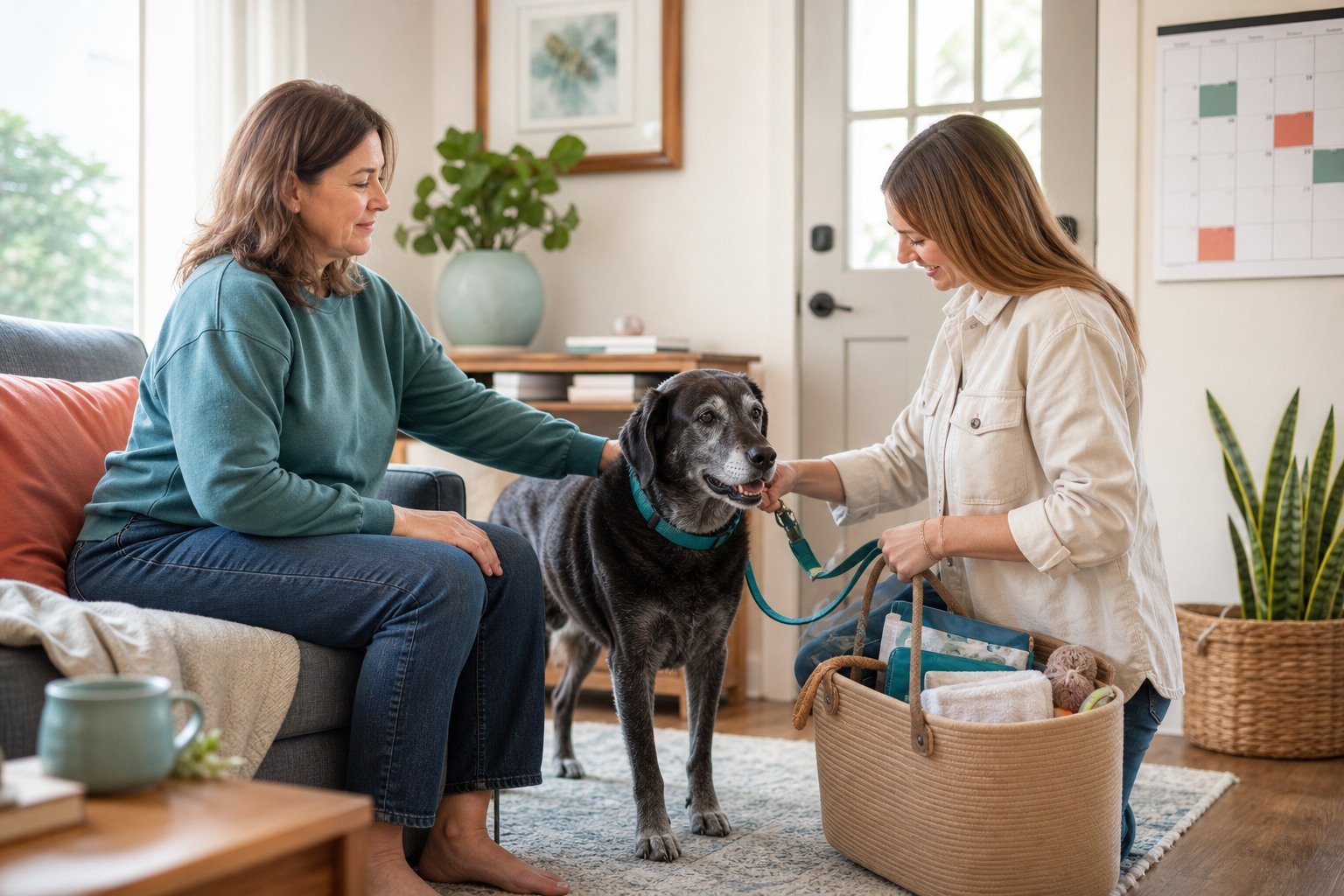
Caring for a senior dog can include interrupted sleep, lifting, toileting, cleaning, medication schedules, special feeding, repeated appointments, financial decisions, and worry about decline. Love and fatigue can exist at the same time. Veterinary research describes caregiver burden as a measurable response to the practical and emotional demands of animal illness, not evidence that an owner lacks commitment. Unmanageable care can also increase the chance of missed doses, unsafe lifting, delayed appointments, resentment, or loss of the caregiver's own sleep and healthcare. Name the tasks, identify which are essential, ask the veterinary team to simplify the canine plan, and share care where possible. Protecting owner wellbeing supports animal welfare. A veterinarian can coordinate the dog's treatment but cannot diagnose or treat a person's physical or mental health. Human health concerns require qualified human healthcare, and an immediate safety or self-harm crisis requires local emergency or crisis services.
Short answer
Caregiver burden is a care-plan signal, not a moral failure
Studies in veterinary settings link caregiver burden with treatment complexity, quality-of-life decisions, and owner distress. The useful response is to make demands visible, improve communication, and design a feasible plan for both patient and caregiver. [1] [2]
- Record timing, context, intensity, recovery, and changes in daily function.
- Use observations to support veterinary assessment, not to diagnose or treat at home.
- Protect predictable routines, physical safety, rest, and access to essential resources.
- Agree on measurable outcomes, a review date, and clear urgent-contact signs.
Safety first
Get immediate human help when safety or survival is at risk
If you may harm yourself, another person, or an animal, or cannot safely provide essential care, contact local emergency services or a crisis line now and move the dog to a safe responsible caregiver if possible. For the dog, seek urgent veterinary care for collapse, breathing difficulty, seizure, severe pain, inability to stand or urinate, repeated vomiting, major trauma, or rapid decline.
- Do not delay care for sudden, severe, escalating, or function-limiting change.
- Do not start, stop, combine, divide, or calculate treatment from this article.
- Use physical separation and professional help whenever a person or animal could be injured.
Veterinary note
This article is educational and does not diagnose, treat, prescribe, or replace care from a licensed veterinarian. Your dog’s history, examination, diet, medications, and current signs determine what is appropriate.
Make the invisible workload visible
List every recurring task: food preparation, medication, lifting, toileting, cleaning, monitoring, exercise, transport, appointments, ordering supplies, and nighttime care. Add time, physical demand, cost, and what happens if the task is missed.
Record the caregiver's sleep, work disruption, pain, anxiety, social isolation, and ability to attend personal healthcare. This is not a veterinary diagnosis; it helps show whether the canine plan is sustainable.
Include enjoyable moments, help already available, and tasks the dog can still do independently. A burden inventory should guide support, not erase attachment or reduce the dog to problems.

Ask the veterinary team to simplify the dog's plan
Bring all prescriptions, supplements, preventives, diets, and topical products to one medication reconciliation. Ask what is essential, what each item is expected to change, how it is monitored, and whether timing can be simplified safely.
Explain practical barriers honestly, including cost, transportation, handling, sleep, work, and physical limitations. A theoretically ideal plan that cannot be performed reliably may need a safer, more feasible alternative.
Request written instructions, demonstrations for lifting or treatment, refill planning, and clear call thresholds. Never combine, divide, stop, or change medication to reduce workload without veterinary direction.
Share care and build respite before crisis
Assign specific tasks to trusted people rather than asking generally for help. A person might cover one walk, meal, appointment, overnight period, supply order, or check-in. Confirm that every helper has current instructions and emergency contacts.
Use professional pet care, rehabilitation, transport, or respite services only after checking suitability for the dog's medical, mobility, and behavior needs. A frail or anxious dog may need gradual introduction and specialized handling.
Prepare a backup plan for caregiver illness or hospitalization. Identify who can enter the home, where records and supplies are kept, which clinic to call, and how the dog can be transported safely.
Protect the caregiver's human health
Maintain food, sleep, movement, prescribed human care, and medical appointments as realistically as possible. Ask a physician or therapist about persistent depression, anxiety, pain, insomnia, or impaired function; the veterinary team is not a substitute for human healthcare.
Seek community, family, faith, workplace, social-service, financial, grief, disability, or mental-health support that fits the situation. In the United States, 988 connects callers and texters with crisis support; elsewhere use the appropriate local service.
Reassess goals before exhaustion becomes an emergency. Quality-of-life, palliative, hospice, rehoming, and end-of-life conversations deserve compassionate veterinary guidance without guilt, coercion, or a one-size-fits-all answer. [3] [4] [5]
Prepare for a focused veterinary conversation
Bring a concise timeline, short natural-movement or symptom videos when safe, the exact names and photographs of every food, treat, medication, and supplement label, and notes about appetite, water intake, stool, sleep, activity, comfort, and behavior. Include recent injuries, travel, boarding, diet changes, missed medication, and previous test results. A complete record helps the veterinary team separate a repeatable pattern from a single impression.
Decide in advance what you need from the visit: an urgency decision, a diagnosis plan, a nutrition review, a pain or mobility assessment, or a monitored trial. Ask what result would change the plan and what finding would rule an option out. This keeps research and product information in the right role. Evidence can shape questions and expectations, but it cannot determine what is safe for an individual dog without the history and examination.
Owner tool
Map senior-dog care without blame
On a phone, swipe across the table to see every column.
| Checkpoint | Record | Why it helps |
|---|---|---|
| Task | Time, skill, cost, physical load | Shows demand |
| Dog need | Essential, flexible, review date | Sets priority |
| Support | Person, service, clinic, backup | Shares care |
| Owner health | Sleep, function, healthcare | Protects safety |
Better questions, calmer next steps
Questions to ask your veterinarian
- Which parts of the canine plan are essential now?
- Can timing or administration be simplified safely?
- What handling or lifting method protects both of us?
- Which signs require urgent veterinary care?
- What backup and quality-of-life plan should we document?
FAQ
Does fatigue mean I do not love my dog?
No. Attachment and caregiver burden can coexist.
Can a veterinarian treat my anxiety or depression?
No. Human health concerns need human healthcare.
Is asking for respite selfish?
No. Safe shared care can protect both owner and dog.
Should I skip a dose when overwhelmed?
No. Call the veterinary team for safe instructions.
When is crisis support appropriate?
Immediately when there is self-harm risk or danger to a person or animal.
Sources
- Frontiers in Veterinary Science: Caregiver Burden in Owners of Dogs with Chronic Paresis. Care burden, quality of life, and treatment demands.
- Veterinary Sciences: Treatment Complexity and Caregiver Burden in Canine Skin Disease. Treatment complexity and owner burden.
- Frontiers in Veterinary Science: Abbreviated Zarit Burden Interview for Companion Animal Caregivers. Measurement of companion-animal caregiver burden.
- PLOS ONE: Companion Animal and Human Caregiver Burden. Comparison of caregiver experiences.
- Journal of Veterinary Internal Medicine: Caregiver Burden in Canine Chronic Enteropathy. Disease burden and caregiver outcomes.
