

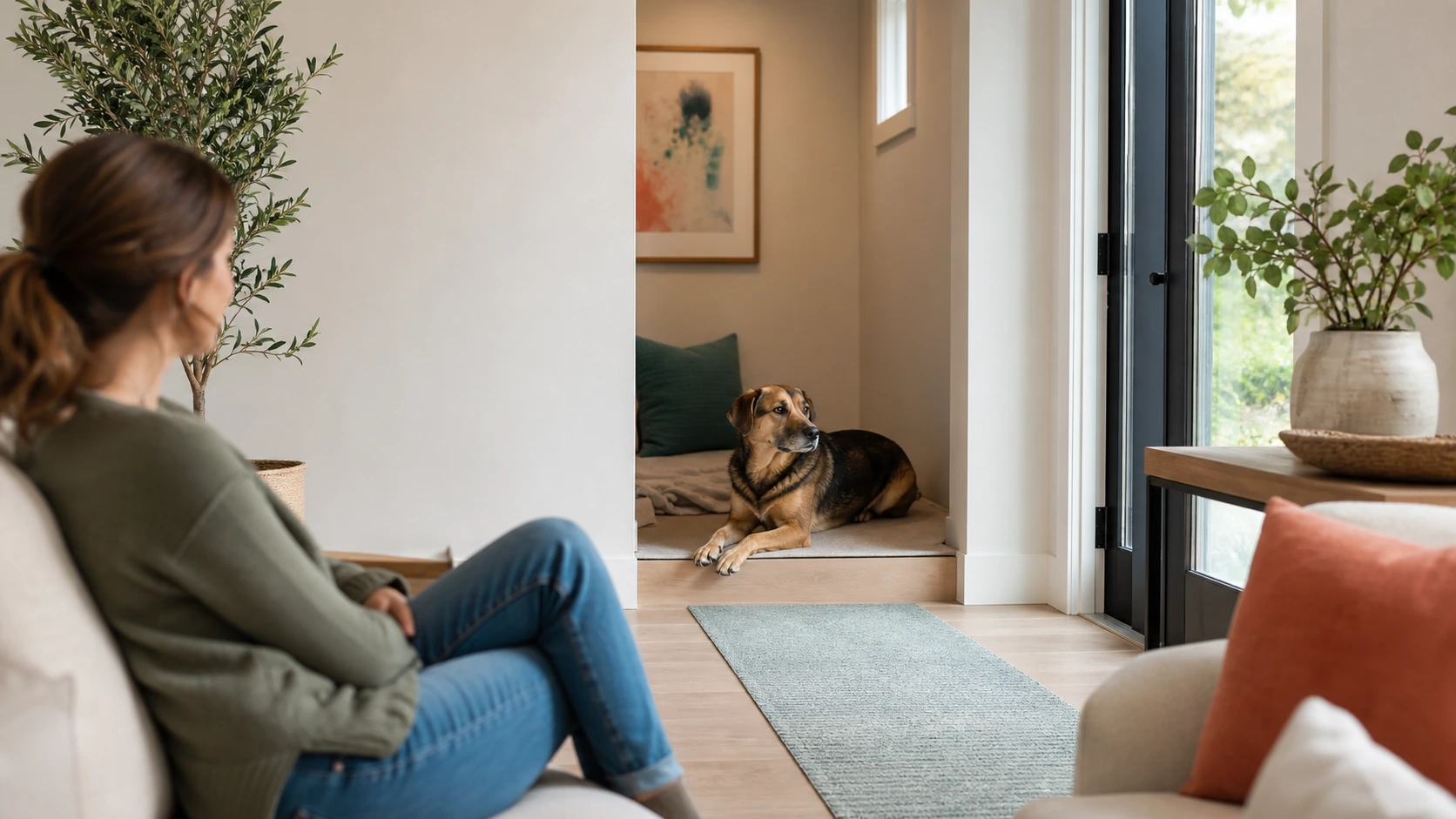
A calm environment is not a silent room, a crate, or a collection of calming products. It is a home setup that makes daily events more predictable, lowers avoidable trigger intensity, gives the dog voluntary retreat options, and lets the family respond consistently. Environmental support can improve welfare and make behavior work possible, but it does not diagnose anxiety or replace care for pain, illness, panic, or bite risk.
Short answer
Calm comes from safety and control, not confinement
Useful environmental management reduces exposure to situations the dog cannot yet handle while preserving choice. A retreat should be comfortable, accessible, and never used as punishment. Predictable cues, distance, barriers, and reward-based learning can support recovery, but severe or sudden distress still needs veterinary assessment. [1] [2]
- Let the dog enter and leave the retreat voluntarily unless a separate safety plan requires managed separation.
- Reduce one known trigger at a time and record whether intensity and recovery actually change.
- Avoid punishment, flooding, forced crating, essential-oil exposure, or unreviewed sedating products.
Safety first
A room setup cannot solve a medical or immediate safety emergency
Contact a veterinarian promptly for sudden behavior change, prolonged inability to settle, self-injury, collapse, disorientation, seizure, toxin exposure, escape into danger, or aggression that cannot be managed safely. Use distance and barriers without cornering a frightened dog. Seek emergency help when people or animals face immediate injury risk.
- Do not lock a panicking dog in a crate simply because the crate is described as a safe space.
- Do not use sound, scent, touch, or forced exposure until the dog stops reacting.
- Do not assume pacing, panting, hiding, or irritability is behavioral before pain and illness are considered.
Veterinary note
This article is educational and does not diagnose, treat, prescribe, or replace care from a licensed veterinarian. Your dog’s history, examination, diet, medications, and current signs determine what is appropriate.
Start with the dog's pattern, not a decorating checklist
Map where the response begins, what predicts it, how the dog moves, whether food is accepted, and how long recovery takes. Doorbells, street views, appliances, household conflict, handling, departures, visitors, and outdoor noise may require different changes. A camera can reveal patterns during absence, but never provoke a reaction for footage. [1] [3]
Medical context belongs in the same record. Pain, sensory decline, gastrointestinal or urinary discomfort, endocrine or neurologic disease, cognitive change, and medication effects can alter tolerance and sleep. Environmental management can reduce stress while the veterinary team investigates; it should not become a reason to delay that investigation. [2]
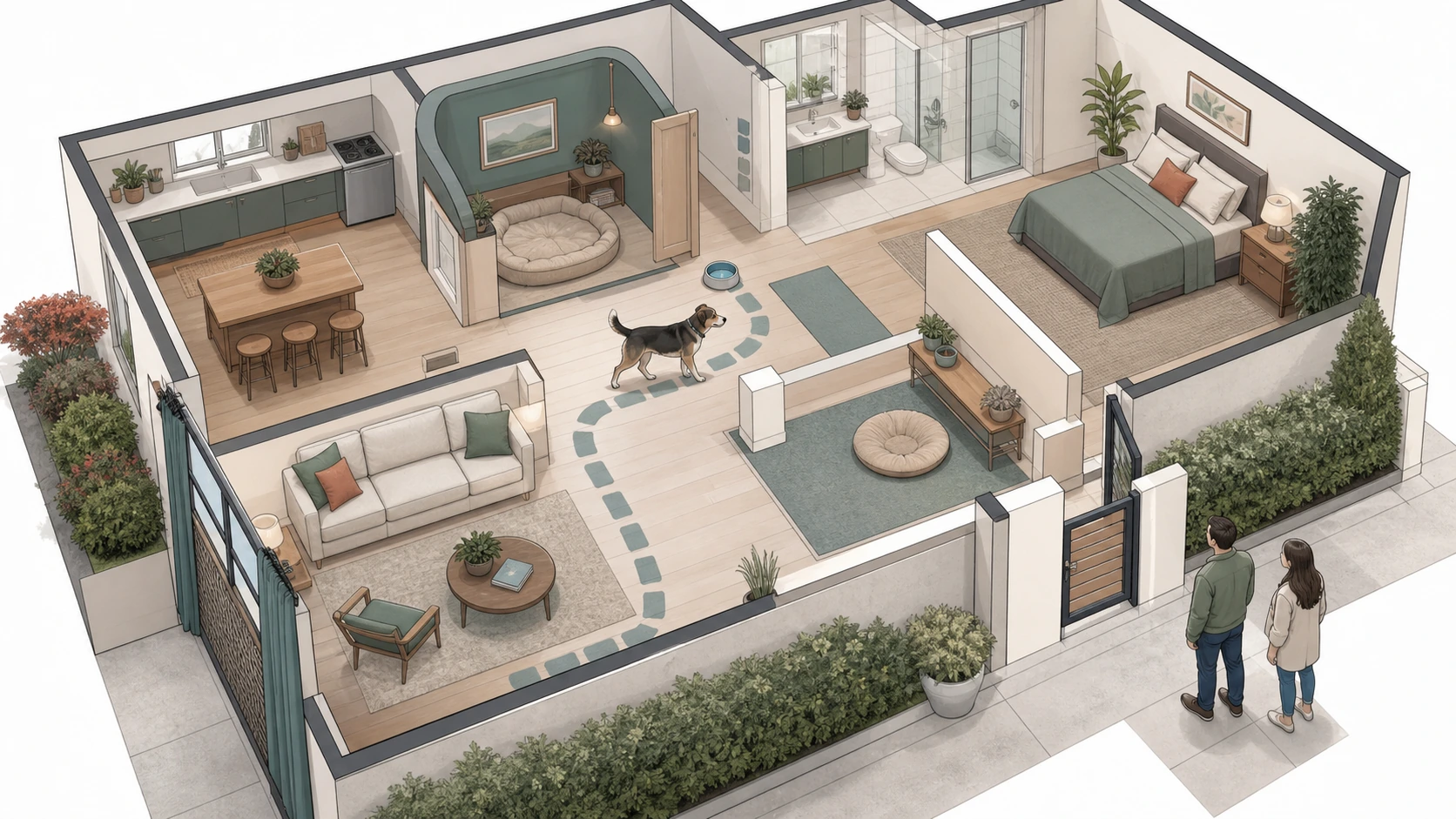
Build a voluntary retreat with a clear exit
Choose a low-traffic area where the dog already relaxes. Provide stable footing, comfortable bedding, water, moderate temperature, and enough room to change position. Use curtains, furniture placement, white noise, or a barrier only when they reduce a documented trigger. Keep children and visitors from entering the retreat after the dog has withdrawn.
A crate can be useful only for a dog with a positive crate history who remains comfortable there. Drooling, frantic escape, bent bars, broken teeth, repeated elimination, or escalating vocalization are signs to stop treating confinement as calming and contact the veterinary team. Separation distress requires its own assessment rather than a stronger crate. [3]
Make daily events predictable without making life rigid
Consistent sequences around meals, walks, rest, visitors, and departures can reduce surprise. Predictability does not require identical clock times. Use simple cues that reliably announce what happens next, and include quiet decompression after difficult events. Maintain appropriate exercise, sniffing, sleep, and social choice according to the dog's health and preferences.
Management should create space for below-threshold learning. Reward calm observation, disengagement, and voluntary retreat. AVSAB recommends reward-based methods and advises against aversive techniques because intimidation and pain can increase fear and suppress warnings without creating safety. [4]
Evaluate sound, scent, and products cautiously
Steady background sound may mask an intermittent trigger for some dogs, while sound can distress others. Keep volume low and allow escape. Scented products are not automatically calming; concentrated essential oils can create exposure concerns, and a dog should never be prevented from leaving a scented area. Record the exact product and discuss it with the veterinarian before use.
Pheromones, garments, supplements, and other aids have mixed and product-specific evidence. They should never be the foundation of an emergency plan or a substitute for diagnosis and behavior care. Introduce only one optional aid at a time after criteria and safety are reviewed, then judge observable response rather than marketing language. [5]
Prepare for a focused veterinary conversation
Bring a concise timeline, short natural-movement or symptom videos when safe, the exact names and photographs of every food, treat, medication, and supplement label, and notes about appetite, water intake, stool, sleep, activity, comfort, and behavior. Include recent injuries, travel, boarding, diet changes, missed medication, and previous test results. A complete record helps the veterinary team separate a repeatable pattern from a single impression.
Decide in advance what you need from the visit: an urgency decision, a diagnosis plan, a nutrition review, a pain or mobility assessment, or a monitored trial. Ask what result would change the plan and what finding would rule an option out. This keeps research and product information in the right role. Evidence can shape questions and expectations, but it cannot determine what is safe for an individual dog without the history and examination.
Owner tool
Audit one space from the dog's point of view
On a phone, swipe across the table to see every column.
| Element | Observe | Possible adjustment |
|---|---|---|
| Access | Can the dog enter, turn, rest, and leave? | Preserve a clear voluntary exit |
| Triggers | Windows, doors, voices, appliances, foot traffic | Add distance or a visual/sound barrier |
| Body | Panting, scanning, freezing, food refusal, sleep | Lower intensity and record recovery |
| Safety | Slippery route, children, other pets, confinement | Use stable footing and household boundaries |
Better questions, calmer next steps
Questions to ask your veterinarian
- Could pain, illness, sensory loss, medication, or cognitive change be contributing?
- Which trigger should we manage first, and what does below-threshold exposure look like?
- Is the current crate or retreat actually comfortable based on this dog's behavior?
- What signs mean the home plan is insufficient or unsafe?
- Should we involve a board-certified veterinary behaviorist or qualified reward-based professional?
FAQ
Should an anxious dog always have a crate?
No. A crate helps only when the dog has a positive history and remains comfortable. Panic during confinement requires a different plan.
Does covering windows help?
It may help when visual triggers drive the pattern. Test the change and record behavior rather than assuming it is useful.
Can music calm every dog?
No. Responses differ by dog, setting, volume, and sound. Keep it optional and allow the dog to leave.
Should visitors ignore a worried dog?
Often the safest start is distance and no forced interaction, but the exact visitor plan should match the dog's risk and behavior assessment.
Can environmental changes replace medication?
No. Management, behavior work, medical care, and medication have different roles. A veterinarian decides what combination is appropriate.
Sources
- Merck Veterinary Manual: Behavior Problems of Dogs. Fear and anxiety assessment, management, and multimodal treatment.
- Merck Veterinary Manual: Diagnosis of Behavior Problems in Animals. Medical differentials and behavior-history reconstruction.
- RSPCA: Learning to be left alone. Confinement, absence behavior, cameras, and gradual training context.
- American Veterinary Society of Animal Behavior: Humane Dog Training Position Statement. Reward-based training and avoidance of aversive methods.
- Veterinary Sciences: Therapy and Prevention of Noise Fears in Dogs. Environmental management and evidence limits for adjunctive aids.
