

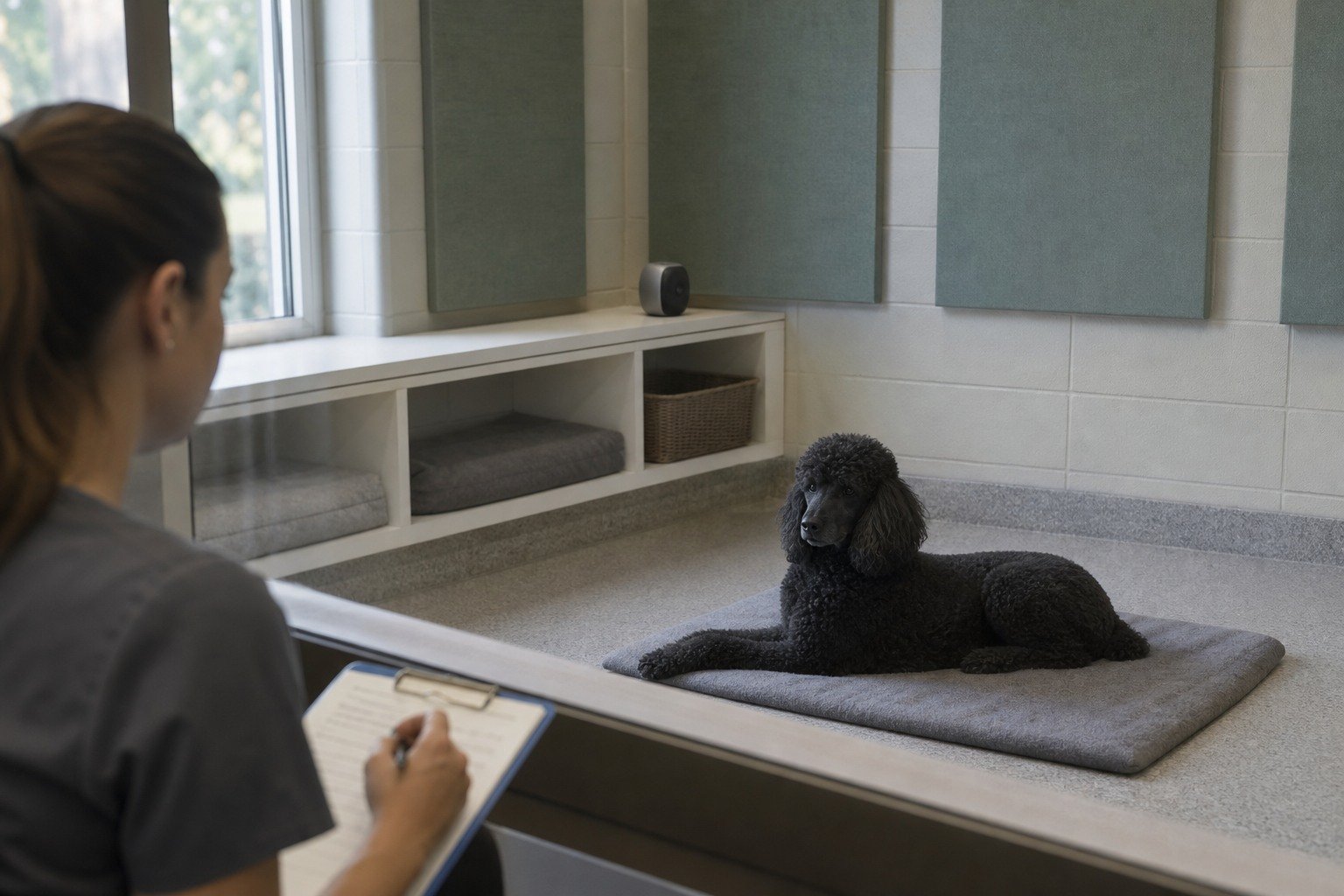
Most published canine auditory-enrichment research has examined dogs in kennels, shelters, or veterinary hospitals, not home treatment of a diagnosed anxiety disorder. Some studies report differences in rest, vocalization, activity, heart-rate variability, or other measures during sound exposure. Results vary by setting, sound condition, individual dog, study day, and outcome, and habituation may reduce an effect. The literature does not establish a universal genre, playlist, volume, timing, duration, or commercially marketed dog-specific music treatment. Evidence also needs an appropriate comparator: less barking may reflect rest, freezing, competing noise, or another environmental change. Behavioral direction, physiology, recovery, and welfare context must be considered together before calling a difference calming. Study duration matters because a response observed on one day may weaken, reverse, or disappear with repetition.
Short answer
Auditory enrichment is not the same as anxiety treatment
A change in resting, vocalization, movement, or physiology during a study can show a response to the environment without proving treatment of an anxiety disorder. Reviews find limited and mixed evidence, with many studies in defined kennel or hospital populations. Sound may be a neutral or useful adjunct for some dogs and aversive or irrelevant for others. [1] [2] [3] [4]
- Record context, frequency, duration, recovery, function, and recent change.
- Treat the article as preparation for professional assessment, not a diagnostic test.
- Agree on monitoring, reassessment, and urgent-response instructions with the veterinary team.
- Bring calm-day and difficult-day observations to each follow-up.
Safety first
Sound should stop when it coincides with distress, and severe anxiety needs broader care
Contact a veterinarian for persistent panic, escape attempts, self-injury, aggression, inability to rest or eat, sudden behavior change, or signs of pain. Do not increase volume, duration, repetition, or forced exposure when a dog hides, startles, scans, pants, paces, freezes, vocalizes, or tries to leave.
- Do not delay care for severe, persistent, escalating, or function-limiting signs.
- Do not start, stop, combine, or calculate treatment from this article.
- Preserve dated observations, safe videos, labels, prior records, and the dog's full health context.
Veterinary note
This article is educational and does not diagnose, treat, prescribe, or replace care from a licensed veterinarian. Your dog’s history, examination, diet, medications, and current signs determine what is appropriate.
Define what the research actually studies
Auditory enrichment means changing the sound environment and observing behavior or physiology. It is not automatically music therapy in the clinical sense, and a study of kennel welfare cannot be translated directly into treatment of separation anxiety, noise phobia, generalized anxiety, or hospital distress.
A review found a small experimental literature concentrated in kennels and hospitals. Populations, genres, sound delivery, control conditions, study length, and outcomes differed, which limits comparison. Commercial dog-specific claims were not established by the reviewed evidence. [1]
Ask what population, setting, sound condition, comparator, outcome, and time frame a claim comes from. A calm-looking dog in a marketing video is not equivalent to controlled evidence.

Read behavioral and physiologic outcomes carefully
A kennelled-dog study reported behavioral and heart-rate-variability changes across genres and study days. The defined population and setting matter, and differences do not supply a home protocol or prove treatment of diagnosed anxiety. [2]
A critical appraisal concluded that evidence for classical music reducing stress in hospitalized dogs was weak overall despite selected reported changes. Weak evidence is not proof of no effect; it means confidence, transfer, and clinical claims should remain limited. [3]
Shelter enrichment research has reported selected behavioral differences with auditory and olfactory exposures. Multiple conditions, short observation windows, and shelter context prevent a universal conclusion about home anxiety care. [4]
Expect individual variation and habituation
Dogs differ in hearing, prior associations, age, health, sensory function, preference, arousal, and environment. The same sound may be familiar, neutral, masked by other noise, or aversive. A genre label cannot predict the individual response.
An initial response may change over repeated days. Habituation, novelty, time of day, staff activity, kennel noise, and other variables can affect observation. Record the dog's behavior before, during, and after naturally occurring sound without deliberately creating distress.
Do not use sound to mask escalating warning signs, replace needed quiet, or avoid assessment. A dog that cannot settle may need pain, medical, sensory, and behavior evaluation rather than a longer playlist.
Place sound inside a broader plan
If the veterinary or behavior team considers auditory enrichment, define the purpose and the observable outcome. Clarify how the dog's ability to move away, rest, eat, sleep, and recover will be protected. This article supplies no volume, speaker placement, duration, timing, or genre instructions.
Do not combine a sound experiment with several new supplements, devices, routines, or training changes. Multiple simultaneous variables make response harder to interpret and can increase burden.
A useful conclusion may be that sound is neutral, poorly tolerated, or one small environmental support. It should never be framed as a cure, a replacement for veterinary care, or proof that a behavior diagnosis has been resolved.
Prepare for a focused veterinary conversation
Bring a concise timeline, short natural-movement or symptom videos when safe, the exact names and photographs of every food, treat, medication, and supplement label, and notes about appetite, water intake, stool, sleep, activity, comfort, and behavior. Include recent injuries, travel, boarding, diet changes, missed medication, and previous test results. A complete record helps the veterinary team separate a repeatable pattern from a single impression.
Decide in advance what you need from the visit: an urgency decision, a diagnosis plan, a nutrition review, a pain or mobility assessment, or a monitored trial. Ask what result would change the plan and what finding would rule an option out. This keeps research and product information in the right role. Evidence can shape questions and expectations, but it cannot determine what is safe for an individual dog without the history and examination.
Owner tool
Appraise a canine sound study
On a phone, swipe across the table to see every column.
| Checkpoint | Record | Why it helps |
|---|---|---|
| Setting | Kennel, shelter, hospital, home | Limits transfer |
| Population | Health, behavior, number, selection | Defines sample |
| Outcome | Rest, vocalization, activity, physiology | Clarifies claim |
| Time | Day, repetition, habituation | Shows durability |
Better questions, calmer next steps
Questions to ask your veterinarian
- What goal would sound serve for this dog?
- Which behavior would show comfort or distress?
- Can the dog move away from the sound?
- What medical or behavior assessment is still needed?
- When should we stop and reassess?
FAQ
Does classical music treat canine anxiety?
Current evidence does not establish a universal clinical treatment effect.
Is dog-specific music proven superior?
The reviewed literature does not support that broad claim.
What volume should I use?
This article provides no protocol; seek case-specific guidance.
Can dogs habituate?
Observed effects may change across repeated exposure.
Should music replace behavior care?
No. It can only be considered as a possible adjunct.
Sources
- Animals: Musical Dogs: Auditory Enrichment Review. Settings, outcomes, individual variation, and limits.
- Physiology & Behavior: Music Genres and Kennelled-Dog Stress. Defined kennel behavioral and physiologic findings.
- Veterinary Evidence: Classical Music in Veterinary Practice. Weak overall hospital evidence.
- Animals: Olfactory and Auditory Enrichment in Shelter Dogs. Selected shelter outcomes and context limits.
