


Cost is a recognized barrier to veterinary care, and owners should be able to discuss it without shame. Budget-conscious behavior care starts by identifying immediate safety and welfare needs, collecting a focused medical and behavior history, and disclosing constraints early. Ask what is essential now, what may be staged, what each option can and cannot answer, and how follow-up will work. Spectrum of care does not mean that every option has the same certainty, risk, benefit, or outcome. Generic remedies, aversive tools, forced exposure, skipped assessment, and self-prescribing can worsen distress or delay identification of pain and illness.
Short answer
Name the constraint early while preserving safety and assessment
Veterinary access literature discusses cost barriers, payment options, and spectrum of care. Behavior guidelines and Merck emphasize medical evaluation and detailed history because pain and illness can contribute to behavior change. These principles support transparent options, not guaranteed availability, equivalent outcomes, or a cheapest-first treatment list. [1] [2] [3]
- Start with the individual dog's baseline, complete history, and current veterinary plan.
- Use repeated observations to improve a veterinary discussion, not to diagnose or treat at home.
- Keep associations, population findings, and research endpoints within their actual limits.
- Escalate sudden, severe, persistent, progressive, dangerous, or function-limiting changes promptly.
Safety first
Danger, severe distress, and sudden change should not wait for a worksheet
Seek prompt help for serious aggression, self-injury, repeated escape attempts, inability to eat or rest, collapse, severe pain, sudden disorientation, neurologic change, or immediate danger to a person or animal. Tell the clinic both the signs and the financial constraint so urgency can be addressed.
- Do not delay urgent care while completing a log, testing a setup, or seeking a lower-cost option.
- Do not provoke, corner, restrain, punish, flood, or force exposure to test a behavior or capture a video.
- Do not start, stop, combine, divide, or calculate medication or supplements from this article.
Veterinary note
This article is educational and does not diagnose, treat, prescribe, or replace care from a licensed veterinarian. Your dog’s history, examination, diet, medications, and current signs determine what is appropriate.
Prepare a concise, decision-useful history
Write onset, frequency, duration, recovery, contexts, observable behavior, daily routine, sleep, appetite, elimination, health changes, medications, supplements, prior interventions, and response. Add safe representative video only when the behavior occurs naturally. Mark which observations are typical, rare, worsening, or linked to a recent medical or household change.
AAHA and Merck behavior resources emphasize medical evaluation and comprehensive history. [2] [3] A focused record can make appointment time more useful, but it cannot diagnose anxiety or rule out pain, neurologic disease, endocrine disease, sensory change, or another contributor.
State practical limits early: budget range if known, transportation, schedule, ability to separate animals, housing rules, administration difficulty, and follow-up capacity. A technically sound plan that the household cannot carry out needs revision. Ask which part is essential for safety if the complete plan is not currently feasible.
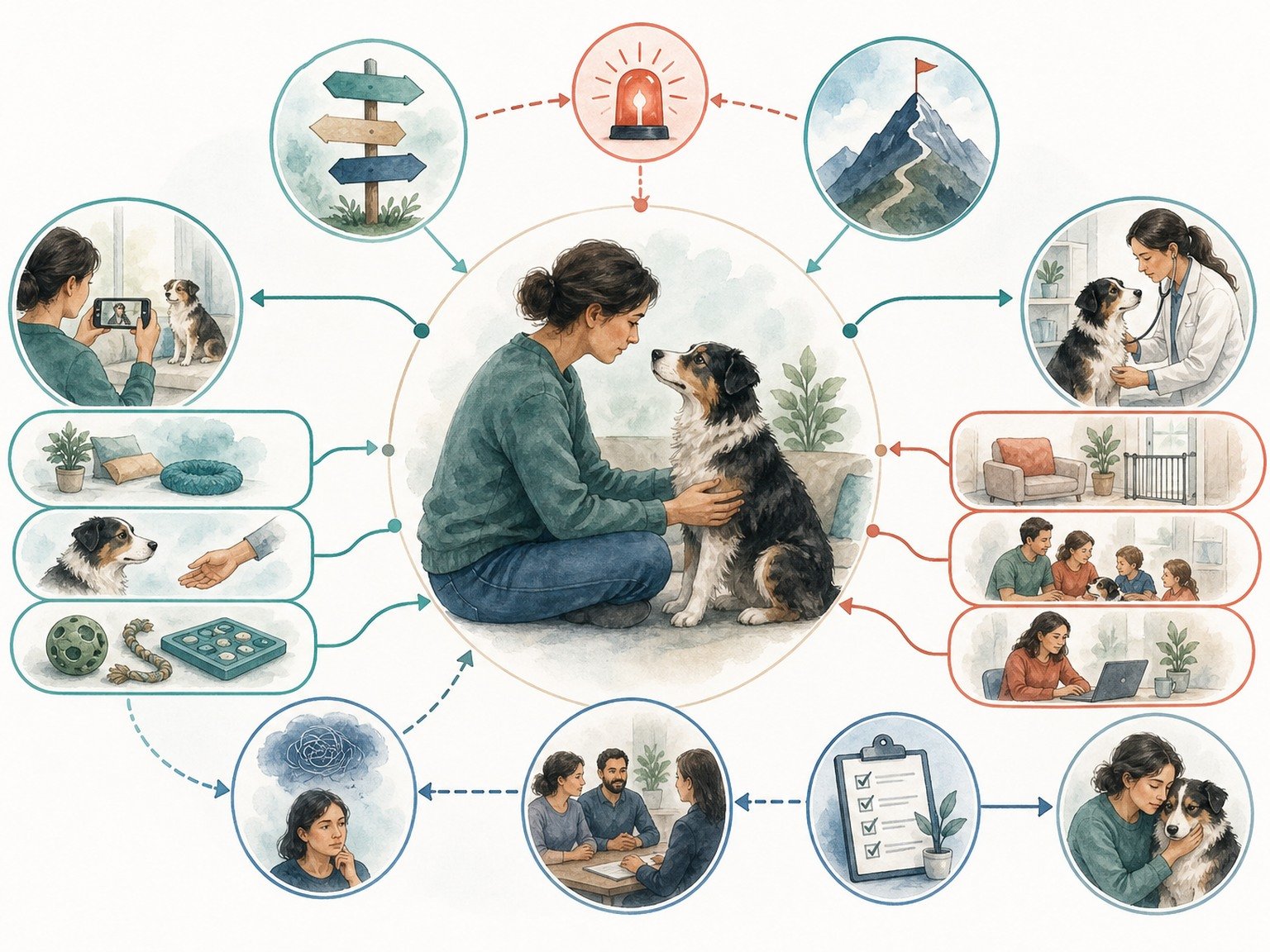
Ask for urgency, options, and tradeoffs
Ask what must happen today, which concern is most dangerous, what information would change the plan, what may be staged, what uncertainty remains, and what signs make a deferred step urgent. Request written estimates when available.
Cost-of-care literature describes payment and spectrum-of-care discussions as possible access tools. [1] Availability varies by clinic and location. A staged or lower-cost option is not automatically equivalent in diagnostic certainty, risk, benefit, monitoring, burden, or outcome.
Ask about payment arrangements or community resources without assuming eligibility. No article can guarantee a program, specialist, medication, or behavior service. Preserve a route for urgent care and qualified referral even when the preferred comprehensive plan is not immediately feasible.
Reject shortcuts that create risk
AVSAB supports reward-based methods, management, medical assessment, and qualified referral rather than aversives or flooding. [4] Cheap shock, prong, intimidation, forced exposure, or punishment is not a humane budget solution and may worsen fear or aggression.
Do not use human medication, leftover prescriptions, random sedatives, supplement stacks, or online dose calculations. Do not skip diagnostics from a generic list. A low sticker price does not establish safety, suitability, or total value.
Environmental management and recordkeeping can support immediate safety and communication, but they do not treat anxiety by themselves. If the dog cannot safely remain in the current setup, say so directly and ask for an urgent risk plan.
Define follow-up before leaving the decision
Agree on the next action, intended functional outcome, monitoring method, contact trigger, and reassessment date. Useful outcomes might include safer departures, shorter recovery after a known event, ability to rest, or reduced escape risk, but definitions must fit the dog.
Record adherence, barriers, adverse effects, worsening, and response. Silence alone is not proof of comfort, and a single easier day is not proof of treatment success. Report concerns rather than quietly abandoning the plan.
Budget-aware care remains active: priorities and options can change with new findings, response, household capacity, or risk. Transparent reassessment is safer than accumulating cheap remedies without a coherent diagnosis or plan.
Prepare for a focused veterinary conversation
Bring a concise timeline, short natural-movement or symptom videos when safe, the exact names and photographs of every food, treat, medication, and supplement label, and notes about appetite, water intake, stool, sleep, activity, comfort, and behavior. Include recent injuries, travel, boarding, diet changes, missed medication, and previous test results. A complete record helps the veterinary team separate a repeatable pattern from a single impression.
Decide in advance what you need from the visit: an urgency decision, a diagnosis plan, a nutrition review, a pain or mobility assessment, or a monitored trial. Ask what result would change the plan and what finding would rule an option out. This keeps research and product information in the right role. Evidence can shape questions and expectations, but it cannot determine what is safe for an individual dog without the history and examination.
Owner tool
Prepare a budget-aware behavior discussion
On a phone, swipe across the table to see every column.
| Checkpoint | What to record | Why it helps |
|---|---|---|
| Safety | Immediate risk, distress, medical change | Sets priority |
| History | Pattern, context, health, prior response | Defines question |
| Options | Benefits, limits, cost, uncertainty | Shows tradeoffs |
| Follow-up | Outcome, trigger, timing, barriers | Keeps care active |
Better questions, calmer next steps
Questions to ask your veterinarian
- What must be addressed today?
- Which assessment is most decision-changing?
- What are the tradeoffs of staging an option?
- Which resources may be available locally?
- What response requires earlier contact?
FAQ
How do I discuss cost?
Raise it early and directly.
Does spectrum of care mean equal outcomes?
No.
Are cheap calming products a substitute?
No.
Can I use leftover medication?
No.
What should never wait?
Immediate danger, severe distress, or sudden medical change.
Sources
- Veterinary Clinics of North America: Cost of Care, Access to Care, and Payment Options. Cost barriers, payment options, and spectrum of care.
- American Animal Hospital Association: Canine and Feline Behavior Management Guidelines. Medical assessment, history, management, and referral.
- Merck Veterinary Manual: Diagnosis of Behavior Problems in Animals. Comprehensive history and medical rule-outs.
- American Veterinary Society of Animal Behavior: Humane Dog Training Position Statement. Reward-based care and opposition to aversives and flooding.
