


The intestinal lining must absorb nutrients while limiting entry of microbes, toxins, and other material. Veterinary researchers can measure aspects of barrier function and have documented altered permeability in some canine gastrointestinal diseases. The popular phrase leaky gut often stretches those findings into a single diagnosis said to cause almost any symptom. Current canine evidence does not support that shortcut.
Short answer
Barrier dysfunction is a mechanism to investigate, not a universal diagnosis
Canine chronic inflammatory enteropathy can involve disruption of mucus, epithelial cells, immune tolerance, microbiota, and the intestinal barrier. Studies using permeability probes have produced useful but sometimes conflicting results, and many techniques remain research tools rather than routine stand-alone diagnostics. Treatment targets the diagnosed disease and the individual dog, not a marketing label. [1] [2]
- Ask which diagnosed disease, measured marker, and canine study a permeability claim refers to.
- Do not infer whole-body toxicity or behavior causation from a general gut-barrier diagram.
- Persistent digestive or systemic signs deserve veterinary assessment before diets or supplements are changed.
Safety first
Do not let a leaky-gut explanation delay diagnosis
Seek prompt veterinary care for repeated vomiting, persistent diarrhea, blood or black stool, severe abdominal pain, a swollen abdomen, weight loss, refusal to eat, fever, dehydration, collapse, marked weakness, or suspected toxin or foreign-body exposure. Protein loss, infection, obstruction, pancreatic disease, cancer, and other serious problems can share vague signs.
- Do not buy a detox or barrier-repair cure in place of diagnostic care.
- Do not start restrictive diets, fasting, antimicrobials, or multiple supplements from a permeability claim.
- Do not interpret stool or commercial wellness tests as proof that material is leaking into the bloodstream.
Veterinary note
This article is educational and does not diagnose, treat, prescribe, or replace care from a licensed veterinarian. Your dog’s history, examination, diet, medications, and current signs determine what is appropriate.
Understand what the intestinal barrier includes
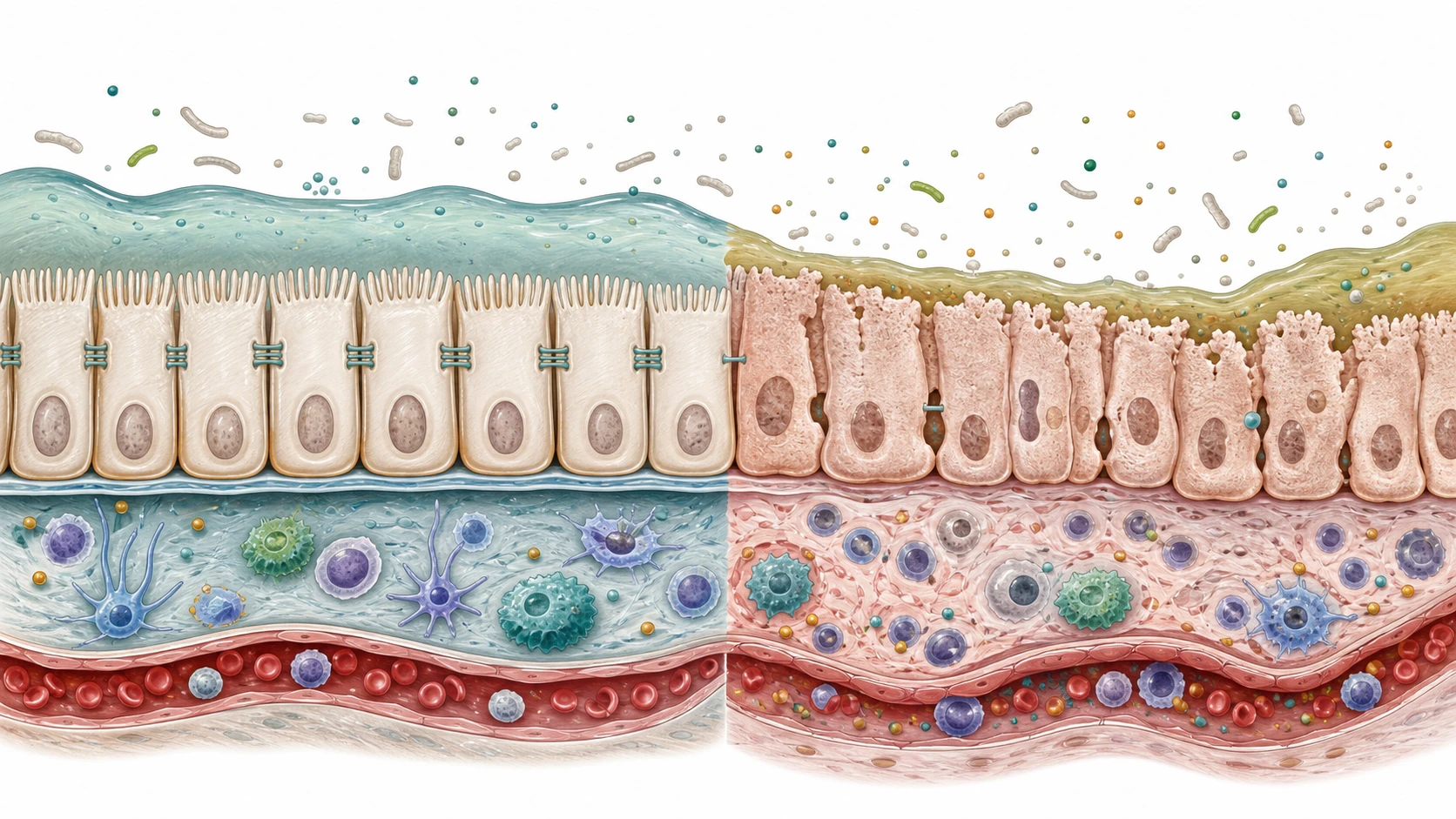
The barrier is not a sheet with simple holes. It includes mucus, antimicrobial products, epithelial cells and their junctions, immune tissue, blood and lymphatic structures, motility, microbiota, and repair processes. It must remain selectively permeable so water and nutrients can cross while harmful exposures are controlled.
Inflammation, infection, ischemia, severe diarrhea, diet, medications, and chronic enteropathy can alter parts of this system. That makes permeability important biology, but altered permeability may be a contributor, consequence, severity marker, or combination. A mechanism does not automatically become one independent disease. [1] [3]
See how veterinary researchers measure permeability
Researchers may administer a probe orally and measure how much reaches blood or urine, or study proteins and tissue associated with junctions and injury. The chronic-enteropathy review notes conflicting results from selective sugar testing and describes iohexol as a promising probe requiring further study in dogs. Many human barrier markers have not been critically assessed in canine clinical practice. [1]
In dogs with acute hemorrhagic diarrhea syndrome, one prospective study found higher serum iohexol concentrations than in healthy controls and an association with clinical severity. That supports measurable barrier dysfunction in a specific severe disease. It does not validate a consumer test or prove that one supplement repairs unrelated chronic symptoms. [3]
Translate chronic-enteropathy findings without overreach
The ACVIM-endorsed consensus describes chronic inflammatory enteropathy as multifactorial, involving host immunity, genetics, microbiota, environment, mucus, microbial metabolites, and epithelial barrier disruption. Recommended care begins with history, assessment of severity and alternative causes, and structured treatment such as therapeutic diet trials when appropriate. [2]
A dog may improve as the underlying enteropathy responds, and barrier function may improve with disease control. That is different from treating leaky gut as the diagnosis. Product claims should identify the exact formulation, disease population, comparator, barrier measure, clinical outcome, and harms. Changes in a laboratory marker do not necessarily equal better comfort, stool, weight, or long-term health.
Handle gut-brain and whole-body claims carefully
The microbiota-gut-brain axis is an active canine research area. Reviews describe plausible neural, immune, endocrine, and metabolic pathways, but associations do not show that permeability causes a dog's anxiety or that a microbiome product treats a behavior disorder. Behavior change can also arise from pain, neurologic disease, sensory decline, medication effects, fear learning, or environmental stress. [4]
When a broad claim links the barrier to skin, joints, behavior, immunity, and every chronic condition, ask what was measured in dogs and whether the finding changes diagnosis or treatment. Avoid a chain of inference that begins with laboratory biology and ends with a guaranteed product result.
A practical owner response is specific: document the actual signs, duration, diet, weight, stool, exposures, medications, and prior tests. Let the veterinarian investigate those signs. Treating a defined disease, maintaining complete nutrition, and monitoring response provides more information than chasing a generalized syndrome.
Prepare for a focused veterinary conversation
Bring a concise timeline, short natural-movement or symptom videos when safe, the exact names and photographs of every food, treat, medication, and supplement label, and notes about appetite, water intake, stool, sleep, activity, comfort, and behavior. Include recent injuries, travel, boarding, diet changes, missed medication, and previous test results. A complete record helps the veterinary team separate a repeatable pattern from a single impression.
Decide in advance what you need from the visit: an urgency decision, a diagnosis plan, a nutrition review, a pain or mobility assessment, or a monitored trial. Ask what result would change the plan and what finding would rule an option out. This keeps research and product information in the right role. Evidence can shape questions and expectations, but it cannot determine what is safe for an individual dog without the history and examination.
Owner tool
Translate barrier language accurately
On a phone, swipe across the table to see every column.
| Statement | Supported meaning | Overreach |
|---|---|---|
| Permeability changed | A probe crossed differently | Every symptom is caused by leakage |
| Barrier proteins changed | A disease pathway may be involved | A product will repair it |
| Microbiome associated | Groups differ in a study | Microbes caused the condition |
| Treatment improved signs | Protocol helped that population | Universal leaky-gut cure |
Better questions, calmer next steps
Questions to ask your veterinarian
- What diagnosed condition could explain these signs?
- Is the proposed test validated for routine use in dogs and clinically actionable?
- Did the study measure permeability, symptoms, or both?
- Does evidence support this exact diet or product in comparable dogs?
- Which changes require faster testing or referral?
FAQ
Is intestinal permeability real in dogs?
Yes. It is a measurable physiologic property that can change in some diseases.
Is leaky gut a stand-alone canine diagnosis?
Current evidence does not support using the broad term as a universal stand-alone diagnosis.
Can a stool test prove it?
Routine stool testing does not directly prove increased passage across the intestinal barrier.
Do probiotics repair the barrier?
Evidence is product-, disease-, and outcome-specific; broad repair claims are not verified.
Can leaky gut cause anxiety?
Canine gut-brain research is emerging and does not establish a simple cause or a substitute for medical and behavioral assessment.
Sources
- Frontiers in Veterinary Science: Canine Chronic Enteropathy: Current State of the Art. Classification, diagnosis, diet response, barrier research, and treatment context.
- Journal of Veterinary Internal Medicine: ACVIM Consensus on Chronic Inflammatory Enteropathy in Dogs. Current evidence-graded diagnostic and dietary guidance.
- Veterinary Sciences: Intestinal Barrier Dysfunction in Dogs with Acute Hemorrhagic Diarrhea. Prospective canine iohexol permeability findings and limits.
- Animals: Canine Behavioral Disorders and the Gut Microbiome. Emerging gut-brain mechanisms and evidence limitations.
- Frontiers in Veterinary Science: Canine Intestinal Microbiome in Health and Disease. Microbiota, metabolites, mucosal immunity, and canine GI disease context.
