

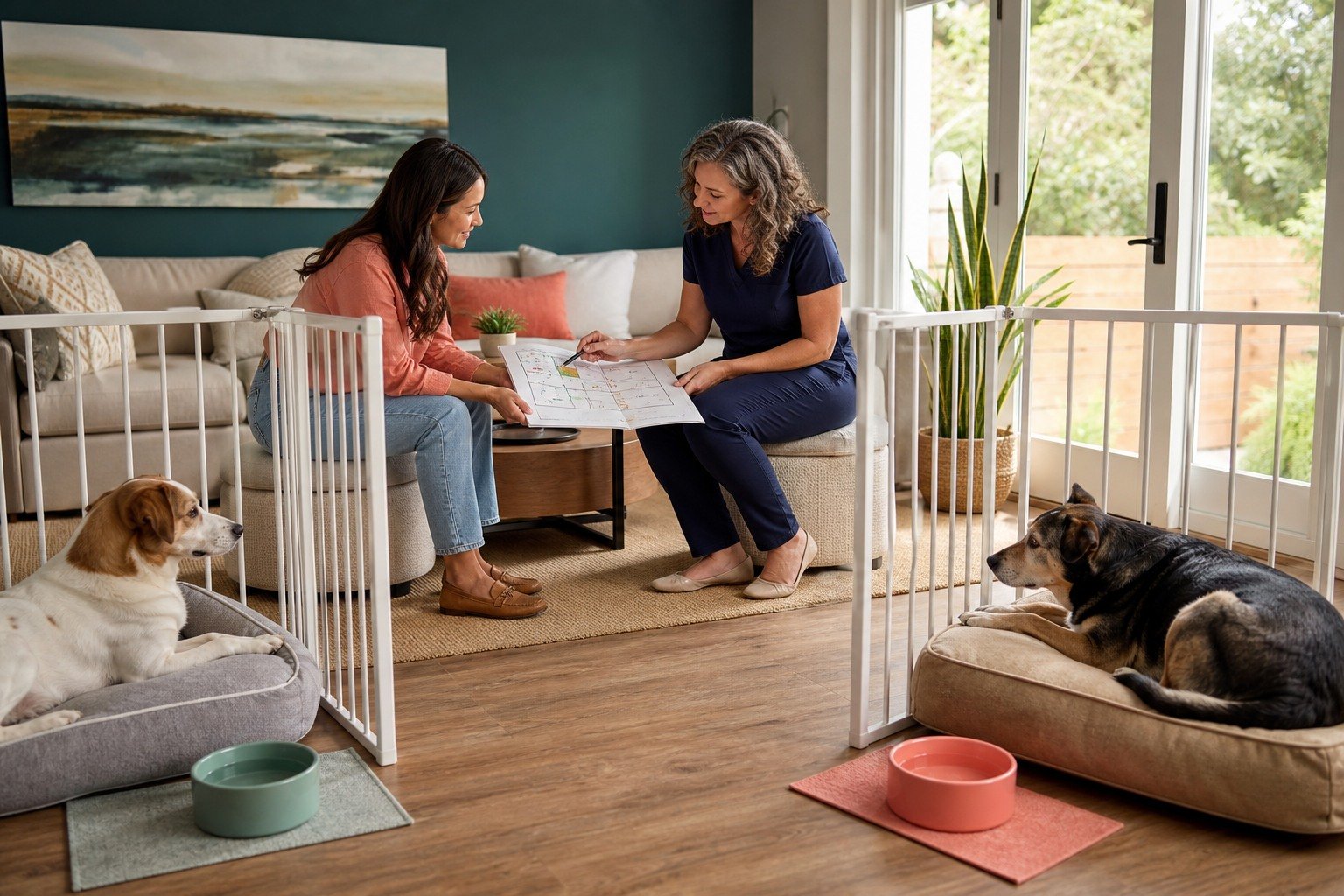
Dogs in one home can influence each other's arousal, fear, barking, resource access, sleep, and recovery. One dog may react to a noise, visitor, fence event, owner arrival, food, toy, doorway, resting place, or pain, and another may join, block, avoid, or redirect. This does not prove that one dog is dominant or that both have the same diagnosis. Household conflict may involve resource guarding, fear, anxiety, overarousal, poor communication, pain, illness, or learned patterns. Safety comes first: prevent rehearsals, separate high-value resources, use physical barriers, protect rest, evaluate each dog medically, and obtain qualified behavior help. Children and visitors should not operate separation systems or mediate interactions. Gates, rotations, deliveries, arrivals, and emergency roles need simple written household rules. Owners should never put hands between fighting dogs or force contact to make them settle differences.
Short answer
Manage the environment before asking either dog to change behavior
Merck guidance identifies resource guarding, fear, anxiety, arousal, and altered communication from age or illness as contributors to familiar-dog aggression, and states that avoidance management is essential for safety and treatment. [1] [2]
- Record the context, trigger, duration, recovery, and effect on daily function.
- Use observations to support veterinary assessment, not to diagnose or treat at home.
- Protect safety and predictability while avoiding punishment, flooding, and forced exposure.
- Agree on measurable outcomes, a review date, and clear urgent-contact signs.
Safety first
Any fight, bite, escalating threat, or redirected aggression requires a safety plan
Separate dogs and contact a veterinarian or veterinary behavior professional after fighting, injury, escalating growling or blocking, repeated guarding, panic, or abrupt behavior change. Keep children and visitors outside the management system, and do not test whether the dogs are ready by removing barriers. Written rotations reduce missed handoffs and accidental contact during busy periods. Protect each dog's access to food, water, sleep, toileting, enrichment, and individual attention during separation. Seek urgent medical care for punctures, bleeding, eye injury, breathing difficulty, collapse, severe pain, or a person who was bitten.
- Do not delay care for sudden, severe, escalating, or function-limiting change.
- Do not start, stop, combine, divide, or calculate treatment from this article.
- Use physical separation and professional help when people or animals could be injured.
Veterinary note
This article is educational and does not diagnose, treat, prescribe, or replace care from a licensed veterinarian. Your dog’s history, examination, diet, medications, and current signs determine what is appropriate.
Stop rehearsals and create reliable separation
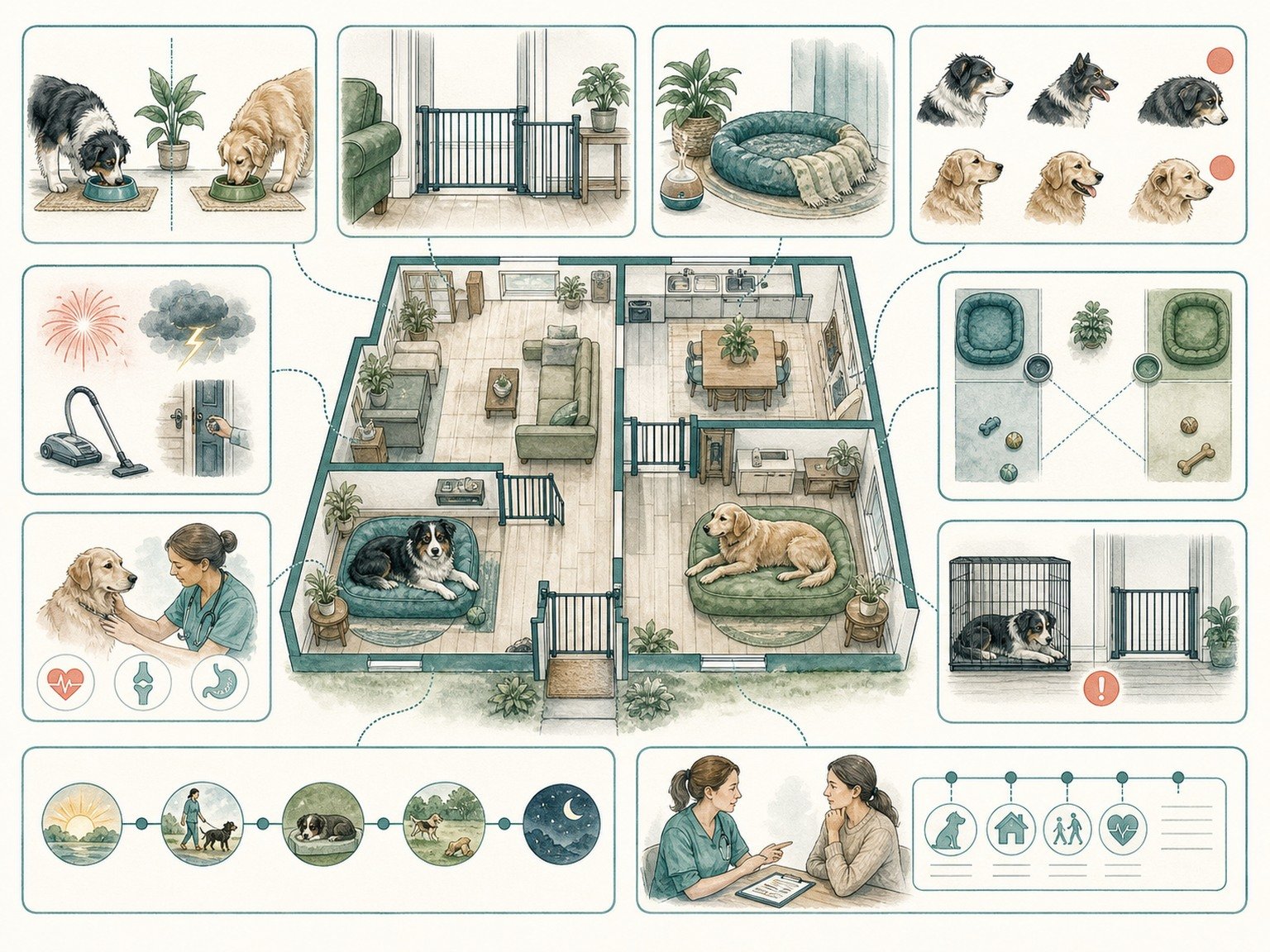
Use closed doors, sturdy gates, separate rooms, secure rotations, and supervised transitions appropriate to the dogs. Barriers must prevent nose-to-nose conflict and should not create a trapped dog beside a trigger.
Feed separately and remove bowls before reunion. Separate dogs for chews, toys, deliveries, visitors, owner arrivals, rough play, grooming, and other predictable high-arousal events until a professional plan says otherwise.
Do not grab collars or reach between dogs during a fight. Prepare an emergency separation plan with the veterinary team or behavior professional, and ensure every adult caregiver understands it.
Identify triggers without staging another incident
Build a timeline for each dog: location, distance, resources, people, noise, body language, who moved first, duration, recovery, and injury. Cameras may help when safe, but never recreate a dangerous event for video.
A retrospective case series found common triggers including owner attention, food, excitement, and found items, but its small referral sample cannot predict an individual household. Individual assessment remains necessary. [3]
Observe early signals such as freezing, hard staring, blocking, hovering, lip lifting, withdrawal, hiding, pacing, or inability to settle. Intervene with distance before escalation rather than punishing communication.
Assess every dog as an individual patient
Pain, sensory change, neurologic disease, medication effects, and aging can alter signals and tolerance. Each dog needs its own medical history, examination, diet, medication list, sleep record, and behavior baseline.
Do not assume the dog who moves first is solely responsible or that the quieter dog is unaffected. Fear, avoidance, restricted access, and disrupted rest matter even when no visible fight occurs.
Household composition and environment influence behavior, but observational associations do not establish simple causes. Avoid blaming rescue history, breed, sex, or owner affection for a complex problem. [4]
Use reward-based skills within a professional plan
Teach each dog separately to move to a station, respond to a recall, disengage, and wait behind a barrier using rewards. Skills support management; they do not make unsafe access acceptable.
AVSAB recommends reward-based methods and rejects aversive tools. Punishment can suppress warning signals, increase fear, and worsen risk. Serious aggression may require veterinary behavior assessment and medication as part of a larger plan. [5]
Set measurable goals: no barrier incidents, calm feeding, independent rest, shorter recovery, or successful structured transitions. Some households require long-term separation, and welfare and human safety must guide decisions.
Prepare for a focused veterinary conversation
Bring a concise timeline, short natural-movement or symptom videos when safe, the exact names and photographs of every food, treat, medication, and supplement label, and notes about appetite, water intake, stool, sleep, activity, comfort, and behavior. Include recent injuries, travel, boarding, diet changes, missed medication, and previous test results. A complete record helps the veterinary team separate a repeatable pattern from a single impression.
Decide in advance what you need from the visit: an urgency decision, a diagnosis plan, a nutrition review, a pain or mobility assessment, or a monitored trial. Ask what result would change the plan and what finding would rule an option out. This keeps research and product information in the right role. Evidence can shape questions and expectations, but it cannot determine what is safe for an individual dog without the history and examination.
Owner tool
Create a multi-dog safety and trigger record
On a phone, swipe across the table to see every column.
| Checkpoint | Record | Why it helps |
|---|---|---|
| Separation | Doors, gates, rotation, handler | Prevents injury |
| Trigger | Resource, person, noise, location | Finds pattern |
| Dog | Health, body language, recovery | Keeps plans individual |
| Review | Incident, progress, professional date | Guides change |
Better questions, calmer next steps
Questions to ask your veterinarian
- What immediate separation plan is safest?
- Which medical issues should each dog be checked for?
- What resources and events must stay separate?
- Which professional should oversee behavior work?
- What outcome would support continued cohabitation?
FAQ
Should dogs work it out themselves?
No. Conflict can escalate and cause injury.
Is this a dominance problem?
That label is usually too simplistic.
Can I punish growling?
No. Growling is safety information.
Can both dogs stay together?
Only if risk and welfare can be managed.
Should both dogs receive the same treatment?
Not automatically; assess each dog.
Sources
- Merck Veterinary Manual: Behavior Problems of Dogs. Familiar-dog aggression and management.
- Merck Veterinary Manual: Behavior Problems in Dogs for Owners. Safety and behavior overview.
- Journal of the American Veterinary Medical Association: Interdog Household Aggression: 38 Cases. Triggers and referral-case outcomes.
- Frontiers in Veterinary Science: Household Factors and Dog Behavior. Household associations and evidence limits.
- American Veterinary Society of Animal Behavior: Humane Dog Training Position Statement. Reward-based methods and safety.
