

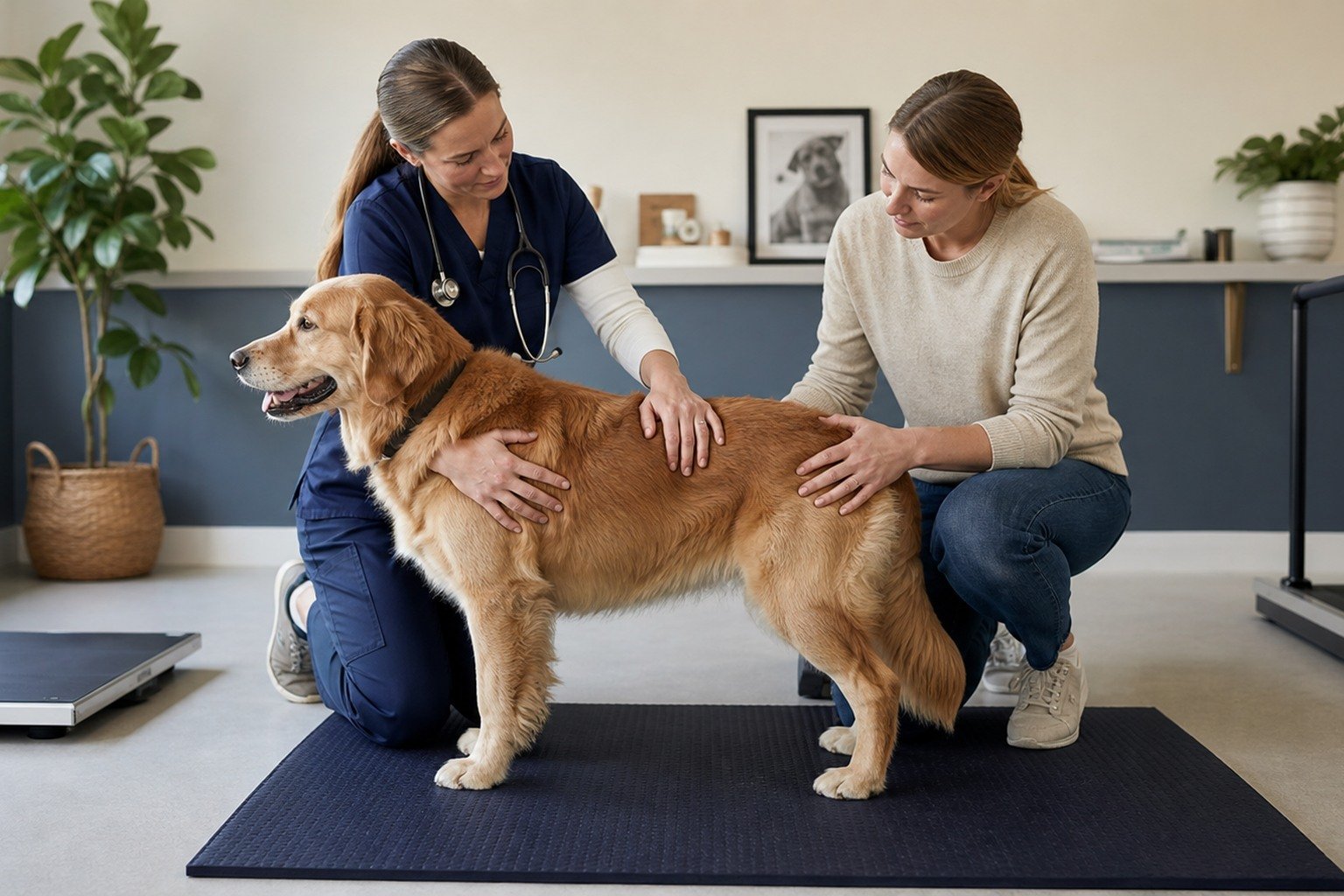
Body weight affects the load a dog carries, but the number on a scale is not a moral judgment and is not the whole joint-health assessment. Two dogs at the same weight can have different frame size, body fat, muscle, disease, pain, and function. Pain can reduce activity and contribute to weight gain; excess body fat can increase mechanical load and inflammatory burden; severe calorie restriction can reduce lean tissue and leave a dog less capable. The useful plan measures weight, body condition, muscle condition, complete food and treats, medications, disease, pain, mobility, environment, and caregiver feasibility. It then sets an individualized nutrition and movement strategy with gradual monitoring. Weight optimization is one part of multimodal joint care, not proof that every limp is caused by weight and not a replacement for diagnosis, pain treatment, traction, rehabilitation, or surgery when indicated. [3] Respectful language improves collaboration and helps owners report barriers early.
Short answer
Assess body fat, muscle, pain, and function together
AAHA nutrition guidance recommends regular individualized nutrition assessment using diet history, body weight, body condition, and muscle condition. AAHA pain guidance identifies weight optimization and dietary management as important parts of chronic-pain care, alongside appropriate movement and other treatment. [1] [2]
- Start with the individual dog's baseline, complete history, and veterinary plan.
- Record function and change over time instead of assigning a diagnosis from one sign.
- Use environment, nutrition, conditioning, and handling as coordinated supports, not substitutes for care.
- Escalate sudden, severe, persistent, or rapidly worsening signs promptly.
Safety first
Do not exercise through pain or use a crash diet
Contact a veterinarian for sudden or persistent lameness, inability to rise, severe pain, swelling, rapid weight or muscle loss, appetite change, vomiting, diarrhea, weakness, breathing change, or a new mobility decline. Seek urgent care after major trauma, collapse, or inability to stand. Do not sharply restrict food, force painful exercise, or use human weight-loss products.
- Do not use this article to diagnose, manipulate a joint, or calculate treatment.
- Do not force activity, food, water, or handling when a dog is distressed or painful.
- Seek urgent veterinary care for collapse, breathing difficulty, severe pain, major trauma, or rapid decline.
Veterinary note
This article is educational and does not diagnose, treat, prescribe, or replace care from a licensed veterinarian. Your dog’s history, examination, diet, medications, and current signs determine what is appropriate.
Use several measurements instead of one scale number
Record weight on a consistent scale when possible, body condition score, muscle condition, waist and rib findings, limb muscle symmetry, appetite, complete intake, and function. Thick coat and gradual change can hide both fat gain and muscle loss.
A body condition score estimates fat, while muscle condition assesses lean tissue. A dog can carry excess fat and still lose muscle, especially with age, pain, or disease; reducing the scale number without protecting muscle can worsen function. [4]
Ask the veterinary team to demonstrate the individual target and record it. Breed appearance, internet charts, and comparison with another dog are less useful than repeated examination.
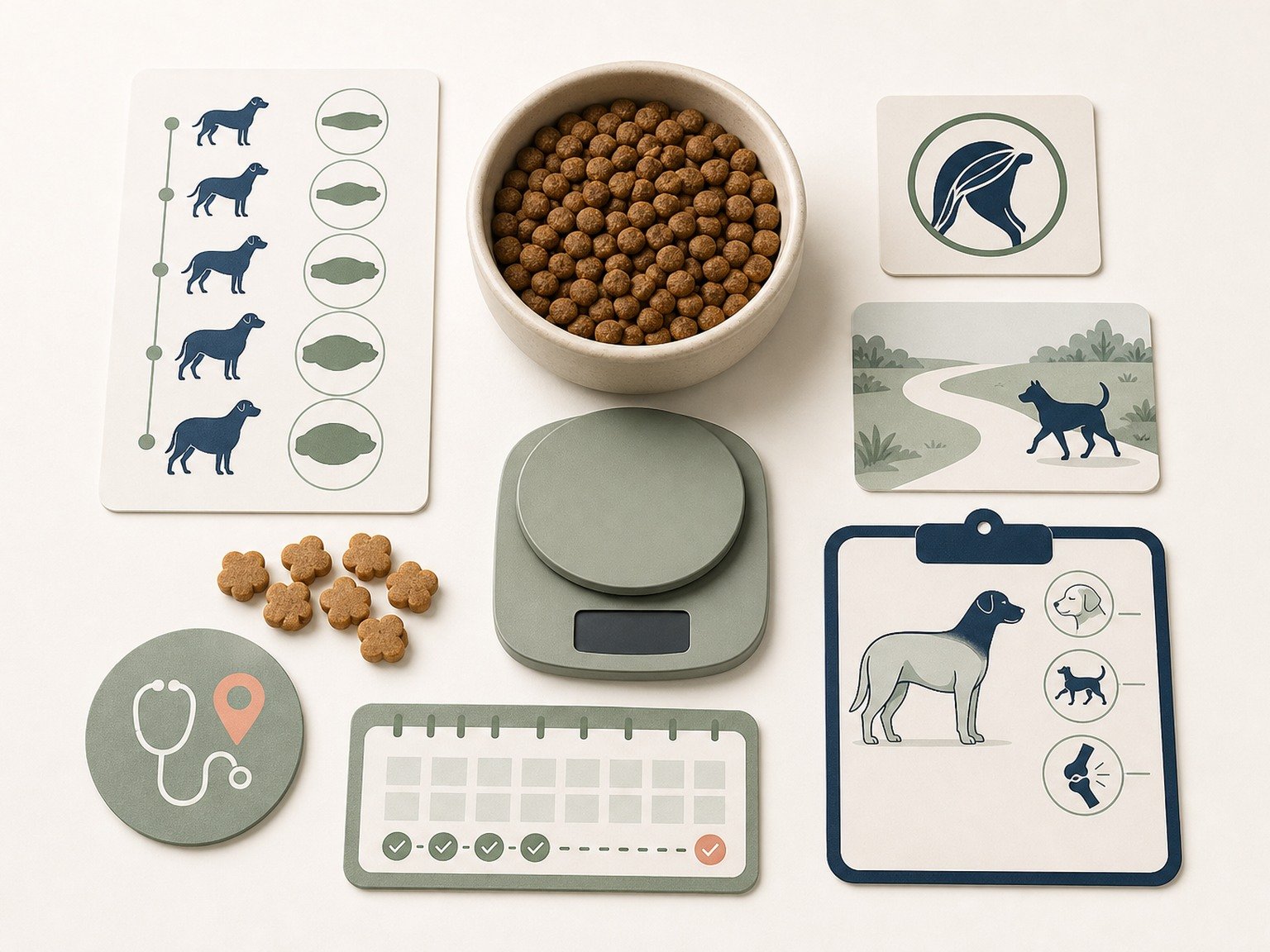
Map every calorie and every barrier
List exact food, measured amount, treats, chews, table food, supplements, food used for medication, stolen food, and contributions from every caregiver. Package feeding directions are a starting point, not an individual prescription. [5]
Also record pain, sleep, medications, endocrine or other disease, household schedule, mobility limits, cost, food security, multiple-pet feeding, and the dog's reinforcement needs. A plan that ignores these factors is difficult to sustain.
Use a complete diet selected for the dog's life stage and health. Do not simply shrink portions until essential nutrient intake or satiety is compromised; the veterinary team may select a different diet or feeding strategy.
Pair nutrition change with pain-aware movement
Pain can make activity harder, and forcing longer walks can create setbacks. Treat and investigate pain, improve traction, and choose veterinarian-approved movement the dog can perform comfortably and repeatably.
Progress duration, terrain, speed, and repetitions gradually. Track willingness, gait, recovery, sleep, stiffness, and next-day function, not calories burned from a generic device.
AAHA pain guidance describes weight optimization and rehabilitation as important nonpharmacologic modalities, but multimodal care may also require medication, environmental change, and treatment of the underlying orthopedic disease. [2]
Monitor gradual change and adjust without blame
Set a review schedule for weight, body and muscle condition, intake accuracy, pain, mobility, adverse signs, and caregiver barriers. The desired rate and target are individual; avoid copying a percentage or calorie calculation from another dog.
Plateaus and setbacks are data. Recheck measurements, hidden intake, disease, medication, activity, diet suitability, and feasibility rather than accusing the dog or owner of noncompliance.
Celebrate functional outcomes such as easier rising, improved comfort, preserved muscle, and sustainable routines alongside appropriate body change. If function worsens, reassess the diagnosis and plan rather than intensifying restriction automatically.
Prepare for a focused veterinary conversation
Bring a concise timeline, short natural-movement or symptom videos when safe, the exact names and photographs of every food, treat, medication, and supplement label, and notes about appetite, water intake, stool, sleep, activity, comfort, and behavior. Include recent injuries, travel, boarding, diet changes, missed medication, and previous test results. A complete record helps the veterinary team separate a repeatable pattern from a single impression.
Decide in advance what you need from the visit: an urgency decision, a diagnosis plan, a nutrition review, a pain or mobility assessment, or a monitored trial. Ask what result would change the plan and what finding would rule an option out. This keeps research and product information in the right role. Evidence can shape questions and expectations, but it cannot determine what is safe for an individual dog without the history and examination.
Owner tool
Build a joint-aware weight plan
On a phone, swipe across the table to see every column.
| Checkpoint | What to record | Why it helps |
|---|---|---|
| Assessment | Weight, body, muscle, pain | Defines baseline |
| Intake | Food, treats, chews, caregivers | Finds total |
| Movement | Type, comfort, recovery | Protects function |
| Review | Trend, muscle, barriers, adjustment | Keeps plan safe |
Better questions, calmer next steps
Questions to ask your veterinarian
- What are this dog's body and muscle condition targets?
- Could pain or disease be changing activity or weight?
- Does the diet remain complete at the planned amount?
- Which movement is comfortable and repeatable?
- When should the plan be adjusted?
FAQ
Is every joint problem caused by excess weight?
No. Weight is one factor and the orthopedic diagnosis still matters.
Should I cut the food in half?
No. Use an individualized complete nutrition plan.
Can painful dogs exercise for weight loss?
Movement must be pain-aware and veterinarian approved.
Does weight loss replace pain treatment?
No. Joint care is multimodal.
Why measure muscle condition?
Scale loss can include muscle, which may reduce function.
Sources
- American Animal Hospital Association: 2021 Nutrition and Weight Management Guidelines. Individual assessment, complete diet history, and communication.
- American Animal Hospital Association: Nonpharmacologic Modalities for Pain Management. Weight optimization, movement, and rehabilitation.
- American College of Veterinary Surgeons: Osteoarthritis in Dogs. OA causes, risk context, and functional signs.
- World Small Animal Veterinary Association: Global Nutrition Toolkit. Body and muscle condition and diet assessment.
- American Animal Hospital Association: Is My Pet Overweight?. Owner-oriented body condition and veterinary planning.
