

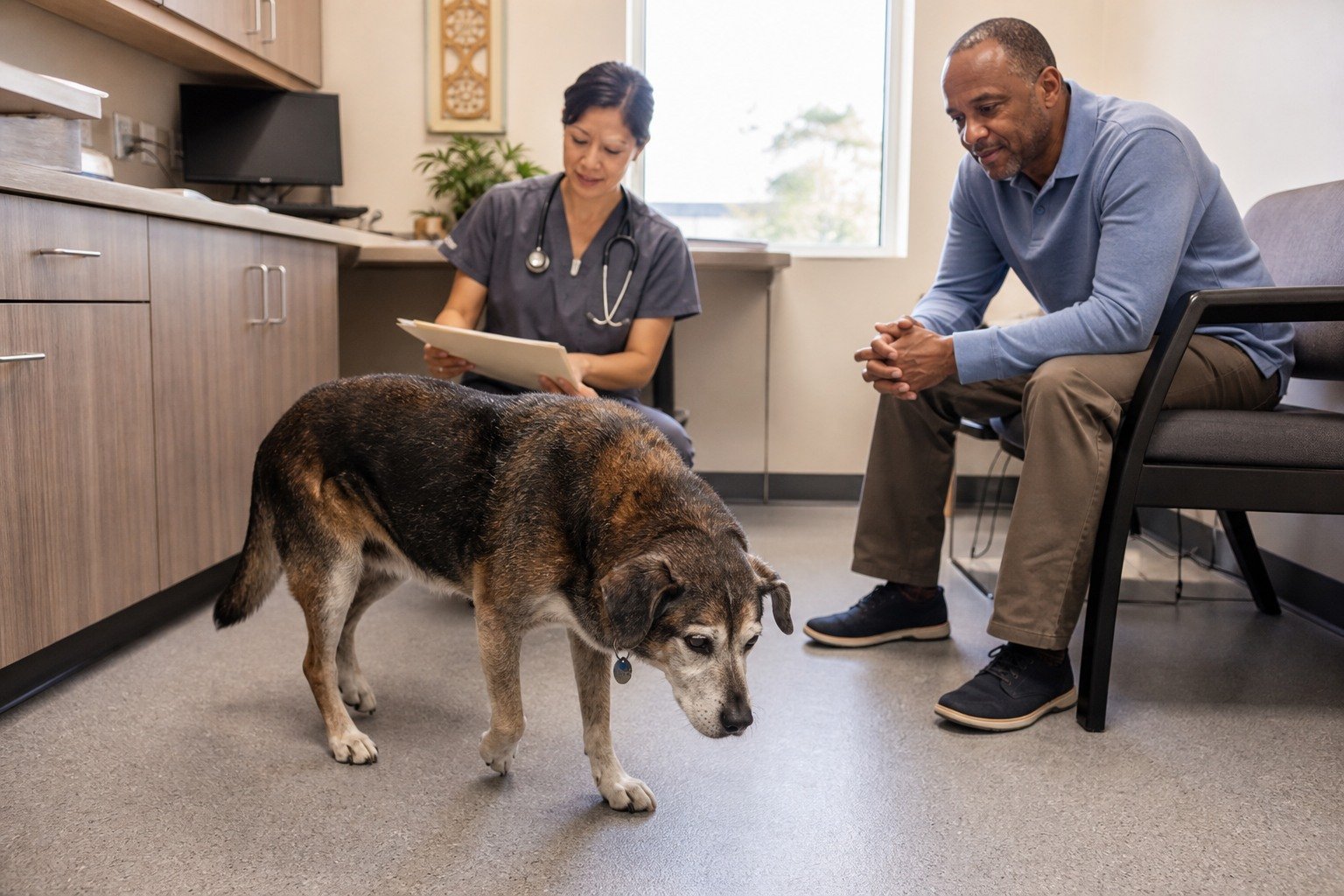
A senior dog's rescue or adoption story may include incomplete records, changing names, multiple caregivers, uncertain medication timing, unfamiliar food, transport, shelter exposure, or behavior observed in a very different environment. None of those facts proves trauma, neglect, hidden disease, or future behavior. The safest first step is an organized handoff: preserve every record, identify known and unknown information, observe ordinary function without forced tests, and arrange an individualized veterinary assessment. A universal first-month test panel or decompression schedule cannot replace examination, location-specific prevention, diagnostic reasoning, and follow-up based on the dog in front of the team.
Short answer
Build a baseline without writing the dog's story for them
AAHA senior guidance supports individualized history, examination, function, nutrition, behavior, and diagnostic planning. Shelter Veterinary guidelines support coordinated population and individual health practices. These sources justify careful records and assessment, but they do not prove that an adopted senior has trauma, infection, pain, or a specific disease because of origin alone. [1] [2] [3] [4]
- Start with the individual dog's baseline, complete history, and current veterinary plan.
- Use repeated observations to improve a veterinary discussion, not to diagnose or treat at home.
- Keep associations, population findings, and research endpoints within their actual limits.
- Escalate sudden, severe, persistent, progressive, dangerous, or function-limiting changes promptly.
Safety first
Urgent illness or safety risk takes priority over settling in
Seek urgent care for breathing difficulty, collapse, severe weakness or pain, inability to stand, seizure, repeated vomiting, repeated unproductive retching, major trauma, inability to urinate, or serious aggression with immediate danger. Contact the clinic promptly for poor intake, diarrhea, cough, discharge, painful movement, medication uncertainty, or progressive behavior or functional change.
- Do not delay urgent care while completing a log, changing the environment, or seeking a lower-cost option.
- Do not provoke, corner, restrain, punish, flood, or force exposure to test a behavior or capture a video.
- Do not start, stop, combine, divide, or calculate medication or supplements from this article.
Veterinary note
This article is educational and does not diagnose, treat, prescribe, or replace care from a licensed veterinarian. Your dog’s history, examination, diet, medications, and current signs determine what is appropriate.
Preserve the complete handoff
Collect shelter, rescue, foster, transport, prior clinic, pharmacy, laboratory, imaging, vaccination, parasite, microchip, dental, surgery, diet, medication, supplement, and behavior records. Keep original dates and source names. Mark a fact unknown rather than filling the gap from memory or assumption.
Photograph every medication and supplement label and record the amount reportedly given, schedule, last known dose, purpose if documented, response, and adverse effects. Do not restart, stop, combine, or substitute a product when the history is unclear; contact the receiving clinic for instructions.
Record the exact current food, measured amount, treats, chews, toppers, access to other bowls, appetite, water, urine, and stool. Avoid abrupt repeated diet changes or supplement stacks intended to correct an unknown deficiency. Nutrition decisions should follow the complete history and health assessment.
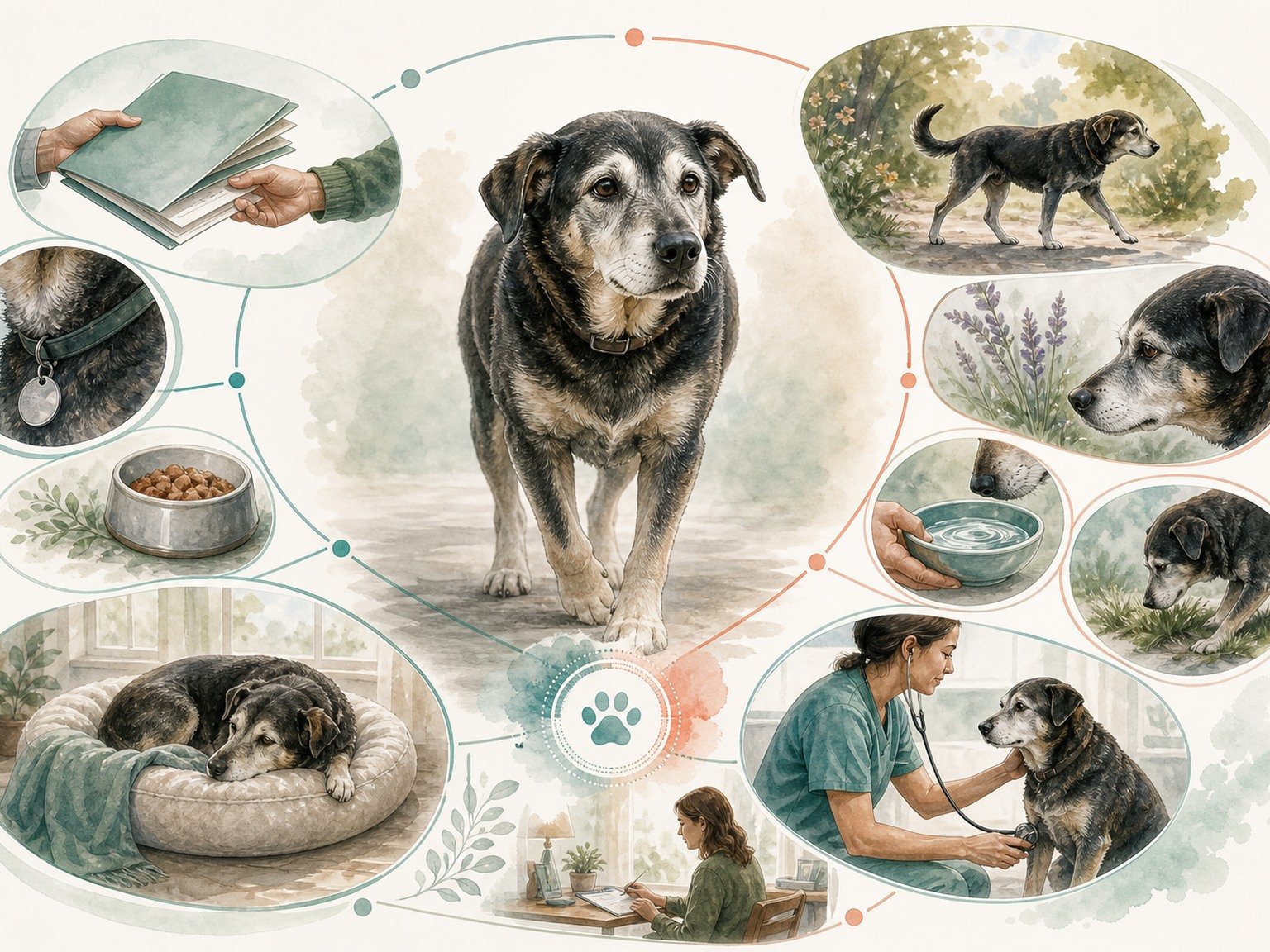
Observe ordinary function with low pressure
Note rising, gait, stairs, jumping, toileting, eating, drinking, sleep, breathing, cough, grooming, skin, hearing, vision, social approach, retreat, handling tolerance, and recovery from ordinary events. Use neutral language and compare changes over time rather than assigning personality or diagnosis on day one.
Provide predictable access to rest, water, food, toileting, traction, and safe separation. Allow choice and distance. Do not force greetings, handling, crate confinement, stairs, play, dog interactions, or trigger exposure to see what the dog can tolerate.
Shelter or foster behavior may differ from behavior in the adoptive home, and behavior can change as health, routine, and learning change. That does not prove deception or trauma. Report context, safety, and function so the veterinary and qualified behavior teams can interpret the pattern.
Prepare for an individualized senior assessment
Bring the records, medication and diet inventory, microchip information, concise timeline, and representative observations. Ask the clinic about safe arrival, waiting, handling, and sample preparation. Do not collect a risky sample or withhold food or medication without instructions.
AAHA recommends a comprehensive senior history and examination with diagnostics selected for the patient. [1] [2] Screening frequency and content depend on findings, age, health, risk, prior records, and clinical judgment. A generic checklist cannot rule out disease or require every test immediately.
Discuss dental health, pain, mobility, body and muscle condition, cognition, sensory function, skin, heart and breathing, gastrointestinal and urinary signs, prevention, vaccination, parasites, reproductive status, and medication reconciliation. Prioritize urgent problems and define what may be staged.
Turn the first visit into a continuing plan
Ask for written current problems, uncertainties, next steps, medication instructions, diet plan, safety management, monitoring targets, and recheck dates. Clarify which former records remain useful and which findings need confirmation.
Track appetite, water, elimination, weight, mobility, sleep, behavior, medication administration, and response after the visit. Report adverse effects or worsening rather than changing the plan independently. A calm first week does not complete senior assessment, and one difficult week does not predict the dog's future.
Update identification and emergency contacts, establish transportation and after-hours plans, and share the approved care plan with household members. The goal is not to uncover every answer on day one; it is to create a reliable baseline and a safe route for reassessment.
Prepare for a focused veterinary conversation
Bring a concise timeline, short natural-movement or symptom videos when safe, the exact names and photographs of every food, treat, medication, and supplement label, and notes about appetite, water intake, stool, sleep, activity, comfort, and behavior. Include recent injuries, travel, boarding, diet changes, missed medication, and previous test results. A complete record helps the veterinary team separate a repeatable pattern from a single impression.
Decide in advance what you need from the visit: an urgency decision, a diagnosis plan, a nutrition review, a pain or mobility assessment, or a monitored trial. Ask what result would change the plan and what finding would rule an option out. This keeps research and product information in the right role. Evidence can shape questions and expectations, but it cannot determine what is safe for an individual dog without the history and examination.
Owner tool
Prepare an adopted senior intake record
On a phone, swipe across the table to see every column.
| Checkpoint | What to record | Why it helps |
|---|---|---|
| Handoff | Records, dates, providers, known and unknown | Preserves facts |
| Inventory | Food, medication, supplements, prevention | Reduces errors |
| Baseline | Function, intake, behavior, recovery | Shows change |
| Plan | Priorities, instructions, recheck, urgent signs | Coordinates care |
Better questions, calmer next steps
Questions to ask your veterinarian
- Which record gaps matter most now?
- What medication instructions apply before the visit?
- Which diagnostics are patient-specific priorities?
- How should arrival and handling be managed?
- What change requires urgent or earlier contact?
FAQ
Does rescue history mean trauma?
No. Avoid assigning a diagnosis or life story from origin alone.
Should every adopted senior receive the same tests?
No. Testing is individualized after history and examination.
Can I stop an old medication?
Only with current veterinary direction.
Should I change food immediately?
Avoid unnecessary abrupt changes; ask about the current diet and health context.
How long does adjustment take?
There is no universal timeline.
Sources
- American Animal Hospital Association: Evaluating the Healthy Senior Pet. Individualized senior history, examination, and baseline.
- American Animal Hospital Association: Diagnostic Tests and Recommended Frequencies. Patient-specific diagnostic planning and monitoring.
- Association of Shelter Veterinarians: Guidelines for Standards of Care in Animal Shelters. Shelter health, records, environment, and welfare practices.
- American Animal Hospital Association: Senior Care Guidelines Introduction. Individual variation, multimorbidity, and senior-care scope.
