


Financial limits are real clinical context, not a moral failure. Senior dogs may have several interacting concerns, and a long unprioritized list can make care feel impossible. The useful response is a direct conversation about the most urgent welfare and safety needs, the owner's goals and limits, what information changes decisions, available options, tradeoffs, staging, monitoring, and follow-up. Spectrum-of-care choices are not automatically equal in certainty, risk, burden, benefit, or outcome. This guide does not rank clinics, tests, diets, medications, supplements, insurance, credit, or charitable programs and cannot tell an owner what to skip. It helps prepare a clearer shared-decision discussion while preserving urgent-care and reassessment pathways.
Short answer
Ask for priorities, options, and tradeoffs
Veterinary access literature recognizes cost, payment, communication, and spectrum-of-care discussions as important factors. AAHA senior guidance emphasizes individualized planning and multimorbidity. These sources support transparent shared decisions; they do not prove that a lower-cost option is equivalent or that a particular test, treatment, or follow-up can safely be omitted. [1] [2] [3] [4]
- Start with the individual dog's baseline, complete history, and current veterinary plan.
- Use repeated observations to improve a veterinary discussion, not to diagnose or treat at home.
- Keep associations, population findings, and research endpoints within their actual limits.
- Escalate sudden, severe, persistent, progressive, dangerous, or function-limiting changes promptly.
Safety first
Financial planning cannot replace urgent assessment
Seek urgent care for breathing difficulty, collapse, severe pain or weakness, inability to stand, seizure, major trauma, repeated unproductive retching, inability to urinate, or rapidly worsening function. Tell the clinic about financial limits immediately so the team can discuss available priorities and options; do not delay while comparing generic lists or trying unverified home remedies.
- Do not delay urgent care while completing a log, changing the environment, or seeking a lower-cost option.
- Do not provoke, corner, restrain, punish, flood, or force exposure to test a behavior or capture a video.
- Do not start, stop, combine, divide, or calculate medication or supplements from this article.
Veterinary note
This article is educational and does not diagnose, treat, prescribe, or replace care from a licensed veterinarian. Your dog’s history, examination, diet, medications, and current signs determine what is appropriate.
Prepare the most decision-useful history
Write the main concern, onset, frequency, progression, function affected, appetite, water, urine, stool, weight, movement, breathing, sleep, behavior, medications, supplements, diagnosed conditions, and response to prior care. Bring safe representative photos or video only when they already exist.
List every current expense and care burden connected to the problem: medication administration, diet, monitoring, transport, mobility help, grooming, toileting, and follow-up. State schedule, housing, physical, and transportation limits. Feasibility affects whether a plan can actually protect welfare.
Do not select a diagnosis or test package before the visit. A concise record helps the team use time well, but it cannot determine which concern is most urgent or which examination, diagnostic, treatment, or referral is appropriate.
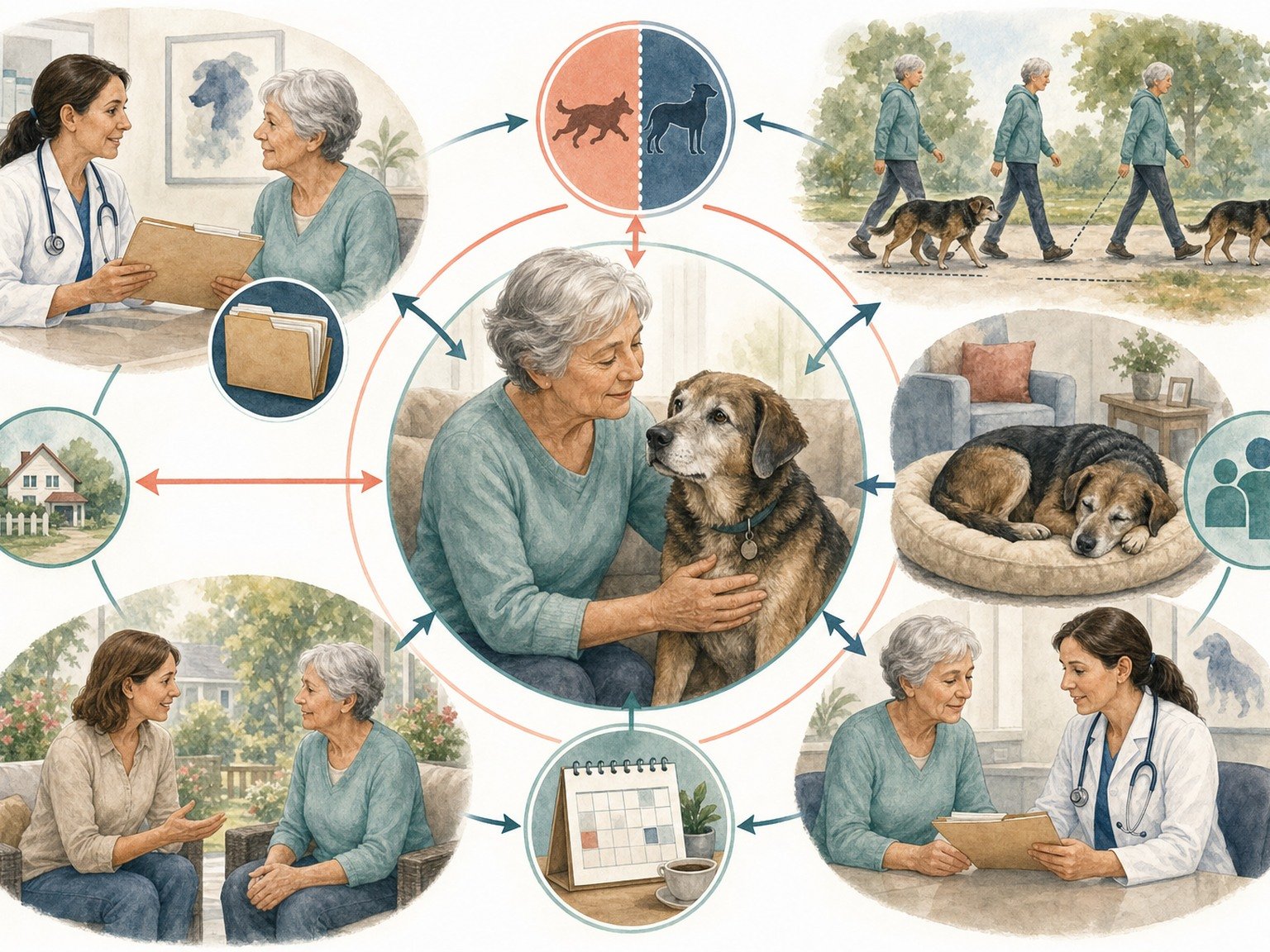
State budget and goals early
Give a realistic spending range when possible and ask for a written estimate. Explain the outcomes that matter most: comfort, eating, toileting, sleep, safe movement, social contact, breathing, or another patient-specific function. Goals should be observable rather than promises of cure or longevity.
Ask what must happen today, what finding would change the plan, which step may be staged, and what uncertainty remains if a step is deferred. A lower initial cost can carry different risk, information, monitoring, or total cost, so compare tradeoffs rather than labels such as best or basic.
Cost-of-care literature discusses payment options and spectrum of care, but availability varies by clinic, community, eligibility, and timing. [1] Do not assume financing, insurance, charity, telemedicine, pharmacy pricing, or a referral will be available or appropriate.
Reject false economies and supplement substitution
Do not use human pain relievers, leftover prescriptions, shared medication, online dose calculations, abrupt diet restriction, or supplement stacks as a budget workaround. An inexpensive product can create toxicity, interactions, delayed diagnosis, or new monitoring costs.
Ask whether a generic medication, compounded form, different administration schedule, therapeutic diet, rehabilitation option, home modification, or staged diagnostic pathway is clinically reasonable for this dog. These are discussion categories, not recommendations, and each has limits and monitoring needs.
Environmental support and careful logs may improve comfort and communication, but they do not replace diagnosis or treatment. A runner, ramp, bed, bowl, harness, or supplement is not automatically the next best purchase. Identify the barrier and intended outcome before spending.
Keep staged care active
Before leaving, record what is being done now, intended benefit, uncertainty, adverse signs, monitoring method, contact trigger, and reassessment date. If a preferred plan is deferred, ask what change makes it urgent and what interim risk remains.
Track response and barriers honestly. Report missed doses, inability to administer care, worsening, and side effects rather than stretching medication, changing frequency, or silently abandoning follow-up. The team can only revise a plan from accurate information.
Priorities may change with new findings or response. Budget-aware care is a continuing shared decision, not a one-time cheaper choice. Reassessment protects the dog when a staged option is ineffective, burdensome, or no longer aligned with welfare goals.
Prepare for a focused veterinary conversation
Bring a concise timeline, short natural-movement or symptom videos when safe, the exact names and photographs of every food, treat, medication, and supplement label, and notes about appetite, water intake, stool, sleep, activity, comfort, and behavior. Include recent injuries, travel, boarding, diet changes, missed medication, and previous test results. A complete record helps the veterinary team separate a repeatable pattern from a single impression.
Decide in advance what you need from the visit: an urgency decision, a diagnosis plan, a nutrition review, a pain or mobility assessment, or a monitored trial. Ask what result would change the plan and what finding would rule an option out. This keeps research and product information in the right role. Evidence can shape questions and expectations, but it cannot determine what is safe for an individual dog without the history and examination.
Owner tool
Prepare a budget-aware senior care discussion
On a phone, swipe across the table to see every column.
| Checkpoint | What to record | Why it helps |
|---|---|---|
| Priority | Urgency, welfare, function affected | Sets order |
| Options | Benefit, limits, uncertainty, cost | Shows tradeoffs |
| Feasibility | Schedule, transport, administration | Tests fit |
| Follow-up | Outcome, trigger, timing, barriers | Keeps care active |
Better questions, calmer next steps
Questions to ask your veterinarian
- What must be addressed today?
- Which information is most decision-changing?
- What are the tradeoffs of staging this step?
- Which alternatives are clinically reasonable here?
- What change requires earlier contact?
FAQ
How do I tell the clinic about cost?
Raise it early and directly so priorities and options can be discussed.
Does lower cost mean lower care?
Options differ; compare welfare, risk, benefit, uncertainty, and monitoring.
Which test should I skip?
A generic article cannot safely make that patient-specific decision.
Are supplements a cheaper substitute?
No. They do not replace diagnosis or prescribed treatment.
Can care be staged?
Sometimes, with explicit tradeoffs and follow-up defined by the veterinary team.
Sources
- Veterinary Clinics of North America: Cost of Care, Access to Care, and Payment Options. Cost barriers, payment discussions, and spectrum of care.
- American Animal Hospital Association: Senior Care Guidelines Introduction. Individual variation, multimorbidity, and coordinated senior care.
- American Animal Hospital Association: Evaluating the Healthy Senior Pet. History, examination, functional baseline, and planning.
- American Animal Hospital Association: Diagnostic Tests and Recommended Frequencies. Patient-specific diagnostics and monitoring.
