


Cost is a real part of veterinary decision-making, and hiding a limit until the end can make planning harder. A budget conversation does not mean accepting unsafe care or choosing the cheapest item. It means identifying urgent threats, the highest-value questions, what each option can and cannot answer, which uncertainties remain, and when the plan must be reassessed. Digestive signs range from brief mild changes to obstruction, toxin exposure, severe dehydration, bleeding, pancreatitis, infection, protein loss, or systemic disease. No generic article can decide which test or treatment is safe to defer. Bring a complete diet, medication, supplement, exposure, and symptom history; request written estimates or tiers when available; ask about payment resources; and avoid spending limited funds on uncoordinated products that do not answer the clinical question.
Short answer
State the budget and the dog's red flags at the beginning
Veterinary access-to-care literature identifies cost as a barrier and discusses spectrum-of-care and payment approaches. Chronic-enteropathy guidance still requires case-specific history, examination, differential diagnosis, and monitoring. A lower-cost pathway may carry narrower answers or greater uncertainty and is never a universal substitute for urgent assessment. [1] [2] [3]
- Start with the individual dog, exact question, complete history, and current veterinary plan.
- Use observations and evidence to improve a veterinary discussion, not to diagnose or treat at home.
- Keep population findings, research endpoints, and product-specific conclusions within their actual limits.
- Escalate sudden, severe, persistent, progressive, or function-limiting signs promptly.
Safety first
Budget limits do not make emergency signs safe to wait
Seek urgent help for collapse, breathing difficulty, repeated vomiting, inability to keep water down, severe pain, substantial blood, a swollen abdomen, unproductive retching, suspected toxin or foreign object, inability to stand, or rapid decline. Tell the clinic the financial constraint while requesting triage and available options.
- Do not delay urgent care while completing a checklist, testing a diet, or seeking a cheaper option.
- Do not start, stop, combine, divide, or calculate medication or supplements from this article.
- After a possible toxin, foreign object, overdose, or hazardous ingestion, contact veterinary or poison help promptly.
Veterinary note
This article is educational and does not diagnose, treat, prescribe, or replace care from a licensed veterinarian. Your dog’s history, examination, diet, medications, and current signs determine what is appropriate.
Prepare information that increases the value of the visit
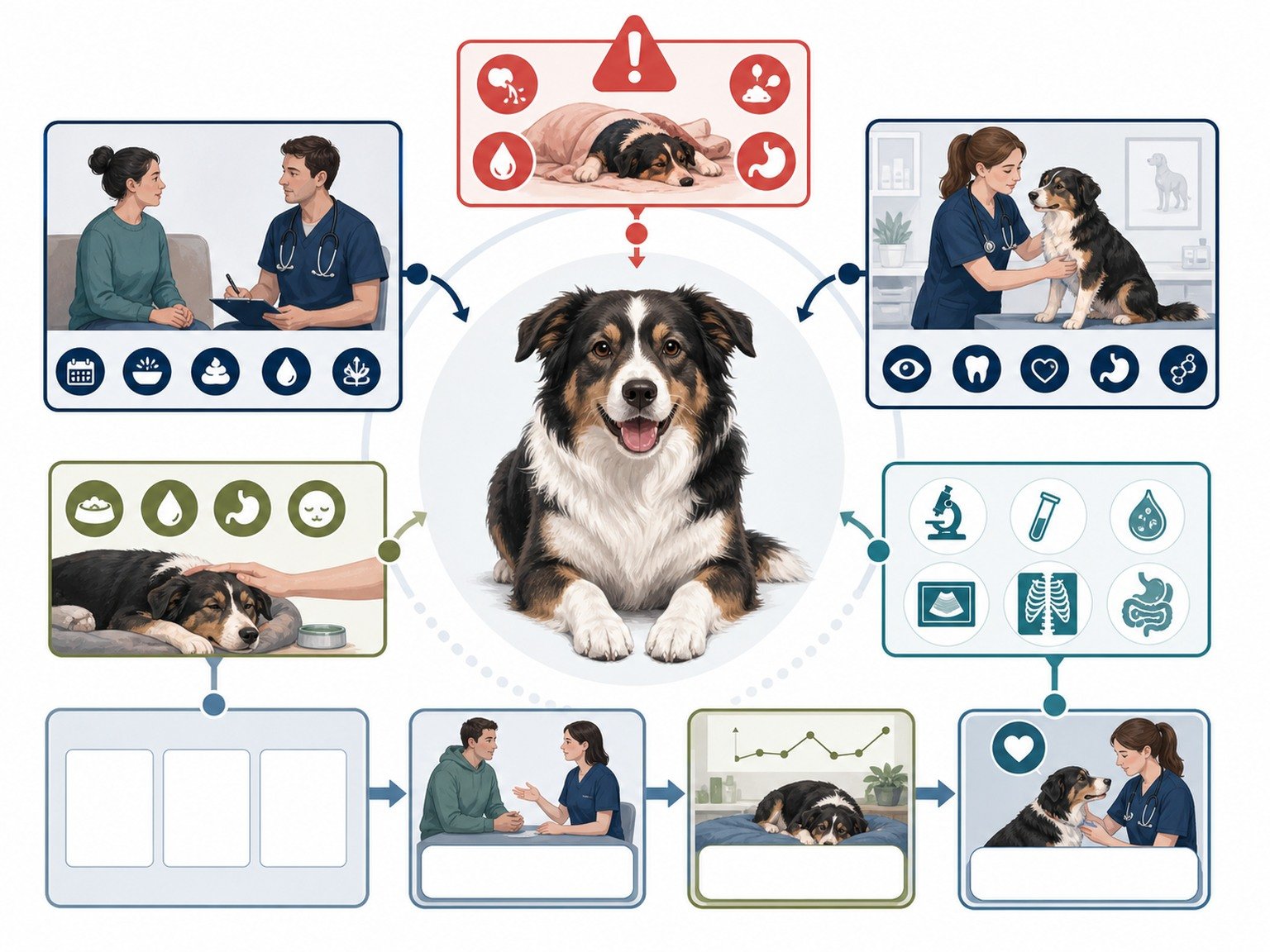
Write a dated timeline for vomiting, stool, appetite, water, urination, pain, energy, weight, and exposures. Bring exact food, treats, supplements, medications, preventives, trash or toxin packages, prior results, and requested samples. Accurate information can reduce repetition and focus the first decision.
AAHA nutrition history guidance covers foods, extras, supplements, medications, feeding practices, environment, activity, and caregiver constraints. [2] Do not omit products because they seem natural or occasional. A complete list can reveal a relevant change without purchasing another test or supplement.
Call before the visit to describe urgency and ask about exam fees, deposit, payment methods, records, sample instructions, and whether teletriage or another service is appropriate. Do not assume an online message can evaluate a dog who needs physical examination.
Ask what each option answers
Request a prioritized problem list and ask what the veterinarian is most concerned about now. For each examination, test, treatment, or referral option, ask what question it addresses, how the result changes action, what uncertainty remains, and what could be missed if it is deferred.
Spectrum of care is a collaborative case-specific process, not a menu proving that lower cost equals the same medical information. Access-to-care literature discusses payment and stratification approaches but does not guarantee equal outcomes for digestive disease. [3]
Ask for a written estimate or options when available and clarify which components are essential today, which are contingent on findings, and which may be scheduled later only if the dog remains stable. Revisit the plan immediately if red flags develop.
Protect limited funds from low-information spending
Repeated food switching, broad supplement stacks, home microbiome tests, unverified intolerance panels, and multiple remedies can consume money while changing the evidence. Chronic enteropathy is heterogeneous, and emerging microbiome interventions and tests have important limits. [4]
Do not call diagnostics unnecessary because one test is normal or a diet briefly helps. The veterinarian uses history, examination, differential diagnoses, and sequential decisions. [1] A narrower first step may be reasonable for a stable dog, but only within a defined safety and follow-up plan.
Ask whether the current diet is complete, whether treats and extras interfere with a planned trial, and whether unused products should remain untouched pending review. Do not stop prescribed items or start a cheaper substitute without confirming equivalence and instructions.
Make reassessment part of the original plan
Record the outcome the team expects, the time and method for follow-up, and the signs that require earlier contact. Track appetite, stool, vomiting, water, weight, pain, activity, medication, and adherence. A plan without reassessment can become more expensive if deterioration is missed.
Ask about generic prescriptions when appropriate, manufacturer or nonprofit assistance, payment plans, community clinics, teaching hospitals, or referral timing, but recognize that availability and eligibility vary. The clinic can explain legitimate local options better than a general list.
If the chosen pathway does not answer the question or the dog worsens, return to the decision rather than repeating the same low-cost step. Financial sustainability and medical safety belong in the same conversation; neither should be hidden or moralized.
Prepare for a focused veterinary conversation
Bring a concise timeline, short natural-movement or symptom videos when safe, the exact names and photographs of every food, treat, medication, and supplement label, and notes about appetite, water intake, stool, sleep, activity, comfort, and behavior. Include recent injuries, travel, boarding, diet changes, missed medication, and previous test results. A complete record helps the veterinary team separate a repeatable pattern from a single impression.
Decide in advance what you need from the visit: an urgency decision, a diagnosis plan, a nutrition review, a pain or mobility assessment, or a monitored trial. Ask what result would change the plan and what finding would rule an option out. This keeps research and product information in the right role. Evidence can shape questions and expectations, but it cannot determine what is safe for an individual dog without the history and examination.
Owner tool
Build a budget-conscious veterinary plan
On a phone, swipe across the table to see every column.
| Checkpoint | What to record | Why it helps |
|---|---|---|
| Triage | Urgent signs and immediate concern | Protects safety |
| Question | What each option answers or misses | Clarifies value |
| Cost | Estimate, tiers, payment resources | Supports choice |
| Follow-up | Outcome, uncertainty, recheck trigger | Prevents drift |
Better questions, calmer next steps
Questions to ask your veterinarian
- What is the most urgent problem to rule out?
- What does each option answer and what could it miss?
- Which steps are essential today?
- Are legitimate payment or assistance options available?
- What change requires immediate reassessment?
FAQ
Is it okay to tell the veterinarian my budget?
Yes. Say it early and directly.
Is the cheapest test the best first step?
Not necessarily; value depends on the clinical question.
Can supplements replace diagnostics?
No.
Can I delay every test if the dog seems stable?
Only the veterinarian can define a safe case-specific pathway.
Does spectrum of care mean equal certainty?
No. Options can differ in information and uncertainty.
Sources
- Journal of Veterinary Internal Medicine: ACVIM Guidelines for Canine Chronic Inflammatory Enteropathy. Individual history, diagnosis, management, and monitoring.
- American Animal Hospital Association: Gathering a Comprehensive Nutrition History. Focused complete diet and exposure history.
- Veterinary Clinics of North America: Cost of Care, Access to Care, and Payment Options. Cost barriers, payment options, and care stratification.
- Frontiers in Veterinary Science: Canine Chronic Enteropathy: Current Concepts. Disease heterogeneity and emerging-test limits.
- World Small Animal Veterinary Association: Global Nutrition Guidelines. Efficient complete nutrition assessment and follow-up.
